
Yangzom Brauen
Author of Across Many Mountains: A Tibetan Family's Epic Journey from Oppression to Freedom
About the Author
Image credit: Yangzom Brauen [links] mit ihrer Mola (Grossmutter) Kunsang Wangmo [Mitte] und ihrer Mutter Sonam Wangmo [rechts]
Works by Yangzom Brauen
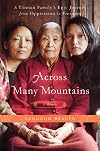
Across Many Mountains: A Tibetan Family's Epic Journey from Oppression to Freedom (2009) 318 copies, 53 reviews
Associated Works
Het Beste Boek 271: Dodenmis / Het Bordeaux-complot / De slotenkunstenaar / Sneeuwland (2011) 1 copy, 1 review
Tagged
Common Knowledge
- Legal name
- Brauen, Yangzom
- Birthdate
- 1980-04-18
- Gender
- female
- Education
- Berner Schauspielschule
- Occupations
- actor
film director
writer - Relationships
- Brauen, Martin (Vater [Pala])
Brauen, Sonam Dölma (Mutter)
Wangmo, Kunsang (Grossmutter [Mola])
Brauen, Tashi (Bruder) - Nationality
- Switzerland
- Birthplace
- Münchwilen, TG, Schweiz
- Places of residence
- Los Angeles, California, USA
- Map Location
- Switzerland
Members
Reviews
There is a distinct lack of personal stories of Tibetan refugees, and with the population aging and dying off, it is vital that Yangzom took the time to document her grandmother's and mother's stories in this remarkable book. I will admit that I don't know much about Tibet and the Chinese invasion and occupation, other than the basics. I also don't know much about Tibetan culture and it's unique form of Buddhism, again, other than the basics.
Brauen takes pains to not only tell her family's show more story, but to explain to the reader Tibetan culture, beliefs, and societal structure. She spent the majority of the book on her grandmother and mother's story, focusing on their life in Tibet, their escape and subsequent life in India, and then in Switzerland. The writing was simplistic, but the story swept me away.
China has written the story of Tibet within its borders as one of liberation and progress, a jingoist picture that I think most outside of China know is false, but it is important that stories such as Across Many Mountains continue to be told, to counteract the Chinese re-interpretation of history. While reading, I came across a few lines in the book that made me pause and reach for a pen to underline it. "I think we have to find a solution that enables the Tibetans and Chinese to live together in such a way that both groups are guaranteed their respective rights and freedoms. Part of this must be a change in the Chinese attitude toward Tibet. The Chinese people know far too little about our culture and history, having for decades been fed a constant diet of misinformation and propaganda." This is key, but will be near impossible in a society as tightly controlled as China, where the government restricts access to information and has proven most adept at brainwashing the current generation of young people, who do not remember Tienanmen Square.
I applaud Brauen and her family for this book, and hope that it can influence some change. Either way, it is an important story that needs to be told. show less
Brauen takes pains to not only tell her family's show more story, but to explain to the reader Tibetan culture, beliefs, and societal structure. She spent the majority of the book on her grandmother and mother's story, focusing on their life in Tibet, their escape and subsequent life in India, and then in Switzerland. The writing was simplistic, but the story swept me away.
China has written the story of Tibet within its borders as one of liberation and progress, a jingoist picture that I think most outside of China know is false, but it is important that stories such as Across Many Mountains continue to be told, to counteract the Chinese re-interpretation of history. While reading, I came across a few lines in the book that made me pause and reach for a pen to underline it. "I think we have to find a solution that enables the Tibetans and Chinese to live together in such a way that both groups are guaranteed their respective rights and freedoms. Part of this must be a change in the Chinese attitude toward Tibet. The Chinese people know far too little about our culture and history, having for decades been fed a constant diet of misinformation and propaganda." This is key, but will be near impossible in a society as tightly controlled as China, where the government restricts access to information and has proven most adept at brainwashing the current generation of young people, who do not remember Tienanmen Square.
I applaud Brauen and her family for this book, and hope that it can influence some change. Either way, it is an important story that needs to be told. show less
 This review was written for LibraryThing Early Reviewers.
Across Many Mountains is multiple stories: a documentary account of old Tibetan society and its destruction by China; the moving tale of privation, escape and survival in the lives of the author’s grandmother and her mother as a young child; a view of various modes of adaptation by multiple generations to a new culture; and a plea for resolution to the ongoing tragedy in Tibet today.
The book is heartfelt and sincere. It is the story of escape and adaptation that most takes hold of the show more reader, perhaps because this part of the story is personal, intimate and immediate. At times, the description of historical Tibet can feel a bit didactic, perhaps necessarily so given the breadth of what the author wishes to tell.
It is hard to imagine remaining unmoved in the face of this anguished story. Painful though it may be, Brauen’s book is planted firmly in the camp of the literature of survival and the triumph of the human spirit. show less
The book is heartfelt and sincere. It is the story of escape and adaptation that most takes hold of the show more reader, perhaps because this part of the story is personal, intimate and immediate. At times, the description of historical Tibet can feel a bit didactic, perhaps necessarily so given the breadth of what the author wishes to tell.
It is hard to imagine remaining unmoved in the face of this anguished story. Painful though it may be, Brauen’s book is planted firmly in the camp of the literature of survival and the triumph of the human spirit. show less
This review was written for LibraryThing Early Reviewers.This is a beautiful memoir that reads like a novel. While everyone has heard of Tibet, few of us, myself included, had an understanding of the history of its occupation or the impact of the Chinese occupation on the history and culture of this unique country. The story of Tibet is told through the story of three generations of a Tibetan family. The author's grandmother is a Tibetan nun; her mother was born in Tibet but fled to India with her parents as a small child, and the author was born show more in Switzerland. Therefore each of them carries the Tibetan culture in different ways, and relates to their homeland from a different perspective.
It was riveting to have a window into the lives of this family, to experience their reactions to the major upheaval in their country, and to see the impact of the occupation as it rippled through generations. The story was easy to get immersed in, as the characters were compelling.
The author poingnantly captures the sense of loss of a people whose country has been taken. She describes how Tibetans today are scattered across the globe; her own family is one small representation of this. She articulately describes the history of the Chinese occupation, the Tibetan activist movement, and her fears that someday the voice of her people will be lost to history. This is a moving, sometimes heartbreaking story that nonetheless manages to inspire hope. show less
It was riveting to have a window into the lives of this family, to experience their reactions to the major upheaval in their country, and to see the impact of the occupation as it rippled through generations. The story was easy to get immersed in, as the characters were compelling.
The author poingnantly captures the sense of loss of a people whose country has been taken. She describes how Tibetans today are scattered across the globe; her own family is one small representation of this. She articulately describes the history of the Chinese occupation, the Tibetan activist movement, and her fears that someday the voice of her people will be lost to history. This is a moving, sometimes heartbreaking story that nonetheless manages to inspire hope. show less
This review was written for LibraryThing Early Reviewers.It is a powerful and very personal story of family, survival, diaspora, bravery, nationalism, and faith.
You will feel like you are with this family on their journey from their home country of Tibet, away from the Chinese oppression, to surviving in India, until they settle in Switzerland where a new generation continues the fight to free Tibet. Along the lines of Amy Tan’s The Joy Luck Club, model/actress Yangzom Brauen shares her family story with much emotion and colorful characters.
I show more love how the story is about three generations of Tibetan women and how different their lives turned out. Kunsang lived in the mountains of Tibet and religiously followed the Buddhist teachings she learned as a nun. Sonam was raised mostly in India where she had her first contact with modern civilization and Westerners. Yangzom was born and brought up in comfortable Switzerland, a world away from where the story began. But their love for Tibet never wavered.
Read the rest of the review on Reading Good Books. show less
You will feel like you are with this family on their journey from their home country of Tibet, away from the Chinese oppression, to surviving in India, until they settle in Switzerland where a new generation continues the fight to free Tibet. Along the lines of Amy Tan’s The Joy Luck Club, model/actress Yangzom Brauen shares her family story with much emotion and colorful characters.
I show more love how the story is about three generations of Tibetan women and how different their lives turned out. Kunsang lived in the mountains of Tibet and religiously followed the Buddhist teachings she learned as a nun. Sonam was raised mostly in India where she had her first contact with modern civilization and Westerners. Yangzom was born and brought up in comfortable Switzerland, a world away from where the story began. But their love for Tibet never wavered.
Read the rest of the review on Reading Good Books. show less
Lists
You May Also Like


Associated Authors
Statistics
- Works
- 5
- Also by
- 2
- Members
- 332
- Popularity
- #71,552
- Rating
- 3.8
- Reviews
- 54
- ISBNs
- 23
- Languages
- 7
- Favorited
- 1
