
Jack Weatherford
Author of Genghis Khan and the Making of the Modern World
About the Author
Jack Weatherford holds the DeWitt Wallace Chair of Anthropology at Macalester College in Minnesota and an honorary position at Chinggis Khaan University in Mongolia. In 2007 he received the Order of the Polar Star, the highest award for service to the Mongol Nation of Genghis Khan.
Works by Jack Weatherford
Indian Givers: How the Indians of the Americas Transformed the World (1988) — Author — 971 copies, 10 reviews
The Secret History of the Mongol Queens: How the Daughters of Genghis Khan Rescued His Empire (2010) — Author — 805 copies, 18 reviews
Genghis Khan and the Quest for God: How the World's Greatest Conqueror Gave Us Religious Freedom (2016) 189 copies, 4 reviews
The Fall of Constantinople 1 copy
Emperor of the seas 1 copy
Tagged
Common Knowledge
- Canonical name
- Weatherford, Jack
- Legal name
- Weatherford, Jack McIver
- Birthdate
- 1946
- Gender
- male
- Education
- University of South Carolina
University of California, San Diego - Occupations
- professor
- Organizations
- Macalester College
Chinggis Khaan University - Awards and honors
- Order of the Pole Star
- Short biography
- JACK WEATHERFORD has retired from the DeWitt Wallace Chair of Anthropology at Macalester College in Minnesota and an honorary position at Chinggis Khaan University in Mongolia. In 2007 he received the Order of the Polar Star, the highest award for service to the Mongol Nation for writing Genghis Khan and the Making of the Modern World. [from the Amazon.com record for Secret History of the Mongol Queens (2010) retrieved 7/15/2025]
- Nationality
- USA
- Places of residence
- Ulaan Baator, Mongolia
Ulan Bator, Mongolia - Associated Place (for map)
- Mongolia
Members
Reviews
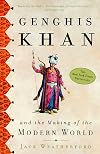
A lot of the negative reviews for this book take issue with its true historicity and its revisionist and somewhat unapologetic agenda. I admit that I got into the book expecting it to be an account of Genghis Khan's conquests with an addendum expounding his legacy, but it was rather the other way around. However, I think it was also quite clear from the outset that Jack Weatherford's aim in this book was not to recount historical facts, but rather to approach the entire perception of the show more Mongol Empire from a different angle.
I thought the book was well-written and easy to read, and was only after I finished reading it that I realised it's actually almost 15 years old. Although undeniably biased towards the Mongols, it certainly does the job of shedding light on elements of the Mongol story that aren't often the focus of historical accounts, and raises some thought provoking points regarding the some more subtle impacts that Genghis Khan had on the world.
Ultimately, to quote Mr Ollivander, I think Genghis Khan has to be considered 'Terrible, but great'. This book may sway slightly too far in favour of the 'great', but it's good to reminded about that perspective of history in a well articulated read. show less
I thought the book was well-written and easy to read, and was only after I finished reading it that I realised it's actually almost 15 years old. Although undeniably biased towards the Mongols, it certainly does the job of shedding light on elements of the Mongol story that aren't often the focus of historical accounts, and raises some thought provoking points regarding the some more subtle impacts that Genghis Khan had on the world.
Ultimately, to quote Mr Ollivander, I think Genghis Khan has to be considered 'Terrible, but great'. This book may sway slightly too far in favour of the 'great', but it's good to reminded about that perspective of history in a well articulated read. show less
This was an Audible audiobook with Jonathan Davis reading Jack Weatherford's "Genghis Khan and the Making of the Modern World".
A somewhat hagiographic biography/history on Genghis Khan and the Mongolian empire, Jonathan Davis begins at the start, the birth of Genghis Khan, covers his rise through his tribe, the important relationships he made and where, when, and who they attacked, invaded, overwhelmed, and absorbed into their tribe and eventually his empire. It covers his death, his show more family, who they were what they did and where and when they did it. The grandchildren were covered with a focus on Kublai Khan and his takeover of the dynastic empire.
It ends somewhat abruptly, but this is not a complete, in-depth title and covers all topics with less specificity, though he does a good job hitting all the high notes and more importantly, the right notes, to piece together a difficult bio/history that came out of the closed off, difficult world to access from the former Soviet Union.
Weatherford does try to show how progressive the Khan's world was comparatively speaking to Europe with their abolishing torture (for a time), the granted universal religious freedom, the importance of women in the Genghis court, and their rejection of the feudal systems of aristocratic privilege, again for a time as Kublai seemed to think otherwise about their privileges.
I have read this is considered "revisionist history" but I argue that this is fresh history. Weatherford used newly accessible, forgotten, lost and secret histories that were freshly released, translated and found. How could a researcher and writer whose is worth their salt not write something using that information that rewrites what was written about previously.
The author clarified what sources were used when he used them which makes his writing crystal clear on how he came to his conclusions.
While it does get a bit much at times as their are bits of minutiae that can make things a bit boring for some, the author seems to do a good job bringing things back around to the interesting. Weatherford also seems to gloss over the brutal history of the armies of the Mongols and what they inflicted on those that opposed them, though he does touch on it at times when the story requires it.
Jonathan Davis does a great job reading this title that I give four stars to. It is great book of history that I recommend to anyone who likes bio/histories, Empire making, Asian history. While it has its bumps, this was a pretty interesting book on a topic that is was only passingly familiar with. show less
A somewhat hagiographic biography/history on Genghis Khan and the Mongolian empire, Jonathan Davis begins at the start, the birth of Genghis Khan, covers his rise through his tribe, the important relationships he made and where, when, and who they attacked, invaded, overwhelmed, and absorbed into their tribe and eventually his empire. It covers his death, his show more family, who they were what they did and where and when they did it. The grandchildren were covered with a focus on Kublai Khan and his takeover of the dynastic empire.
It ends somewhat abruptly, but this is not a complete, in-depth title and covers all topics with less specificity, though he does a good job hitting all the high notes and more importantly, the right notes, to piece together a difficult bio/history that came out of the closed off, difficult world to access from the former Soviet Union.
Weatherford does try to show how progressive the Khan's world was comparatively speaking to Europe with their abolishing torture (for a time), the granted universal religious freedom, the importance of women in the Genghis court, and their rejection of the feudal systems of aristocratic privilege, again for a time as Kublai seemed to think otherwise about their privileges.
I have read this is considered "revisionist history" but I argue that this is fresh history. Weatherford used newly accessible, forgotten, lost and secret histories that were freshly released, translated and found. How could a researcher and writer whose is worth their salt not write something using that information that rewrites what was written about previously.
The author clarified what sources were used when he used them which makes his writing crystal clear on how he came to his conclusions.
While it does get a bit much at times as their are bits of minutiae that can make things a bit boring for some, the author seems to do a good job bringing things back around to the interesting. Weatherford also seems to gloss over the brutal history of the armies of the Mongols and what they inflicted on those that opposed them, though he does touch on it at times when the story requires it.
Jonathan Davis does a great job reading this title that I give four stars to. It is great book of history that I recommend to anyone who likes bio/histories, Empire making, Asian history. While it has its bumps, this was a pretty interesting book on a topic that is was only passingly familiar with. show less
Saying “The Mongols” tends to call to mind hordes of screaming barbarians intent on ravaging the land, looting cities, and destroying everything in their path. Weatherford shows that this depiction is completely unfair as they were actually a very forward-thinking people in many ways.
The book starts with Genghis Khan but it’s not just about him. It covers his rise to power down to his grandson Kublai Khan and a bit further than that. It turns out the Mongol Empire did lay a lot of the show more groundwork for the modern world. Granted their methods of doing the actual conquering were terrifying and effective (they were designed to be), but once the fighting stopped they operated very differently than any other empire before (or since). They didn’t try to impose Mongolian values on everyone. “In probably the first law of its kind anywhere in the world, Genghis Khan decreed complete and total religious freedom for everyone.” Funny to think that it took a ‘mindless barbarian’ to come up with that. No, they were much more interested in learning from each culture they encountered the best way of doing what needed doing. They were always on the lookout for scientists, scholars, doctors, artists, and the like. They also realized that the rich and powerful usually can’t be trusted to serve anything but their own interests, so Genghis Khan instituted a policy of executing the aristocrats right off the bat when he took a city just to avoid trouble later on — and it worked. They laid the foundations for international exchange and trade that are still relevant today.
Now I’m not completely stupid, and I actually stayed awake through most of my schooling, but even so, my education about that part of the world in that period of history was extremely vague. This book fills in a lot of those gaps and addresses why there were gaps in the first place. In Renaissance times, the Mongols were regarded as an exotic people who had the best of everything available to them (which, thanks to their diligent fostering of trade and commerce was largely true). They got fawning mentions by everyone from Giotto to Chaucer. It was during the Age of So-Called Enlightenment that Europeans at least started souring on them, eventually concocting all kinds of pseudo-science classifying them as inferior human beings. That old BS routine, you know.
The writing is clean and smart. The author covers a lot of material without ever getting too bogged down in dates and times and blah blah blah, keeping the narrative moving at an enjoyable pace. He even makes the description of how he did all his research into a sort of adventure story, because it kinda was. So it was a fun read, and I now know stuff I didn’t know before. Win-win. show less
The book starts with Genghis Khan but it’s not just about him. It covers his rise to power down to his grandson Kublai Khan and a bit further than that. It turns out the Mongol Empire did lay a lot of the show more groundwork for the modern world. Granted their methods of doing the actual conquering were terrifying and effective (they were designed to be), but once the fighting stopped they operated very differently than any other empire before (or since). They didn’t try to impose Mongolian values on everyone. “In probably the first law of its kind anywhere in the world, Genghis Khan decreed complete and total religious freedom for everyone.” Funny to think that it took a ‘mindless barbarian’ to come up with that. No, they were much more interested in learning from each culture they encountered the best way of doing what needed doing. They were always on the lookout for scientists, scholars, doctors, artists, and the like. They also realized that the rich and powerful usually can’t be trusted to serve anything but their own interests, so Genghis Khan instituted a policy of executing the aristocrats right off the bat when he took a city just to avoid trouble later on — and it worked. They laid the foundations for international exchange and trade that are still relevant today.
Now I’m not completely stupid, and I actually stayed awake through most of my schooling, but even so, my education about that part of the world in that period of history was extremely vague. This book fills in a lot of those gaps and addresses why there were gaps in the first place. In Renaissance times, the Mongols were regarded as an exotic people who had the best of everything available to them (which, thanks to their diligent fostering of trade and commerce was largely true). They got fawning mentions by everyone from Giotto to Chaucer. It was during the Age of So-Called Enlightenment that Europeans at least started souring on them, eventually concocting all kinds of pseudo-science classifying them as inferior human beings. That old BS routine, you know.
The writing is clean and smart. The author covers a lot of material without ever getting too bogged down in dates and times and blah blah blah, keeping the narrative moving at an enjoyable pace. He even makes the description of how he did all his research into a sort of adventure story, because it kinda was. So it was a fun read, and I now know stuff I didn’t know before. Win-win. show less
After reading this book I realized how much I didn't know about world history. I also realized that much of what I learned about European and Russian history was in fact propaganda. Of course by now we shoud expect this, but I have to admit to being surprised.
This book, drawing on long-lost primary source documents, as well as on other documents that have been underutilized, draws a fascinating picture of the empire of the Mongols, one that belies the images of barbarity, mindless violence show more and atrocities. In fact, Weatherford does a good job showing that in many ways the Mongols were well ahead of their time when it came to ruling.
Did the Mongols commit atrocities? Well, yes, but no more than European leaders and armies of that time period. And unlike the Europeans, the Mongols didn't impose their religion onto the populations they conquered.
Fascinating as well is Weatherford's description of the Mongol attempts to establish ties with Europe, at a time the Europeans were ignorant of the great empire to their east. Also interesting was the key role of the Mongols in the establishment of a united Chinese state. Finally, I remember the maps of what's now Russia and Central Asia with the words "Golden Horde" superimposed on large areas. Turns out the "Golden Horde" was the name of one branch of Genghis Khan's family (the "Golden" family"), and horde means order.
This book contains countless and fascinating examples of debunking what we learned about history. It's also a great read. Highly recommended! show less
This book, drawing on long-lost primary source documents, as well as on other documents that have been underutilized, draws a fascinating picture of the empire of the Mongols, one that belies the images of barbarity, mindless violence show more and atrocities. In fact, Weatherford does a good job showing that in many ways the Mongols were well ahead of their time when it came to ruling.
Did the Mongols commit atrocities? Well, yes, but no more than European leaders and armies of that time period. And unlike the Europeans, the Mongols didn't impose their religion onto the populations they conquered.
Fascinating as well is Weatherford's description of the Mongol attempts to establish ties with Europe, at a time the Europeans were ignorant of the great empire to their east. Also interesting was the key role of the Mongols in the establishment of a united Chinese state. Finally, I remember the maps of what's now Russia and Central Asia with the words "Golden Horde" superimposed on large areas. Turns out the "Golden Horde" was the name of one branch of Genghis Khan's family (the "Golden" family"), and horde means order.
This book contains countless and fascinating examples of debunking what we learned about history. It's also a great read. Highly recommended! show less
Lists
Awards


You May Also Like


Associated Authors
Statistics
- Works
- 17
- Members
- 6,927
- Popularity
- #3,529
- Rating
- 4.0
- Reviews
- 147
- ISBNs
- 75
- Languages
- 11
- Favorited
- 4