
Marta Hillers (1911–2001)
Author of A Woman in Berlin: Eight Weeks in the Conquered City: A Diary
About the Author
Image credit: Marta Hillers (1935)
Works by Marta Hillers
Associated Works
Tagged
Common Knowledge
- Canonical name
- Hillers, Marta
- Legal name
- Hillers, Marta
- Other names
- Anonyma
- Birthdate
- 1911-05-26 (Krefeld, Germany)
- Date of death
- 2001-06-16 (Basel, Switzerland)
- Gender
- female
- Education
- Sorbonne, Paris
- Occupations
- diarist
journalist - Organizations
- Ins neue Leben, Magazine de jeunesse, Minerva-Verlag (Rédactrice, 19 45, Editeur en chef, 19 48 | 19 50)
Hilf mit, Magazine jeunesse national-socialiste (Rédacteur en chef, 19 41 | 19 45)
Freude und Arbeit, Journal (Secrétaire de rédaction, 19 40 | 19 41)
Soyusphoto = Союзфото, Agence de photo soviétique, Moscou (Assistante germanophone, 19 31 | 19 33)
DEROP, société de négoce allemande de produits pétroliers russes, Düsseldorf (Institutrice, 19 31)
Société Regis, Krefeld (Secrétaire, 19 30 | 19 31) - Relationships
- Marek, Hannelore (Amie, Exécuteur testamentaire)
Marek, Kurt W. (Ami)
Löbel, Bruni (Amie)
Hillers, Hans Wolfgang (Cousin)
Dietschy, Karl (Epoux, 19 55 | 19 70) - Short biography
- Eine Frau in Berlin (English translation: A Woman in Berlin) was first published anonymously in 1954. An English-language version of the book, re-issued in 2005, listed Hannelore Marek, executor of Hillers' literary estate, as the copyright holder. Marta Hillers' identity as the author was revealed (against her wish) after her death by Jens Bisky, literary editor of the Süddeutsche Zeitung. Hillers was a magazine and newspaper journalist living in Berlin when the Soviets captured the city at the end of World War II. She kept a detailed diary, on which the book is based. She married in the 1950s and moved to Switzerland, giving up journalism. A Woman in Berlin was her only book. A film based on it was released in Germany and Poland in 2008.
- Nationality
- Germany
- Birthplace
- Krefeld, Nordrhein-Westfalen, Germany
- Places of residence
- Berlin, Germany
Geneva, Switzerland
Paris, Île-de-France, France - Place of death
- Basel, Basel-Stadt, Switzerland
- Map Location
- Germany
Members
Reviews

*A Woman in Berlin* by A Woman in Berlin feels less like a war memoir and more like watching a human consciousness contract and expand under pressure. What surprised me most was not the brutality, though there is plenty of that, but how intellectual and philosophical the narration is. Anonymous is clearly highly educated and deeply reflective. She is not emotionally distant, but analytical, constantly examining what the collapse of Berlin is doing to her morality, beliefs, identity, and show more understanding of humanity.
The diary begins with a wider lens: war, politics, soldiers, society, the machinery of collapse. But as conditions worsen, her world physically and psychologically narrows until life becomes centered around the attic, food, survival, and avoiding danger. Then, when circumstances improve even slightly, her world expands again. The structure of the book mirrors survival itself, shrinking and stretching with each new crisis.
What struck me most is that she never fully retreats from humanity. Even after repeated trauma, she continues to go outside, barter, observe, speak to people, and engage with the ruined society around her. She remains curious about people even when people are dangerous. That tension gives the memoir much of its power.
The book is also unflinching about sexual violence. At first, the assaults come randomly from Soviet soldiers. Later, like many women in Berlin, she makes calculated choices to attach herself to higher-ranking officers in hopes of gaining some protection from constant assault. The memoir refuses to simplify these choices into heroism or shame. Women, young and old alike, were forced into impossible negotiations for survival. Anonymous presents this reality with painful honesty.
What makes this memoir extraordinary is that it complicates the comforting simplicity of liberation narratives. Most people are understandably relieved that the Soviet army entered Berlin and ended the Nazi regime. But this book forces the reader to confront who paid the immediate human price for that victory: women, children, and the elderly civilians left behind in the ruins. Not generals, not politicians, not the architects of the war, but ordinary people trapped beneath history as it rolled over them like tank tracks through wet plaster. show less
The diary begins with a wider lens: war, politics, soldiers, society, the machinery of collapse. But as conditions worsen, her world physically and psychologically narrows until life becomes centered around the attic, food, survival, and avoiding danger. Then, when circumstances improve even slightly, her world expands again. The structure of the book mirrors survival itself, shrinking and stretching with each new crisis.
What struck me most is that she never fully retreats from humanity. Even after repeated trauma, she continues to go outside, barter, observe, speak to people, and engage with the ruined society around her. She remains curious about people even when people are dangerous. That tension gives the memoir much of its power.
The book is also unflinching about sexual violence. At first, the assaults come randomly from Soviet soldiers. Later, like many women in Berlin, she makes calculated choices to attach herself to higher-ranking officers in hopes of gaining some protection from constant assault. The memoir refuses to simplify these choices into heroism or shame. Women, young and old alike, were forced into impossible negotiations for survival. Anonymous presents this reality with painful honesty.
What makes this memoir extraordinary is that it complicates the comforting simplicity of liberation narratives. Most people are understandably relieved that the Soviet army entered Berlin and ended the Nazi regime. But this book forces the reader to confront who paid the immediate human price for that victory: women, children, and the elderly civilians left behind in the ruins. Not generals, not politicians, not the architects of the war, but ordinary people trapped beneath history as it rolled over them like tank tracks through wet plaster. show less
While the subtitle is "Eight Weeks in Berlin", it must have seemed like a lifetime for the German women and men who lived through it. The diary commences on April 20, 1945, Hitler's birthday. The Russians were closing in from the East and had begun shelling the city. Food rations had been meager under the German government but now all organization collapsed so food became the issue for everyone.
The real hell for the civilians started when the Russian troops arrived and they went on a rampage show more of rape and pillage. They took anything they saw as the consumer goods Germans took for granted were new to the Russian soldiers.
The Russian soldiers' raping frenzy knew no age. Any woman if found could face it and in many case from multiple attackers at the same time. Why did they did they do it? Was it for sexual release and gratification? Or was it revenge for what the SS and German troops had done in Russia? Or was it release from four years of harassment by their officers and commissars? What ever the reason, it forced many Germans to commit suicide or hide out for long periods of time in filthy conditions. Others accepted their fate and even tried to get food from the soldiers who were assaulting them.
At one point the author wonders if her relationship with a Russian officer where he gets sex and she receives food makes her a whore.
A heartbreaking book but a vivid description of life in a city with no real controls. show less
The real hell for the civilians started when the Russian troops arrived and they went on a rampage show more of rape and pillage. They took anything they saw as the consumer goods Germans took for granted were new to the Russian soldiers.
The Russian soldiers' raping frenzy knew no age. Any woman if found could face it and in many case from multiple attackers at the same time. Why did they did they do it? Was it for sexual release and gratification? Or was it revenge for what the SS and German troops had done in Russia? Or was it release from four years of harassment by their officers and commissars? What ever the reason, it forced many Germans to commit suicide or hide out for long periods of time in filthy conditions. Others accepted their fate and even tried to get food from the soldiers who were assaulting them.
At one point the author wonders if her relationship with a Russian officer where he gets sex and she receives food makes her a whore.
A heartbreaking book but a vivid description of life in a city with no real controls. show less

https://nwhyte.livejournal.com/3758659.html
A Woman in Berlin is the diary of an anonymous resident of Berlin during and after the final defeat of the Third Reich, from 20 April to 22 June. It's an intense, closely observed account of how an entire society and system of government collapses, and then the first steps to restoring it to a state of order, though under foreign occupation and with a new ideology being imposed on the disempowered inhabitants.
If that were all, it would still be a show more really valuable account of catastrophic endings and stumbling beginnings at a truly historical moment for Europe. But that is not all. From 27 April to 7 May, the writer, and pretty much every woman in Berlin who did not manage to hide, was raped repeatedly by Russian soldiers (strictly, Soviet soldiers; she mentions some from other parts of the USSR). I guess I've always known that this was an integral part of the collapse of the Eastern Front, but it's quite another matter to read a first person account. The details are calmly recounted, as the Russians arrive and take what they want, using German homes and bodies with no need for restraint and encountering little resistance (but no consent). It's a collective experience for the women of Berlin, and to an extent their few remaining men who are unable to intervene; but also an intensely personal and individual one for every woman affected. This grim situation is not unique to Germany in 1945, but it can rarely have been better described.
And yet those 11 days of constant rape are less than a fifth of the time period covered by the diary. On 8 May, VE Day, Berliners, women and men, wake up to the abrupt disappearance of the Russians and then the gradual restoration of civil authority after total catastrophe. The writer, aged 34 in 1945, later moved to Switzerland, and after the brutal reception of her diary when published in Germany in 1959, decided that it would not see light again in her lifetime. She died in 2001, and her identity is now pretty well established; it was republished in 2003 and a 2008 film is based on it.
A few years back I found a fascinating short film of scenes from Berlin in July 1945. The general absence of men is very notable. But every single woman we see must have been through the same experience.
This is a really gripping book, if a very tough read. show less
A Woman in Berlin is the diary of an anonymous resident of Berlin during and after the final defeat of the Third Reich, from 20 April to 22 June. It's an intense, closely observed account of how an entire society and system of government collapses, and then the first steps to restoring it to a state of order, though under foreign occupation and with a new ideology being imposed on the disempowered inhabitants.
If that were all, it would still be a show more really valuable account of catastrophic endings and stumbling beginnings at a truly historical moment for Europe. But that is not all. From 27 April to 7 May, the writer, and pretty much every woman in Berlin who did not manage to hide, was raped repeatedly by Russian soldiers (strictly, Soviet soldiers; she mentions some from other parts of the USSR). I guess I've always known that this was an integral part of the collapse of the Eastern Front, but it's quite another matter to read a first person account. The details are calmly recounted, as the Russians arrive and take what they want, using German homes and bodies with no need for restraint and encountering little resistance (but no consent). It's a collective experience for the women of Berlin, and to an extent their few remaining men who are unable to intervene; but also an intensely personal and individual one for every woman affected. This grim situation is not unique to Germany in 1945, but it can rarely have been better described.
And yet those 11 days of constant rape are less than a fifth of the time period covered by the diary. On 8 May, VE Day, Berliners, women and men, wake up to the abrupt disappearance of the Russians and then the gradual restoration of civil authority after total catastrophe. The writer, aged 34 in 1945, later moved to Switzerland, and after the brutal reception of her diary when published in Germany in 1959, decided that it would not see light again in her lifetime. She died in 2001, and her identity is now pretty well established; it was republished in 2003 and a 2008 film is based on it.
A few years back I found a fascinating short film of scenes from Berlin in July 1945. The general absence of men is very notable. But every single woman we see must have been through the same experience.
This is a really gripping book, if a very tough read. show less
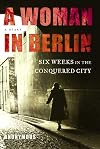
A Woman in Berlin is an excellent book. At some points, the horrors it describes are hard to read but it is, at the same time, a testimony to intellectual honesty, strength of character, and if not exactly an optimism, at least an indomitable spirit. Anonymous was a journalist who, pre-war, had traveled extensively and who spoke some Russian (which became very useful). She was in Berlin when the Red Army swept in and then, in the first couple of weeks, engaged in mass rape; the best show more estimates are that 100,000 women were raped in Berlin, many repeatedly in gang rapes or in other incidents. Anonymous was herself raped several times until she found refuge, as did many, in attaching herself to one "protector" with whom she would have sex (rape by another name) in exchange for protection from marauders. There was an added ‘benefit' in that the protectors, as victors, had access to foodstuffs that Berliners could only dream about, and which, in many instances, made the difference between life and death. Anonymous had three or four protectors and each time she managed to raise the bar in terms of the education and finesse of the man involved. For one of them she even developed a certain fondness. But with one or two of these, in particular, one was always walking on eggs because, especially in their drink, the Russians could go off and become extremely violent in a time and place when life, especially German life, was not even cheap, it was insignificant.
Anonymous also had very strong powers of observation, and the memoir is an excellent description of the last days of the Nazi regime in the crumbling city and disintegrating social system, the sweeping in of the Red Army, the rebuilding of community services and infrastructure, the relations between people themselves undergoing incredible tensions, the good, the bad and the ugly of personal behaviours (she refers a few times to homo homini lupus), and the effect of war, crushing defeat and destruction on individual lives. Small wonder that the book had a difficult time finding a publisher post-war and when published, it did not do very well; it aroused too many emotions.
Anonymous is honest. She notes at one point that everyone is "turning their backs on Adolf, no one was ever a supporter. Everyone was persecuted, and no one denounced anyone else". And then she asks: "What about me? Was I for.....or against? What's clear is that I was there, that I breathed what was in the air and it affected all of us, even if we didn't want it to".
Despite the despair, which would be so easy to give into, Anonymous has the strength to face her situation and her future:
"I feel that I belong to my people, that I want to share their fate, even now. But how? When I was young the red flag seemed like such a bright beacon, but there's no way back to that now, not for me;...And I long ago lost my childhood piety, so that God and the Beyond have become mere symbols and abstractions. Should I believe in progress? Yes, to bigger and better bombs. The happiness of the greater number? Yes, for Petka [one of her Russian protectors] and his ilk. An idyll in a quiet corner? Sure, for people who comb the fringes of their rugs. Possessions, contentment? I have to keep from laughing, homeless urban nomad that I am. Love? Lies trampled on the ground. And were it ever to rise again, I would always be anxious, could never find true refuge, would never again hope for permanence.
Perhaps art, toiling away in the service of form? Yes, for those who have the calling, but I don't. I'm just an ordinary laborer, I have to be satisfied with that. All I can do is touch my small circle and be a good friend. What's left is just to wait for the end. Still, the dark and amazing adventure of life is beckoning. I'll stick around, out of curiosity and because I enjoy breathing and stretching my limbs."
A remarkable woman. A book well worth reading. It is a very great pity that she did not write more in later years about her own personal journey and the reconstruction of German society; based on this memoir, it would have been excellent.
(April/06) show less
Anonymous also had very strong powers of observation, and the memoir is an excellent description of the last days of the Nazi regime in the crumbling city and disintegrating social system, the sweeping in of the Red Army, the rebuilding of community services and infrastructure, the relations between people themselves undergoing incredible tensions, the good, the bad and the ugly of personal behaviours (she refers a few times to homo homini lupus), and the effect of war, crushing defeat and destruction on individual lives. Small wonder that the book had a difficult time finding a publisher post-war and when published, it did not do very well; it aroused too many emotions.
Anonymous is honest. She notes at one point that everyone is "turning their backs on Adolf, no one was ever a supporter. Everyone was persecuted, and no one denounced anyone else". And then she asks: "What about me? Was I for.....or against? What's clear is that I was there, that I breathed what was in the air and it affected all of us, even if we didn't want it to".
Despite the despair, which would be so easy to give into, Anonymous has the strength to face her situation and her future:
"I feel that I belong to my people, that I want to share their fate, even now. But how? When I was young the red flag seemed like such a bright beacon, but there's no way back to that now, not for me;...And I long ago lost my childhood piety, so that God and the Beyond have become mere symbols and abstractions. Should I believe in progress? Yes, to bigger and better bombs. The happiness of the greater number? Yes, for Petka [one of her Russian protectors] and his ilk. An idyll in a quiet corner? Sure, for people who comb the fringes of their rugs. Possessions, contentment? I have to keep from laughing, homeless urban nomad that I am. Love? Lies trampled on the ground. And were it ever to rise again, I would always be anxious, could never find true refuge, would never again hope for permanence.
Perhaps art, toiling away in the service of form? Yes, for those who have the calling, but I don't. I'm just an ordinary laborer, I have to be satisfied with that. All I can do is touch my small circle and be a good friend. What's left is just to wait for the end. Still, the dark and amazing adventure of life is beckoning. I'll stick around, out of curiosity and because I enjoy breathing and stretching my limbs."
A remarkable woman. A book well worth reading. It is a very great pity that she did not write more in later years about her own personal journey and the reconstruction of German society; based on this memoir, it would have been excellent.
(April/06) show less
Lists
Awards


You May Also Like


Associated Authors
Statistics
- Works
- 2
- Also by
- 1
- Members
- 2,100
- Popularity
- #12,256
- Rating
- 4.3
- Reviews
- 72
- ISBNs
- 45
- Languages
- 12
- Favorited
- 2


