
Hans Fallada (1893–1947)
Author of Every Man Dies Alone
About the Author
Hans Fallada is a pseudonym of Rudolf Ditzen, who was born in Greifswald, Germany, in 1893. Many of Fallada's works, including the posthumously published The Drinker, were about his life, which was rife with addictions and instability. Another subject of his works was his homeland Germany. Earlier show more works, including international bestseller Little Man, What Now?, show a Germany that would allow itself to become a Nazi nation under Hitler. Later works deal with the aftermath and guilt of this decision. He died on February 5, 1947, in Berlin. (Bowker Author Biography) show less
Works by Hans Fallada
Hakkendahl gir sig ikke, del 2 4 copies
Die Kuh, der Schuh, dann du (eine Novelle), die gro e Liebe (eine Erziehung), der Apparat der Liebe (eine Erzählung), i (1993) 4 copies
Hackendahl gir sig ikke. B.1 4 copies
I en ulvetid 3 3 copies
I en ulvetid 2 3 copies
Der gestohlene Weihnachtsbaum: Einmalige Sonderausgabe | Das perfekte Geschenk zu Weihnachten (2022) 3 copies
I en ulvetid 1 2 copies
Ricominciare 2 copies
Jeder stirbt für sich allein 2 2 copies
Jeder stirbt für sich allein 1 2 copies
Pijak 2 copies
Obras 2 copies
Lood lastele — Author — 2 copies
Novelas escogidas 2 copies
Alone In Berlin 1 copy
Nightmare In Berlin 1 copy
2005 1 copy
Mäuseken Wackelohr 1 copy
Kleine man wil vooruit 1 copy
Aspettavamo un bimbo 1 copy
Starp vilkiem. Romāns 1 copy
Der eiserne Gustav Hans Fallada [d.i. Rudolf Ditzen] ; Roman. (Bearb. von Peter W[illers] Tügel) 1 copy
Μόνος στο Βερολίνο 1 copy
Marerittet 1 copy
Singur in Berlin 1 copy
Sedláci se bouří : román 1 copy
Demasiado íntimo 1 copy
Senza amore 1 copy
Zgodbe o zmešnjavah 1 copy
¿Y AHORA QUE? 1 copy
Staré srdce jde do světa 1 copy
Associated Works
Geschichten, Geschichten, Geschichten. ( Ab 8 J.). Zum Vorlesen und zum Selberlesen. (1988) — Contributor — 11 copies
Die Einsamen. Kindheitsnovellen von O. Dymow, A.v. Hatzfeld, H. Hesse, J. Mühlberger, R. Musil, F. Ssologub und St. Zweig. (1947) — Contributor — 2 copies
Es muss einer den Frieden beginnen: Jahrhundertautoren gegen den Krieg (2014) — Contributor — 2 copies, 1 review
Kinder sind auch Menschen : Heiteres gezeichnet und geschrieben für alle, die Kinder lieben — Contributor — 1 copy
Tagged
Common Knowledge
- Canonical name
- Fallada, Hans
- Legal name
- Ditzen, Rudolf Wilhelm Adolf
- Other names
- Fallada, Hans
- Birthdate
- 1893-07-21
- Date of death
- 1947-02-05
- Gender
- male
- Education
- Königin-Carola-Gymnasium, Leipzig, Saxony, Germany
Gymnasium Fridericianum, Rudolstadt, Thuringia, Germany - Occupations
- interim mayor (Feldberg ∙ Germany)
journalist
clerk
bookkeeper
novelist
potato grower (show all 7)
estate agent - Organizations
- Wandervogel
International Order of Good Templars
Reichsarbeitsdienst (RAD) - Relationships
- Putnam, George (publisher)
- Short biography
- Hans Fallada's life story reads like an outsized novel. Before World War II, his novels were international bestsellers and his first big success Little Man, What Now? (1933) was adapted into a Hollywood movie. After the rise of the Nazis to power that year, his work was banned from being sold outside Germany. He refused to join the Nazi party and was arrested by the Gestapo; although released, he was regularly interrogated by the Nazis about his writing. He refused to flee the country. The pressure took its toll and as he resorted to drugs and alcohol for relief; he was eventually imprisoned in an asylum for the criminally insane. He survived and was freed at the end of the war. But he was a shattered man and died in 1947 at age 53. He remained a popular writer in Germany after his death, but outside his own country he faded into obscurity for decades. Then in 2009, American publishers began reissuing his works in translation and his talents were rediscovered.
- Cause of death
- heart failure
- Nationality
- Germany
- Birthplace
- Greifswald, Pomerania, Kingdom of Prussia, German Empire
- Places of residence
- Leipzig, Germany
- Place of death
- Berlin, Germany
- Burial location
- Fallada-Park, Carwitz, Mecklenburg-Vorpommern, Germany
- Map Location
- Germany
Members
Reviews
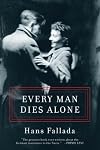
It’s 1940 and Otto Quangel’s life revolves around his job as foreman at a Berlin furniture factory and his wife, Anna, whom he loves unequivocally. He’s a quiet, undemonstrative man, preferring his private ruminations to mindless chatter with those around him. Yet when they receive word that their son has been killed at the front and Anna, in her initial stage of grief, refers to “you and your Fuhrer,” Otto knows he must do something to show her how wrong she is. He is not even a show more Party member, which she knows; what can he do to assure her and the world of his hate for the Nazi Party that is turning the lives of all Germans into a private hell? He devises a plan and Anna enthusiastically joins him in it, even after he warns her that if they are caught they will probably be charged with treason and executed.
Based on the true story of Otto and Elise Hampel, the tale that Fallada tells is the compelling story of that plan: its inception, its execution and its final outcome. The book gets to the heart of the struggle that the average German faced every day, from food shortages and ration cards, to terror of suspicion by the mighty Gestapo, no one was safe. He paints a chilling portrait of wartime Berlin as the Quangels carry out their plan. That the book is a riveting page turner goes without saying. But this reader found herself admiring the quiet courage showed by those German people who attempted to save their fellow citizens and the country they loved from the crazed military that had taken over their lives. Can a single citizen bring about change even as all citizens are living in mortal fear?
Fallada, who refused to leave Germany at this time, demonstrates a fluid storytelling ability with a bleak irony. Certainly as in other wartime situations, your situation is improved if you know the right people, have an in. Consider this as the author describes how
“Baldur Persicke, the most successful scion of the Persicke clan, had pulled all the strings he could....and in the end he had succeeded in having the whole rotten business discreetly set aside....so the Persicke honor remained unstained. While the Hergesells were being threatened with violence and capital punishment for a crime they hadn’t committed, Party member Persicke was forgiven for one he had.”
The way in which Fallada is able to demonstrate the horror and brutality of the time with vignette’s about the lives of stunningly vivid characters makes you think you are on the streets of Berlin with them. And yet, it’s the love of a man and woman for each other and their country that makes this story so memorable. This harrowing saga should be at the top of your list of WWII literary accounts of life in Nazi Germany. Very highly recommended. show less
Based on the true story of Otto and Elise Hampel, the tale that Fallada tells is the compelling story of that plan: its inception, its execution and its final outcome. The book gets to the heart of the struggle that the average German faced every day, from food shortages and ration cards, to terror of suspicion by the mighty Gestapo, no one was safe. He paints a chilling portrait of wartime Berlin as the Quangels carry out their plan. That the book is a riveting page turner goes without saying. But this reader found herself admiring the quiet courage showed by those German people who attempted to save their fellow citizens and the country they loved from the crazed military that had taken over their lives. Can a single citizen bring about change even as all citizens are living in mortal fear?
Fallada, who refused to leave Germany at this time, demonstrates a fluid storytelling ability with a bleak irony. Certainly as in other wartime situations, your situation is improved if you know the right people, have an in. Consider this as the author describes how
“Baldur Persicke, the most successful scion of the Persicke clan, had pulled all the strings he could....and in the end he had succeeded in having the whole rotten business discreetly set aside....so the Persicke honor remained unstained. While the Hergesells were being threatened with violence and capital punishment for a crime they hadn’t committed, Party member Persicke was forgiven for one he had.”
The way in which Fallada is able to demonstrate the horror and brutality of the time with vignette’s about the lives of stunningly vivid characters makes you think you are on the streets of Berlin with them. And yet, it’s the love of a man and woman for each other and their country that makes this story so memorable. This harrowing saga should be at the top of your list of WWII literary accounts of life in Nazi Germany. Very highly recommended. show less
What a smooth ruinous descent. Sommer careens down the slippery dip of his life, lubed up with his own pettiness and need to self-aggrandise. Little handholds of hope were constantly dangled in front of him and me - we were both constantly deluding ourselves into thinking that he could possibly pause, repent, and reverse his sordid descent.
The small reprieves followed Fallada's usual belief in the healing nature of the outdoors and labour. The most satisfying scene for me was Sommer's show more broom-making. I had thought that this was going to the major redemption for the book, but I'll happily take Magda's eventual freedom instead, especially if it's the only balm to Sommer's increasingly overt misogyny.
Advice: Read this between two childhood nostalgic faves, otherwise you may do irreparable damage to your psyche. show less
The small reprieves followed Fallada's usual belief in the healing nature of the outdoors and labour. The most satisfying scene for me was Sommer's show more broom-making. I had thought that this was going to the major redemption for the book, but I'll happily take Magda's eventual freedom instead, especially if it's the only balm to Sommer's increasingly overt misogyny.
Advice: Read this between two childhood nostalgic faves, otherwise you may do irreparable damage to your psyche. show less
Every Man Dies Alone is disturbing, engrossing, and powerful. Based on the real experiences of a married couple's resistance to the Nazis, it is an insightful story of love, standing up for one's beliefs, and the atrocities committed by power that is fed by fear.
Enno and Anna Quangel are middle-aged, working-class Berliners whose son is killed in France. Together they launch a private war against the Führer, dropping anonymous postcards around Berlin in an attempt to expose the Nazis as show more insane bullies and destructive liars. As their campaign advances, their lives entwine with dozens of other Berliners' in unimaginable ways, some compassionate, some desperate, some despicable. Their commitment to resistance is tested again and again, but Anna and Otto demonstrate how vital to human being are integrity, honour, kindness, and courage.
The novel evokes consistent tension in the reader; it also speaks with immediacy and an almost ultra-real level of detail. The action is relentless, unflinching. Readers may find the novel reminiscent of Marge Piercy's Gone to Soldiers (1987) in its entwining of various plots and of Ursula Hegi's Stones from the River (1994) in its look at the daily lives of Germans under Nazism, but it is stylistically distinct. The author uses some interesting technique in tense shifting to bring the reader into the moment of the action, and the diction is exquisitely managed to enrich character, setting, and situation (kudos to the translator!).
This is a long novel — some 500 pages — but it moves extremely quickly and kept me consistently wanting to know what would happen next. The footnotes and afterword are nice touches. I was not familiar with some of the more obscure elements of Germany society under the Nazis, and greatly appreciated learning more about the author, Hans Fallada, whose work is new to me. This is a masterful novel, and learning that Fallada wrote it a matter of weeks makes it even more impressive.
Anyone interested in the Second World War, social justice, or the psychology of fear should enjoy this novel, as should anyone who simply wants a compelling read. It is extremely well written and will leave a reader with much on which to reflect. show less
Enno and Anna Quangel are middle-aged, working-class Berliners whose son is killed in France. Together they launch a private war against the Führer, dropping anonymous postcards around Berlin in an attempt to expose the Nazis as show more insane bullies and destructive liars. As their campaign advances, their lives entwine with dozens of other Berliners' in unimaginable ways, some compassionate, some desperate, some despicable. Their commitment to resistance is tested again and again, but Anna and Otto demonstrate how vital to human being are integrity, honour, kindness, and courage.
The novel evokes consistent tension in the reader; it also speaks with immediacy and an almost ultra-real level of detail. The action is relentless, unflinching. Readers may find the novel reminiscent of Marge Piercy's Gone to Soldiers (1987) in its entwining of various plots and of Ursula Hegi's Stones from the River (1994) in its look at the daily lives of Germans under Nazism, but it is stylistically distinct. The author uses some interesting technique in tense shifting to bring the reader into the moment of the action, and the diction is exquisitely managed to enrich character, setting, and situation (kudos to the translator!).
This is a long novel — some 500 pages — but it moves extremely quickly and kept me consistently wanting to know what would happen next. The footnotes and afterword are nice touches. I was not familiar with some of the more obscure elements of Germany society under the Nazis, and greatly appreciated learning more about the author, Hans Fallada, whose work is new to me. This is a masterful novel, and learning that Fallada wrote it a matter of weeks makes it even more impressive.
Anyone interested in the Second World War, social justice, or the psychology of fear should enjoy this novel, as should anyone who simply wants a compelling read. It is extremely well written and will leave a reader with much on which to reflect. show less
 This review was written for LibraryThing Early Reviewers.
Fallada’s 1932 bestseller is the story of a young couple struggling with the economic realities of life in Weimar Germany during the Great Depression. We have a pretty good idea of the sort of world the young bookkeeper Pinneberg and his Lämmchen are facing already in the opening chapter, where the lovers visit a gynaecologist and learn the bad news that they have unwittingly condemned themselves to parenthood and marriage.
It’s all very New Objectivity, written in stark, plain language show more with a focus on the mundane details of income and expenditure that come to dominate the characters’ lives, and on the many small hazards that lie in wait for those with no safety margin. Pinneberg is not a Mr Micawber who can rise above the humiliations life throws at him, he is repeatedly knocked down by the sense of worthlessness he gets from being unemployed and forced to depend on the odd jobs his wife is able to pick up here and there. Touching and painful to read, and there’s probably a lot here that would resonate with young people today struggling to earn enough to be able to afford the basics of modern life. show less
It’s all very New Objectivity, written in stark, plain language show more with a focus on the mundane details of income and expenditure that come to dominate the characters’ lives, and on the many small hazards that lie in wait for those with no safety margin. Pinneberg is not a Mr Micawber who can rise above the humiliations life throws at him, he is repeatedly knocked down by the sense of worthlessness he gets from being unemployed and forced to depend on the odd jobs his wife is able to pick up here and there. Touching and painful to read, and there’s probably a lot here that would resonate with young people today struggling to earn enough to be able to afford the basics of modern life. show less
Lists
Five star books (1)
Writers at Risk (1)
THE WAR ROOM (1)
On the pile (1)
A Novel Cure (1)
Next 100 books (1)
Awards


You May Also Like


Associated Authors
Statistics
- Works
- 153
- Also by
- 8
- Members
- 8,222
- Popularity
- #2,940
- Rating
- 4.1
- Reviews
- 263
- ISBNs
- 583
- Languages
- 21
- Favorited
- 25


