
Emilie Carles (1900–1979)
Author of A Life of Her Own: The Transformation of a Countrywoman in Twentieth-Century France
About the Author
Emilie Carles (1900-1979) wrote one book in her lifetime, an internationally best-selling autobiography, A Life of Her Own: A Countrywoman in Twentieth-Century France, originally published as Une soupe aux herbes sauvages (A Wild Herb Soup, 1977). Carles was teacher, feminist, pacifist, and show more political activist despite the fact that she spent almost her entire life in the isolated and impoverished Claree Valley where she was born. She began writing in notebooks as a child, intending to document the story of her life. Despite the inherent difficulties of being a woman entering the educational system early in the twentieth century, she became a teacher who urged her students to read and think for themselves. Carles became a pacifist out of horror at the mutilation and death of World War At twenty-eight, she married Jean Carles, a freethinking workingman she met on a train. When Carles was seventy-seven, she led her neighbors in a successful fight to save their valley from a proposed superhighway. As an adult, Carles set to work on her autobiography and, towards the end of her life when cancer made it impossible to write, she finished it by dictating to Robert (Bowker Author Biography) show less
Works by Emilie Carles
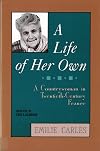
A Life of Her Own: The Transformation of a Countrywoman in Twentieth-Century France (1977) — Author — 361 copies, 5 reviews
Associated Works
Tagged
Common Knowledge
- Canonical name
- Carles, Emilie
- Legal name
- Allais, Marie Julie Emilie
- Other names
- Carles, Emilie
- Birthdate
- 1900-05-29
- Date of death
- 1979-07-29
- Gender
- female
- Occupations
- teacher
pacifist
environmental activist
memoirist - Relationships
- Carles, Jean (Epoux)
- Short biography
- Emilie Carles was born in 1900 into a poor peasant community in the High Alps of southeastern France. She worked as a teacher alongside farming and bringing up a family. An ardent pacifist all her life, in later years she became a fierce environmental campaigner and successfully protected her home, the Claree Valley, from developers. A Wild Herb Soup (apa A Life of Her Own), her memoirs, was a bestseller all over Europe. (Orion Publishing Group)
- Nationality
- France
- Birthplace
- Val-des-Prés, Hautes-Alpes, France
- Places of residence
- Briançon, Haute-Alpes, France
Val-des-Prés, Hautes-Alpes, France - Place of death
- Val-des-Prés, Hautes-Alpes, France
- Burial location
- Cimetière communal, Val-des-Prés, Hautes-Alpes, Provence-Alpes-Côte d'Azur, France
- Map Location
- France
- Associated Place (for map)
- Hautes-Alpes, France
Members
Reviews
A life of her own : the transformation of a countrywoman in twentieth -century France by Emilie Carles

I was enthralled by this woman's story. She writes in such a kindly manner you just know she could be a friend, yet she stood up for what is right. She had incredible inner strength and intelligence. Born in 1900 in an isolated mountain village, she fought for her right to receive a complete education, spent her adult life teaching village children (esp. to question the patriarchal authorities), refused to settle for marriage to any man with the typical domineering mindset of the times, was show more generous with her time and resources in helping those in need, took on the raising of her youngest sister & a sister's children, and support (as he aged) of her father. With all that, she eventually met someone who respected her enough to give her a good marriage, a companion who shared her dreams of nonviolence and independence. Even after retirement, championing the clean mountain air and water, she was active in preventing a superhighway from being built thru this farming/mountain community.
The writing was so down-to-earth, and contained so many idiomatic expressions that it was hard to remember this was written in French. Avriel Goldberger, translator of this edition, did a superb job.
In between sit-down time reading this, I was listening to "Independent People" by Halldor Laxness, also set in early 1900s. I was struck by the similar primitive poverty in both areas, no running water or electricity, often living in quarters shared/above sheep, wood heat, food supply so dependent on what they can grow & the weather, patriarchal culture which treated women as possessions, isolation when winter closes in the village, the independent spirit which refuses charity even if they are starving. Emilie's family was unusual in their generosity. And at least in her area the villagers lived close enough to gather for community singing & story telling in the winter. show less
The writing was so down-to-earth, and contained so many idiomatic expressions that it was hard to remember this was written in French. Avriel Goldberger, translator of this edition, did a superb job.
In between sit-down time reading this, I was listening to "Independent People" by Halldor Laxness, also set in early 1900s. I was struck by the similar primitive poverty in both areas, no running water or electricity, often living in quarters shared/above sheep, wood heat, food supply so dependent on what they can grow & the weather, patriarchal culture which treated women as possessions, isolation when winter closes in the village, the independent spirit which refuses charity even if they are starving. Emilie's family was unusual in their generosity. And at least in her area the villagers lived close enough to gather for community singing & story telling in the winter. show less

A Life of Her Own (1977) is a memoir by Frenchwoman Emilie Carles born in 1900 in a remote Alpine village near the Swiss/Italian/France border, sort of the poor Appalachia of France. There are stories of hard work, poverty and a lifestyle akin to the Middle Ages - they didn't even have a metal wood-burning stove, much less running water or electricity. And we learn of Emilie's family - mother/father, 5 siblings and 5 uncles - all of whom but two die young from accident, war and suicide - a show more record of de-population not uncommon in 20th century France. It's a story of outright survival, strength and personal integrity in the face of adversity and hardship. It's an uplifting memoir and one feels Emilie is a friend and mentor who lived an admirable life.
I read the book as part of a course in modern French history taught by Yale professor John Merriman (free online). Novelistic in scope, it is much more than one woman's life, her story is "dense with history", without being a history book. I came away with a deeper understanding, not only of French history, but generational differences between those born in the 19th and 20th century. The change experienced during Emilie's lifespan is perhaps most striking since her village is so remote and isolated, attitudes and world view from father to daughter is a gap of many centuries.
A Life of Her Own was a best-seller in Europe when it came out in the late 70s, under the much better title A Wild Herb Soup. The small village Val-des-Prés has since become a mecca for tourists to see her house, the fields, the places she taught school, etc... The book (and Emilie herself) played no small role in stopping a highway construction project that would have ruined the picaresque Clarée Valley. Only in 1991 did the book finally appear in English translation. With the recent success of Little Heathens (2007), Emile's story is equally engrossing if not more amazing, it should find a wider audience.
--Review by Stephen Balbach, via CoolReading (c) 2008 cc-by-nd show less
I read the book as part of a course in modern French history taught by Yale professor John Merriman (free online). Novelistic in scope, it is much more than one woman's life, her story is "dense with history", without being a history book. I came away with a deeper understanding, not only of French history, but generational differences between those born in the 19th and 20th century. The change experienced during Emilie's lifespan is perhaps most striking since her village is so remote and isolated, attitudes and world view from father to daughter is a gap of many centuries.
A Life of Her Own was a best-seller in Europe when it came out in the late 70s, under the much better title A Wild Herb Soup. The small village Val-des-Prés has since become a mecca for tourists to see her house, the fields, the places she taught school, etc... The book (and Emilie herself) played no small role in stopping a highway construction project that would have ruined the picaresque Clarée Valley. Only in 1991 did the book finally appear in English translation. With the recent success of Little Heathens (2007), Emile's story is equally engrossing if not more amazing, it should find a wider audience.
--Review by Stephen Balbach, via CoolReading (c) 2008 cc-by-nd show less
The simply written autobiography of a courageous woman who grew up in a poor and conservative peasant family in the Hautes Alpes of France in the early twentieth century. Given the unusual gift of higher education, she rebelled against the narrow conventions within which she had been raised, speaking out against patriarchy, chauvinism, nationalism, militarism—even the Catholic Church and its God. She saw it as her role as a longtime schoolteacher in her native valley to shape and broaden show more the perspectives of the peasant children whom she taught, and nearing death in her mid-seventies, reflected that it was “splendid to leave life with the thought that you have done the maximum possible to defend the ideas you believe just and human, and to help those who need to be helped without discrimination.” An unusual, thoughtful, albeit sometimes naïve, look at life. show less
Awards

You May Also Like


Associated Authors
Statistics
- Works
- 2
- Also by
- 1
- Members
- 366
- Popularity
- #65,729
- Rating
- 4.0
- Reviews
- 5
- ISBNs
- 16
- Languages
- 3
