
Thomas Harriot (–1621)
Author of A Brief and True Report of the New Found Land of Virginia
About the Author
Image credit: Thomas Harriot. Wikimedia Commons.
Works by Thomas Harriot
North Carolina in 1585. 1 copy
Associated Works
The Heath Anthology of American Literature, Concise Edition (2003) — Contributor — 73 copies, 1 review
The First Colonists: Documents on the Planting of the First English Settlements in North America, 1584-1590 (1973) — Contributor — 58 copies
Tagged
Common Knowledge
- Birthdate
- c. 1560
- Date of death
- 1621-07-02
- Gender
- male
Members
Reviews
A Briefe and True Report of the New Found Land of Virginia: The 1590 Theodor De Bry Latin Edition by Thomas Harriot
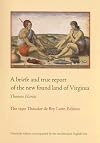
Thomas Hariot's A Briefe and True Report of the New Found Land of Virginia is one of the earliest and most important accounts of Indian life along the coast of what is now North Carolina and Virginia, as well as an interesting compilation of 'commodities' and natural resources of the region.
The University of Virginia Press has just issued a beautiful facsimile of the 1590 Theodor de Bry Latin edition, which includes a modernized English text. The copy used for the facsimile, that of the show more Mariners' Museum, is one of two known in which the engravings (from John White's famous drawings) were hand-colored at the time of publication. The high-quality facsimile, photographed and printed by the Stinehour Press, is remarkably clean and bright; not only the colors but also the shades of the paper come through sharply (even the small amount of off-setting is replicated).
Alone, the Hariot/de Bry facsimile would be a great book; combined as it is with excellent complementary essays, this is a work which is certain to hold a wide appeal. Karen Ordahl Kupperman's contextual introduction summarizes the expeditions during which Hariot and White did their work, while Peter Stallybrass examines the history of Hariot's manuscript, White's drawings, and de Bry's combination thereof into the 1590 folio editions (English, French and German editions were also printed). He comments on the rationale behind the printing of such an expensive volume (to appeal to the natural history-obsessed European elite), and also analyzes the interesting differences between the White drawings and the de Bry engravings (as well as the Hariot captions).
Of the huge crop of books appearing this spring related to the Jamestown anniversary, this is certainly the best designed and most lavishly illustrated. Kupperman's and Stallybrass' essays complement the facsimile nicely, and Hariot's text manages to remain interesting across the centuries. Highly recommended.
http://philobiblos.blogspot.com/2007/04/book-review-briefe-and-true-report.html show less
The University of Virginia Press has just issued a beautiful facsimile of the 1590 Theodor de Bry Latin edition, which includes a modernized English text. The copy used for the facsimile, that of the show more Mariners' Museum, is one of two known in which the engravings (from John White's famous drawings) were hand-colored at the time of publication. The high-quality facsimile, photographed and printed by the Stinehour Press, is remarkably clean and bright; not only the colors but also the shades of the paper come through sharply (even the small amount of off-setting is replicated).
Alone, the Hariot/de Bry facsimile would be a great book; combined as it is with excellent complementary essays, this is a work which is certain to hold a wide appeal. Karen Ordahl Kupperman's contextual introduction summarizes the expeditions during which Hariot and White did their work, while Peter Stallybrass examines the history of Hariot's manuscript, White's drawings, and de Bry's combination thereof into the 1590 folio editions (English, French and German editions were also printed). He comments on the rationale behind the printing of such an expensive volume (to appeal to the natural history-obsessed European elite), and also analyzes the interesting differences between the White drawings and the de Bry engravings (as well as the Hariot captions).
Of the huge crop of books appearing this spring related to the Jamestown anniversary, this is certainly the best designed and most lavishly illustrated. Kupperman's and Stallybrass' essays complement the facsimile nicely, and Hariot's text manages to remain interesting across the centuries. Highly recommended.
http://philobiblos.blogspot.com/2007/04/book-review-briefe-and-true-report.html show less
A Briefe and True Report of the New Found Land of Virginia (Rosenwald Collection Reprint Series) by Thomas Harriot
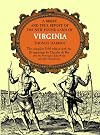
[A Briefe and true report of the new found land of Virginia] - Thomas Harriot.
This gives a tantalising glimpse of the life of the British settlers who attempted to establish a colony on the island of Roanoake which is now part of North Carolina. Thomas Harriot was a member of the Grenville expedition of 1585/6, which under the patronage of Sir Walter Raleigh took out over a hundred settlers to establish a colony in the New Found lands. They were aiming for Chesapeake bay, but weather show more conditions forced them to land at Roanoake. Thomas Harriot was an astronomer, mathematician, ethnographer and translator and his primary function was to make accurate maps of the area. When he returned to England he published a quarto edition of the new found land of Virginia in 1588. In 1590 a folio edition was published by Theodore de Bruys which contains Harriots original quarto along with engravings made by John White (one time governor of the colony) featuring the indigenous Indian population. Roanoake was never successfully colonised by the British, because the settlers were not able to support themselves and had further difficulties when they took up arms against the Indians.
Harriot's original quarto was published in an attempt to make the colony attractive to would be settlers and investors, however by the time that it was published the colony was already in trouble. It relied too much on supplies from England, and the Spanish Armada and weather conditions put paid to any meaningful support. In 1590 no trace of the colonists were found and it has remained a mystery as to their fate. Harriot's original quarto is a list with a short paragraph on each of the commodities that could be found on the island. It starts with silk worms with a comment that good profits could be made in the harvesting, there are otters for fur and plentiful deposits of iron. From then on it gets more sketchy with Harriot saying that some copper implements were seen, but no evidence of any mining. In fact the Indian population were largely metal free. Maize and tobacco were the main crops with Harriots comment that tobacco was particularly good for the health as the smoking of the powder opened up the pores of the skin. Deer, rabbits and Bears were in evidence and Harriot noted that of the 108 original settlers (all men) only 4 had died during the first year. The colony had relied on trade with the Indians for survival.
The attraction today of the 1590 edition is the engravings by John White of the Indian population; they are quite stunning. Harriot comments on their willingness to learn and ability to imitate the ways of the civilised settlers and that they would be open to conversion to christianity is in keeping with the aims of his original quarto. The descriptions of their clothing and celebrations and the glimpse of their characteristics makes this a worthwhile read today - I read the Dover edition with an introduction by Paul Hulton which contains John Whites engravings. - 4 stars. show less
This gives a tantalising glimpse of the life of the British settlers who attempted to establish a colony on the island of Roanoake which is now part of North Carolina. Thomas Harriot was a member of the Grenville expedition of 1585/6, which under the patronage of Sir Walter Raleigh took out over a hundred settlers to establish a colony in the New Found lands. They were aiming for Chesapeake bay, but weather show more conditions forced them to land at Roanoake. Thomas Harriot was an astronomer, mathematician, ethnographer and translator and his primary function was to make accurate maps of the area. When he returned to England he published a quarto edition of the new found land of Virginia in 1588. In 1590 a folio edition was published by Theodore de Bruys which contains Harriots original quarto along with engravings made by John White (one time governor of the colony) featuring the indigenous Indian population. Roanoake was never successfully colonised by the British, because the settlers were not able to support themselves and had further difficulties when they took up arms against the Indians.
Harriot's original quarto was published in an attempt to make the colony attractive to would be settlers and investors, however by the time that it was published the colony was already in trouble. It relied too much on supplies from England, and the Spanish Armada and weather conditions put paid to any meaningful support. In 1590 no trace of the colonists were found and it has remained a mystery as to their fate. Harriot's original quarto is a list with a short paragraph on each of the commodities that could be found on the island. It starts with silk worms with a comment that good profits could be made in the harvesting, there are otters for fur and plentiful deposits of iron. From then on it gets more sketchy with Harriot saying that some copper implements were seen, but no evidence of any mining. In fact the Indian population were largely metal free. Maize and tobacco were the main crops with Harriots comment that tobacco was particularly good for the health as the smoking of the powder opened up the pores of the skin. Deer, rabbits and Bears were in evidence and Harriot noted that of the 108 original settlers (all men) only 4 had died during the first year. The colony had relied on trade with the Indians for survival.
The attraction today of the 1590 edition is the engravings by John White of the Indian population; they are quite stunning. Harriot comments on their willingness to learn and ability to imitate the ways of the civilised settlers and that they would be open to conversion to christianity is in keeping with the aims of his original quarto. The descriptions of their clothing and celebrations and the glimpse of their characteristics makes this a worthwhile read today - I read the Dover edition with an introduction by Paul Hulton which contains John Whites engravings. - 4 stars. show less
A briefe and true report of the new found land of Virginia. By Thomas Hariot. The 1590 Theodor de Bry Latin Edition. Facsimile edition accompanied by the modernized English text. (Charlottesville and London: Published by the University of Virginia Press for the Library at the Mariners’ Museum, 2007. Pp. Xviii, 189. Paper, $35.00, ISBN 978-0-8139-2605-6; cloth, $200, ISBN 978-0-8139-2604-9.)
The new facsimile edition of the Latin version of Thomas Hariot’s A briefe and true report of the show more new found land of Virginia, accompanied by Theodor de Bry’s hand-tinted copper engravings of White’s watercolors, is a perfect complement to the new catalogue. The facsimile, made from a copy held at the Mariners’ Museum in Newport News, Virginia, gives readers insight into how Europeans were introduced to coastal Carolina’s Algonkian people. Though the facsimile is of a Latin edition, it is accompanied by a skillfully modernized English text prepared by Jay E. Moore and Janet C. Robertson. The real stars of the volume, though, are the magnificently rendered copper engravings, reproduced in all their hand-painted splendor, testifying to the richness of European visions of the New World.
Acompanying the facsimile and its English version are two essays, one by Karen O. Kupperman providing a brief history and context of the Roanoke venture, and another by Peter Stallybrass on A brief and true report, which he dubs “a European bestseller.” Stallybrass describes how Thomas Hariot’s work—previously known in England only by a cheap folio edition of 1588—came to be printed in four languages in an expensive edition by a Huguenot exile living in Germany. But more importantly, Stallybrass argues that the significance of de Bry’s edition was its botanical context—a novel approach to a set of engravings whose main import historians have seen as being visual representations of southern coastal Algonkians. Stallybrass expertly situates the engravings in the story of sixteenth-century European botanical literature: “[i]n Frankfurt in 1590, a handbook on colonization was transformed into a catalog not only of the people of America but also of the American plants that were materially reshaping Europe and the rest of the world.” (30)
While this volume will probably not replace the inexpensive Dover edition of A briefe and true report in survey classes, scholars of sixteenth-century Europe and North America will appreciate access to the facsimile of the hand-colored de Bry engravings and to the Latin edition (which was undoubtedly more widely read than the English, French, and German editions also published that same year).
-Rebecca A. Goetz, reviewed in the Journal of Southern History, vol. 74, no. 3 (August 2008), 707-709. show less
The new facsimile edition of the Latin version of Thomas Hariot’s A briefe and true report of the show more new found land of Virginia, accompanied by Theodor de Bry’s hand-tinted copper engravings of White’s watercolors, is a perfect complement to the new catalogue. The facsimile, made from a copy held at the Mariners’ Museum in Newport News, Virginia, gives readers insight into how Europeans were introduced to coastal Carolina’s Algonkian people. Though the facsimile is of a Latin edition, it is accompanied by a skillfully modernized English text prepared by Jay E. Moore and Janet C. Robertson. The real stars of the volume, though, are the magnificently rendered copper engravings, reproduced in all their hand-painted splendor, testifying to the richness of European visions of the New World.
Acompanying the facsimile and its English version are two essays, one by Karen O. Kupperman providing a brief history and context of the Roanoke venture, and another by Peter Stallybrass on A brief and true report, which he dubs “a European bestseller.” Stallybrass describes how Thomas Hariot’s work—previously known in England only by a cheap folio edition of 1588—came to be printed in four languages in an expensive edition by a Huguenot exile living in Germany. But more importantly, Stallybrass argues that the significance of de Bry’s edition was its botanical context—a novel approach to a set of engravings whose main import historians have seen as being visual representations of southern coastal Algonkians. Stallybrass expertly situates the engravings in the story of sixteenth-century European botanical literature: “[i]n Frankfurt in 1590, a handbook on colonization was transformed into a catalog not only of the people of America but also of the American plants that were materially reshaping Europe and the rest of the world.” (30)
While this volume will probably not replace the inexpensive Dover edition of A briefe and true report in survey classes, scholars of sixteenth-century Europe and North America will appreciate access to the facsimile of the hand-colored de Bry engravings and to the Latin edition (which was undoubtedly more widely read than the English, French, and German editions also published that same year).
-Rebecca A. Goetz, reviewed in the Journal of Southern History, vol. 74, no. 3 (August 2008), 707-709. show less
You May Also Like


Associated Authors
Statistics
- Works
- 7
- Also by
- 3
- Members
- 218
- Popularity
- #102,473
- Rating
- 3.7
- Reviews
- 3
- ISBNs
- 12
- Languages
- 2