
Richard Stern (1928–2013)
Author of Other Men's Daughters (New York Review Books Classics)
About the Author
Richard Gustave Stern was born in New York City on February 25, 1928. He received an undergraduate degree from the University of North Carolina at Chapel Hill in 1947, a master's degree from Harvard University, and a Ph.D. from the University of Iowa. After a year teaching at Connecticut College in show more New London, he started teaching literature and creative writing at the University of Chicago in 1955, where he remained until his retirement in 2001. His first novel, Golk, was published in 1960. His other novels include Europe: Or Up and Down with Schreiber and Baggish, Stitch, Natural Shocks, Other Men's Daughters, and A Father's Words. An early story, The Sorrows of Captain Schreiber, won an O. Henry award as one of the best short stories of 1954. His short story collections include Packages, Noble Rot, and Almonds to Zhoof. He also wrote a collection of essays entitled The Books in Fred Hampton's Apartment and a memoir about his older sister entitled A Sistermony. In 1985, he received the Medal of Merit for the Novel, awarded every six years by the Academy of Arts and Letters. He died of cancer on January 24, 2013 at the 84. (Bowker Author Biography) show less
Image credit: By Stern family - Wikipedia:Contact us/Photo submission, CC BY-SA 3.0, https://commons.wikimedia.org/w/index.php?curid=5059488
Works by Richard Stern
Other Men's Daughter's 1 copy
Associated Works
Writers on Writing, 2: More Collected Essays from the New York Times (2003) — Contributor — 200 copies, 3 reviews
The Workshop: Seven Decades of the Iowa Writers Workshop - 43 Stories, Recollections, & Essays on Iowa's Place in Twentieth-Century American Literature (1999) — Contributor — 197 copies, 1 review
The New Bedside Playboy: A Half Century of Amusement, Diversion & Entertainment (2006) — Foreword — 39 copies, 1 review
Livros Condensados: Tsunami! | O Presente de Asinus | Daddy | Um Mergulho na Escuridão (1990) — Author — 5 copies
Tagged
Common Knowledge
- Legal name
- Stern, Richard Gustave
- Birthdate
- 1928-02-25
- Date of death
- 2013-01-24
- Gender
- male
- Education
- University of North Carolina
Harvard University
University of Iowa - Occupations
- teacher
novelist
short story writer - Awards and honors
- American Academy of Arts and Letters Academy Award (Literature, 1968)
- Nationality
- USA
- Birthplace
- New York, New York, USA
- Places of residence
- New York, New York, USA (birth)
- Place of death
- Tybee Island, Georgia, USA
- Associated Place (for map)
- New York, USA
Members
Reviews

Richard Stern, who died in 2013, is said to be one of those sadly neglected "writers' writers." Before this I had only read - and loved - OTHER MEN'S DAUGHTERS, probably his best known and most successful novel. Now, having read this one, A FATHER'S WORDS, I appreciate his craft even more, because this is, quite simply, a damn good book. It's about being a father, about selfishness and compromise and other difficulties of love and marriage, about filial love, losing one's parents and show more mortality. In short, this is a novel about all the important issues of being a human being.
Yes, deep stuff. Even war gets its due: "Is war essential to industrial capitalism, the only sufficiently rapid consumer of goods? ... A nation's a nation when it has weapons. Without them you have bad feelings, not corpses."
But fatherhood is the central subject here, represented mainly in the prickly and difficult relationship between protagonist/narrator Cy Reimer and his slacker son, Jack. Cy is a writer, Jack seems to pride himself on being nothing, a taker. Tension, guilt, anger, disgust - a soup of emotions results.
And on his own father, dead at 92 of dementia, Cy says -
"Ten years before his death, when his mind was still all right, I gave him a Woolworth notebook and suggested he write his autobiography. [telling him] 'You've had a wonderful life and you're a wonderful fellow. Everybody's life is precious. Things that no one else has ever known will disappear from the world when you do. It doesn't have to be a great book. Anything you write, I'll love. So will the children.'..."
This hit me right in the heart. I proposed the same thing to my mother when she was ninety. She started to write, got nearly 40 pages in, then stopped and never started again. She died at 96, but I will treasure those pieces of her life that she did write down. I wonder if this interest in our parents' lives always comes too late. In another scene, Cy meets a middle-aged woman on a plane, flying to visit her aged and ill father -
"... she was going to get him to talk into a tape recorder about his life. 'I'll have his voice, his life.'..."
Cy Reimer, divorced and living with a much younger woman, has two sons, two daughters. A writer who values his solitude and privacy, his relationships wit his ex-wife, his sons, his daughters are all fraught with complexity - guilt is a constant.
"A father's words" are so important - what he says, how he says it. Words have lasting effects that reverberate through lives, down through generations even.
Damn, this was a good book! HIGHLY recommended. And now on to an even older Stern novel, IN ANY CASE. Stay tuned. show less
Yes, deep stuff. Even war gets its due: "Is war essential to industrial capitalism, the only sufficiently rapid consumer of goods? ... A nation's a nation when it has weapons. Without them you have bad feelings, not corpses."
But fatherhood is the central subject here, represented mainly in the prickly and difficult relationship between protagonist/narrator Cy Reimer and his slacker son, Jack. Cy is a writer, Jack seems to pride himself on being nothing, a taker. Tension, guilt, anger, disgust - a soup of emotions results.
And on his own father, dead at 92 of dementia, Cy says -
"Ten years before his death, when his mind was still all right, I gave him a Woolworth notebook and suggested he write his autobiography. [telling him] 'You've had a wonderful life and you're a wonderful fellow. Everybody's life is precious. Things that no one else has ever known will disappear from the world when you do. It doesn't have to be a great book. Anything you write, I'll love. So will the children.'..."
This hit me right in the heart. I proposed the same thing to my mother when she was ninety. She started to write, got nearly 40 pages in, then stopped and never started again. She died at 96, but I will treasure those pieces of her life that she did write down. I wonder if this interest in our parents' lives always comes too late. In another scene, Cy meets a middle-aged woman on a plane, flying to visit her aged and ill father -
"... she was going to get him to talk into a tape recorder about his life. 'I'll have his voice, his life.'..."
Cy Reimer, divorced and living with a much younger woman, has two sons, two daughters. A writer who values his solitude and privacy, his relationships wit his ex-wife, his sons, his daughters are all fraught with complexity - guilt is a constant.
"A father's words" are so important - what he says, how he says it. Words have lasting effects that reverberate through lives, down through generations even.
Damn, this was a good book! HIGHLY recommended. And now on to an even older Stern novel, IN ANY CASE. Stay tuned. show less
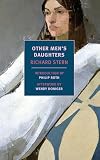
"Miss Ryder was golden-haired but almost Indian dark, slimly full, tall, slightly prognathous, brown-eyed. Her hair waterfalled to the top thoracic vertebra, her tanned flesh issued from a laundered yellow corolla. A human sunflower." - Richard Stern, Other Men's Daughters
Other Men’s Daughters - American author Richard Stern’s 1973 novel of forty-year-old family man and Harvard professor Robert Merriweather’s transformation brought about by his relationship with a twenty-year-old show more beauty by the name of Cynthia Ryder. For instance, here's the author’s description of Merriweather’s wife catching a whiff of the change: “For months now, Sarah specialized in her husband’s moves. She classified his gestures, checked his bills, noted his new suit, his brighter ties, the extra shag in his hair. He spent more time in the lab than he had for fifteen years. There is a new ease in his speech and dress, yet he has long since stopped asking her what she had even longer refused him.”
In a way, this is a timeless tale of modern life: older university professor stuck in a stale marriage discovers new dimensions of love and intimacy with bright, vivacious younger woman. Robert Merriweather shares a good deal in common with another professor from a much beloved classic: William Stoner in John Williams’ Stoner, a novel set at the University of Missouri in the early 1930s. And, of course, the respective dramas of William Stoner and Robert Merriweather have been repeated scores of times across college campuses ever since.
In yet another sense Richard Stern’s novel captures the unique social and cultural shift that occurred in the United States in the 1960s. So much so, Philip Roth notes in his Introduction to this New York Review Books edition: “Other Men’s Daughters illuminates a decisive turning point in American mores. The novel reminds us of where we were, morally speaking, when the vast assault upon convention, propriety, and entrenched belief began to challenge authority, high and low, and of the wreckage that caused, the theatrics it fostered, the hope and euphoria and intemperance it quickened.”
In Saul Bellow’s Herzog, the entire novel is told wholly from main character Herzog’s point of view - his memories, his thoughts, his perceptions, the letters he writes; a novel that’s a hair’s breath away from Herzog relating the story himself in the first-person. Very different from Richard Stern’s third person narrator, where unfolding events are reported a great deal more objectively and occasionally shift from Robert Merriweather to focus on the reflections and feelings of others: Cynthia Ryder, Merriweather’s wife Sarah, a former Harvard colleague, Cynthia’s father who happens to be a wealthy lawyer from North Carolina. All with great precision and economy.
To share a small sample, here is Sarah, irate and furious, fuming over her role as Robert’s short, chubby, unattractive, stay-at-home wife: “He would be off, the secret prowler. While she kept the home fires burning. And he blamed her. As if her body could be purchased by three daily meals, and this leaky hutch which she alone kept up. (He couldn’t hammer a nail.) As if he really cared to make love to her. Frigid? No, no more than any woman with a husband who saw her as an interior broom.” Is it any wonder literary critic Anatole Broyard reviewing the novel for the New York Times said Sarah loves her hatred with a sexual intensity?
And in case anybody is wondering about Cynthia Ryder being the young innocent seduced by a smooth talking older man, here is the North Carolina lovely on her teenage love life prior to meeting Merriweather: “Boys were there to be used, to be loved, to be lost in, to be surmounted. Virginity was the first obstacle. Between that and marriage was the Era of Exploration: boys-men were to be explored, tested. For Cynthia, the spring of Sixty-Nine had been a sexual pageant. Behind Jamie’s back (her steady boyfriend at the time), she’d slept at least once with eight boys.”
As readers we share the various (and somewhat predictable) scenes of Robert Merriweather going through the travails of his divorce – the showdown with Sarah, the distasteful meeting with Sarah’s lawyer, picking over the details of the divorce settlement, the last family Thanksgiving and Christmas with Sarah and their two sons and two daughters in the New England house that has been in Merriweather’s family for generations. Richard Stern's writing brings out the touching humanness without sliding into emotions overly sentimental or cloying.
Such a penetrating, well-written novel, thus I will conclude with a quote from one of America’s foremost literary masters, Thomas Berger: “For years I have admired the elegant fiction of Richard Stern for its impeccable language, its gracious erudition, and, above all, it’s brilliant wit. In Other Men’s Daughters, to me his most moving novel, these qualities serve the cause of mercy.”
American author Richard Stern (1928-2013) show less

IN ANY CASE, by Richard G. Stern, is a novel I've had lying around here for months, ever since I read A CRITICAL FRIENDSHIP, a book of letters between Stern and the poet, Donald Justice. At that time I had read only one Stern book, a novel called OTHER MEN'S DAUGHTERS, one of those books you keep and read again every now and then. (I've probably read it 3-4 times now.) But the book of letters, showing a lifelong friendship between the two writers, was so fascinating that I wanted to read show more more Stern. So I read his A FATHER'S WORDS, which I liked very much. And now, finally, this one.
IN ANY CASE is called "a novel of suspense and self-discovery," and it is indeed. It covers a five-year period between 1948 and 1953 in the life of Sam Curry, an expatriate WWI veteran living in Paris, as he tries to unravel the mystery and betrayals surrounding the death of his son, Bobbie, who was part of the Allied Underground working with the French Resistance during the Second World War. It is a very complex story, filled with interesting characters, so many in fact that I almost had to start writing them down. Sam himself is the most interesting of all, of course, as the story is told in his voice. You learn he was a rather selfish, hedonistic man for much of his life, but now, in his late fifties and early sixties, he begins to reflect on and evaluate his life and feels guilt at how he neglected his son, the son who is dead now and beyond any reconciliation. But he meets Jacqueline, who was his son's lover and comrade in the world of espionage during the war, and falls in love with her. More guilty feelings, of course. He also meets and befriends the man who may have been responsible for Bobbie's death. It is a complex web of double agents and subterfuge that Sam uncovers as he tries to clear his son's name of the wrongdoing ascribed to him in a book written a few years after the war. This is not an easy read. You have to pay close attention to keep abreast of who betrayed who. But when a strange triangle forms between Sam, Jacqueline, and Jean Arastignac, cover name "Robert," the story begins to snowball ahead and I was drawn quickly into it. Stern obviously did a lot of historical research for this 1962 book, and his narrative is compelling and genuine-feeling. I enjoyed it immensely, even though it's not the kind of book I would normally pick up and read. I'd probably still rank OTHER MEN'S DAUGHTERS as my favorite Stern book, but this one too is a keeper, and I will recommend it, especially to WWII history buffs. show less
IN ANY CASE is called "a novel of suspense and self-discovery," and it is indeed. It covers a five-year period between 1948 and 1953 in the life of Sam Curry, an expatriate WWI veteran living in Paris, as he tries to unravel the mystery and betrayals surrounding the death of his son, Bobbie, who was part of the Allied Underground working with the French Resistance during the Second World War. It is a very complex story, filled with interesting characters, so many in fact that I almost had to start writing them down. Sam himself is the most interesting of all, of course, as the story is told in his voice. You learn he was a rather selfish, hedonistic man for much of his life, but now, in his late fifties and early sixties, he begins to reflect on and evaluate his life and feels guilt at how he neglected his son, the son who is dead now and beyond any reconciliation. But he meets Jacqueline, who was his son's lover and comrade in the world of espionage during the war, and falls in love with her. More guilty feelings, of course. He also meets and befriends the man who may have been responsible for Bobbie's death. It is a complex web of double agents and subterfuge that Sam uncovers as he tries to clear his son's name of the wrongdoing ascribed to him in a book written a few years after the war. This is not an easy read. You have to pay close attention to keep abreast of who betrayed who. But when a strange triangle forms between Sam, Jacqueline, and Jean Arastignac, cover name "Robert," the story begins to snowball ahead and I was drawn quickly into it. Stern obviously did a lot of historical research for this 1962 book, and his narrative is compelling and genuine-feeling. I enjoyed it immensely, even though it's not the kind of book I would normally pick up and read. I'd probably still rank OTHER MEN'S DAUGHTERS as my favorite Stern book, but this one too is a keeper, and I will recommend it, especially to WWII history buffs. show less
Yet another novel about a middle-aged, white guy's mid-life crisis. Great writing, though.
Awards


You May Also Like


Associated Authors
Statistics
- Works
- 32
- Also by
- 7
- Members
- 426
- Popularity
- #57,312
- Rating
- 3.9
- Reviews
- 10
- ISBNs
- 67
- Languages
- 3