
Mick Herron
Author of Slow Horses
About the Author
Mick Herron is a British author, born in Newcastle upon Tyne. He writes mystery and thriller novels and short stories. He is the author of Slow Horses, Dead Lions, Real Tigers, and Spook Street, in the Jackson Lamb series. His other works include Down Cemetery Road, Smoke & Whispers, The Last Voice show more You Hear, Why We Die, The List: A Novella, and Spook Street. He won the 2013 CWA Goldsboro Gold Dagger for his novel, Dead Lions. (Bowker Author Biography) show less
Series
Works by Mick Herron
Slow Horses (Season 1) — Author — 13 copies
The Other Half - story 1 copy
Slough House 02: Dead Lions 1 copy
På fremmed jord 1 copy
La calle de los espías (Serie Slow Horses 4): Los thrillers en los que se inspira la serie de televisión (Spanish Edition) 1 copy, 1 review
Slough House 08: Bad Actors 1 copy
Slough House 06: Joe Country 1 copy
Slough House 03: Real Tigers 1 copy
Zoë Boehm 03: Why We Die 1 copy
Slough House 01: Slow Horses 1 copy
Slow Horses (Season 1-3) 1 copy
Associated Works
The Usual Santas: A Collection of Soho Crime Christmas Capers (2017) — Contributor — 160 copies, 10 reviews
Slow Horses : Stagione 2 4 copies
Tagged
Common Knowledge
- Birthdate
- 1963
- Gender
- male
- Education
- Balliol College, Oxford (English)
- Agent
- Juliet Burton
- Nationality
- UK
- Birthplace
- Newcastle-upon-Tyne, Northumberland, England, UK
- Places of residence
- Oxford, England, UK
- Map Location
- England, UK
Members
Reviews
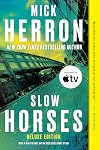
"You know what?" Hassan said. "You make me ashamed I'm British."
That line speaks volumes.
I was fortunate enough to pick up a copy of Mick Herron's Real Tigers earlier this year, and I say fortunate because I was completely unaware of the author and I absolutely loved the book. So when I recently found Slow Horses (2010) it definitely made my day.
Mine is a Tenth Anniversary copy (2020), and the preface is interesting in itself. It briefly covers the inspiration for and / or the circumstances show more that conspired to create Slough House, and the events leading Herron to switch gears in his writing genre and to undertake more global political and unpleasant criminal themes like terrorism (yes, beheadings are extremely hardcore). It also mentions the pushback he got after he wrote this story:
"My original UK publisher took exception to the book; he thought its plot strand concerning the resurgence of the far right ridiculously unlikely, and references to, for instance, Britain leaving the European Union revealed how out of touch I was with contemporary politics. I, on the other hand, thought I'd found my own voice at last; not entirely different from the one I'd developed in the earlier books, but more confident, more individual. Being dropped by that publisher shortly after Slow Horses appeared wasn't the most auspicious of starts, but I felt at last that I was ready."
Funny that, since Fascism and the so-called "far-right" (or simply political right) has always been hiding in plain sight. In most places the far-right has largely been the sole power structure and authority held in place by its ardent supporters. The far-right has always controlled the message, and any failures to see the obvious is the fault of the viewer which is mostly due to holding a full set of false beliefs (hence, the message). I do like that the far-right is more mainstream and out of the shadows, I like that we now have facts (for the political center and so-called "left") and alternative-facts.
[Hard to believe, but the Hippies don't really run Canary Wharf, the Square Mile, or Lombard Street. They don't even run Barclays, HSBC, Lloyds or NatWest. Nor do they control UBS and Credit Suisse. The Hippies don't even control the Giant Media Conglomerates. Crazy, I know, but it’s true!]
Mick Herron’s writing is superb and sublime. There will be passages that say next to nothing, where you have to literally read between the lines, and I'll be like... huh, what? I will have to read the passage a couple of times before I put the pieces together and then... son of a bitch! By saying less, he was actually saying more and it's brilliant. I'm not sure how he does it, but that is real genius.
I love all the characters in Slough House. I also like smart people. I really, really like smart people... maybe because they are in such short supply. And I love the idea of Slough House, a crew of misfits that are polar opposites of the "London Rules" wonks overpopulating Regent's Park. How on any given day, with fewer tools and resources, the Slow Horses can run circles around their more upstanding counterparts. Black sheep, slow horses, whatever, I'll take them any day. show less
That line speaks volumes.
I was fortunate enough to pick up a copy of Mick Herron's Real Tigers earlier this year, and I say fortunate because I was completely unaware of the author and I absolutely loved the book. So when I recently found Slow Horses (2010) it definitely made my day.
Mine is a Tenth Anniversary copy (2020), and the preface is interesting in itself. It briefly covers the inspiration for and / or the circumstances show more that conspired to create Slough House, and the events leading Herron to switch gears in his writing genre and to undertake more global political and unpleasant criminal themes like terrorism (yes, beheadings are extremely hardcore). It also mentions the pushback he got after he wrote this story:
"My original UK publisher took exception to the book; he thought its plot strand concerning the resurgence of the far right ridiculously unlikely, and references to, for instance, Britain leaving the European Union revealed how out of touch I was with contemporary politics. I, on the other hand, thought I'd found my own voice at last; not entirely different from the one I'd developed in the earlier books, but more confident, more individual. Being dropped by that publisher shortly after Slow Horses appeared wasn't the most auspicious of starts, but I felt at last that I was ready."
Funny that, since Fascism and the so-called "far-right" (or simply political right) has always been hiding in plain sight. In most places the far-right has largely been the sole power structure and authority held in place by its ardent supporters. The far-right has always controlled the message, and any failures to see the obvious is the fault of the viewer which is mostly due to holding a full set of false beliefs (hence, the message). I do like that the far-right is more mainstream and out of the shadows, I like that we now have facts (for the political center and so-called "left") and alternative-facts.
[Hard to believe, but the Hippies don't really run Canary Wharf, the Square Mile, or Lombard Street. They don't even run Barclays, HSBC, Lloyds or NatWest. Nor do they control UBS and Credit Suisse. The Hippies don't even control the Giant Media Conglomerates. Crazy, I know, but it’s true!]
Mick Herron’s writing is superb and sublime. There will be passages that say next to nothing, where you have to literally read between the lines, and I'll be like... huh, what? I will have to read the passage a couple of times before I put the pieces together and then... son of a bitch! By saying less, he was actually saying more and it's brilliant. I'm not sure how he does it, but that is real genius.
I love all the characters in Slough House. I also like smart people. I really, really like smart people... maybe because they are in such short supply. And I love the idea of Slough House, a crew of misfits that are polar opposites of the "London Rules" wonks overpopulating Regent's Park. How on any given day, with fewer tools and resources, the Slow Horses can run circles around their more upstanding counterparts. Black sheep, slow horses, whatever, I'll take them any day. show less
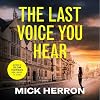
’The Last Voice You Hear’ was a twisty, sometimes violent, thriller, dominated by two strong women. It was a book that managed to feel character-driven while delivering unexpected plot twists and gradually revealing the relationship between apparently unrelated events.
The novel takes place a couple of years after the events of ‘Down Cemetery Road’ (2003). This time, the story focuses not on Sarah Tucker, but on Zoë Boehm, the Private Detective who only became a main character in show more the last third of ‘Down Cemetery Road'.
Much of the story is told from Zoë’s point of view, and one of the things I enjoyed most about the novel was getting to spend time inside her head. Her slightly unconventional and cleverly articulated thoughts made her an engaging character while effortlessly delivering plot exposition and manipulating the level of tension in the story. I enjoyed watching Zoë fail to keep the emotional distance from the people around her that she aspires to as she navigated a series of puzzling, sometimes threatening, encounters that lead, through a series of surprising twists and turns, to a very tense, very violent climax.
In a mirror image of ‘Down Cemetery Road’, Sarah Tucker only appears in the last third of the novel. She is probably the only person who Zoë. The two women are quite different to one another, but the bond between them is strong. When Sarah entered the story, the tension rose as there was more at risk, and Zoë came more clearly into focus as Sarah provided a context that reframed my view of her.
I liked the intricacy of the plot, the credible levels of threat and the slow but inexorable convergence of people and events that kept me almost permanently in suspense. I loved the perfectly choreographed tension of the violent denouement.
Even so, what I enjoyed most was the character-building, especially the way Zoe formulates her thoughts, and how the relationship between Zoë and Sarah seems to empower them both.
I’m sold on this series now. I’ve already added ‘Why We Die’ (2006), the next book in the series, to my TBR pile. show less
The novel takes place a couple of years after the events of ‘Down Cemetery Road’ (2003). This time, the story focuses not on Sarah Tucker, but on Zoë Boehm, the Private Detective who only became a main character in show more the last third of ‘Down Cemetery Road'.
Much of the story is told from Zoë’s point of view, and one of the things I enjoyed most about the novel was getting to spend time inside her head. Her slightly unconventional and cleverly articulated thoughts made her an engaging character while effortlessly delivering plot exposition and manipulating the level of tension in the story. I enjoyed watching Zoë fail to keep the emotional distance from the people around her that she aspires to as she navigated a series of puzzling, sometimes threatening, encounters that lead, through a series of surprising twists and turns, to a very tense, very violent climax.
In a mirror image of ‘Down Cemetery Road’, Sarah Tucker only appears in the last third of the novel. She is probably the only person who Zoë. The two women are quite different to one another, but the bond between them is strong. When Sarah entered the story, the tension rose as there was more at risk, and Zoë came more clearly into focus as Sarah provided a context that reframed my view of her.
I liked the intricacy of the plot, the credible levels of threat and the slow but inexorable convergence of people and events that kept me almost permanently in suspense. I loved the perfectly choreographed tension of the violent denouement.
Even so, what I enjoyed most was the character-building, especially the way Zoe formulates her thoughts, and how the relationship between Zoë and Sarah seems to empower them both.
I’m sold on this series now. I’ve already added ‘Why We Die’ (2006), the next book in the series, to my TBR pile. show less
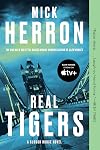
The things that make the "Slow Horses" series worth reading — the quick repartee; the very idea of unglamorous, occasionally incompetent spies; the unbearable Britishness of the entire exercise — are still in evidence here, as well as a shootout worthy of any action movie that takes up the last fifth or so of the book. Jackson Lamb, shot-caller at MI5's own living graveyard, seems to be becoming nastier and less hygienic as this series progresses, and some readers may find this show more increasingly difficult to take. I do have to say I rather enjoyed new additions Marcus, a genuinely skilled agent with a nasty gambling habit, and Shirley, another able operator who just so happens to have a "strictly Thursday-to-Tuesday" cocaine habit. The theme that Herron seems most eager to investigate here is how true the old saw "knowledge is power" really is, which is why several men are willing to risk their lives for a few yellowed files and why some dusty librarians at Regent's Park — grandmothers all, probably — are shown to wield almost imaginable amounts of power behind the scenes. This is served up with a side dish of good, old-fashioned bureaucratic infighting, which may be why Herron might have felt obligated to include that extended action scene, which, truth be told, seems a bit out of step with his series' usual modus operandi. Still, spending time with these lovable intelligence service losers is so genuinely pleasurable, I'm willing to forgive him this one. This one is perfect for a long flight, a bad mood, or a lazy summer afternoon. show less
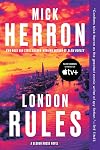
Herron keeps up the high standard that he's maintained throughout the "Slow Horses" series here. While "London Rules" may contain any major changes, either in Herron's style or in the series' overall trajectory, there are some small shifts to mention here. The first is that Herron seems to have realized that he might be a better comic writer than he is a spy novelist: the Slow Horses books were always funny, but they're sharper here than ever. There are some real put-down-the-book-and-laugh show more moments in this one. While there are a few episodes of high drama and a few desperate confrontations, the bloodshed is kept to a minimum: this book's body count is probably lower than that of its predecessors. Slough House's resident tech-head, Roderick Ho, also gets a sound ribbing both from the book's characters and from, I think, the author himself. But the Rodster's not a lovable loser as much as he is just a loser, so there's no problem there.
I think some readers might complain that Herron plays a bit of dirty pool when he narrates certain events only to reveal — at the end of the sentence, or at the beginning of the next paragraph — that those were just imagined or forecast, and not real, outcomes. Is this fair? Oh, maybe not. But I was having too much fun reading "London Rules" to really complain about it. Four stars, as usual. show less
I think some readers might complain that Herron plays a bit of dirty pool when he narrates certain events only to reveal — at the end of the sentence, or at the beginning of the next paragraph — that those were just imagined or forecast, and not real, outcomes. Is this fair? Oh, maybe not. But I was having too much fun reading "London Rules" to really complain about it. Four stars, as usual. show less
Lists
To Read (1)
Movies/Shows (1)
Awards


You May Also Like


Associated Authors
Statistics
- Works
- 49
- Also by
- 6
- Members
- 14,680
- Popularity
- #1,568
- Rating
- 4.0
- Reviews
- 688
- ISBNs
- 499
- Languages
- 13
- Favorited
- 16
