
Karl Popper (1902–1994)
Author of The Logic of Scientific Discovery
About the Author
Although he writes widely in philosophy, Sir Karl Raimund Popper is best known for his thesis that an empirical statement is meaningless unless conditions can be specified that could show it to be false. He was born and educated in Vienna, where he was associated with, although not actually a show more member of, the Vienna Circle. Two years after the German publication of his Logic of Scientific Discovery (1935), he left Austria for New Zealand, where he was senior lecturer at the University of Canterbury. In 1945 he moved to England and began a distinguished career at the London School of Economics and Political Science. According to Popper, there is no "method of discovery" in science. His view holds that science advances by brilliant but unpredictable conjectures that then stand up well against attempts to refute them. This view was roundly criticized by more dogmatic positivists, on the one hand, and by Feyerabend and Kuhn, on the other. In 1945 he published The Open Society and Its Enemies, which condemns Plato, Georg Hegel, and Karl Marx as progenitors of totalitarianism and opponents of freedom. The scholarship that underpins this book remains controversial. Popper's later works continue his interest in philosophy of science and also develop themes in epistemology and philosophy of mind. He is particularly critical of historicism, which he regards as an attitude that fosters a deplorable tendency toward deterministic thinking in the social sciences. (Bowker Author Biography) show less
Image credit: Lise Meitner-Graf / © ÖNB/Wien
Series
Works by Karl Popper
The Logic of Scientific Discovery (1934) — Author; Translator, some editions — 1,971 copies, 17 reviews
The Open Society and Its Enemies, Vol. 2: Hegel, Marx, and the Aftermath (1945) 933 copies, 5 reviews
Quantum Theory and the Schism in Physics: From The Postscript to the Logic of Scientific Discovery (1982) 112 copies, 1 review
Popper 4 copies
Epistemologia razionalità e libertà 2 copies
Filosofía radical: Conversaciones con Marcuse (CLA-DE-MA / Política nº 302652) (Spanish Edition) (2018) 2 copies
Kritik und Vernunft. 4 Cassetten. . Von der Unendlichkeit des Nichtwissens. Reden und Gespräche (2001) 2 copies
O racionalismo crítico na política 2 copies
Falsche Propheten. Hegel, Marx und die Folgen (Die offene Gesellschaft und ihre Feinde, Bd. 2) 1 copy
PËR FILOZOFINË DHE SHKENCËN 1 copy
o mito do contexto 1 copy
Cattiva maestra televisione 1 copy
Logica cercetarii 1 copy
درس القرن العشرين 1 copy
Um caso de Verificacionismo 1 copy
OS PARADOXOS DA SOBERANIA 1 copy
Contro Marx 1 copy
Lección pronunciada por Sir Karl R. Popper con motivo de su investidura como Doctor Honoris Causa por la Universidad Complutense de Madrid 1 copy, 1 review
Contro Hegel 1 copy
Popper [Opere di] 1 copy
Associated Works
The Critical Approach to Science and Philosophy : In Honor of Karl R. Popper (1964) — honoree — 19 copies
Tagged
Common Knowledge
- Legal name
- Popper, Karl Raimund
- Birthdate
- 1902-07-28
- Date of death
- 1994-09-17
- Gender
- male
- Education
- University of Vienna (Doktor|philosophy, 1928)
- Occupations
- philosopher
university professor - Organizations
- Social Democratic Workers' Party of Austria
Canterbury College, Christchurch, New Zealand
London School of Economics
Aristotelian Society
Academy of Humanism - Awards and honors
- Companion of Honour (1982)
British Academy (Fellow, 1958)
Royal Society (Fellow, 1976)
Order of the British Empire (Knight Commander, 1965)
James Scott Prize Lectureship (1966-1970)
Otto Hahn Peace Medal (1993) (show all 14)
Grand Decoration for Services to the Republic of Austria (1986)
Sonning Prize (1973)
Lippincott Award
de Tocqueville Prize (1984)
Catalunya Prize (1989)
Kyoto Prize 91992)
Goethe Medal (1992)
Karl Renner Prize (1978) - Relationships
- Hayek, Friedrich (friend, colleague)
Soros, George (student)
Lakatos, Imre (student, colleague)
Medawar, Peter (friend, colleague) - Nationality
- Austria
UK - Birthplace
- Vienna, Austria
- Places of residence
- Vienna, Austria-Hungary
London, England, UK
Croydon, Surrey, England, UK
Christchurch, New Zealand - Place of death
- London, England, UK
- Burial location
- Lainzer Cemetery, Vienna, Austria
Members
Discussions
karl popper in Philosophy and Theory (March 2009)
Reviews
The open universe : an argument for indeterminism : from the Postscript to The logic of scientific discovery by Karl Popper

The Open Universe consists of the main essay, which takes up slightly less than two thirds of the book, and then three appendices which partly extend the main essay's argument and partly link it to the topic of reductionism. While the entire thing is called a 'postscript' to the Logic of Scientific Discovery, there are relatively few references to that work, and many more to Popper's later books and essays.
The book's main argument is an argument against what Popper calls 'scientific' show more determinism -- complete with the square quotes. This is the claim that an ideal scientist could predict with any desired accuracy any future event. An ideal scientist is someone who may transcend our limitations, but only in quantity, not in kind. Thus, an ideal scientist can make very fast computations, but not infinitely fast ones; must be thought of as inside the universe; can only gain information about events in his/her own past light cone; and so on. Given all these limitations, one wonders if anyone has ever signed up to 'scientific' determinism. (Popper claims that Laplace wanted us to understand his demon in this way, but this seems clearly false.) Popper is interesting and inventive when he attacks this form of determinism, but the reader is left to wonder how much is being accomplished.
When he later turn his attention to the more familiar metaphysical determinism, Popper seems to believe that his earlier attack on 'scientific' determinism has taken away any reason to use science as an argument for metaphysical determinism. That is, he claims to have undercut this series of inferences: our theories are deterministic -> 'scientific' determinism is true -> metaphysical determinism is true. But it seems to me that the second step is superfluous. Surely, it is from the fact that our best theories are deterministic that we immediately conclude that the world is deterministic? (At least, that is what the determinist does.) I suspect Popper's reasoning is dependent on his own anti-inductivist philosophy of science, but he does not spell this out.
Throughout, the book is characterised by a combination of fecundity of ideas and laxness in working them out. This is particularly true in Popper's discussion of his Worlds 1, 2 and 3 in the first addendum. These worlds are supposed to carry a lot of weight in metaphysical argumentation, but their status is left entirely unclear. World 3, the world of theories, is supposed to be brought into existence by humans beings, but also has autonomy. How is that possible? Do theories appear in the world when they are invented? Or only when they are believed? Do they ever disappear? What is the ontological status of these entities? Popper says nothing about it. Or again, in the discussion about reduction of the last two addenda, Popper somehow fails to define what he means by 'reduction', leaving the reader unable to evaluate his rather mystifying claim that chemistry cannot be reduced to physics because chemistry involves questions about how the elements were formed by cosmological processes.
All in all, an interesting but flawed defence of indeterminism. show less
The book's main argument is an argument against what Popper calls 'scientific' show more determinism -- complete with the square quotes. This is the claim that an ideal scientist could predict with any desired accuracy any future event. An ideal scientist is someone who may transcend our limitations, but only in quantity, not in kind. Thus, an ideal scientist can make very fast computations, but not infinitely fast ones; must be thought of as inside the universe; can only gain information about events in his/her own past light cone; and so on. Given all these limitations, one wonders if anyone has ever signed up to 'scientific' determinism. (Popper claims that Laplace wanted us to understand his demon in this way, but this seems clearly false.) Popper is interesting and inventive when he attacks this form of determinism, but the reader is left to wonder how much is being accomplished.
When he later turn his attention to the more familiar metaphysical determinism, Popper seems to believe that his earlier attack on 'scientific' determinism has taken away any reason to use science as an argument for metaphysical determinism. That is, he claims to have undercut this series of inferences: our theories are deterministic -> 'scientific' determinism is true -> metaphysical determinism is true. But it seems to me that the second step is superfluous. Surely, it is from the fact that our best theories are deterministic that we immediately conclude that the world is deterministic? (At least, that is what the determinist does.) I suspect Popper's reasoning is dependent on his own anti-inductivist philosophy of science, but he does not spell this out.
Throughout, the book is characterised by a combination of fecundity of ideas and laxness in working them out. This is particularly true in Popper's discussion of his Worlds 1, 2 and 3 in the first addendum. These worlds are supposed to carry a lot of weight in metaphysical argumentation, but their status is left entirely unclear. World 3, the world of theories, is supposed to be brought into existence by humans beings, but also has autonomy. How is that possible? Do theories appear in the world when they are invented? Or only when they are believed? Do they ever disappear? What is the ontological status of these entities? Popper says nothing about it. Or again, in the discussion about reduction of the last two addenda, Popper somehow fails to define what he means by 'reduction', leaving the reader unable to evaluate his rather mystifying claim that chemistry cannot be reduced to physics because chemistry involves questions about how the elements were formed by cosmological processes.
All in all, an interesting but flawed defence of indeterminism. show less
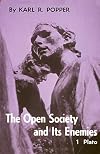
This is Volume I centered on Plato. The tos and fros of philosophy have always been a trial for me and this presentation is no different. Still, I am grateful that Popper has shown me what totalitarian tendencies Plato had and the environment that he was reacting against. Athenian democracy was (and still is) a messy work in progress that included slavery. Plato is shown as a traitor to Socrates and accepting lying and force as part of his propaganda and way to get back to the perfect state. show more It is interesting to note that change itself was a big enemy of his. That this was written during World War II suggests why the inquiry into totalitarianism is direct and intense and has the added sense of immediacy.
Quotes: (page 56) “His stories of the Decline and Fall, and with it nearly all the later stories, exhibit at least two characteristics which we have not discussed so far. He conceived these declining societies as some kind of organism, and the decline as a process similar to aging. And he believed that the decline is well deserved in the sense of moral decay, a fall and decline of the soul, goes hand in hand with that of the social body.”
(page 86) “His fundamental demands can be expressed in either of two formulae, the first corresponding to his idealist theory of change and rest, the second to his naturalism. The idealist formula is: Arrest all political change! Change is evil, rest divine. All change can be arrested if the state is made an exact copy of the original, ie, of the Form or Idea of the city. Should it be asked how this is practicable, we can reply with the naturalistic formula: Back to nature! Back to the original state of our forefathers, the primitive state founded in accordance with human nature, and therefore stable; back to tribal patriarchy of the time before the Fall, to the natural class rule of the wise few over the ignorant many.”
(page 148) “But the claim of the Pythagoreans to a supernatural basis of their authority remained. Thus Plato's philosophical education has a definite political function. It puts a mark on the rulers, and it establishes a barrier between the rulers and the ruled. (This has remained a major function of 'higher' education down to our time.) Platonic wisdom is acquired largely for the sake of establishing a permanent political class rule.”
(page 200) “ Socrates had refused to compromise his personal integrity. Plato, with all his uncompromising, canvas-clearing, was led along a path on which he compromised his integrity with every step he took. He was forced to combat free thought, and the pursuit of truth. He was led to defend lying, political miracles, tabooistic superstition, the suppression of truth, and ultimately brutal violence. In spite of Socrates' warning against misanthropy and misology, he was led to distrust man and to fear argument. In spite of his own hatred of tyranny, he was led to look to a tyrant for help, and to defend the most tyrannical measures. By the internal logic of his anti-humanitarian aim, the internal logic of power, he was led unawares to the same point to which once the Thirty had been led, and at which, later, his friend Dio arrived, and among others his numerous tyrant-disciples. He did not succeed in arresting social change.” show less
Quotes: (page 56) “His stories of the Decline and Fall, and with it nearly all the later stories, exhibit at least two characteristics which we have not discussed so far. He conceived these declining societies as some kind of organism, and the decline as a process similar to aging. And he believed that the decline is well deserved in the sense of moral decay, a fall and decline of the soul, goes hand in hand with that of the social body.”
(page 86) “His fundamental demands can be expressed in either of two formulae, the first corresponding to his idealist theory of change and rest, the second to his naturalism. The idealist formula is: Arrest all political change! Change is evil, rest divine. All change can be arrested if the state is made an exact copy of the original, ie, of the Form or Idea of the city. Should it be asked how this is practicable, we can reply with the naturalistic formula: Back to nature! Back to the original state of our forefathers, the primitive state founded in accordance with human nature, and therefore stable; back to tribal patriarchy of the time before the Fall, to the natural class rule of the wise few over the ignorant many.”
(page 148) “But the claim of the Pythagoreans to a supernatural basis of their authority remained. Thus Plato's philosophical education has a definite political function. It puts a mark on the rulers, and it establishes a barrier between the rulers and the ruled. (This has remained a major function of 'higher' education down to our time.) Platonic wisdom is acquired largely for the sake of establishing a permanent political class rule.”
(page 200) “ Socrates had refused to compromise his personal integrity. Plato, with all his uncompromising, canvas-clearing, was led along a path on which he compromised his integrity with every step he took. He was forced to combat free thought, and the pursuit of truth. He was led to defend lying, political miracles, tabooistic superstition, the suppression of truth, and ultimately brutal violence. In spite of Socrates' warning against misanthropy and misology, he was led to distrust man and to fear argument. In spite of his own hatred of tyranny, he was led to look to a tyrant for help, and to defend the most tyrannical measures. By the internal logic of his anti-humanitarian aim, the internal logic of power, he was led unawares to the same point to which once the Thirty had been led, and at which, later, his friend Dio arrived, and among others his numerous tyrant-disciples. He did not succeed in arresting social change.” show less
Conjectures and Refutations: The Growth of Scientific Knowledge (Routledge Classics) by Karl R. Popper

Cogent, direct, not generous.
Perhaps in contrast with his reputation, Popper is a quick read. I believe this speaks to his legibility, which is very "Debate Club" in the sense that he will state the contention, show his proof, and conclude with a summary statement. If you know what he is trying to do, you can often fill in the second and third parts yourself (with or without the mathematical approach). Perhaps due to the thoroughness of Popper's earlier work, significant portions of show more Conjectures and Refutations are almost completely redundant - though he belabors the point more extensively for those who weren't able to "get it" the first time. To not run through old ruts, we will focus on the Refutations, which are responses to more concrete questions.
The crux of the Popper-ian philosophical argument is "hooking the leg," so-to-speak, meaning he is trying to demonstrate an association between an opponent's position and a (fatal) pejorative. (Very much like debate-team argumentation: "So you're a 'deontologist' let me start reading my block.") Once Popper's opponent is demonstrated to be an "inductivist" or a "positivist" or a "meta-physicist" he is subsequently refuted by the connection to a "contradiction" or a "negation" which completes the refutation. The tough part, therefore, is not the second part of the argument, which is thoroughly demonstrated, but the first step of associating an opponent's arguments with the thinking one has already demonstrated to be fallacious. Unfortunately, the Refutation requires an oppositional dialectic which frequently runs counter to Popper's previously stated principle of generosity. (In The Logic of Scientific Discovery, one is instructed only to make assumptions favorable to the opponent (such as the favorable assumptions used to construct the Carnot engine for the demonstration of the laws of thermodynamics).)
On Prediction and Refutation
If scientific theories are only valid insofar as they can be used to make predictions (per Popper) and can be disproven by an inappropriate prediction, this can (un-generously) be used as refutation of "Dialectal Materialism" on the basis of a survey of History. Yet the generous interpretation which allows us to understand western economics as a description of economic forces not necessarily refuted by predictions of certain economists and the most recent economic disaster, would also be applicable to dialectical materialism as a theory of forces of capital and labor at play in a given situation, and the analysis of these forces would be a testable outcome upon which predictions could be made, and which Popper, in good faith, cannot refute from the armchair a priori without further testing. (Popper's efforts against the Heisenberg uncertainty principle have been similarly unsuccessful.) And though it may come to pass that dialectical materialism is refuted as a theory, Popper would be "right, but for the wrong reasons," which, by his own standard, is not worth anything at all.
On Contradiction
A certain lack of generosity characterizes the description of every contradiction as a philosophical failure which "therefore permits anything." For someone so well-versed in the pre-Socratics, and author of an extensive treatise on Plato, Popper writes as if he has never encountered the aporetic dialogues, nor any of the "philosophical problems" which have characterized the history of philosophy since. The resolution of philosophical problems into soluble "contradictions" and "nonsense statements" would surely dissolve the apparent problems at hand, though they would merely saturate the transcendent analytic theory in occult form. A more generous interpretation would not stride past difficulty so easily.
On Utopia
Popper has particularly harsh words for those who, he states, wish to construct a "utopia," and therefore want to destroy society. It appears the term, "utopia," is a not-very-generous pejorative which the author is using to distance himself from a certain school of thought. The irony being that, by Popper's own metric, the testing of theories requires more and more precise measurements. The physicist constructs the particle collider to examine the properties of matter - why shouldn't the sociologist construct the sociological particle collider to test their hypothesis. The reason against this is the cryptogenic moral code which underlies the author's critique, though Popper, not (intentionally) a moral philosopher, avoids elaboration. The Revolution is refuted by two assertions: First, "The current system is pretty good," and, second, "No other system is possible." (i.e. the Revolution will eventually produce the same system we have now and will go no further.) Popper may or may not be correct, but it has been demonstrated (by experiment) that his axiomatic faith has produced some risible blunders. From Popper's A History of Our Time (1956):
To what extent is Popper's academic ascent due to graduate students for whom the opportunity to grade ten lines of "philosophical arithmetic" rather than ten pages on Hegel is already Utopia? show less
Perhaps in contrast with his reputation, Popper is a quick read. I believe this speaks to his legibility, which is very "Debate Club" in the sense that he will state the contention, show his proof, and conclude with a summary statement. If you know what he is trying to do, you can often fill in the second and third parts yourself (with or without the mathematical approach). Perhaps due to the thoroughness of Popper's earlier work, significant portions of show more Conjectures and Refutations are almost completely redundant - though he belabors the point more extensively for those who weren't able to "get it" the first time. To not run through old ruts, we will focus on the Refutations, which are responses to more concrete questions.
The crux of the Popper-ian philosophical argument is "hooking the leg," so-to-speak, meaning he is trying to demonstrate an association between an opponent's position and a (fatal) pejorative. (Very much like debate-team argumentation: "So you're a 'deontologist' let me start reading my block.") Once Popper's opponent is demonstrated to be an "inductivist" or a "positivist" or a "meta-physicist" he is subsequently refuted by the connection to a "contradiction" or a "negation" which completes the refutation. The tough part, therefore, is not the second part of the argument, which is thoroughly demonstrated, but the first step of associating an opponent's arguments with the thinking one has already demonstrated to be fallacious. Unfortunately, the Refutation requires an oppositional dialectic which frequently runs counter to Popper's previously stated principle of generosity. (In The Logic of Scientific Discovery, one is instructed only to make assumptions favorable to the opponent (such as the favorable assumptions used to construct the Carnot engine for the demonstration of the laws of thermodynamics).)
On Prediction and Refutation
If scientific theories are only valid insofar as they can be used to make predictions (per Popper) and can be disproven by an inappropriate prediction, this can (un-generously) be used as refutation of "Dialectal Materialism" on the basis of a survey of History. Yet the generous interpretation which allows us to understand western economics as a description of economic forces not necessarily refuted by predictions of certain economists and the most recent economic disaster, would also be applicable to dialectical materialism as a theory of forces of capital and labor at play in a given situation, and the analysis of these forces would be a testable outcome upon which predictions could be made, and which Popper, in good faith, cannot refute from the armchair a priori without further testing. (Popper's efforts against the Heisenberg uncertainty principle have been similarly unsuccessful.) And though it may come to pass that dialectical materialism is refuted as a theory, Popper would be "right, but for the wrong reasons," which, by his own standard, is not worth anything at all.
On Contradiction
A certain lack of generosity characterizes the description of every contradiction as a philosophical failure which "therefore permits anything." For someone so well-versed in the pre-Socratics, and author of an extensive treatise on Plato, Popper writes as if he has never encountered the aporetic dialogues, nor any of the "philosophical problems" which have characterized the history of philosophy since. The resolution of philosophical problems into soluble "contradictions" and "nonsense statements" would surely dissolve the apparent problems at hand, though they would merely saturate the transcendent analytic theory in occult form. A more generous interpretation would not stride past difficulty so easily.
On Utopia
Popper has particularly harsh words for those who, he states, wish to construct a "utopia," and therefore want to destroy society. It appears the term, "utopia," is a not-very-generous pejorative which the author is using to distance himself from a certain school of thought. The irony being that, by Popper's own metric, the testing of theories requires more and more precise measurements. The physicist constructs the particle collider to examine the properties of matter - why shouldn't the sociologist construct the sociological particle collider to test their hypothesis. The reason against this is the cryptogenic moral code which underlies the author's critique, though Popper, not (intentionally) a moral philosopher, avoids elaboration. The Revolution is refuted by two assertions: First, "The current system is pretty good," and, second, "No other system is possible." (i.e. the Revolution will eventually produce the same system we have now and will go no further.) Popper may or may not be correct, but it has been demonstrated (by experiment) that his axiomatic faith has produced some risible blunders. From Popper's A History of Our Time (1956):
"[Regarding the United States, Canada, England, and New Zealand] we have, in fact, something approaching classless societies."
"Aggressive war has become almost a moral impossibility. [...] Thus as far as the free world is concerned, war has been conquered."
"The truth is that the idea of India’s freedom was born in Great Britain; [...] And those Britishers who provided Lenin and Mr Krushchev with their moral ammunition were closely connected, or even identical, with those Britishers who gave India the idea of freedom."
To what extent is Popper's academic ascent due to graduate students for whom the opportunity to grade ten lines of "philosophical arithmetic" rather than ten pages on Hegel is already Utopia? show less

The main question driving this two-volume masterpiece of political philosophy is this: What are the intellectual origins of totalitarianism and how can we combat them with better principles?
This takes Popper all the way back to ancient Greece, where he makes the strong (read: indisputable) case that the intellectual origin of totalitarianism starts with Plato (the subject of the first volume). While Popper admired many aspects of Plato’s works, he recognized in his political philosophy show more the first and most influential intellectual defense of totalitarian government.
Not that this was, in hindsight, particularly difficult to see (once we get over our infatuation with Plato’s genius). A quick read of Plato’s Republic will reveal his plans for a caste-based society with state-controlled human reproduction (i.e., eugenics), limited to no social mobility between the classes, the prevention of the mixing of blood between races, centralized and censored education, and intentionally lying to the population to maintain social control and harmony. (The link between state-controlled human breeding and totalitarianism is hard to deny even for Plato’s biggest apologists.)
Plato is quite clear in his desire to eradicate all forms of individualism. As Plato wrote, “In the highest form of the state there is common property of wives, of children, and of all chattels. And everything possible has been done to eradicate from our life everywhere and in every way all that is private and individual.”
In contrast to the egalitarian philosophy of superior thinkers like Pericles, Democritus, and others, Plato’s idea of justice is any action that benefits the state collectively, without regard to its individual members.
This idea of asking the individual members of a society to make great sacrifices for some eventual utopian ideal did not end with Plato. In fact, Karl Marx would take these ideas—transmitted principally through Aristotle and Hegel—to their most dangerous levels, as described in the second volume of The Open Society.
What you’ll find in the second volume is the best and most thorough critique of Marxism available. Unlike with Plato, however, Popper gives Marx more credit for his humanitarian intentions. We should remember that when Marx was critiquing capitalism, working conditions were horrendous, to say the least (including rampant child labor and 15-hour work days). Against this backdrop of unrestrained capitalism, we can see how Marx would think (and hope) that it would only be a matter of time before the workers revolted.
Where Marx went wrong was in his historicist approach (i.e., the uncovering of historical “laws” that can be used to predict the future). Marx thought that capitalism would destroy itself because it would inevitably lead to an increased concentration of wealth, increasing levels of misery among the workers, and increasing class tension that could never be mitigated by political reform.
Except that political reform is exactly what happened; Marx failed to anticipate wealth redistribution, in which the state redistributes capitalist profits through taxation, providing, among other things, subsidies for medical insurance, education, social security, and welfare. The state has also taken an active role in regulating the capitalists by limiting working hours and setting minimum pay levels, for example.
That Marxists fail to see these developments as falsifying Marxism speaks to the power of historical prophecy; regardless of what happens, it can always be made to fit into the Marxist narrative (i.e., the road to socialism is not linear). Ironically, this makes Marxism unscientific (because it's not falsifiable), despite the fact that Marxism is often claimed to be a scientific theory.
The dangers of Marxism are the same as with Platonism; it asks people to make great sacrifices for a distant ideal or utopian vision and ignores the types of reforms that can make people’s lives better in the near-term (and it disregards the conception of justice as the non-violent resolution of conflicting priorities).
But be careful to not take from this that Popper was a conservative. Popper used the concept of the paradox of freedom to show that unlimited freedom—including economic freedom—destroys itself. Just as the state restricts the freedom of others to commit physical violence, Popper recommends state intervention to prevent the economically strong from dominating the economically weak. That’s why Popper is best thought of as a progressive (using the state to combat economic injustice), rather than as either a Marxist (who thinks the social revolution will make the state unnecessary) or a conservative/libertarian (who advocates for unlimited economic freedom, and therefore, for economic exploitation).
The Open Society is sometimes thought of only as a critique of Plato and Marx (and an effective one at that), but it is something much more profound than even that. Popper lays out his own innovative political philosophy that replaces the question “Who should rule?” with the better question “How can we so organize political institutions that bad or incompetent rulers can be prevented from doing too much damage?”
This shift of emphasis is grounded in the historical fact that most leaders throughout history have exhibited below-average intelligence and morality, indicating that humanity is generally quite bad at selecting capable and worthwhile leaders. While we should hope for the best in our political leaders, we should also prepare for the worst. Democracy, in this sense, is less about the authoritative rule of the majority as it is the perpetual defense against tyranny.
This is why a focus on institutions, and the establishment of effective systems of accountability, is far more important than selecting any particular leader, particularly if that leader is determined to weaken those very democratic institutions.
Additionally, the implementation of policy should “adopt the method of searching for, and fighting against, the greatest and most urgent evils of society, rather than searching for, and fighting for, its greatest ultimate good.”
The “piecemeal social engineer,” using Popper’s term, will, like the scientist, run experiments and measure outcomes with an eye toward the reduction of unnecessary suffering, harm, and injustice, without concern for the eventual attainment of perfection (solving problems only introduces new ones). Because things do not always turn out as we imagine—and often generate unintended consequences—it is always necessary to test and revise our ideas. This doesn’t prohibit bold or progressive policy, it only suggests that we should maintain some humility with regard to our ability to prophesy the future. As Popper wrote:
“In fact, [a scientific orientation to politics] might lead to the happy situation where politicians begin to look out for their own mistakes instead of trying to explain them away and to prove that they have always been right. This—and not Utopian planning or historical prophecy—would mean the introduction of scientific method into politics, since the whole secret of scientific method is a readiness to learn from mistakes.” show less
This takes Popper all the way back to ancient Greece, where he makes the strong (read: indisputable) case that the intellectual origin of totalitarianism starts with Plato (the subject of the first volume). While Popper admired many aspects of Plato’s works, he recognized in his political philosophy show more the first and most influential intellectual defense of totalitarian government.
Not that this was, in hindsight, particularly difficult to see (once we get over our infatuation with Plato’s genius). A quick read of Plato’s Republic will reveal his plans for a caste-based society with state-controlled human reproduction (i.e., eugenics), limited to no social mobility between the classes, the prevention of the mixing of blood between races, centralized and censored education, and intentionally lying to the population to maintain social control and harmony. (The link between state-controlled human breeding and totalitarianism is hard to deny even for Plato’s biggest apologists.)
Plato is quite clear in his desire to eradicate all forms of individualism. As Plato wrote, “In the highest form of the state there is common property of wives, of children, and of all chattels. And everything possible has been done to eradicate from our life everywhere and in every way all that is private and individual.”
In contrast to the egalitarian philosophy of superior thinkers like Pericles, Democritus, and others, Plato’s idea of justice is any action that benefits the state collectively, without regard to its individual members.
This idea of asking the individual members of a society to make great sacrifices for some eventual utopian ideal did not end with Plato. In fact, Karl Marx would take these ideas—transmitted principally through Aristotle and Hegel—to their most dangerous levels, as described in the second volume of The Open Society.
What you’ll find in the second volume is the best and most thorough critique of Marxism available. Unlike with Plato, however, Popper gives Marx more credit for his humanitarian intentions. We should remember that when Marx was critiquing capitalism, working conditions were horrendous, to say the least (including rampant child labor and 15-hour work days). Against this backdrop of unrestrained capitalism, we can see how Marx would think (and hope) that it would only be a matter of time before the workers revolted.
Where Marx went wrong was in his historicist approach (i.e., the uncovering of historical “laws” that can be used to predict the future). Marx thought that capitalism would destroy itself because it would inevitably lead to an increased concentration of wealth, increasing levels of misery among the workers, and increasing class tension that could never be mitigated by political reform.
Except that political reform is exactly what happened; Marx failed to anticipate wealth redistribution, in which the state redistributes capitalist profits through taxation, providing, among other things, subsidies for medical insurance, education, social security, and welfare. The state has also taken an active role in regulating the capitalists by limiting working hours and setting minimum pay levels, for example.
That Marxists fail to see these developments as falsifying Marxism speaks to the power of historical prophecy; regardless of what happens, it can always be made to fit into the Marxist narrative (i.e., the road to socialism is not linear). Ironically, this makes Marxism unscientific (because it's not falsifiable), despite the fact that Marxism is often claimed to be a scientific theory.
The dangers of Marxism are the same as with Platonism; it asks people to make great sacrifices for a distant ideal or utopian vision and ignores the types of reforms that can make people’s lives better in the near-term (and it disregards the conception of justice as the non-violent resolution of conflicting priorities).
But be careful to not take from this that Popper was a conservative. Popper used the concept of the paradox of freedom to show that unlimited freedom—including economic freedom—destroys itself. Just as the state restricts the freedom of others to commit physical violence, Popper recommends state intervention to prevent the economically strong from dominating the economically weak. That’s why Popper is best thought of as a progressive (using the state to combat economic injustice), rather than as either a Marxist (who thinks the social revolution will make the state unnecessary) or a conservative/libertarian (who advocates for unlimited economic freedom, and therefore, for economic exploitation).
The Open Society is sometimes thought of only as a critique of Plato and Marx (and an effective one at that), but it is something much more profound than even that. Popper lays out his own innovative political philosophy that replaces the question “Who should rule?” with the better question “How can we so organize political institutions that bad or incompetent rulers can be prevented from doing too much damage?”
This shift of emphasis is grounded in the historical fact that most leaders throughout history have exhibited below-average intelligence and morality, indicating that humanity is generally quite bad at selecting capable and worthwhile leaders. While we should hope for the best in our political leaders, we should also prepare for the worst. Democracy, in this sense, is less about the authoritative rule of the majority as it is the perpetual defense against tyranny.
This is why a focus on institutions, and the establishment of effective systems of accountability, is far more important than selecting any particular leader, particularly if that leader is determined to weaken those very democratic institutions.
Additionally, the implementation of policy should “adopt the method of searching for, and fighting against, the greatest and most urgent evils of society, rather than searching for, and fighting for, its greatest ultimate good.”
The “piecemeal social engineer,” using Popper’s term, will, like the scientist, run experiments and measure outcomes with an eye toward the reduction of unnecessary suffering, harm, and injustice, without concern for the eventual attainment of perfection (solving problems only introduces new ones). Because things do not always turn out as we imagine—and often generate unintended consequences—it is always necessary to test and revise our ideas. This doesn’t prohibit bold or progressive policy, it only suggests that we should maintain some humility with regard to our ability to prophesy the future. As Popper wrote:
“In fact, [a scientific orientation to politics] might lead to the happy situation where politicians begin to look out for their own mistakes instead of trying to explain them away and to prove that they have always been right. This—and not Utopian planning or historical prophecy—would mean the introduction of scientific method into politics, since the whole secret of scientific method is a readiness to learn from mistakes.” show less
Lists
Antigua Grecia (1)
Awards


You May Also Like


Associated Authors
Statistics
- Works
- 118
- Also by
- 8
- Members
- 11,011
- Popularity
- #2,146
- Rating
- 4.1
- Reviews
- 98
- ISBNs
- 579
- Languages
- 26
- Favorited
- 35