
William Whewell (1794–1866)
Author of Theory of Scientific Method
About the Author
Born the son of a builder in Lancaster, England, William Whewell soon revealed his intellectual gifts, which opened the doors to an education at Trinity College, Cambridge University. Whewell is remembered chiefly for having been an extraordinary polymath. His earliest studies were in mathematics, show more with his first publications being two very successful textbooks on mechanics. In 1826 he was ordained a priest and two years later became professor of mineralogy at Trinity. In a few short years he revolutionized British crystallography with the introduction of a new system of nomenclature and taxonomy. At the same time he was writing a work on the architecture of German churches; he soon resigned the professorship to continue his architectural studies. Whewell next turned to astronomy, natural theology, and a mathematical study of the tides. In 1837 he published his History of the Inductive Sciences, which served as the foundation for his magnum opus, The Philosophy of the Inductive Sciences (1840). This work is strikingly modern in its insistence that the philosophy of science be sensitive to the history of science, but Whewell's Kantianism and the religious setting of his philosophy of science may strike the modern reader as somewhat anachronistic. Whewell's later works included a book arguing for the likelihood of extraterrestial life, translations of Plato (see also Vol. 3) and of various poets, and several works on moral philosophy, most notably the Elements of Morality Including Polity (1845). In 1838 he became professor of moral philosophy at Trinity College. He soon resigned his second professorship and in 1841 was made master of Trinity. (Bowker Author Biography) show less
Image credit: William Whewell by James Lonsdale circa 1800
Works by William Whewell
History of the inductive sciences, from the earliest to the present time (2010) — Author — 15 copies
Novum Organon Renovatum: Being The Second Part Of The Philosophy Of The Inductive Sciences (2007) 6 copies
Lectures on the History of Moral Philosophy in England (And) Additional Lectures on the History of Moral Philosophy [185 (1862) 5 copies
Of Induction: With Especial Reference To Mr. J. Stuart Mill's System Of Logic (1849) (2008) 3 copies
History of the inductive sciences from the earliest to the present time. By William Whewell ...: Vol. 2 (2006) 3 copies
Indications of the creator : extracts, bearing upon theology, from the History and the Philosophy of the inductive sciences. (1845) 2 copies
Analytical Statics 1 copy
On the Principles of English University Education: Including Additional Thoughts on the Study of Mathematics (2010) 1 copy
History of the inductive sciences from the earliest to the present time. By William Whewell ...: Vol. 1 (2006) 1 copy
History of Scientific Ideas 1 copy
Associated Works
Tagged
Common Knowledge
- Canonical name
- Whewell, William
- Birthdate
- 1794-05-28
- Date of death
- 1866-03-06
- Gender
- male
- Education
- University of Cambridge
- Occupations
- scientist
priest
philosopher
theologian
historian of science
professor - Organizations
- Cambridge University
Trinity College, Cambridge - Nationality
- England
UK - Birthplace
- Lancaster, Lancashire, England, UK
- Places of residence
- Cambridge, Cambridgeshire, England, UK
- Place of death
- Cambridge, Cambridgeshire, England, UK
- Burial location
- Mill Road Cemetery, Cambridge, Cambridgeshire, England, UK
- Associated Place (for map)
- Cambridge, Cambridgeshire, England, UK
Members
Reviews
Of the Plurality of Worlds: A Facsimile of the First Edition of 1853; Plus Previously Unpublished Material Excised by the Author Just Before the Book Went to Press; and Whewell's Dialogue Rebutting His Critics, Reprinted from the Second Edition by William Whewell
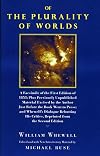
William Whewell was a mid-Victorian scientist-- arguably the Victorian scientist, as he's the one who coined the word in 1833, though it didn't catch on for several decades. Of the Plurality of Worlds is Whewell's attempt to determine if there is life on other planets. He says "no," but it seems to me a somewhat reserved "no," as he admits that it is possible by any number of arguments... it's just that none of these arguments prove anything. You can only trust analogy so far, after all, and show more that's largely all we have going for us in our "examination" of distant stars.
Whewell wrote works on the philosophy of science, and hints of his perspective from those texts bleed through here: he warns that astronomers must "be upon their guard against the tricks which fancy plays upon their senses" (168). I particularly enjoyed reading some of his utopian thoughts from the excised chapters: Whewell claims that "[i]f the nations of the earth were to employ, for the promotion of human knowledge, a small fraction only of the means, the wealth, the ingenuity, the energy, the combination, which they have employed in every age, for the destruction of human life and of human means of enjoyment; we might soon find that what we hitherto knew, is little compared with what man has the power of knowing" (344). Even better, though, would be to form a Divine Society based on sympathy towards others-- what a George Eliotian thought, so perfectly of its time. show less
Whewell wrote works on the philosophy of science, and hints of his perspective from those texts bleed through here: he warns that astronomers must "be upon their guard against the tricks which fancy plays upon their senses" (168). I particularly enjoyed reading some of his utopian thoughts from the excised chapters: Whewell claims that "[i]f the nations of the earth were to employ, for the promotion of human knowledge, a small fraction only of the means, the wealth, the ingenuity, the energy, the combination, which they have employed in every age, for the destruction of human life and of human means of enjoyment; we might soon find that what we hitherto knew, is little compared with what man has the power of knowing" (344). Even better, though, would be to form a Divine Society based on sympathy towards others-- what a George Eliotian thought, so perfectly of its time. show less
A Treatise on Dynamics: Containing a Considerable Collection of Mechanical Problems by William Whewell

Binding repaired 11/1999 for $135.00
You May Also Like
Associated Authors
Statistics
- Works
- 34
- Also by
- 2
- Members
- 160
- Popularity
- #131,701
- Rating
- 4.0
- Reviews
- 2
- ISBNs
- 56
- Languages
- 1


