
Alan Stern
Author of Chasing New Horizons: Inside the Epic First Mission to Pluto
About the Author
Image credit: Official NASA Photo by Bill Ingalls
Works by Alan Stern
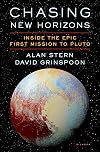
Chasing New Horizons: Inside the Epic First Mission to Pluto (2018) — Author — 289 copies, 7 reviews
Bil Baird's Whistling Wizard 3 copies
Phone interview 1 copy
Gravity Rules 1 copy
When Copernicus Smiled 1 copy
Associated Works
Tagged
Common Knowledge
- Canonical name
- Stern, Alan
- Legal name
- Stern, S. Alan
- Birthdate
- 1957-11-22
- Gender
- male
- Education
- University of Colorado, Boulder (PhD - Astrophysics and Planetary Science)
University of Texas at Austin (BS - Physics, BS - Astronomy, MS - Aerospace Engineeing, MS - Planetary Atmospheres)
St. Mark's School (Dallas) - Occupations
- planetary scientist
aerospace engineer - Organizations
- University of Colorado
Southwest Research Institute
NASA Outer Planets Science Working Group
Challenger Center for Space Science Education
National Aeronautics and Space Administration
Martin Marietta Aerospace (show all 8)
Odyssey Moon Limited
Blue Origin - Awards and honors
- Time Magazine's 100 Most Influential People in The World (2007)
- Nationality
- USA
- Birthplace
- New Orleans, Louisiana, USA
- Associated Place (for map)
- Louisiana, USA
Members
Reviews
I love reading science-by-scientists books, where we learn the questions modern scientists are asking and the day-by-days tasks and troubles they face to find the answers. This book follows the inspirational New Horizons mission to Pluto (and now, in 2019, to the Kuiper Belt object Ultima Thule), from the very beginning of planning any mission at all, to securing funding for this mission, to building and launching New Horizons, to its final Pluto flyby. It is a great story.
Compared to other show more books in this genre, I'm rating this one a bit lower, for two reasons. First, the authorial structure is a bit weird. The book seems to mostly have been written by David Grinspoon, who is a scientist but not directly involved with New Horizons, based on interviews with Alan Stern, the project's PI. It also includes long quotes from Stern. This one level of indirection is suboptimal, and the way they paper it over can be awkward. Secondly, I did find it interesting to learn how a project leader manages to get $700 million from NASA to lead a team of thousands—a long ordeal that includes lots of politics, and it is cool to get a behind-the-scenes perspective on the politics, strategies and bickering (especially between JPL and APL). However, that's not really what I came for. I wanted to learn more of the science, but I guess there's another level of indirection between the PI Stern, who manages everything, and the scientists who are getting their hands dirty studying Pluto. I missed a first-hand perspective on the science.
Still, the book takes off in the second half, where we learn some details of managing a space mission, the considerations that have to be made and the problems that arose. (There could still have been more details.)
I don't think the authors do a great job surfacing the interesting factoids that I wanted. For example, they compare getting New Horizons to Pluto as like hitting a hole-in-one from Los Angeles to Washington, DC—or some similar utterly nonsensical comparison. What does that even mean? It's *impossible* to hit a hole-in-one at that distance. New Horizons made course corrections the whole way, so maybe a better comparison would be to flying a plane from LA to Washington, DC? I have no idea. The authors could have tried to teach us something, for example, how precise did the initial aiming of the rockets have to be, before going beyond the limits of what could be corrected en route? But instead, they made the lazy and meaningless golf ball comparison. This is just one example, but with more work, and more direct involvement from Stern and, especially, other people on the project, readers could have learned so much more.
Quote, from after the Bush administration tried to cancel the Pluto program: "I was so mad I couldn’t see straight, and I smelled something fishy. If Europa went forward, JPL would be guaranteed to get the work, because that mission had simply been assigned to JPL—without competition—and it was also a far bigger monetary prize than winning Pluto would be. Alan speculated that JPL had worked behind the scenes to persuade the Bush administration more or less to trade the Pluto mission for a new start on Europa. He also believed that JPL had another interest in killing Pluto, because if APL actually won, APL’s hand would forever be strengthened as a powerful competitor in all future outer solar system exploration." show less
Compared to other show more books in this genre, I'm rating this one a bit lower, for two reasons. First, the authorial structure is a bit weird. The book seems to mostly have been written by David Grinspoon, who is a scientist but not directly involved with New Horizons, based on interviews with Alan Stern, the project's PI. It also includes long quotes from Stern. This one level of indirection is suboptimal, and the way they paper it over can be awkward. Secondly, I did find it interesting to learn how a project leader manages to get $700 million from NASA to lead a team of thousands—a long ordeal that includes lots of politics, and it is cool to get a behind-the-scenes perspective on the politics, strategies and bickering (especially between JPL and APL). However, that's not really what I came for. I wanted to learn more of the science, but I guess there's another level of indirection between the PI Stern, who manages everything, and the scientists who are getting their hands dirty studying Pluto. I missed a first-hand perspective on the science.
Still, the book takes off in the second half, where we learn some details of managing a space mission, the considerations that have to be made and the problems that arose. (There could still have been more details.)
I don't think the authors do a great job surfacing the interesting factoids that I wanted. For example, they compare getting New Horizons to Pluto as like hitting a hole-in-one from Los Angeles to Washington, DC—or some similar utterly nonsensical comparison. What does that even mean? It's *impossible* to hit a hole-in-one at that distance. New Horizons made course corrections the whole way, so maybe a better comparison would be to flying a plane from LA to Washington, DC? I have no idea. The authors could have tried to teach us something, for example, how precise did the initial aiming of the rockets have to be, before going beyond the limits of what could be corrected en route? But instead, they made the lazy and meaningless golf ball comparison. This is just one example, but with more work, and more direct involvement from Stern and, especially, other people on the project, readers could have learned so much more.
Quote, from after the Bush administration tried to cancel the Pluto program: "I was so mad I couldn’t see straight, and I smelled something fishy. If Europa went forward, JPL would be guaranteed to get the work, because that mission had simply been assigned to JPL—without competition—and it was also a far bigger monetary prize than winning Pluto would be. Alan speculated that JPL had worked behind the scenes to persuade the Bush administration more or less to trade the Pluto mission for a new start on Europa. He also believed that JPL had another interest in killing Pluto, because if APL actually won, APL’s hand would forever be strengthened as a powerful competitor in all future outer solar system exploration." show less

This book gives a behind-the-scenes look at the New Horizons interplanetary space probe: what it took to get it funded, the work necessary to get the public excited about Pluto and the mission, some of the decision-making processes along the way, and more.
I didn't write it down, but I believe the primary narrator for this was David Grinspoon - Alan Stern also narrated a bit, but only small sections. (Or I mixed up the names and it's actually the reverse.) Although the narration wasn't show more terrible, and definitely communicated how exciting and nerve-wracking this mission was, I found myself wishing that it had been narrated by someone else. It took me longer than it should have to get through this book, two checkout periods, and my slight dislike of the narration was part of the reason why. Grinspoon's voice didn't quite work for me.
Overall, this was a nice overview of the New Horizons mission for someone like myself (enough of an interest in space to have listened to at least one other nonfiction book on the topic, but otherwise not very knowledgeable). I could feel the tension whenever the team ran into problems, and one of my favorite parts was the nerve-wracking bit just before the close flyby at Pluto. I also liked the book's science communication aspects - in order for the project to happen in the first place, a lot of people had to be convinced that it was worth doing, and part of that relied on selling the public on Pluto and its importance. And, same as in Rob Manning and William L. Simon's Mars Rover Curiosity: An Inside Account from Curiosity's Chief Engineer, a large chunk of the book was devoted to efforts to get the mission funded. I wasn't as interested in this, but it was clearly a source of stress and concern for the team.
The narrative could get a bit melodramatic at times, and the authors were fond of Star Wars references. Also, yeesh, there were a lot of bickering scientists. JPL vs. APL and efforts to get approval and funding, and the whole "Pluto isn't a planet" thing brushed off as just one scientist disliking another one enough to want to undo his legacy. Still, this was a decent book, and I definitely learned a few things.
(Original review posted on A Library Girl's Familiar Diversions.) show less
I didn't write it down, but I believe the primary narrator for this was David Grinspoon - Alan Stern also narrated a bit, but only small sections. (Or I mixed up the names and it's actually the reverse.) Although the narration wasn't show more terrible, and definitely communicated how exciting and nerve-wracking this mission was, I found myself wishing that it had been narrated by someone else. It took me longer than it should have to get through this book, two checkout periods, and my slight dislike of the narration was part of the reason why. Grinspoon's voice didn't quite work for me.
Overall, this was a nice overview of the New Horizons mission for someone like myself (enough of an interest in space to have listened to at least one other nonfiction book on the topic, but otherwise not very knowledgeable). I could feel the tension whenever the team ran into problems, and one of my favorite parts was the nerve-wracking bit just before the close flyby at Pluto. I also liked the book's science communication aspects - in order for the project to happen in the first place, a lot of people had to be convinced that it was worth doing, and part of that relied on selling the public on Pluto and its importance. And, same as in Rob Manning and William L. Simon's Mars Rover Curiosity: An Inside Account from Curiosity's Chief Engineer, a large chunk of the book was devoted to efforts to get the mission funded. I wasn't as interested in this, but it was clearly a source of stress and concern for the team.
The narrative could get a bit melodramatic at times, and the authors were fond of Star Wars references. Also, yeesh, there were a lot of bickering scientists. JPL vs. APL and efforts to get approval and funding, and the whole "Pluto isn't a planet" thing brushed off as just one scientist disliking another one enough to want to undo his legacy. Still, this was a decent book, and I definitely learned a few things.
(Original review posted on A Library Girl's Familiar Diversions.) show less
It always impresses me how much goes on behind the scenes. While the media and the general public are only ever interested in launches and final photos, the process of getting a ship from Earth to Pluto requires an incredible amount of forethought, intelligence, and money.
Chasing New Horizons at times feels a little too shallow for its own sake. This isn't American Moonshot which spends 700 pages delving into political and scientific niceties. However, this book does give its reader a good show more idea of how much work went into the project and why New Horizons was so important. show less
Chasing New Horizons at times feels a little too shallow for its own sake. This isn't American Moonshot which spends 700 pages delving into political and scientific niceties. However, this book does give its reader a good show more idea of how much work went into the project and why New Horizons was so important. show less

A really fascinating look into the behind-the-scenes of a NASA planetary exploration project. This book goes through the science, the politics, and the personality behind getting a mission like this funded and executed. None of it is trivial. I very much appreciated how many women scientists were included in this project, and I was super thrilled to see the inclusion of at least one LGBT scientist as well. Highly recommended if you're into NASA, space exploration, or the solar system's show more cutest planet. show less
Lists
Awards


You May Also Like


Associated Authors
Statistics
- Works
- 12
- Also by
- 1
- Members
- 441
- Popularity
- #55,515
- Rating
- 4.1
- Reviews
- 10
- ISBNs
- 31