
Mary Roach
Author of Stiff: The Curious Lives of Human Cadavers
About the Author
Mary Roach was born and raised in Etna, New Hampshire. She has a BA degree in psychology from Wesleyan University. She spent a few years as a free-lance copy editor before she landed a job at the San Francisco Zoological Society turning out press releases. She then moved on to write humor pieces show more for such periodicals as The New York Times Magazine, The San Francisco Chronicle and Sports Illustrated. Her article "How to Win at Germ Warfare" was a National Magazine Award Finalist, in 1995. In 1996, her article on earthquake-proof bamboo houses took the Engineering Journalism Award. She published several books such as Stiff: The Curious Lives of Human Cadavers (2003) and Packing for Mars (2010). Mary's title Grunt: The Curious Science of Humans at War, made the New York Times Bestseller list in 2016. (Bowker Author Biography) show less
Works by Mary Roach
Two-Minute Revelation 2 copies
Bamboo Solution 1 copy
New World Pompeii 1 copy
1996 Sex: No Shortage Yet 1 copy
The Prince and the Pauper 1 copy
Secrets of the Shamans 1 copy
Hollywood Hills 1 copy
Meteorite Hunters 1 copy
Associated Works
There's No Toilet Paper on the Road Less Traveled: The Best of Travel Humor and Misadventure (1998) — Contributor — 217 copies, 5 reviews
Tagged
Common Knowledge
- Canonical name
- Roach, Mary
- Birthdate
- 1959-03-20
- Gender
- female
- Education
- Wesleyan University (BA ∙ psychology ∙ 1981)
Hanover High School - Occupations
- columnist
copywriter
non-fiction writer - Organizations
- Salon.com
Reader's Digest
San Francisco Zoological Society - Agent
- Erin Lovett (publicist)
Jay Mandel (agent) - Relationships
- Rachles, Ed (husband)
- Short biography
- Mary Roach grew up in a small house in Etna, New Hampshire. She graduated from Wesleyan in 1981, and then moved out to San Francisco s. She spent a few years working as a freelance copy editor before landing a half-time PR job at the SF Zoo. During that time she wrote freelance articles for the local newspaper's Sunday magazine.
Though she mostly focuses on writing books, she writes the occasional magazine piece. These have run in Outside, National Geographic, New Scientist, Wired, and The New York Times Magazine, as well as many others. A 1995 article of herse called "How to Win at Germ Warfare" was a National Magazine Award Finalist, and in 1996, her article on earthquake-proof bamboo houses took the Engineering Journalism Award in the general interest magazine category. Mary Roach also reviews books for The New York Times.
Her first book, Stiff, was an offshoot of a column she wrote for Salon.com. Her other books include Spook: Science Tackles the Afterlife, Bonk: The Curious Coupling of Science and Sex, and Packing for Mars: The Curious Science of Life in the Void.
http://www.bookbrowse.com/biographies... - Nationality
- USA
- Birthplace
- Hanover, New Hampshire, USA
- Places of residence
- Etna, New Hampshire, USA
San Francisco, California, USA
Alameda, California, USA
Oakland, California, USA - Associated Place (for map)
- California, USA
Members
Reviews
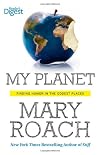
I love Mary Roach. So much. And finding humor in the oddest places is absolutely the schtick that made her famous.
This is not it. This is finding humor in the most trite, pedestrian places. Like, stop me if you've heard this one: there isn't much knee room on airplanes! Phone trees are incomprehensible! Tech support isn't based in the USA and also doesn't like to help you! Women don't like their bodies as they age! Men are slobs who like sports!
Also, speaking of aging with indignity, many show more of these jokes didn't age well. About three essays in, when we got to TV channels, I double checked the publication date: 2013. Huh. OK. And then an Anna Nicole Smith sent me to double check...2013. Eight years didn't feel that long ago, but I was ready to buy it until the mysterious object called the "Roomba" was discussed with great pomp AND Roach expressed indignity about websites not having phone numbers to call, google sent me to the Reader's Digest archives, where I found that most of these essays date back to the Dubya era...the first term. (If I hadn't figured it out by then, an essay featuring receiving netflix in the mail and an iPod shuffle would have given it away.)
What else didn't age well? Two different jokes making fun of Native American languages. And an internalized misogyny thinly disguised as self-deprecating humor. But the timeline raises more questions than it answers: in My Planet, Roach presents herself as appalled by the extremes of her aging face and body, incapable of adapting to new technology and tottering towards senescence. This feels impossible to reconcile with a woman who in 2008 agrees to have sex in an MRI (wikipedia tells me I'm remembering it wrong and it's an ultrasound...) and then 8 years after that bullies her way into an Army base in Djibouti to investigate diarrhea. The answer is that Roach was an ancient 43 when she wrote this book, an age that feels way younger than these essays read. I wonder which Roach is the real one.
And this is the rub: I'm a Mary Roach fan because she makes my work in the weird biochemistry of the body feel seen and relevant. When I read her other books, part of the joy is imagining her coming to interview me and giggling like old friends about some hilarious joke I tell with the punchline involving an organic acid and the tandem mass spectrometer. When I read this book? And I imagine this woman obsessed with her body shape and gender essentialism and very, very well-trod punchlines...if this woman ever wanted to interview me at work, I'd pawn it off on the fellows. (Maybe she's both things -- the adventurous, witty, dry humorous writer and the cliched wine mom type and it's my own internalized misogyny that won't let me reconcile them. Who knows?) show less
This is not it. This is finding humor in the most trite, pedestrian places. Like, stop me if you've heard this one: there isn't much knee room on airplanes! Phone trees are incomprehensible! Tech support isn't based in the USA and also doesn't like to help you! Women don't like their bodies as they age! Men are slobs who like sports!
Also, speaking of aging with indignity, many show more of these jokes didn't age well. About three essays in, when we got to TV channels, I double checked the publication date: 2013. Huh. OK. And then an Anna Nicole Smith sent me to double check...2013. Eight years didn't feel that long ago, but I was ready to buy it until the mysterious object called the "Roomba" was discussed with great pomp AND Roach expressed indignity about websites not having phone numbers to call, google sent me to the Reader's Digest archives, where I found that most of these essays date back to the Dubya era...the first term. (If I hadn't figured it out by then, an essay featuring receiving netflix in the mail and an iPod shuffle would have given it away.)
What else didn't age well? Two different jokes making fun of Native American languages. And an internalized misogyny thinly disguised as self-deprecating humor. But the timeline raises more questions than it answers: in My Planet, Roach presents herself as appalled by the extremes of her aging face and body, incapable of adapting to new technology and tottering towards senescence. This feels impossible to reconcile with a woman who in 2008 agrees to have sex in an MRI (wikipedia tells me I'm remembering it wrong and it's an ultrasound...) and then 8 years after that bullies her way into an Army base in Djibouti to investigate diarrhea. The answer is that Roach was an ancient 43 when she wrote this book, an age that feels way younger than these essays read. I wonder which Roach is the real one.
And this is the rub: I'm a Mary Roach fan because she makes my work in the weird biochemistry of the body feel seen and relevant. When I read her other books, part of the joy is imagining her coming to interview me and giggling like old friends about some hilarious joke I tell with the punchline involving an organic acid and the tandem mass spectrometer. When I read this book? And I imagine this woman obsessed with her body shape and gender essentialism and very, very well-trod punchlines...if this woman ever wanted to interview me at work, I'd pawn it off on the fellows. (Maybe she's both things -- the adventurous, witty, dry humorous writer and the cliched wine mom type and it's my own internalized misogyny that won't let me reconcile them. Who knows?) show less
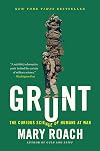
“People tend to think of military science as strategy and weapons — fighting, bombing, advancing.... I'm interested in the parts no one makes movies about — not the killing but the keeping alive.” — Mary Roach, “Grunt”
Hollywood is not likely to make a movie based on Mary Roach's “Grunt” (2016), but if it could make one as interesting and as amusing as her book, it could be a box-office smash.
As a young girl Roach must have read one of those books with titles like “Science show more Is Fun” and believed every word of it, for all her books, with titles like “Spook” and “Bonk,” take science seriously, but not all that seriously. This time her subject is military science, not better weapons but better ways of protecting American soldiers or, failing that, helping them recover from their wounds.
She writes about the science of camouflage, noting that the Navy uses a blue camouflage that looks like water. She quotes one anonymous officer as wryly observing, "That's so no can see you if you fall overboard."
She notes that soldiers can now wear underwear popularly termed Blast Boxers that, while hardly bombproof, can guard against contamination of wounds in that area from fungi and bacteria.
Elsewhere she comments that the fittest soldiers are often those most likely to suffer from heatstroke, simply because they are the ones most likely to push themselves hardest in hot climates.
She writes too about ear protection in the extreme noise of war, genital transplants and medical maggots. Even in peacetime, she notes, sailors aboard nuclear submarines are kept so busy that there is little time for sleep. Thus a submarine might leave port with a thousand pounds of coffee aboard to keep everyone awake. She also observes that the most dangerous part of a submarine voyage is coming to the surface, since it can be extremely difficult even with today's technology to know what might be directly above.
Like Roach, one does not need to have any interest in battles, weapons or military strategy to find all this fascinating — and despite the serious subject matter, often very, very funny. show less
Hollywood is not likely to make a movie based on Mary Roach's “Grunt” (2016), but if it could make one as interesting and as amusing as her book, it could be a box-office smash.
As a young girl Roach must have read one of those books with titles like “Science show more Is Fun” and believed every word of it, for all her books, with titles like “Spook” and “Bonk,” take science seriously, but not all that seriously. This time her subject is military science, not better weapons but better ways of protecting American soldiers or, failing that, helping them recover from their wounds.
She writes about the science of camouflage, noting that the Navy uses a blue camouflage that looks like water. She quotes one anonymous officer as wryly observing, "That's so no can see you if you fall overboard."
She notes that soldiers can now wear underwear popularly termed Blast Boxers that, while hardly bombproof, can guard against contamination of wounds in that area from fungi and bacteria.
Elsewhere she comments that the fittest soldiers are often those most likely to suffer from heatstroke, simply because they are the ones most likely to push themselves hardest in hot climates.
She writes too about ear protection in the extreme noise of war, genital transplants and medical maggots. Even in peacetime, she notes, sailors aboard nuclear submarines are kept so busy that there is little time for sleep. Thus a submarine might leave port with a thousand pounds of coffee aboard to keep everyone awake. She also observes that the most dangerous part of a submarine voyage is coming to the surface, since it can be extremely difficult even with today's technology to know what might be directly above.
Like Roach, one does not need to have any interest in battles, weapons or military strategy to find all this fascinating — and despite the serious subject matter, often very, very funny. show less

This book is probably one of the most unique books I will ever read. Writers spend most of their careers on writing about the living, both real and fictional - so reading about cadavers (the scientific term for corpses) was an eye-opening experience, in more ways than one.
Cadavers have been awkward to read and write about - understandably, people don't want to think about what happens to people after they're dead, because that inevitably leads to the sometimes distressing thought of one's show more own mortality.
But this book breaks all such inhibitions and throws them out of the window. If you're squeamish, don't expect this to be a clean and cheerful ride. Mary Roach makes you realise, by the end of the book, about how cadavers are used everywhere - ranging from good (crash testing) and neutral (bullet impact testing), to the controversial (testing if Jesus was really crucified, by crucifying cadavers). The descriptions are, to put it diplomatically, anatomically accurate.
'Tis not a completely nihilistic ride though. The author's tales of embarrassment and mortification are laugh-out-loud (a phrase which I would never imagine saying for a book about the deceased), and the author makes you think about topics which you would normally never think about - such as dissection, who should be given responsibility over the remains, and human head transplants.
TL;DR - a unique and immensely readable work, describing the heavy topic of the deceased with the depth and breadth it deserves - sometimes morbid, sometimes hilarious, but always entertaining. A must read if you have a strong stomach, and can think about your own mortality without dissolving into a mess. show less
Cadavers have been awkward to read and write about - understandably, people don't want to think about what happens to people after they're dead, because that inevitably leads to the sometimes distressing thought of one's show more own mortality.
But this book breaks all such inhibitions and throws them out of the window. If you're squeamish, don't expect this to be a clean and cheerful ride. Mary Roach makes you realise, by the end of the book, about how cadavers are used everywhere - ranging from good (crash testing) and neutral (bullet impact testing), to the controversial (testing if Jesus was really crucified, by crucifying cadavers). The descriptions are, to put it diplomatically, anatomically accurate.
'Tis not a completely nihilistic ride though. The author's tales of embarrassment and mortification are laugh-out-loud (a phrase which I would never imagine saying for a book about the deceased), and the author makes you think about topics which you would normally never think about - such as dissection, who should be given responsibility over the remains, and human head transplants.
TL;DR - a unique and immensely readable work, describing the heavy topic of the deceased with the depth and breadth it deserves - sometimes morbid, sometimes hilarious, but always entertaining. A must read if you have a strong stomach, and can think about your own mortality without dissolving into a mess. show less

Mary Roach takes a look at the various factors that go into maintaining human life in space, and in the process delves into areas that most books on the subject -- usually for perfectly understandable reasons -- tend to gloss over. Do astronauts get on each other's nerves when they've been cooped up together for too long? How bad does a guy who's been sitting in a space suit for two weeks smell? What happens when you vomit in your helmet?
It's not all space madness and bodily fluids; Roach show more looks at the effect of high g-forces and prolonged weightlessness on the human body, for instance, and rides along on a simulated Mars expedition. On the other hand, I now know far, far more about the workings of a zero-gravity toilet than I ever wanted to. Even if I thought I did, it turns out that, no, I really kind of didn't. Even if the subject is strangely fascinating, in a disgusting sort of way.
This approach admittedly takes much of the glamor out of space travel, but compensates for it with a level of human detail that makes the whole enterprise, and the people involved in it, feel somehow more real, and perhaps ultimately even more wonderful. And Roach's writing, as always, is clear, lively, funny, and marvelously readable.
I'm probably biased, since space travel is a subject near to my heart, but I think this is her best book since Stiff. show less
It's not all space madness and bodily fluids; Roach show more looks at the effect of high g-forces and prolonged weightlessness on the human body, for instance, and rides along on a simulated Mars expedition. On the other hand, I now know far, far more about the workings of a zero-gravity toilet than I ever wanted to. Even if I thought I did, it turns out that, no, I really kind of didn't. Even if the subject is strangely fascinating, in a disgusting sort of way.
This approach admittedly takes much of the glamor out of space travel, but compensates for it with a level of human detail that makes the whole enterprise, and the people involved in it, feel somehow more real, and perhaps ultimately even more wonderful. And Roach's writing, as always, is clear, lively, funny, and marvelously readable.
I'm probably biased, since space travel is a subject near to my heart, but I think this is her best book since Stiff. show less
 This review was written for LibraryThing Early Reviewers.
Lists
Awards


You May Also Like


Associated Authors
Statistics
- Works
- 24
- Also by
- 5
- Members
- 33,627
- Popularity
- #574
- Rating
- 3.9
- Reviews
- 1,539
- ISBNs
- 204
- Languages
- 14
- Favorited
- 122


