
Jose Antonio Vargas
Author of Dear America: Notes of an Undocumented Citizen
About the Author
Image credit: Author Jose Antonio Vargas at the 2018 Texas Book Festival in Austin, Texas, United States. By Larry D. Moore - Own work, CC BY-SA 4.0, https://commons.wikimedia.org/w/index.php?curid=73960431
Works by Jose Antonio Vargas
Associated Works
Tagged
Common Knowledge
- Birthdate
- 1981-02-03
- Gender
- male
- Education
- San Francisco State University (BA | Political Science and Black Studies)
- Organizations
- Define America
- Agent
- Jennifer Rudolph Walsh (WME)
Jay Mandel (WME) - Nationality
- Philippines
- Birthplace
- Antipolo, Philippines
- Associated Place (for map)
- Antipolo, Philippines
Members
Reviews

Jose Antonio Vargas come to America as a small child accompanied by an "uncle" - sent by his mother on a flight to the US to live with his grandparents. In Filipino culture all your adult male relations are referred to as "uncle" so Antonio wasn't particularly troubled that he hadn't previously met this man. Safely delivered to his grandparents in California, Jose began his American life, assured that his mother would soon be joining him.
But his mother was not able to get a visa and never show more did come to America. It wasn't until Jose was a teenager who went on his own to apply for a drivers license that he learned his green card was invalid. His grandfather confessed that the "uncle" who brought him to America was in fact a paid smuggler and that Jose was undocumented.
Jose's grandfather and mother meant well. They thought that if all else failed, Jose would meet, fall in love with and marry an American girl, and the marriage would confer citizenship on him. This plan was foiled when Jose came out as gay.
In Dear America Jose tells the story of how he dealt with his undocumented status, and was able to go to college and become a respected journalist. While he was out as gay, he hid his undocumented status in the closet. When he finally revealed that he was undocumented he did so as a journalist, writing about it for a major US publication. He went on to found the organization Define American, which seeks to reshape American opinion on immigration. You may agree or disagree with some of the decisions he has made, but given his situation there is no easy legal way to "fix" his undocumented status. I found his story well told and some of the struggles he went through and how they affected him heartbreaking.
I give Dear America Four Stars ⭐⭐⭐⭐. I have heard of Vargas and read some of his work, but I did not know anything about his undocumented citizenship until I picked up this book. Recommended. show less
But his mother was not able to get a visa and never show more did come to America. It wasn't until Jose was a teenager who went on his own to apply for a drivers license that he learned his green card was invalid. His grandfather confessed that the "uncle" who brought him to America was in fact a paid smuggler and that Jose was undocumented.
Jose's grandfather and mother meant well. They thought that if all else failed, Jose would meet, fall in love with and marry an American girl, and the marriage would confer citizenship on him. This plan was foiled when Jose came out as gay.
In Dear America Jose tells the story of how he dealt with his undocumented status, and was able to go to college and become a respected journalist. While he was out as gay, he hid his undocumented status in the closet. When he finally revealed that he was undocumented he did so as a journalist, writing about it for a major US publication. He went on to found the organization Define American, which seeks to reshape American opinion on immigration. You may agree or disagree with some of the decisions he has made, but given his situation there is no easy legal way to "fix" his undocumented status. I found his story well told and some of the struggles he went through and how they affected him heartbreaking.
I give Dear America Four Stars ⭐⭐⭐⭐. I have heard of Vargas and read some of his work, but I did not know anything about his undocumented citizenship until I picked up this book. Recommended. show less
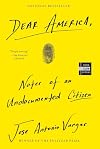
Jose Antonio Vargas came to America from the Philippines when he was 12 years old, hastily packed off onto a plane with an "uncle" by his single mom, to live with his maternal grandparents in Mountain View, California. It wasn't until he was 16, and tried to get a driver's license, that he discovered that the paperwork used to get him into the U.S. was all fake and that "uncle" was a "Coyote" paid dearly to smuggle him into the country. Vargas spills it all in his memoir-cum-political show more commentary, DEAR AMERICA: NOTES OF AN UNDOCUMENTED CITIZEN (2019/2025). We learn a bit about his childhood in the Philippines with a hardworking mom - his father was long gone. But there is much more about his coming of age years on the poor side of the affluent Silicon Valley town of Mountain View. Vargas excelled in high school, and "came out" twice. First as gay, and later, with much trepidation, as undocumented. But with the help and generosity of some influential white friends, he was able to go to college and become a journalist, initially with local papers and later at the Washington Post, always fearful that he would be found out as an "illegal." Eventually he comes out publicly, and nothing happens. And when he is arrested, in Texas, some important friends get him released. Vargas has become an important voice in exposing how broken our immigration system is, and has his own organization called DefineAmerican.
I found the personal side of his story - about his family - much more interesting than the political. How his grandfather kicked him out when he came out as gay in high school, but not permanently. How he became more "homeless" after that second coming out, always moving, on the road. His realization about America's stark Black vs White mentality is also very affecting. The two separate worlds he grew up in - the working class Filipinos and the wealthy whites, the "Taglish" hybrid of Tagalog and English spoken at home and in his neighborhood.
Vargas appears to still be in a kind of stateless limbo as of this new edition of his memoir, although he has attained some official documentation now.
This is a very interesting read for anyone who wants to learn more about what a heartbreaking and frustrating clusterf**k our immigration system has been and still is. Vargas has lived it. Very highly recommended.
- Tim Bazzett, author of the memoir, BOOKLOVER show less
I found the personal side of his story - about his family - much more interesting than the political. How his grandfather kicked him out when he came out as gay in high school, but not permanently. How he became more "homeless" after that second coming out, always moving, on the road. His realization about America's stark Black vs White mentality is also very affecting. The two separate worlds he grew up in - the working class Filipinos and the wealthy whites, the "Taglish" hybrid of Tagalog and English spoken at home and in his neighborhood.
Vargas appears to still be in a kind of stateless limbo as of this new edition of his memoir, although he has attained some official documentation now.
This is a very interesting read for anyone who wants to learn more about what a heartbreaking and frustrating clusterf**k our immigration system has been and still is. Vargas has lived it. Very highly recommended.
- Tim Bazzett, author of the memoir, BOOKLOVER show less

this is a really important read. he says that this isn't about immigration policy and technically it isn't, but i don't know how you can read this and not want a change in that unspoken policy. how is there no legal way to remedy being undocumented? all the people yelling about "get in line" and "make yourself legal" have no idea how to do that (spoiler - there isn't a way). he is doing so much by putting a face to this situation. one thing i was thinking about as i was reading this, and show more then he wrote of it too, is how being undocumented mostly isn't possible without having help from "legal" citizens. and if there are 11 million undocumented people, if even 1 person if helping them (and often it's going to be more than that), then that is already a good number of people on the side of reform and assistance. we should be able to make strides, the numbers are there. this whole book is eye opening for what sort of things documentation allows you to do (drive, work, travel) and how our government is happy to take the taxes and money of undocumented people, but give them nothing in return.
"I swallowed American culture before I learned how to chew it."
"I was no longer the blameless kid who wasn't aware of the circumstances of how I arrived in America. I was now a nineteen-year-old making a difficult and necessary choice to survive, which meant breaking the law.
What would you have done? Work under the table? Stay under the radar? Not work at all?
Which box would you check?
What have you done to earn your box?
Besides being born at a certain place in a certain time, did you have to do anything?
Anything at all?
If you wanted to have a career, if you wanted to have a life, if you wanted to exist as a human being, what would you have done?"
"Understanding the experience of black people in America - why black was created so people could be white - pried open how Latinos, Asians, Native Americans, and other marginalized groups have been historically oppressed through laws and systems that had little or nothing to do with what was right. White as the default, white as the center, white as the norm, is the central part of the master narrative. The centrality of whiteness - how it constructed white versus black, legal versus illegal - hurts not only people of color who aren't white but also white people who can't carry the burden of what they've constructed."
"If just five people - a friend, a co-worker, a classmate, a neighbor, a faith leader - helped one of the estimated 11 million undocumented people in our country, then illegal immigration as we know it would touch at least 66 million people."
"The lies had gotten so big that they swallowed everything up, including all the good things. ... I couldn't be present for my own life."
"According to the nonpartisan Institute on Taxation and Economic Policy, undocumented immigrants nationwide pay an estimated 8 percent of their incomes in state and local taxes on average. To put that in perspective, the top 1 percent of taxpayers pay an average nationwide effective tax rate of just 5.4 percent."
"Our country's mainstream news organizations often fail to report basic facts about how much undocumented workers pay into a government that vilifies us. Whether because of ignorance or indifference, or both, failure to report these facts and provide context has perpetuated the myth of the 'illegal' who is taxing social services and taking away from 'real Americans.'"
"How do we demolish white supremacy without pushing more white people to white nationalism?" show less
"I swallowed American culture before I learned how to chew it."
"I was no longer the blameless kid who wasn't aware of the circumstances of how I arrived in America. I was now a nineteen-year-old making a difficult and necessary choice to survive, which meant breaking the law.
What would you have done? Work under the table? Stay under the radar? Not work at all?
Which box would you check?
What have you done to earn your box?
Besides being born at a certain place in a certain time, did you have to do anything?
Anything at all?
If you wanted to have a career, if you wanted to have a life, if you wanted to exist as a human being, what would you have done?"
"Understanding the experience of black people in America - why black was created so people could be white - pried open how Latinos, Asians, Native Americans, and other marginalized groups have been historically oppressed through laws and systems that had little or nothing to do with what was right. White as the default, white as the center, white as the norm, is the central part of the master narrative. The centrality of whiteness - how it constructed white versus black, legal versus illegal - hurts not only people of color who aren't white but also white people who can't carry the burden of what they've constructed."
"If just five people - a friend, a co-worker, a classmate, a neighbor, a faith leader - helped one of the estimated 11 million undocumented people in our country, then illegal immigration as we know it would touch at least 66 million people."
"The lies had gotten so big that they swallowed everything up, including all the good things. ... I couldn't be present for my own life."
"According to the nonpartisan Institute on Taxation and Economic Policy, undocumented immigrants nationwide pay an estimated 8 percent of their incomes in state and local taxes on average. To put that in perspective, the top 1 percent of taxpayers pay an average nationwide effective tax rate of just 5.4 percent."
"Our country's mainstream news organizations often fail to report basic facts about how much undocumented workers pay into a government that vilifies us. Whether because of ignorance or indifference, or both, failure to report these facts and provide context has perpetuated the myth of the 'illegal' who is taxing social services and taking away from 'real Americans.'"
"How do we demolish white supremacy without pushing more white people to white nationalism?" show less
Vargas, a Pulitzer Prize-winning journalist, writes in this poignant book about this experiences since immigrating as a child from the Philippines, discovering at the age of sixteen, to his surprise and horror, that he was in fact undocumented. Despite the fortune of connections to friends and colleagues who were able to help open doors to education and employment that would otherwise have been inaccessible, Vargas lived in fear every day since that revelation -- until he decided, through show more his writing, to go public with his story.
Vargas' experiences illustrate painfully just how incredibly broken and inequitable the immigration system is in the United States, leaving the reader musing over questions like "What does it actually mean to be an American?" and "What is citizenship?" I facilitated the discussion for this book at my library's adult book club, and right off the bat we all marveled that none of us had ever heard of the author previously. It felt to me as though some of the childhood anecdotes included were perhaps invented or at least exaggerated for comedic value, but that did little to take away from how heartbreaking (and infuriating) the truth about immigration policy is. show less
Vargas' experiences illustrate painfully just how incredibly broken and inequitable the immigration system is in the United States, leaving the reader musing over questions like "What does it actually mean to be an American?" and "What is citizenship?" I facilitated the discussion for this book at my library's adult book club, and right off the bat we all marveled that none of us had ever heard of the author previously. It felt to me as though some of the childhood anecdotes included were perhaps invented or at least exaggerated for comedic value, but that did little to take away from how heartbreaking (and infuriating) the truth about immigration policy is. show less
Lists
Awards


You May Also Like


Associated Authors
Statistics
- Works
- 4
- Also by
- 3
- Members
- 665
- Popularity
- #37,922
- Rating
- 4.1
- Reviews
- 16
- ISBNs
- 24
- Languages
- 1