
Trish Marx
Author of Hanna's Cold Winter
Works by Trish Marx
Sharing Our Homeland: Palestinian and Jewish Children at Summer Peace Camp (2010) 57 copies, 6 reviews
Tagged
Common Knowledge
- Birthdate
- 20th century
- Gender
- female
- Education
- College of St. Catherine
University of Minnesota - Occupations
- teacher
- Nationality
- USA
- Places of residence
- Worthington, Minnesota, USA
New York, New York, USA - Associated Place (for map)
- USA
Members
Reviews

Narrated by young Tibor, this poignant picture-book explores the life of one Hungarian family before and during World War II, and their relationship to the hippopotamuses in the Budapest zoo. Although the family enjoy Sunday outings every week, Tibor and his siblings, Gabor and Eva, particularly love to go to the zoo and see the hippos. Kept warm by the hot springs in the city, the hippos are a popular attraction, and none more so than Hanna, a friendly (and very hungry) female hippo. But show more then the war comes, with soldiers everywhere, and the family stop visiting the zoo. A terrible winter leaves the rivers frozen, and the hippos huddling in their indoor enclosure, in danger of slowly starving to death. Fortunately, Tibor's Papa has an idea, and soon the citizens of Budapest are donating their straw slippers, doormats and hats to keep the hippos alive...
Apparently based upon true events, related to author Trish Marx when she was visiting the Budapest zoo, Hanna's Cold Winter presents an engaging family story, and a deeply moving historical drama. Tibor's family are ordinary people—his father works at a paprika factory—who find themselves caught up in terrible times. Despite this, they think of the welfare of the animals that they love, and act to save them when they are threatened. I really enjoyed the story, from the loving closeness of the human family, to the happy outcome for the hippos. I also greatly appreciated the artwork (it looks to be done in watercolor) from illustrator Barbara Knutson, who visited the Budapest zoo in order to create the visuals here. I did find myself wondering about the nutritional value of old straw—can straw-eating animals subsist on straw hats and mats, in emergencies?—and discovered, in the course of online searching, that the fate of the Budapest zoo animals during WWII was rather grim. Apparently the zoo was bombarded during the siege of Budapest, destroying most of the buildings and killing the majority of the animals. In the aftermath of the siege, the starving citizens ate most of the survivors, with only 15 animals of an initial 2,000 surviving the period. I looked on the zoo's history page for any mention of the story of Hanna and the hippos, but was unable to find it.
Trish Marx's brief afterword here mentions that more than 9,000 straw items were collected from the citizens of Budapest, in order to feed the hippos, and that Hanna and the hippos survived the war, so perhaps they were among those lucky fifteen. I realize it is outside the scope of the fictional story here, which is meant to be more uplifting—hope in dark times, and so on—but I wish that the author has elaborated on the larger story in her afterword. I also wish that she had provided a written source, rather that just stating that the story was told to her. All that being said, I still enjoyed this one, and recommend it to picture-book readers looking for stories set during World War II, or featuring the sadness of people and animals caught up in conflicts. show less
Apparently based upon true events, related to author Trish Marx when she was visiting the Budapest zoo, Hanna's Cold Winter presents an engaging family story, and a deeply moving historical drama. Tibor's family are ordinary people—his father works at a paprika factory—who find themselves caught up in terrible times. Despite this, they think of the welfare of the animals that they love, and act to save them when they are threatened. I really enjoyed the story, from the loving closeness of the human family, to the happy outcome for the hippos. I also greatly appreciated the artwork (it looks to be done in watercolor) from illustrator Barbara Knutson, who visited the Budapest zoo in order to create the visuals here. I did find myself wondering about the nutritional value of old straw—can straw-eating animals subsist on straw hats and mats, in emergencies?—and discovered, in the course of online searching, that the fate of the Budapest zoo animals during WWII was rather grim. Apparently the zoo was bombarded during the siege of Budapest, destroying most of the buildings and killing the majority of the animals. In the aftermath of the siege, the starving citizens ate most of the survivors, with only 15 animals of an initial 2,000 surviving the period. I looked on the zoo's history page for any mention of the story of Hanna and the hippos, but was unable to find it.
Trish Marx's brief afterword here mentions that more than 9,000 straw items were collected from the citizens of Budapest, in order to feed the hippos, and that Hanna and the hippos survived the war, so perhaps they were among those lucky fifteen. I realize it is outside the scope of the fictional story here, which is meant to be more uplifting—hope in dark times, and so on—but I wish that the author has elaborated on the larger story in her afterword. I also wish that she had provided a written source, rather that just stating that the story was told to her. All that being said, I still enjoyed this one, and recommend it to picture-book readers looking for stories set during World War II, or featuring the sadness of people and animals caught up in conflicts. show less

An engaging picture-book exploration of a difficult topic, even for adults - namely, the Israeli/Palestinian conflict - Sharing Our Homeland: Palestinian and Jewish Children at Summer Peace Camp looks at the wider issue through a narrow focus, telling the true story of two children who attend the Menashe Summer Peace Camp, run by Givat Haviva, an educational organization that works on social justice issues, particularly promoting peaceful coexistence between Jews and Arabs. Starting with an show more introduction to the two children - Alya, a Palestinian Israeli girl living in the Arab village of Meiser, in north-central Israel, and Yuval, a young Jewish Israeli boy living in Maor, a moshav (a cooperative farming community where property is individually owned) near Meiser - then moving through a brief overview of the history of the area, and the (most) recent conflict over it, the book devotes most of its space to the various activities at the camp: the fun and games, educational field trips to a kibbutz and to an Arab village, and the exciting sleepover which marks the end of camp.
As author Trish Marx, who has traveled to Israel five times, once with photographer Cindy Karp to document the story of the Peace Camp, notes in her afterword, this story offers a "message of peace and hope not often heard from this region." For that alone, it is most welcome! Informative, without being overwhelming, it presents its topic evenhandedly, focusing, when the subject of violence arises, mostly on its effects on the children being depicted. It's amazing to think that these children - all citizens of Israel - live so near to one another, and yet, save for the Peace Camp, have almost no interaction with one another, or with anyone from the 'other' community. Such rigid segregation, while not alone responsible for prejudice and a lack of understanding between communities, can surely not be a help in changing them either! One wishes that more children had an opportunity to attend such camps... after all, these children may be Palestinian and Jewish, but they are all Israeli citizens, living within Israel proper. But what about children living in the occupied territories of West Bank and Gaza? Of course no organization can do it all, so thank goodness for what the Peace Camp can do!
Highly recommended to anyone, be they parent, teacher or librarian, looking for quality children's non-fiction about this thorny topic, one which presents its information in a non-sensational, non-biased manner, and which also offers some hope for the possibility of progress. show less
As author Trish Marx, who has traveled to Israel five times, once with photographer Cindy Karp to document the story of the Peace Camp, notes in her afterword, this story offers a "message of peace and hope not often heard from this region." For that alone, it is most welcome! Informative, without being overwhelming, it presents its topic evenhandedly, focusing, when the subject of violence arises, mostly on its effects on the children being depicted. It's amazing to think that these children - all citizens of Israel - live so near to one another, and yet, save for the Peace Camp, have almost no interaction with one another, or with anyone from the 'other' community. Such rigid segregation, while not alone responsible for prejudice and a lack of understanding between communities, can surely not be a help in changing them either! One wishes that more children had an opportunity to attend such camps... after all, these children may be Palestinian and Jewish, but they are all Israeli citizens, living within Israel proper. But what about children living in the occupied territories of West Bank and Gaza? Of course no organization can do it all, so thank goodness for what the Peace Camp can do!
Highly recommended to anyone, be they parent, teacher or librarian, looking for quality children's non-fiction about this thorny topic, one which presents its information in a non-sensational, non-biased manner, and which also offers some hope for the possibility of progress. show less
Kindergarten Day USA and China: A Flip-Me-Over Book (Global Fund for Children Books (Paperback)) by Trish Marx
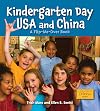
I really enjoyed reading this book from the very beginning. The book was double sided. On one side, you read about the school day in the USA. On the other, you read about the school day in China. You see the similarities and differences between the classrooms. There are not actual characters in the story, but you can see photos of children doing their routines. I liked the aspect of not having real characters in this book, because you get a sense of realism while reading. You see the show more children participating in activities throughout the day, such as arriving to school, doing math, and ending the school day. There is also a clock that represents the times in both countries. At 9AM in the US, it is 9PM in China. Also, I liked that in the Chinese side of the book, they used some Chinese language, which included the characters and the spelled out words. After stating the word, they then translated the word in English in the paragraph, and again, on the bottom of the page. The main idea of this children’s book is showing differences and similarities. Even though we may be in two different countries, we still have some of the same routines. show less
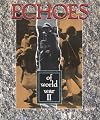
This is a short volume aimed at kids and young adults but of interest, I think, to everyone. Writer Trish Marx interviewed six people who were children during World War II and created brief oral histories for each of them, with Marx's own copy providing historical context used liberally throughout as well.
The subjects here include people who, as children 1) survived Auschwitz, 2) lived though the Nazi occupation of France and took part (as a teenager) in the French resistance 3) lived in show more London during the beginnings of the Blitz and was then sent to live with strangers in the English countryside 4) spent years in the Philippines interned with her mother as a prisoner of the Japanese and 5) was a child in Japan during the war and endured bombings and years of severe hunger.
As I said, each of the chapters is short, but the stories are told with the sort of details, and compassion, that help bring each person's experiences vividly to life. Most of these chapters would work very well as teaching aides. show less
The subjects here include people who, as children 1) survived Auschwitz, 2) lived though the Nazi occupation of France and took part (as a teenager) in the French resistance 3) lived in show more London during the beginnings of the Blitz and was then sent to live with strangers in the English countryside 4) spent years in the Philippines interned with her mother as a prisoner of the Japanese and 5) was a child in Japan during the war and endured bombings and years of severe hunger.
As I said, each of the chapters is short, but the stories are told with the sort of details, and compassion, that help bring each person's experiences vividly to life. Most of these chapters would work very well as teaching aides. show less
Lists
Awards


You May Also Like


Associated Authors
Statistics
- Works
- 14
- Members
- 565
- Popularity
- #44,254
- Rating
- 3.8
- Reviews
- 30
- ISBNs
- 31
- Languages
- 1