
Colin Baker (2) (1943–)
Author of Doctor Who: Vengeance on Varos [videorecording]
For other authors named Colin Baker, see the disambiguation page.
About the Author
Image credit: Colin Baker with "carrot juice" at New York Comic Con '08.
Works by Colin Baker
The Worlds of Blake's 7: Bayban the Butcher [Sound Recording] (2022) — Narrator — 5 copies, 1 review
Stranger: the Terror Game 2 copies
Associated Works
Doctor Who: Vengeance on Varos [novelization] (1988) — Narrator, some editions — 195 copies, 1 review
Second Flight: Back to the Vortex II: The Unofficial and Unauthorised Guide to Doctor Who 2006 (2006) — Foreword — 35 copies
Doctor Who - The Collection - Season 22 - Limited Edition Packaging [Blu-ray] [2022] — Actor — 14 copies
Christmas at the Holly Day Inn [2023 film] — Actor — 1 copy
Tagged
Common Knowledge
- Birthdate
- 1943-06-08
- Gender
- male
- Occupations
- actor
time traveller - Nationality
- UK
- Birthplace
- London, England, UK
- Associated Place (for map)
- England, UK
Members
Reviews

Access a version of the below that includes illustrations on my blog.
It works pretty well here. When we last saw the Doctor, Peri, and Frobisher, they were travelling together having fought the Cybermen on Planet 14; evidently in the interim, The Trial of a Time Lord happened (without Frobisher, maybe he went fishing), and now Frobisher and the Doctor periodically check in on Peri on Krontep, the planet where she settled down with King Yrcanos after Trial. Assume the Doctor regenerates show more off-panel (as he always does in DWM-land), and this leads right into A Cold Day in Hell!
So how's the story-- written by none other than Colin Baker (the first Doctor to write licensed fiction; Tom Baker became the second twenty-five years later with Scratchman)? Well, it's fun. None too deep, but fun. Krontep is in a time of crisis when a solo Doctor visits; Peri's granddaughter Actis asks the Doctor to get Frobisher and help. The Doctor, Frobisher, and Carf (a Krontep warrior) go on a quest to figure out what ails the land, then they go on another to find Actis when she goes missing. There's a bit too much gubbins at times-- what is up with the alien the Doctor meets?-- but if your idea of a good time is a quest story where the participants are the Doctor, a talking penguin, and a giant bearded warrior who shouts "VROOMNIK" a lot, then you will have one. Mine is, and I particularly enjoyed their forays into the underground cult. The Doctor's ultimate foe being a hallucination that he is on This Is Your Life is delightfully bonkers.
The first quarter is drawn by John M. Burns; the remaining parts by Barrie Mitchell. Both are good artists, working well with the story's epic nature. I did have the impression, though, that Barrie Mitchell wasn't drawing Colin Baker so much as the steel-jawed hero of a men's 1950s adventure comic wearing a Colin Baker wig. And of course the sixth Doctor was made for color!
It's not all good. Somehow though the Doctor and Frobisher have visited Krontep and Peri's family a lot over the years, Actis knows them but her older brothers don't! The resolution of the political subplot is rushed and sudden, too. But on the whole, I enjoyed this, a weird slice of Doctor Who history that plugs a hole in the tv show but does something uniquely DWM at the same time.
Stray Observations:
It works pretty well here. When we last saw the Doctor, Peri, and Frobisher, they were travelling together having fought the Cybermen on Planet 14; evidently in the interim, The Trial of a Time Lord happened (without Frobisher, maybe he went fishing), and now Frobisher and the Doctor periodically check in on Peri on Krontep, the planet where she settled down with King Yrcanos after Trial. Assume the Doctor regenerates show more off-panel (as he always does in DWM-land), and this leads right into A Cold Day in Hell!
So how's the story-- written by none other than Colin Baker (the first Doctor to write licensed fiction; Tom Baker became the second twenty-five years later with Scratchman)? Well, it's fun. None too deep, but fun. Krontep is in a time of crisis when a solo Doctor visits; Peri's granddaughter Actis asks the Doctor to get Frobisher and help. The Doctor, Frobisher, and Carf (a Krontep warrior) go on a quest to figure out what ails the land, then they go on another to find Actis when she goes missing. There's a bit too much gubbins at times-- what is up with the alien the Doctor meets?-- but if your idea of a good time is a quest story where the participants are the Doctor, a talking penguin, and a giant bearded warrior who shouts "VROOMNIK" a lot, then you will have one. Mine is, and I particularly enjoyed their forays into the underground cult. The Doctor's ultimate foe being a hallucination that he is on This Is Your Life is delightfully bonkers.
The first quarter is drawn by John M. Burns; the remaining parts by Barrie Mitchell. Both are good artists, working well with the story's epic nature. I did have the impression, though, that Barrie Mitchell wasn't drawing Colin Baker so much as the steel-jawed hero of a men's 1950s adventure comic wearing a Colin Baker wig. And of course the sixth Doctor was made for color!
It's not all good. Somehow though the Doctor and Frobisher have visited Krontep and Peri's family a lot over the years, Actis knows them but her older brothers don't! The resolution of the political subplot is rushed and sudden, too. But on the whole, I enjoyed this, a weird slice of Doctor Who history that plugs a hole in the tv show but does something uniquely DWM at the same time.
Stray Observations:
- I like the idea that the Doctor periodically drops in on Peri and her family and gives them odd presents. I didn't like that part 14 of Trial undid Peri's death, but if she was to live, I don't like the idea that the Doctor never looked in on her, and I find this take on her future preferable to that offered by Nev Fountain over in the audio dramas.
- Speaking of which, this would be a good one for Big Finish's stillborn range of audio adaptations of DWM comics. Colin Baker and Robert Jezek would crush this!
- It's rather nice and unexpected that upon getting to write a Doctor Who story, Colin Baker picks as his Doctor's companion a character he never actually appeared opposite on screen! I guess he likes Steven Parkhouse and John Ridgway as much as the rest of us. It is a bit odd that a black-and-white companion was chosen for DWM's first (I think) full-length color endeavor, however!
- I didn't need to read the Tardis wiki to know that this was originally written and drawn as a four-issue miniseries; it was obvious when on the 22nd page, there was suddenly a splash panel on a dramatic moment, and then the 23rd page was the same moment again, and this repeated two more times.
- On the other hand, the Tardis wiki claims this volume "nearly doubled the number of comic panels that had been devoted to [Baker's] incarnation of the Doctor." There are 88 story pages here; the two DWM graphic novels of sixth Doctor strips total about 350 pages. For Age of Chaos to nearly double the number of panels those 350 pages contained, this would have to have over three times as many panels per page! It doesn't seem likely.

Access a version of the below that includes illustrations on my blog.
The Age of Chaos
Already reviewed on its own here.
Under Pressure
The seventh Doctor tells Ace a story of the time the fourth Doctor (on a submarine) secretly helped the third and Jo (on a surface vessel) avert a crisis with the Sea Devils. It's pretty charming: Abnett captures the voices of both past Doctors pretty well, and the ways the fourth Doctor helps the third are fun. There are some good moments, such as the fourth show more ingratiating himself with the submarine's captain. My main issue is the Sea Devils never feel like much of a threat, as we barely see them. I did really like the panel of them all swimming around the sub, the kind of thing you could never afford to do onscreen, but it comes after they've been neutralized. But it's enjoyable enough.
Metamorphosis
The seventh Doctor and Ace battle (spoiler) Daleks on a space freighter. As Cornell says in his notes, this is pretty generic action-adventure stuff, but it's good anyway, lifted by some cool ideas (there's a reason Steven Moffat stole the "eggs" bit, and the Doctor becoming a Dalek is good, too), some horrific ones (human embryos mutated into Daleks!), and some excellent artwork from Lee Sullivan. Sullivan draws great Daleks, but also a strong Doctor and Ace, capturing their facial expressions well, and clear action sequences. Generic... but solid. The last line is a groaner, in the most delightful way.
The Last Word
And here, the comic strip adventures of the seventh Doctor, Ace, and Benny come to an end. For reasons I didn't understand, this is framed as the Doctor writing up an account (in the third person) of a recent adventure the TARDIS crew had. The adventure itself is somewhere between a parody and a pastiche of the Virgin New Adventures: Gareth Roberts lists all the tropes in the notes at the end, but I picked out most of them myself. Journeys into 1970s pop culture, overcomplicated plots, a voyage into "puterspace," and the Doctor being mentally tormented by all the people and planets he's let die. I had fun, and it mostly comes across as good-spirited. It's funny, though, that despite being a DWMification of the VNAs, it doesn't feel anything like the actual DWM strips that tied into the VNAs! I feel like it makes a better finale to this era than Cuckoo/Uninvited Guest, so I'm glad I read it here. With a wink and tounge-in-cheek, it's time to switch to something completely different!
Stray Observations:
The Age of Chaos
Already reviewed on its own here.
Under Pressure
The seventh Doctor tells Ace a story of the time the fourth Doctor (on a submarine) secretly helped the third and Jo (on a surface vessel) avert a crisis with the Sea Devils. It's pretty charming: Abnett captures the voices of both past Doctors pretty well, and the ways the fourth Doctor helps the third are fun. There are some good moments, such as the fourth show more ingratiating himself with the submarine's captain. My main issue is the Sea Devils never feel like much of a threat, as we barely see them. I did really like the panel of them all swimming around the sub, the kind of thing you could never afford to do onscreen, but it comes after they've been neutralized. But it's enjoyable enough.
Metamorphosis
The seventh Doctor and Ace battle (spoiler) Daleks on a space freighter. As Cornell says in his notes, this is pretty generic action-adventure stuff, but it's good anyway, lifted by some cool ideas (there's a reason Steven Moffat stole the "eggs" bit, and the Doctor becoming a Dalek is good, too), some horrific ones (human embryos mutated into Daleks!), and some excellent artwork from Lee Sullivan. Sullivan draws great Daleks, but also a strong Doctor and Ace, capturing their facial expressions well, and clear action sequences. Generic... but solid. The last line is a groaner, in the most delightful way.
The Last Word
And here, the comic strip adventures of the seventh Doctor, Ace, and Benny come to an end. For reasons I didn't understand, this is framed as the Doctor writing up an account (in the third person) of a recent adventure the TARDIS crew had. The adventure itself is somewhere between a parody and a pastiche of the Virgin New Adventures: Gareth Roberts lists all the tropes in the notes at the end, but I picked out most of them myself. Journeys into 1970s pop culture, overcomplicated plots, a voyage into "puterspace," and the Doctor being mentally tormented by all the people and planets he's let die. I had fun, and it mostly comes across as good-spirited. It's funny, though, that despite being a DWMification of the VNAs, it doesn't feel anything like the actual DWM strips that tied into the VNAs! I feel like it makes a better finale to this era than Cuckoo/Uninvited Guest, so I'm glad I read it here. With a wink and tounge-in-cheek, it's time to switch to something completely different!
Stray Observations:
- Since all these are outside of the usual DWM context, there's no clear chronological placement; what I can see online (from the "Interweaving with the New Adventures" article and various fan sites) disregard the clues in the stories themselves. Under Pressure's Ace seems to be pre-Spacefleet, while Metamorphosis's is afterwards (though Benny is not around). The Last Word could go pretty much anywhere during Ace and Benny's travels, as long as enough time has passed for Ace and Benny to become aware of the clichés of their own lives.
- I found Vincent Danks and Cam Smith's art on Under Pressure kind of flat, but looking at the uncolored pages in the back, it seems that this is down to the coloring eliminating some of the finer linework.
- Gareth Roberts in the notes: "imagine a world where you could not even know what a minority of random noisy strangers were saying on the internet, and where nobody cared about them, took them seriously, or reacted to them." Gee, why would you hope for such a thing, Gareth?
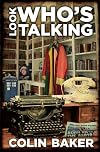
Colin Baker’s Look Who’s Talking collects material from his columns that appeared in the Bucks Free Press between 1995 – 2009, offering insight into his work as an actor, his life growing up, and his insights into current events. Baker divides the pieces into chapters based on their theme, with articles ranging in publication date over the course of his time writing for the Bucks Free Press. Baker demonstrates a strong sense of justice, discussing the way rising legal costs have put show more the protection of and remuneration from the law outside the reach of the poor and even the middle class (pg. 11). Later, in a piece he wrote on the verge of the 2008 recession, he suggests the desire to watch financial institutions go down as a result of their actions though realizes this is an unrealistic position as the public would suffer the most (pg. 17). Elsewhere, the section he titles “Grumpy Old Git” recalls the work of Andy Rooney.
Discussing his work making audio dramas, Baker wrote in 2009, “For the last ten yeas I have been recording Doctor Who audio plays for a BBC licensed company, Big Finish. The joy of audio is that I look the same as I did in the 80’s, the sets are stunning, the actresses gorgeous and the monsters really scary. They are limited only be the listener’s imagination. Between the end of Sylvester McCoy’s reign as Doctor on TV in 1989 and the renaissance of ‘new Who’ in 2005, these stories, recorded by me or the Davison, McCoy or McGann versions of the Doctor kept the deprived fans ticking over during the ‘wilderness years’” (pg. 80). He further links these audio dramas with maintaining a fanbase for classic Doctor Who in the U.S., getting him invites to conventions like San Diego Comic Con. He further describes a bit of culture shock when, at a convention in the U.S. “in the 1980’s, when Doctor Who as at the crest of its popularity,” he discovered that an armed security guard had been provided for his protection, though her armed presence caused him greater nervousness than a fan knocking at his hotel door (pg. 120).
Writing about his tenure on Doctor Who, Baker discusses how he was able to play with language. He writes, “During my spell as Doctor Who in the 1980’s I was allowed occasionally to slip in words into my dialogue that demonstrated my Doctor’s corresponding love of language. I called a character in Timelash a ‘microcephalic apostate’ when we agreed that the existing insult in the script was too prosaic and simply not ‘Doctor’-ish enough” (pg. 143). He continues, referencing issues during the final years of Doctor Who in the 1980s, “I was in fact completely unaware of the undercurrents that were going on during my time as ‘Old Sixie’ as I like to call my incarnation of the good Doctor. It was only towards the end of my three year tenure of the role that I came to learn of dissension in the production office and lack of support from on high” (pg. 247). In 2007, he was able to visit the set in Cardiff where Russell T. Davies and David Tennant were filming “Voyage of the Damned” – the 2007 Christmas special. Baker writes, “What was reassuring for this old Tardis key holder was that although the programme has moved into the 21st century and manages that impossible task of appealing to a completely new audience without losing the beating heart of the programme, the process and the atmosphere on set remained as special as I remembered it. I can think of no other job I have done which would see me at 3-50 in the morning still enjoying the work in the company of others similarly motivated” (pg. 256). He also enjoyed the “very genuine affection” showrunner Russell T. Davies and producer Phil Collinson had “for the original programme – ‘Classic Who’ as it is now called” (pg. 256). He concludes of the fans, “In the twenty five years since my Doctor first appeared on our screens, fans have been remarkably supportive and friendly towards me. I think that they know that I view the programme with as much affection as they do and that I continue to be proud of my association with the show” (pg. 257).
Baker’s book is full of humor and wit, making for an enjoyable read with some wonderful topical comedy. His honesty and openness will appeal to general readers, while his discussion of his acting career will most interest Doctor Who fans. show less
Discussing his work making audio dramas, Baker wrote in 2009, “For the last ten yeas I have been recording Doctor Who audio plays for a BBC licensed company, Big Finish. The joy of audio is that I look the same as I did in the 80’s, the sets are stunning, the actresses gorgeous and the monsters really scary. They are limited only be the listener’s imagination. Between the end of Sylvester McCoy’s reign as Doctor on TV in 1989 and the renaissance of ‘new Who’ in 2005, these stories, recorded by me or the Davison, McCoy or McGann versions of the Doctor kept the deprived fans ticking over during the ‘wilderness years’” (pg. 80). He further links these audio dramas with maintaining a fanbase for classic Doctor Who in the U.S., getting him invites to conventions like San Diego Comic Con. He further describes a bit of culture shock when, at a convention in the U.S. “in the 1980’s, when Doctor Who as at the crest of its popularity,” he discovered that an armed security guard had been provided for his protection, though her armed presence caused him greater nervousness than a fan knocking at his hotel door (pg. 120).
Writing about his tenure on Doctor Who, Baker discusses how he was able to play with language. He writes, “During my spell as Doctor Who in the 1980’s I was allowed occasionally to slip in words into my dialogue that demonstrated my Doctor’s corresponding love of language. I called a character in Timelash a ‘microcephalic apostate’ when we agreed that the existing insult in the script was too prosaic and simply not ‘Doctor’-ish enough” (pg. 143). He continues, referencing issues during the final years of Doctor Who in the 1980s, “I was in fact completely unaware of the undercurrents that were going on during my time as ‘Old Sixie’ as I like to call my incarnation of the good Doctor. It was only towards the end of my three year tenure of the role that I came to learn of dissension in the production office and lack of support from on high” (pg. 247). In 2007, he was able to visit the set in Cardiff where Russell T. Davies and David Tennant were filming “Voyage of the Damned” – the 2007 Christmas special. Baker writes, “What was reassuring for this old Tardis key holder was that although the programme has moved into the 21st century and manages that impossible task of appealing to a completely new audience without losing the beating heart of the programme, the process and the atmosphere on set remained as special as I remembered it. I can think of no other job I have done which would see me at 3-50 in the morning still enjoying the work in the company of others similarly motivated” (pg. 256). He also enjoyed the “very genuine affection” showrunner Russell T. Davies and producer Phil Collinson had “for the original programme – ‘Classic Who’ as it is now called” (pg. 256). He concludes of the fans, “In the twenty five years since my Doctor first appeared on our screens, fans have been remarkably supportive and friendly towards me. I think that they know that I view the programme with as much affection as they do and that I continue to be proud of my association with the show” (pg. 257).
Baker’s book is full of humor and wit, making for an enjoyable read with some wonderful topical comedy. His honesty and openness will appeal to general readers, while his discussion of his acting career will most interest Doctor Who fans. show less

http://nwhyte.livejournal.com/1773421.html
This was the last of the old Doctor Who annuals, a series which started in 1966 and ended in 1986. It is one of the more interesting ones - not a huge variety of material, with just seven stories and a feature piece about the work of a make-up artist on the show, but the stories are fairly better than those in the 1985 season which preceded this annual; the Doctor / Peri relationship seems rather more on track, and both are drawn in loving detail; show more there are two stories featuring the Master, obviously the Jonathan Pryce incarnation from The Curse of Fatal Death judging by the art. Going back to 1966, I was struck that one story, "Beauty and the Beast", reads like an obvious rewrite of The Savages, and another, "The Radio Waves", has significant borrowings from The War Machines; I wonder if Ian Stuart Black was consulted? While I can't claim high literary quality for this collection, it does feel in the tradition of Who, and so one can conclude the series of annuals on a relatively positive note. show less
This was the last of the old Doctor Who annuals, a series which started in 1966 and ended in 1986. It is one of the more interesting ones - not a huge variety of material, with just seven stories and a feature piece about the work of a make-up artist on the show, but the stories are fairly better than those in the 1985 season which preceded this annual; the Doctor / Peri relationship seems rather more on track, and both are drawn in loving detail; show more there are two stories featuring the Master, obviously the Jonathan Pryce incarnation from The Curse of Fatal Death judging by the art. Going back to 1966, I was struck that one story, "Beauty and the Beast", reads like an obvious rewrite of The Savages, and another, "The Radio Waves", has significant borrowings from The War Machines; I wonder if Ian Stuart Black was consulted? While I can't claim high literary quality for this collection, it does feel in the tradition of Who, and so one can conclude the series of annuals on a relatively positive note. show less
You May Also Like


Associated Authors
Statistics
- Works
- 24
- Also by
- 154
- Members
- 213
- Popularity
- #104,443
- Rating
- 3.5
- Reviews
- 13
- ISBNs
- 92
- Languages
- 3
