
Roger Williams (3) (1603–1683)
Author of A Key Into the Language of America
For other authors named Roger Williams, see the disambiguation page.
Series
Works by Roger Williams
Associated Works
The Heath Anthology of American Literature, Volume 1 (1990) — Contributor, some editions — 252 copies, 1 review
The American Intellectual Tradition, A Sourcebook: Volume I, 1630-1865 (1989) — Contributor, some editions — 203 copies
The Heath Anthology of American Literature, Concise Edition (2003) — Contributor — 73 copies, 1 review
American Literature: The Makers and the Making (In Two Volumes) (1973) — Contributor, some editions — 25 copies
The Serpent and the Fire: Poetries of the Americas from Origins to Present (2024) — Contributor — 18 copies
Tagged
Common Knowledge
- Birthdate
- 1603-12-21
- Date of death
- 1683
- Gender
- male
- Education
- University of Cambridge (Pembroke College)
- Nationality
- England
- Birthplace
- London, England
- Place of death
- Providence, Rhode Island, USA
- Map Location
- UK
Members
Reviews
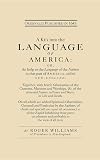
I really enjoyed reading this book. It took me two months and I quickly came to the realization that in order to be able to finish it I had to stop reading the Native American words because some of them are just so long and eye-crossing to an English speaker such as myself (Nummachinammin is "I doe not like", Maunetash nquenowhick is "I want many things", both with accent marks). I would occasionally read one or two to get the rhythm of the language.
In addition to gaining a small show more understanding of what words were important to Native Americans and Roger Williams in his decision to include them in his Key, his observations and "More particulars" were wonderful.
I could vividly see Native American life through his observations, some long, some short, some of particular events, some of generalized descriptions of common activities, behaviors, and rituals. Here is an observation he put in after the Native American and English words for "Their pounding Mortar":
"Obs. Their women constantly beat all their corne with hand: they plant it, dresse it, gather it, barne it, beat it, and take as much paines as any people in the world, which labour is questionlesse one cause of their extraordinary ease of childbirth."
The "More particular"s are spiritual observations and are in the form of poetry, for example, this one relating to money:
The Indians prize not English gold,
Nor English Indians shell:
Each in his place will passe for ought,
What ere men buy or sell.
English and Indians all passe hence,
To an eternall place,
Where shells nor finest gold's worth out,
Where nought's worth ought but Grace.
This Coyne the Indians know not of,
Who knows how soone they may?
The English knowing, prize it not,
But fling't like drosse away.
I found the book erudite, charming, sad, and full of what now, of course, seem like the most terrible prejudices and judgments. In some ways I think Roger Williams respected the Native Americans and tried very hard to keep his prejudices at bay in his observations. He wasn't always successful, but I respect the complexity of what he accomplished and the level of detail and sharing of his personal experiences. show less
In addition to gaining a small show more understanding of what words were important to Native Americans and Roger Williams in his decision to include them in his Key, his observations and "More particulars" were wonderful.
I could vividly see Native American life through his observations, some long, some short, some of particular events, some of generalized descriptions of common activities, behaviors, and rituals. Here is an observation he put in after the Native American and English words for "Their pounding Mortar":
"Obs. Their women constantly beat all their corne with hand: they plant it, dresse it, gather it, barne it, beat it, and take as much paines as any people in the world, which labour is questionlesse one cause of their extraordinary ease of childbirth."
The "More particular"s are spiritual observations and are in the form of poetry, for example, this one relating to money:
The Indians prize not English gold,
Nor English Indians shell:
Each in his place will passe for ought,
What ere men buy or sell.
English and Indians all passe hence,
To an eternall place,
Where shells nor finest gold's worth out,
Where nought's worth ought but Grace.
This Coyne the Indians know not of,
Who knows how soone they may?
The English knowing, prize it not,
But fling't like drosse away.
I found the book erudite, charming, sad, and full of what now, of course, seem like the most terrible prejudices and judgments. In some ways I think Roger Williams respected the Native Americans and tried very hard to keep his prejudices at bay in his observations. He wasn't always successful, but I respect the complexity of what he accomplished and the level of detail and sharing of his personal experiences. show less
This is a reprint of volume 5 of the 1963 edition of The Complete Writings of Roger Williams, which, in turn, was a reprint of volume 5 of the nineteenth-century Narragansett Edition. The entire volume is devoted to Roger Williams's last major work: George Fox Digg'd out of his Burrowes ("GFDB"). The present edition appears to reproduce exactly the 1676 edition of GFDB except for the addition (in printed footnotes) of marginal handwritten corrections made by Roger Williams to a published show more copy of the work. If there was an edition of this book published prior to 1676, it apparently is no longer extant, as English Early Books Online (EEBO) also reproduces the 1676 edition with the same printed footnotes that are included in the present edition.
GFDB is an account of four days of live debate in August of 1672 between Williams and representatives of the Quakers (Friends) on theological issues. The first three days occurred in Newport (Rhode Island); the last day took place in Providence (Rhode Island). Williams had hoped to hire a stenographer to take down the exact words of the debates. Since he was unable to obtain a stenographer, he relied on his memory, augmented by extensive additional reflections, in writing this book. The Quakers, who did retain a stenographer to record the debates, responded to GFDB with their own account of the debates and an extended response to Williams's book. Although Williams began to prepare a reply to the Quakers' response, he was dissuaded from completing this project by an unknown friend who "advised to let it sleep, and for beare publicke Contests with Protestants since it is the Designe of Hell and Rome [the Roman Catholic Church] etc. to cut the throats of all the protesters [Protestants] in the world." Letter of Williams to Governor Simon Bradstreet, May 6, 1682, in The Correspondence of Roger Williams, ed. Glenn W. LaFantasie (Hanover, NH: University Press of New England / Brown University Press, 1988), 2:777-78.
Most of Williams's earlier works, to the extent they have survived, involved the issues of freedom of conscience and separation of church and state. Williams opposed the governmentally established Church of England as well as the legal establishment of the Roman Catholic Church throughout much of continental Europe. But his publications on religious liberty were written during periods when his relevant governmental authorities were neither Anglican nor Catholic. Williams was banished from the colony of Massachusetts Bay in 1635-36 after he opposed its Calvinist Puritan theocracy; he then founded the settlement of Providence, which later evolved into what we know as Rhode Island. Williams's new colony was based on the principles of separation of church and state and complete liberty of conscience. John Cotton was the most important clerical representative of the Massachusetts Bay theocracy, and Williams and Cotton engaged in an extended written disputation on the proper relationship between church and state. Williams also made return trips to England during the English Civil Wars and Interregnum. During those visits, the Church of England had been disestablished, and the Presbyterians were attempting to create their own theocracy, while the Independents, under Oliver Cromwell, were developing a modified theocratic system based on governmentally required religious tithes and a limited toleration of some but not all Protestant sects (Quakers were not included in the toleration). Accordingly, Williams's publications during this period were directed not only against John Cotton and Massachusetts Bay but also against the Presbyterian and Independent efforts to replace the Church of England with some sort of Calvinist theocracy.
Cotton, the Presbyterians, and the Independents all shared with Williams the basics of Calvinist theology. Accordingly, in his writings opposing their theocratic efforts, Williams always treated his coreligionists with a certain amount of respect. Not so, the Quakers. The Friends proceeded from entirely different theological foundations, and Williams identified those principles with Satan and the Roman Catholic Church (which virtually all Protestants at the time regarded as the "Antichrist"). Williams's theological debates with the Quakers were full of emotional invective on both sides. Space does not permit a discussion of those theological disputes here. They will be treated in greater depth in my forthcoming book The First American Founder: Roger Williams and Freedom of Conscience.
Although I disagree with the theology of Roger Williams expressed in GFDB, I give this edition five stars for its accuracy in reproducing the 1676 publication and for the clarity with which Roger Williams presented his theological dispute with the Friends. Williams's earlier works did not fully explicate his theological principles. Many secondary accounts have accordingly largely ignored his decidedly unmodern theology. His conservative theology did not, however, prevent Williams from articulating a very strong commitment to liberty of conscience and separation of church and state. With the possible exception of one ambiguous statement (discussed in my forthcoming book), Williams did not depart from these principles in GFDB. Indeed, Williams accused the Quakers of religious principles that would, if they ever obtained control of government, lead to their own establishment of religion and persecution of religious dissenters. Today, we find Williams's view of the Friends virtually incomprehensible. However, the pacific Quakers of recent times were different from the militant Quakers of the seventeenth century. The earlier Quakers tested, by public acts as well as doctrine, the limits of freedom and the very definition of civility. Roger Williams's attempts to reconcile, intellectually and emotionally, the tension between his conservative theology and his commitment to religious freedom make this work one of enduring interest. show less
GFDB is an account of four days of live debate in August of 1672 between Williams and representatives of the Quakers (Friends) on theological issues. The first three days occurred in Newport (Rhode Island); the last day took place in Providence (Rhode Island). Williams had hoped to hire a stenographer to take down the exact words of the debates. Since he was unable to obtain a stenographer, he relied on his memory, augmented by extensive additional reflections, in writing this book. The Quakers, who did retain a stenographer to record the debates, responded to GFDB with their own account of the debates and an extended response to Williams's book. Although Williams began to prepare a reply to the Quakers' response, he was dissuaded from completing this project by an unknown friend who "advised to let it sleep, and for beare publicke Contests with Protestants since it is the Designe of Hell and Rome [the Roman Catholic Church] etc. to cut the throats of all the protesters [Protestants] in the world." Letter of Williams to Governor Simon Bradstreet, May 6, 1682, in The Correspondence of Roger Williams, ed. Glenn W. LaFantasie (Hanover, NH: University Press of New England / Brown University Press, 1988), 2:777-78.
Most of Williams's earlier works, to the extent they have survived, involved the issues of freedom of conscience and separation of church and state. Williams opposed the governmentally established Church of England as well as the legal establishment of the Roman Catholic Church throughout much of continental Europe. But his publications on religious liberty were written during periods when his relevant governmental authorities were neither Anglican nor Catholic. Williams was banished from the colony of Massachusetts Bay in 1635-36 after he opposed its Calvinist Puritan theocracy; he then founded the settlement of Providence, which later evolved into what we know as Rhode Island. Williams's new colony was based on the principles of separation of church and state and complete liberty of conscience. John Cotton was the most important clerical representative of the Massachusetts Bay theocracy, and Williams and Cotton engaged in an extended written disputation on the proper relationship between church and state. Williams also made return trips to England during the English Civil Wars and Interregnum. During those visits, the Church of England had been disestablished, and the Presbyterians were attempting to create their own theocracy, while the Independents, under Oliver Cromwell, were developing a modified theocratic system based on governmentally required religious tithes and a limited toleration of some but not all Protestant sects (Quakers were not included in the toleration). Accordingly, Williams's publications during this period were directed not only against John Cotton and Massachusetts Bay but also against the Presbyterian and Independent efforts to replace the Church of England with some sort of Calvinist theocracy.
Cotton, the Presbyterians, and the Independents all shared with Williams the basics of Calvinist theology. Accordingly, in his writings opposing their theocratic efforts, Williams always treated his coreligionists with a certain amount of respect. Not so, the Quakers. The Friends proceeded from entirely different theological foundations, and Williams identified those principles with Satan and the Roman Catholic Church (which virtually all Protestants at the time regarded as the "Antichrist"). Williams's theological debates with the Quakers were full of emotional invective on both sides. Space does not permit a discussion of those theological disputes here. They will be treated in greater depth in my forthcoming book The First American Founder: Roger Williams and Freedom of Conscience.
Although I disagree with the theology of Roger Williams expressed in GFDB, I give this edition five stars for its accuracy in reproducing the 1676 publication and for the clarity with which Roger Williams presented his theological dispute with the Friends. Williams's earlier works did not fully explicate his theological principles. Many secondary accounts have accordingly largely ignored his decidedly unmodern theology. His conservative theology did not, however, prevent Williams from articulating a very strong commitment to liberty of conscience and separation of church and state. With the possible exception of one ambiguous statement (discussed in my forthcoming book), Williams did not depart from these principles in GFDB. Indeed, Williams accused the Quakers of religious principles that would, if they ever obtained control of government, lead to their own establishment of religion and persecution of religious dissenters. Today, we find Williams's view of the Friends virtually incomprehensible. However, the pacific Quakers of recent times were different from the militant Quakers of the seventeenth century. The earlier Quakers tested, by public acts as well as doctrine, the limits of freedom and the very definition of civility. Roger Williams's attempts to reconcile, intellectually and emotionally, the tension between his conservative theology and his commitment to religious freedom make this work one of enduring interest. show less

A great little historical curiosity, this early "dictionary" is sorted by subject matter. There are a few terms (spelling not consistent but that's all right, it helps with the pronunciation) and then a little commentary, such as this one under Chap.V:
Their Virgins are distinguished by a bashful falling downe of their haire over their eyes.
Roger Williams, as the Editors inform us, wrote this, his first published work, in 1643. As an early Anthropologist and Linguist, he mentions different show more dialects but does not distinguish greatly between the Algonkian tribes. Some words are similar to those of the Abenaki, one tribe found further to the west, but others are not.
I could do without his three verses of four lines each that are found at the end of each chapter, generally pontificating on the superiority of the Christian faith over the heathen, although Williams gained fame as much, or more, for his independent views on religious tolerance that landed him in hot water (as well as exile) from his fellow "Pilgrims".
Because there were no cameras or recordings at the time, we owe Roger Williams a great debt of gratitude for the little slice of history that he saved for us. show less
Their Virgins are distinguished by a bashful falling downe of their haire over their eyes.
Roger Williams, as the Editors inform us, wrote this, his first published work, in 1643. As an early Anthropologist and Linguist, he mentions different show more dialects but does not distinguish greatly between the Algonkian tribes. Some words are similar to those of the Abenaki, one tribe found further to the west, but others are not.
I could do without his three verses of four lines each that are found at the end of each chapter, generally pontificating on the superiority of the Christian faith over the heathen, although Williams gained fame as much, or more, for his independent views on religious tolerance that landed him in hot water (as well as exile) from his fellow "Pilgrims".
Because there were no cameras or recordings at the time, we owe Roger Williams a great debt of gratitude for the little slice of history that he saved for us. show less
This is a 2005 reprint by the Baptist Standard Bearer of volume 2 of the 1963 edition (Russell & Russell) of The Complete Writings of Roger Williams. It includes the following works: John Cotton's Reply to Mr. Williams, his Examination (originally published in 1647 with John Cotton's Bloudy Tenent, Washed) and Williams's Queries of Highest Consideration (originally published in 1644). The Queries of Highest Consideration commenced Williams's long engagement with the church-state issues of show more the English Civil War and Interregnum during his two return visits (1643-44 and 1651-54) to England.
The works in this edition denote the pagination of the originals in brackets within the texts. Although not facsimiles of the originals, they reproduce the orthography and other features of the originals. Accordingly, the 1963 edition (or a reprint of same) is frequently cited in the scholarly literature. The originals of these publications are now also available on Early English Books Online (EEBO).
I give this edition five stars in view of the accuracy of the reprints of the originals as well as the power and cogency of Roger Williams's Queries of Highest Consideration. This rating does not apply to the March 1867 editorial commentary of the Reverend J. Lewis Diman on Cotton's Reply, which is sorely deficient. However, Reuben Albridge Guild's March 1867 introduction to Queries of Highest Consideration does provide some helpful historical background to that work. My forthcoming book The First American Founder: Roger Williams and Freedom of Conscience will discuss the meaning and significance of the Queries in some depth. show less
The works in this edition denote the pagination of the originals in brackets within the texts. Although not facsimiles of the originals, they reproduce the orthography and other features of the originals. Accordingly, the 1963 edition (or a reprint of same) is frequently cited in the scholarly literature. The originals of these publications are now also available on Early English Books Online (EEBO).
I give this edition five stars in view of the accuracy of the reprints of the originals as well as the power and cogency of Roger Williams's Queries of Highest Consideration. This rating does not apply to the March 1867 editorial commentary of the Reverend J. Lewis Diman on Cotton's Reply, which is sorely deficient. However, Reuben Albridge Guild's March 1867 introduction to Queries of Highest Consideration does provide some helpful historical background to that work. My forthcoming book The First American Founder: Roger Williams and Freedom of Conscience will discuss the meaning and significance of the Queries in some depth. show less
Lists
You May Also Like


Associated Authors
Statistics
- Works
- 20
- Also by
- 8
- Members
- 245
- Popularity
- #92,909
- Rating
- 4.1
- Reviews
- 11
- ISBNs
- 262
- Languages
- 15