
William Wright (1) (1930–2016)
Author of Harvard's Secret Court: The Savage 1920 Purge of Campus Homosexuals
For other authors named William Wright, see the disambiguation page.
About the Author
William Connor Wright Jr. was born in Philadelphia, Pennsylvania on October 22, 1930. He received a bachelor's degree in English from Yale University. He then spent four years as a linguist with the United States Army Language School. He wrote several non-fiction works during his lifetime including show more Lillian Hellman: The Image, the Woman; Harvard's Secret Court; The von Bu?low Affair; and Born That Way: Genes, Behavior, Personality. He also wrote two as-told-to autobiographies of Luciano Pavarotti entitled Pavarotti: My Own Story and Pavarotti: My World. He died on June 5, 2016 at the age of 85. (Bowker Author Biography) show less
Works by William Wright
Tagged
Common Knowledge
- Other names
- Wright, William Connor, Jr.
- Birthdate
- 1930-10-22
- Date of death
- 2016-06-04
- Gender
- male
- Education
- Yale College (AB|English)
- Occupations
- biographer
editor
playwright
linguist - Organizations
- US Army Language School
Holiday magazine
Chicago magazine
Spoleto Festival - Relationships
- Raine, Barry (longtime companion)
- Nationality
- USA
- Birthplace
- Philadelphia, Pennsylvania, USA
- Places of residence
- New York, New York, USA
Key West, Florida, USA - Place of death
- Branford, Connecticut, USA
- Associated Place (for map)
- USA
Members
Reviews
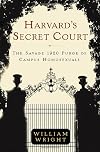
Written midway through the past decade, Harvard's Secret Court hasn't been touted as it should be or read as widely as it needs to be. Wright's nonfiction study of a gay witch hunt at one of the country's most respected universities reads like a fiction thriller. Those who tend to shy away from nonfiction will find this book as exciting to read as the best of the mystery genre. The sad part is that the witch hunt, the suspense with which Wright seduces the reader, and the characters are all show more real. Everyone should read this book: gay folks, straight folks, history buffs, parents with sons or daughters at universities, and anyone who fears prejudice and hate. This well-written and well-researched book shows us how easy it is for the fear of one or two individuals to ruin the lives of many. Yes, the action in Harvard's Secret Court took place in 1920, but what happened then could happen again. This book, although of gay and lesbian interest, should not be stuck on a "gay ghetto" bookshelf awaiting only gay readers. Wright's work deserves to be read - and thought about - by a large cross section of the reading public: high-school students, college graduates, atheists, and the right-wing religious. Harvard's Secret Court will keep the reader up all night as the action - and the appalling reality - sends one back to a New England campus in the 1920s to meet an interesting cast of characters. We will all look forward to future work of this caliber from William Wright. show less

Remember Lillian Hellman shilling for mink coats? Well, that was not her only controversy.
There was controversy over her play play The Children's Hour, which was unfairly passed over for accolade due to slight homosexual content. The play was in serious consideration for the Pulitzer Prize for Drama for 1934–35. The award was presented instead to Zoë Akins' play The Old Maid. Accused of rejecting Hellman's play because of its controversial subject—one of the Pulitzer judges had refused show more to see it. Angered by the Pulitzer Prize decision, the New York Drama Critics' Circle began awarding its own annual prize for drama the following year, indignant over the injustice to Hellman's play and to the implication of artistic censorship. Members of the circle made no secret that their motive was to protest the outdated standards of the Pulitzer judges and to establish awards based on more enlightened criteria
My draw to the biography was because of "Commies!" Hellman was active in her support of Stalin, the USSR, and communism and general. She found a fellow traveler in Dashiell Hammett.
Hammett's influence by transference went possibly even into co-writing Hellman's best output, it seems.
Hellman wrote a famous letter to HUAC where before testifying she tried unsuccessfully to negotiate away any obligation to speak about others.
It appears along the way in a fierce life, she felt obligated to lean into mendacity. In 1962, Signoret translated Lillian Hellman's play The Little Foxes into French for a production in Paris that ran for six months. Hellman in print lied saying earlier than the day before opening night she raised questions, wanting changes. But, she wasn't there or communicating until opening night.
Then, she made false promises to Hammett's daughters on their father's literary estate.
She was also apparently just generally disagreeable to work with.
It is interesting how from the radical left perspective, she cast Nixon as an outcome of McCarthyist anti-Communism.
Also, interesting to me is the description of an "anticommunist left".
Hellman appears to have long held Stalin in high regard.
"...Hellman was a systematic supporter of Stalinism, in spite of its mass horrors, for many, many years, and a savage critic of American liberals who opposed both McCarthy and American communists..."
The mendacity, false history had one of its peak expressions in the film Julia (1977) . show less
There was controversy over her play play The Children's Hour, which was unfairly passed over for accolade due to slight homosexual content. The play was in serious consideration for the Pulitzer Prize for Drama for 1934–35. The award was presented instead to Zoë Akins' play The Old Maid. Accused of rejecting Hellman's play because of its controversial subject—one of the Pulitzer judges had refused show more to see it. Angered by the Pulitzer Prize decision, the New York Drama Critics' Circle began awarding its own annual prize for drama the following year, indignant over the injustice to Hellman's play and to the implication of artistic censorship. Members of the circle made no secret that their motive was to protest the outdated standards of the Pulitzer judges and to establish awards based on more enlightened criteria
My draw to the biography was because of "Commies!" Hellman was active in her support of Stalin, the USSR, and communism and general. She found a fellow traveler in Dashiell Hammett.
On several occasions Faulkner spoke to the press of his dislike of "literary circles" and told one reporter he "never associated with other writers." It was not the only instance of Faulkner's striking a pose. The fact is, he spent many long evenings with Hellman and Hammett-just the three of them sitting up all night talking and drinking. Faulkner was intrigued by Hammett, recognizing at once his unaffected honesty. He also identified with Hammett's roustabout background and especially envied his years as a Pinkerton agent. One area of potential discord was politics. Hammett was then beginning his long involvement with Marxism. Although his opinions were unformulated and unorthodox, they were sufficiently communistic to upset Faulkner, who abhorred any form of radicalism.
Hammett's influence by transference went possibly even into co-writing Hellman's best output, it seems.
former self, became a model of purposefulness and decisiveness. Although the purposes and decisions were markedly colored by Hammett's own, they were still hers. Hammett was genuinely fascinated by the person he saw behind the confusions and contradictions of Hellman. Energized by his love for her, he set to work to bring that person into being. Hammett is frequently given credit for Hellman's emergence as a playwright-which is certainly true, but not in the collaborative way that is often implied; his contribution was far broader. He was a collaborator in the creation not so much of the plays as of Lillian Hellman herself.
Hellman wrote a famous letter to HUAC where before testifying she tried unsuccessfully to negotiate away any obligation to speak about others.
I am prepared to waive the privilege against self-incrimination and to tell you anything you wish to know about my views or actions if your Committee will agree to refrain from asking me to name other people. If the Committee is un-willing to give me this assurance, I will be forced to plead the privilege of the Fifth Amendment at the hearing.
[...]
The committee's response was terse. It would not enter into negotiations with witnesses about what they would and would not testify to.
There is a subtlety to the Fifth Amendment that lay behind this exchange and determined Hellman's eventual course-as it did for many other witnesses. Once you have answered a question that could in any way be considered incriminating, you have waived your right to plead the Fifth Amendment on lesser matters relating to this admission. That is, if you admitted to having been a communist, which was a crime at that time, you couldn't then plead the Fifth when asked the names of other communists you might have known. The Fifth Amendment protects against self-incrimination, not against incriminating others. The Supreme Court had not yet ruled on the constitutionality of the Smith Act and was vague about what was "incriminating." So witnesses before HUAC had to walk gingerly around any questions that could be so construed, even about actions they didn't mind admitting to, if they wanted to keep the Fifth Amendment in their arsenal.
It appears along the way in a fierce life, she felt obligated to lean into mendacity. In 1962, Signoret translated Lillian Hellman's play The Little Foxes into French for a production in Paris that ran for six months. Hellman in print lied saying earlier than the day before opening night she raised questions, wanting changes. But, she wasn't there or communicating until opening night.
Then, she made false promises to Hammett's daughters on their father's literary estate.
In order to buy the rights, Hellman still had to obtain written consent from Hammett's daughters. She wrote them several letters, persuading them of the wisdom of her offer. Her main argument was that if they were to retain the rights, they would be liable for their father's considerable debts. This was not true, as the Government had acquiesced to the sale of the rights in order to close the Hammett account.
She was also apparently just generally disagreeable to work with.
Dorothy Samuels, while admiring Hellman, found her an extremely difficult boss. "She was always making dramas out of nothing. She would take things people had said and twist them around until they became dramas of some sort. Orville Schell finally resigned as her co-chairman. He couldn't take the bickering that Lillian thrived on. She got very down on Ray Calamaro, an executive director who preceded me. She was so nasty to him, we all thought he must have turned her down. Whatever it was that set her against him, he finally quit and went to work at the Justice Department.
It is interesting how from the radical left perspective, she cast Nixon as an outcome of McCarthyist anti-Communism.
...accusing the intellectuals of failing to speak out against McCarthy, she wrote: "None of them, as far as I know, has yet found it a part of conscience to admit their Cold War anti-Communism was perverted, possibly against their wishes, into the Vietnam War and then into the reign of Nixon, their unwanted but inevitable leader."
Also, interesting to me is the description of an "anticommunist left".
... the man who saved Hellman at the time of her HUAC ordeal was Joe Rauh, a pillar of the anticommunist left, of which she and Garry Wills are so scornful. (Rauh himself says, "Not just me, everybody who helped her, Abe Fortas, Stanley Isaacs-we were all of the anticommunist left.") Howe had numerous other complaints, and he ended his piece with an answer to one of Hellman's main Scoundrel Time themes: while having been mistaken in "taking too long to see what was going on in the Soviet Union, I do not believe we did our country any harm" (and the McCarthyites did). Howe wrote:DEAR LILLIAN HELLMAN,
You could not be more mistaken. Those who supported Stalinism and its political enterprises, either here or abroad, helped befoul the cultural atmosphere, helped bring totalitarian methods into trade unions, helped perpetrate one of the great lies of the century, helped destroy whatever possibilities there might have been for a resurgence of serious radicalism in America. Isn't that harm enough?
Hellman appears to have long held Stalin in high regard.
"...Hellman was a systematic supporter of Stalinism, in spite of its mass horrors, for many, many years, and a savage critic of American liberals who opposed both McCarthy and American communists..."
The mendacity, false history had one of its peak expressions in the film Julia (1977) . show less
It's an account of the purges of gay students from the campus after the suicide of one of them that occurred in the nineteen-twenties. Very shocking, especially considering that the purges themselves led to more suicides and completely ruined the lives of the students in question. Not only did Harvard purge their names from the permanent records, they also sent out letters to explain why they dismissed this students if they chose to associate themselves with the university in any CV they show more wrote for an application to other schools or jobs. This meant that many of these students could not hope for further education at other schools at all or for jobs. The last of these letters was sent in the early seventies.
What struck me as very strange is Wight's last chapter which outlines the possibility that homophobia may be as genetically induced as homosexuality. While I get that he probably had to include something of the sort to stop him from being in trouble with the renowned university, it was still rather baffling to see him struggling to explain and absolve these decisions which had ruined the lives of some twenty students for decades to come, sometimes on the basis of mere association with gay students. show less
What struck me as very strange is Wight's last chapter which outlines the possibility that homophobia may be as genetically induced as homosexuality. While I get that he probably had to include something of the sort to stop him from being in trouble with the renowned university, it was still rather baffling to see him struggling to explain and absolve these decisions which had ruined the lives of some twenty students for decades to come, sometimes on the basis of mere association with gay students. show less

This is the book that can not win.
The first half is taken mostly by the family feuds and Christina's major love interests. Some of the friends and aquaintences that mean most to her, even though this period, are mere ghosts in this part of the book, mentioned like passing ships in the night. (pardon the pun)
In the second, it turns to her quest to fill the hole in her life and some of the crazy and outrageous things she did in the pursuit of her (understandably) mixed-up interpretation of sex show more and love; as what came over to me a result of her desire to be wanted and valued. Some of those ghosts do start to come a little more to the foreground, but I feel that other people who were important in her life, are relegated to very slim places. Given the recent nature of the events with regard to the publication date, this may have been necessary to win the co-operation of some of them.
The fickle finger of fate has decided that I have never set foot on Greek soil, but many years ago I spent a little time in some ex-pat Greek communities and; this is strange to tell, but I am a quarter Greek and it seems that once they know Greek blood is somewhere in your veins, a fresh degree of warmth appears from nowhere and I have been treated as if a long lost cousin by people who had never met me before. There are behaviours attributed to Greek people that are difficult to explain, but nevertheless hold a solid ring of truth; like some men holding to their mothers, etc. I can also confirm that Greek blood, even when watered down a little, can still be quite unstable. It is liable to volatile explosion and after-burn at such a furious rate, that few would believe until they had seen it for themselves.
The result of my personal experiences, is that what is written here of Onassis and the family rings true. I believe every word of what Wright has written. Wright has done a superb job of taking the various accounts of the people with whom he talked, and the research he had to undertake, and turned all that in to a flowing story. Perhaps one of the saddest ever to be told. He has included enough statement of doubt, where conflict exists in the research, to make me believe him when he has written with surety.
Those that stand the most to benefit from reading this, are the one percent. It is a stark demonstration that we are not invulnerable, that you can not buy love and that if immortality is the goal, then the closest that can be achieved is to do the right thing by society. It is the names of those that sacrificed, who society and the history books will remember most keenly and favourably. For those who use their wealth to fund an extravagant lifestyle; a book such as this, awaits their memory.
It was a hard book for me to read; both from the wanton extravagances and wastefulness on the part of Christina, and also the predatory, ruthless way that she and her fortune were taken advantage of. This account does serve as a haunting, harrowing tale of all the pain that money can, indeed, buy. There were references in there like being, "bearded," and, "in his cups," which I had to look up, but mostly the book was very accessible.
The story itself has not ended, as her daughter is making her own splash. I have read it reported, that there is a legal argument and wrangling over the ownership of Skorpios and also a battle for the trust half of the Onassis estate; although for various reasons this likely does not make the press in anywhere near the quantities that Christina's exploits ever did, even if those reports are true.
I found the book a heavy read, more for the subject matter than the writing style; with a light sprinkling of terms that I feel belong to an era decades earlier than the 1991 publishing date. It also felt that much was missing; but that if it were fleshed out to account for all the important people who would justly hold a position within its pages, then it might become the envy of many a boat anchor.
Wright has nevertheless appeared to have done diligent and no doubt politically difficult work, in bringing this story to paper. show less
The first half is taken mostly by the family feuds and Christina's major love interests. Some of the friends and aquaintences that mean most to her, even though this period, are mere ghosts in this part of the book, mentioned like passing ships in the night. (pardon the pun)
In the second, it turns to her quest to fill the hole in her life and some of the crazy and outrageous things she did in the pursuit of her (understandably) mixed-up interpretation of sex show more and love; as what came over to me a result of her desire to be wanted and valued. Some of those ghosts do start to come a little more to the foreground, but I feel that other people who were important in her life, are relegated to very slim places. Given the recent nature of the events with regard to the publication date, this may have been necessary to win the co-operation of some of them.
The fickle finger of fate has decided that I have never set foot on Greek soil, but many years ago I spent a little time in some ex-pat Greek communities and; this is strange to tell, but I am a quarter Greek and it seems that once they know Greek blood is somewhere in your veins, a fresh degree of warmth appears from nowhere and I have been treated as if a long lost cousin by people who had never met me before. There are behaviours attributed to Greek people that are difficult to explain, but nevertheless hold a solid ring of truth; like some men holding to their mothers, etc. I can also confirm that Greek blood, even when watered down a little, can still be quite unstable. It is liable to volatile explosion and after-burn at such a furious rate, that few would believe until they had seen it for themselves.
The result of my personal experiences, is that what is written here of Onassis and the family rings true. I believe every word of what Wright has written. Wright has done a superb job of taking the various accounts of the people with whom he talked, and the research he had to undertake, and turned all that in to a flowing story. Perhaps one of the saddest ever to be told. He has included enough statement of doubt, where conflict exists in the research, to make me believe him when he has written with surety.
Those that stand the most to benefit from reading this, are the one percent. It is a stark demonstration that we are not invulnerable, that you can not buy love and that if immortality is the goal, then the closest that can be achieved is to do the right thing by society. It is the names of those that sacrificed, who society and the history books will remember most keenly and favourably. For those who use their wealth to fund an extravagant lifestyle; a book such as this, awaits their memory.
It was a hard book for me to read; both from the wanton extravagances and wastefulness on the part of Christina, and also the predatory, ruthless way that she and her fortune were taken advantage of. This account does serve as a haunting, harrowing tale of all the pain that money can, indeed, buy. There were references in there like being, "bearded," and, "in his cups," which I had to look up, but mostly the book was very accessible.
The story itself has not ended, as her daughter is making her own splash. I have read it reported, that there is a legal argument and wrangling over the ownership of Skorpios and also a battle for the trust half of the Onassis estate; although for various reasons this likely does not make the press in anywhere near the quantities that Christina's exploits ever did, even if those reports are true.
I found the book a heavy read, more for the subject matter than the writing style; with a light sprinkling of terms that I feel belong to an era decades earlier than the 1991 publishing date. It also felt that much was missing; but that if it were fleshed out to account for all the important people who would justly hold a position within its pages, then it might become the envy of many a boat anchor.
Wright has nevertheless appeared to have done diligent and no doubt politically difficult work, in bringing this story to paper. show less
Lists
Awards

You May Also Like


Statistics
- Works
- 10
- Members
- 631
- Popularity
- #39,928
- Rating
- 3.7
- Reviews
- 12
- ISBNs
- 152
- Languages
- 9