
Nancy Rubin Stuart
Author of Isabella of Castile: The First Renaissance Queen
About the Author
Nancy Rubin Stuart is an award-winning author specializing in women's and social history. She has appeared on national television and National Public Radio and has contributed to the New York Times, among other publications. Stuart is aboard member of the Women Writing Women's Lives Seminar at the show more City University of New York Graduate Center and is executive director of the Cape God Writers Center. show less
Image credit: Bruce Allen
Works by Nancy Rubin Stuart
Defiant Brides: The Untold Story of Two Revolutionary-Era Women and the Radical Men They Married (2013) 95 copies, 5 reviews
The Muse of the Revolution: The Secret Pen of Mercy Otis Warren and the Founding of a Nation (2008) 74 copies, 3 reviews
Poor Richard's Women: Deborah Read Franklin and the Other Women Behind the Founding Father (2022) 47 copies, 1 review
Saints and strangers 1 copy
Associated Works
Ingenue to Icon: 70 Years of Fashion from the Collection of Marjorie Merriweather Post (2015) — Introduction, some editions — 24 copies
Tagged
Common Knowledge
- Birthdate
- 1944-11-25
- Gender
- female
- Education
- Tufts University (BA)
Brown University (MAT) - Occupations
- journalist
- Organizations
- American Society of Journalists and Authors
Authors Guild
Authors League of America
PEN America Center
Women's Ink - Nationality
- USA
- Places of residence
- Boston, Massachusetts, USA
New York, New York, USA - Associated Place (for map)
- USA
Members
Reviews
Poor Richard's Women: Deborah Read Franklin and the Other Women Behind the Founding Father by Nancy Rubin Stuart
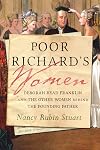
For too long, Ben Franklin’s common-law wife has been dismissed as illiterate and boring. Nancy Rubin Stuart’s post-feminism approach restores Deborah Reed Franklin to the esteem in which she was held in during her lifetime.
Poor Richard’s Women demonstrates that Deborah ably managed the family business while Ben spent years abroad, as well as the post office, while raising four children (included his illegitimate son), caring for her ailing mother, and supervising the building and show more outfitting of their new home at Franklin Court. In short, the woman was a powerhouse more like Abigail Adams than people think. When rioters protesting the Stamp Act threatened Franklin Court, Deborah brought in help and stood watch with a gun, ready to protect their home and Ben’s reputation! That’s Dolley Madison worthy!
Ben had a penchant for falling for his landladies and their daughters. Deborah was the daughter of the first Philadelphia family he boarded with. They were ready to be married when an opportunity arose or Ben to travel to London to purchase equipment to start his own publishing business. The money fell through, and he was stuck abroad. He found work and a room, then promptly became cozy with his widowed landlady. And, smitten with her daughter, as well. They became a second family, and it appears received the best of his love.
Deborah’s parents urged her to move on before she was over the hill. She married a worthless man who soon disappeared. When Ben finally returned to Philly, the two reunited and decided to resume their relationship. Then, Ben presented Deborah with his illegitimate son to raise!
For much of their marriage, Ben was abroad in England and France working for the patriot cause. He sent home loving letters—sometimes. And, followed his heart all the time. Along with his London landlady, he fell for a series of French women. They were close, but they all disappointed him when it came to the more physical intimacies he desired. By the time Ben came home for good, Deborah had died, and his London landlady as well, but her daughter Polly joined him in Philadelphia. As his health declined, he was lovingly cared for by Polly and his and Deborah’s daughter Sally. It had to rankle Sally to have Polly there!
The book is easy, engaging reading, full of fascinating women. We also met Ben’s children and grandchildren. They were a flawed, but interesting family.
I received a free egalley from the publisher through Edeweiss+. My review is fair and unbiased. show less
Poor Richard’s Women demonstrates that Deborah ably managed the family business while Ben spent years abroad, as well as the post office, while raising four children (included his illegitimate son), caring for her ailing mother, and supervising the building and show more outfitting of their new home at Franklin Court. In short, the woman was a powerhouse more like Abigail Adams than people think. When rioters protesting the Stamp Act threatened Franklin Court, Deborah brought in help and stood watch with a gun, ready to protect their home and Ben’s reputation! That’s Dolley Madison worthy!
Ben had a penchant for falling for his landladies and their daughters. Deborah was the daughter of the first Philadelphia family he boarded with. They were ready to be married when an opportunity arose or Ben to travel to London to purchase equipment to start his own publishing business. The money fell through, and he was stuck abroad. He found work and a room, then promptly became cozy with his widowed landlady. And, smitten with her daughter, as well. They became a second family, and it appears received the best of his love.
Deborah’s parents urged her to move on before she was over the hill. She married a worthless man who soon disappeared. When Ben finally returned to Philly, the two reunited and decided to resume their relationship. Then, Ben presented Deborah with his illegitimate son to raise!
For much of their marriage, Ben was abroad in England and France working for the patriot cause. He sent home loving letters—sometimes. And, followed his heart all the time. Along with his London landlady, he fell for a series of French women. They were close, but they all disappointed him when it came to the more physical intimacies he desired. By the time Ben came home for good, Deborah had died, and his London landlady as well, but her daughter Polly joined him in Philadelphia. As his health declined, he was lovingly cared for by Polly and his and Deborah’s daughter Sally. It had to rankle Sally to have Polly there!
The book is easy, engaging reading, full of fascinating women. We also met Ben’s children and grandchildren. They were a flawed, but interesting family.
I received a free egalley from the publisher through Edeweiss+. My review is fair and unbiased. show less

An excellent biography one of of America's most successful businesswomen. American Empress follows the life of Marjorie Merriweather Post, whose fortune derived from her father's founding of Post Cereal. This book details Marjorie's extraordinary eye for art and beauty and we are treated to vivid descriptions of her homes, yachts, jewels, and experiences as an ambassador's wife in the USSR under Stalin. Because she had money and Russia needed cash, she was allowed to scrounge around the show more warehouses of Faberge for Imperial treasures, including two Faberge eggs. Her home in Washington D.C. is today a museum and her home Mar-A-Lago in Florida is owned by US President Donald Trump. Marjorie had intended for it to be used as a Winter White House after her death. Her dream was realized when Donald Trump became president and hosted several diplomatic events there.
An excellent and fascinating read! show less
An excellent and fascinating read! show less
The Muse of the Revolution: The Secret Pen of Mercy Otis Warren and the Founding of a Nation by Nancy Rubin Stuart
As America's first female playwright, nonfiction writer, and copyright holder, Mercy Otis Warren (1728-1814) deserves more fame than she currently has. This dry biography by Nancy Rubin Stuart is unlikely to bring it to her. Much of the book is not about Mercy herself, but about the early American history in general, Mercy's male relatives, and her close friends John and Abigail Adams. Mercy herself comes across as a privileged yet prim and often sickly woman who believes in revolutionary show more ideals, but who also longs for domestic tranquility and relief from loneliness. Her unhinged brother Jemmy and her scofflaw son Winslow are more interesting than she is.
If there is an upside to this book, it is that it made me want to read Mercy's poems, plays and letters (as well as her three-volume masterwork, History of the Rise, Progress and Termination of the American Revolution), for myself. show less
If there is an upside to this book, it is that it made me want to read Mercy's poems, plays and letters (as well as her three-volume masterwork, History of the Rise, Progress and Termination of the American Revolution), for myself. show less
The muse of the revolution : the secret pen of Mercy Otis Warren and the founding of a nation by Nancy Rubin Stuart
This biography details the fascinating life of Mercy Otis Warren, a poet, playwright, journalist, and historian in Massachusetts during the time of the American Revolution and the rise of the new republic. Warren was an ardent proponent of resistance to royal authority in the colonies, with some of her sharpest barbs target at Royal Governor Thomas Hutchinson. Although Warren was from a privileged family, the Revolutionary War affected her directly causing her to move around as well as show more bringing her into direct contact with revolutionary political and military leaders. She reported on these events in direct first person accounts. Later in life Warren drew on her own memories, correspondence, and official records to compose a three volume history of the revolutionary period, published in 1805 as History of the Rise, Progress, and Termination of the American Revolution.
As often proves necessary in the biography of women, a lot of the details are drawn from her relationships with the men in her life. This includes her brother James Otis Jr., one of the earliest agitators in the years leading up to the Revolution. Her husband James Warren was a prominent legislator who sought her opinions, relied on her as a secretary, and encouraged her writing. Warren was also a friend or correspondent with Samuel Adams, John Hancock, George Washington, Thomas Jefferson, and most closely with John and Abigail Adams. Nevertheless, during the Constitutional Convention, Warren sided with the Anti-Federalists and later with Jefferson's new Republican party (quite unusual in Federalist New England). Warren's scathing commentary on John Adam's monarchist leanings and her description of him in her history contributed to a strained relationship between the Warrens and the Adamses, although they did manage to reconcile.
This is a fascinating and important work for learning about an influential revolutionary figure who happens to be overlooked because she was a woman. show less
As often proves necessary in the biography of women, a lot of the details are drawn from her relationships with the men in her life. This includes her brother James Otis Jr., one of the earliest agitators in the years leading up to the Revolution. Her husband James Warren was a prominent legislator who sought her opinions, relied on her as a secretary, and encouraged her writing. Warren was also a friend or correspondent with Samuel Adams, John Hancock, George Washington, Thomas Jefferson, and most closely with John and Abigail Adams. Nevertheless, during the Constitutional Convention, Warren sided with the Anti-Federalists and later with Jefferson's new Republican party (quite unusual in Federalist New England). Warren's scathing commentary on John Adam's monarchist leanings and her description of him in her history contributed to a strained relationship between the Warrens and the Adamses, although they did manage to reconcile.
This is a fascinating and important work for learning about an influential revolutionary figure who happens to be overlooked because she was a woman. show less
Awards


You May Also Like


Statistics
- Works
- 12
- Also by
- 1
- Members
- 548
- Popularity
- #45,523
- Rating
- 4.1
- Reviews
- 13
- ISBNs
- 28
- Languages
- 1


