

Justin Fox (1) (1964–)
Author of The Myth of the Rational Market: A History of Risk, Reward, and Delusion on Wall Street
For other authors named Justin Fox, see the disambiguation page.
About the Author
Justin Fox is editorial director of the Harvard Business Review Group, and a contributor to Time magazine and PBS's Nightly Business Report. Previously, he was a columnist at Time and an editor and writer at Fortune. He lives in Cambridge, Massachusetts, with his wife and son.
Image credit: photo by Deborah Copaken
Works by Justin Fox
The Myth of the Rational Market: A History of Risk, Reward, and Delusion on Wall Street (2009) 540 copies, 9 reviews
Tagged
Common Knowledge
- Birthdate
- 1964
- Gender
- male
- Agent
- Elyse Cheney
- Short biography
- [from author's website]
Justin Fox is a columnist for Bloomberg Opinion and a contributor to Bloomberg Businessweek. He was previously editorial director and executive editor of the Harvard Business Review. He is the author of The Myth of the Rational Market: A History of Risk, Reward, and Delusion on Wall Street. Before joining HBR, he wrote a column for Time and created the Curious Capitalist blog for Time.com, and before that he spent more than a decade writing for Fortune magazine. He was a senior fellow at Harvard Kennedy School and a Young Global Leader of the World Economic Forum. - Nationality
- USA
- Associated Place (for map)
- USA
Members
Reviews

What determines the price of a security traded on one of our stock markets? Is there a science to predicting the direction in which stock prices are likely to change? Justin Fox’s very readable The Myth of the Rational Market recounts a recent history of our stock markets and the academic economic analyses of them. He avers:
“This book offers no grand new theory of how markets truly behave. It is instead a history of the rise and fall of the old theory - the rational market theory.”
John show more Maynard Keynes is said to have quipped that investing in the stock market was making a bet on what the average man thought other average men would be willing to pay for a security in the future. Other economists and stock market analysts tried to develop a theory to determine what actual values of securities might be. Such information obviously would be extremely valuable in predicting future stock prices.
One prominent group of economists (Milton Friedman, George Stigler, Aaron Director, Eugene Fama, Merton Miller, et alia), who taught at or were educated at the University of Chicago, developed the theory that the stock market was very “efficient” in determining “appropriate” stock prices. In the words of Chicago’s Melvin Reder, he and his Hyde Park based colleagues “believed in ‘tight prior equilibrium,’ while economists at other universities believed in ‘diffuse prior equilibrium.’” In effect, the Chicagoans attacked almost every economic problem with the starting assumption that, absent interference from government, the market got things right.
But what was “right” in relation to stock prices? Nearly all economists came to subscribe to the capital asset pricing model known as “CAPM,” which said the true value of a stock was the present value of the discounted future free cash flows it would generate. The discount rate in the calculation was thought to be a number appropriate to the riskiness of the security. In one sense CAPM was very valuable in that it emphasized cash flows rather than “earnings” as calculated by accountants. But although recent cash flows could be measured exactly, future cash flows remained anybody’s guess. Moreover, the appropriate discount rate was something of a conjecture.
If the Chicagoans were right about the market, then the current price of a stock reflected the collective judgement of millions of investors about the future cash flows to be generated by the stock. Daily changes in the price reflected new information becoming available. Those changes were likely to be relatively small and unpredictable. To the extent prices got out of line with CAPM’s dictates, savvy traders were expected to jump in to take advantage of arbitrage opportunities and stabilize the market. In fact, there seemed to be pretty good evidence that those changes followed a pattern know as a “random walk,” in which the magnitude of changes were grouped in a Gaussian or “normal” distribution.
The Chicago school of analysis dominated academic economic thought, garnering a disproportionate number of Nobel Prizes, from the early 60s through the late 80s. But then came October 19, 1987, when the market lost a fifth of its value in a single day! Mark Robinson, a UC Berkeley economist, calculated that the likelihood of a normally distributed price change of that magnitude to be about 10^-160, or something that should happen only once in about 12 billion years. Oops.
So maybe the market wasn’t always rational. Richard Thaler (yet another “Chicagoan”), Daniel Kahneman, and Amos Tversky provided the intellectual horsepower for a new form of analysis dubbed “behavioral economics,” which studied the way large groups of people acted irrationally in concert. Their insights made the dreams of analysts to be able to predict the market even more fantastical.
I really enjoyed this book for many reasons. I interrupted my legal career for seven years in the early 80s to take a (not terribly successful) stab at investment banking. I even got an M.B.A. from—you guessed it—the University of Chicago. At that time, the issues discussed in the book were very hot topics in the business world. I met, studied under, or had business dealings with at least 5 of the principal characters in the book. The message of the book is an important one—it shows how difficult it is, even for very smart people, to model a phenomenon as complex as the international securities market.
(JAB) show less
“This book offers no grand new theory of how markets truly behave. It is instead a history of the rise and fall of the old theory - the rational market theory.”
John show more Maynard Keynes is said to have quipped that investing in the stock market was making a bet on what the average man thought other average men would be willing to pay for a security in the future. Other economists and stock market analysts tried to develop a theory to determine what actual values of securities might be. Such information obviously would be extremely valuable in predicting future stock prices.
One prominent group of economists (Milton Friedman, George Stigler, Aaron Director, Eugene Fama, Merton Miller, et alia), who taught at or were educated at the University of Chicago, developed the theory that the stock market was very “efficient” in determining “appropriate” stock prices. In the words of Chicago’s Melvin Reder, he and his Hyde Park based colleagues “believed in ‘tight prior equilibrium,’ while economists at other universities believed in ‘diffuse prior equilibrium.’” In effect, the Chicagoans attacked almost every economic problem with the starting assumption that, absent interference from government, the market got things right.
But what was “right” in relation to stock prices? Nearly all economists came to subscribe to the capital asset pricing model known as “CAPM,” which said the true value of a stock was the present value of the discounted future free cash flows it would generate. The discount rate in the calculation was thought to be a number appropriate to the riskiness of the security. In one sense CAPM was very valuable in that it emphasized cash flows rather than “earnings” as calculated by accountants. But although recent cash flows could be measured exactly, future cash flows remained anybody’s guess. Moreover, the appropriate discount rate was something of a conjecture.
If the Chicagoans were right about the market, then the current price of a stock reflected the collective judgement of millions of investors about the future cash flows to be generated by the stock. Daily changes in the price reflected new information becoming available. Those changes were likely to be relatively small and unpredictable. To the extent prices got out of line with CAPM’s dictates, savvy traders were expected to jump in to take advantage of arbitrage opportunities and stabilize the market. In fact, there seemed to be pretty good evidence that those changes followed a pattern know as a “random walk,” in which the magnitude of changes were grouped in a Gaussian or “normal” distribution.
The Chicago school of analysis dominated academic economic thought, garnering a disproportionate number of Nobel Prizes, from the early 60s through the late 80s. But then came October 19, 1987, when the market lost a fifth of its value in a single day! Mark Robinson, a UC Berkeley economist, calculated that the likelihood of a normally distributed price change of that magnitude to be about 10^-160, or something that should happen only once in about 12 billion years. Oops.
So maybe the market wasn’t always rational. Richard Thaler (yet another “Chicagoan”), Daniel Kahneman, and Amos Tversky provided the intellectual horsepower for a new form of analysis dubbed “behavioral economics,” which studied the way large groups of people acted irrationally in concert. Their insights made the dreams of analysts to be able to predict the market even more fantastical.
I really enjoyed this book for many reasons. I interrupted my legal career for seven years in the early 80s to take a (not terribly successful) stab at investment banking. I even got an M.B.A. from—you guessed it—the University of Chicago. At that time, the issues discussed in the book were very hot topics in the business world. I met, studied under, or had business dealings with at least 5 of the principal characters in the book. The message of the book is an important one—it shows how difficult it is, even for very smart people, to model a phenomenon as complex as the international securities market.
(JAB) show less
The Myth of the Rational Market: A History of Risk, Reward, and Delusion on Wall Street by Justin Fox
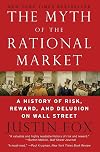
Interesting historical review of the evolution of financial markets, with a behavioral bent that reminded me of the courses delivered by Prof. Shiller (Yale, see oyc.yale.edu, now a Nobel laureate); every model is an abstraction made by people who decide what is relevant ;)
And people, even economists hiding behind formulas, are a constant confirmation of Cipolla's Laws of Human Stupidity: a pile of degrees will not spare you from being conned or deceived- even by yourself, moreover in a show more "science" (as criticised by an LSE professor from Eastern Europe) where you can not only chose, but even make your own facts show less
And people, even economists hiding behind formulas, are a constant confirmation of Cipolla's Laws of Human Stupidity: a pile of degrees will not spare you from being conned or deceived- even by yourself, moreover in a show more "science" (as criticised by an LSE professor from Eastern Europe) where you can not only chose, but even make your own facts show less
The Myth of the Rational Market: A History of Risk, Reward, and Delusion on Wall Street by Justin Fox
A topic of absorbing interest among boys who have grown into men, has been the possibilities of beating the stock market in western capitalist free economies. The author takes us through an absorbing and competent journey, from the early economists like Adam Smith and Ricardo, rhrough the nineteenth-century mathematical students of probabiulity and prediction, the 20th-century periods of despair and optimism between and during the two great world wars, and so to the modern age of computers show more and financial whizz-kids who almost succeeded in destroying the whole financial system. One is impressed by the author's wide knowkedge of the major and minor actors and scholars over these few centuries, and also by his seeming deep understanding, at both the theoretical and the practical levels, of what is to most of us an imcomprehensible mine-field of obscure jargon and lies dressed up as half-truths. A truly erudite and comprehensive introduction to the subject, it can well form a road-map to anyone intending to study it in more depth. show less
The Myth of the Rational Market: A History of Risk, Reward, and Delusion on Wall Street by Justin Fox
The Myth of the Rational Market is an extensive history of the efficient market hypothesis, starting in the late 1800s and continuing all the way through 2008. It covers all the major players, explains the discoveries and theories that lead to the hypothesis, and explains how it came unraveled in the 1980s and beyond. As economics can be, sometimes it was a little hard to keep all the threads aligned in my head. Fox does a fairly admirable job of juggling them all, better than many economics show more texts I’ve read.
It’s rare for me to finish an economics book and feel better informed with information on issues that I actually discuss with friends. Okay, mostly I’m talking about wing-nut friends who like to post "the market is always best" tripe on Facebook or LiveJournal. Now I’ve got the evidence to say "you’re an idiot".
Full review here: http://reading.kingrat.biz/reviews/myth-of-the-rational-market-justin-fox show less
It’s rare for me to finish an economics book and feel better informed with information on issues that I actually discuss with friends. Okay, mostly I’m talking about wing-nut friends who like to post "the market is always best" tripe on Facebook or LiveJournal. Now I’ve got the evidence to say "you’re an idiot".
Full review here: http://reading.kingrat.biz/reviews/myth-of-the-rational-market-justin-fox show less
Lists
Awards


You May Also Like


Statistics
- Works
- 1
- Members
- 540
- Popularity
- #46,138
- Rating
- 3.9
- Reviews
- 9
- ISBNs
- 36
- Languages
- 2