
Susan Mccarthy
Author of When Elephants Weep: The Emotional Lives of Animals
Susan Mccarthy is Susan McCarthy (1). For other authors named Susan McCarthy, see the disambiguation page.
About the Author
Susan McCarthy holds degrees in biology and journalism, writes regularly for Salon.com, and has contributed to Best American Science Writing. She lives in San Francisco
Image credit: Photo by Brady Lea
Works by Susan Mccarthy
Associated Works
Tagged
Common Knowledge
- Gender
- female
- Education
- Reed College (MS|Biology)
University of California, Berkeley (MJ|Journalism) - Occupations
- science writer
journalist - Nationality
- USA
- Places of residence
- San Francisco, California, USA
- Associated Place (for map)
- California, USA
Members
Reviews
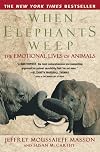
If you have ever loved an animal, shared your life with an animal or wondered just how much the animals we live with have in common with us, here is a book you cannot miss. When Elephants Weep is an eloquent and compelling reminder that one of the traits we share with many other mammals are that we experience our world through emotional response as well as physical response (or at least that the two are inexorably linked). With touching and thought provoking examples and anecdotes, Masson show more presents a strong case for the rich and nuanced emotional life of creatures of than humans, and challenges readers to examine their own resistance to admitting how much we have in common with other living beings, with persons who walk on paws, who sheathe claws, who have flippers and fins. show less
Generally speaking I only like hard science books on animal behaviour and so I put off reading this for a while because I thought it would be fluffy stories of sweet little animals. It didn't help that the author often collaborates on books with Jeffrey Moussaieff, the master of the fluffy animal behavioural tome. However, one day, without any new book to read I thought I would give it a try. It was amazing!
The problem with the strictly-scientific animal behaviour books is that the research show more is generally done in laboratories where the animal lives an extremely deprived life. The problems it is expected to solve are ones that interest people, not necessarily ones that interest a bored animal. (Or person for that matter. I was recently reading of an experiment where the pigeons who got the answers right were rewarded with seeds to eat. They did a lot better than the test group of students who were only rewarded by a sound. Perhaps the students would have scored better given an M&M or gummy bear).
However, if an animal behaviour book is based solely on field and anectodal observation it has a tendency to be tainted with anthropomorphism. Hence my dislike for the overly-emotional Moussaieff books.
This often-amusing and very easy to read book is a mixture of hard science and scientist-gathered field observation and anecdotal reportage. Thus we learn that although gorillas when tested in a laboratory do not recognise themselves in mirrors, one gorilla who had not only a mirror but a video camera and monitor in his room could certainly recognise himself. He liked to eat his food up close to the camera and watch himself in the monitor. Further, he liked to shine a torch down his throat directly under the camera whilst looking in the monitor. Certainly this gorilla could identify himself and perhaps this means that all previous tests on gorillas have been badly-designed. Without this anecdotal information I would forever be thinking that gorillas couldn't recognise themselves.
Each section of the book moves along rapidly, each paragraph contains a gem of research or reportage, everything from the high problem solving abilities of the cannibalistic portia spider to the strange lengths humans sometimes go to in experiments. (In order for Whooping Cranes to avoid imprinting on people, the experimenters dressed up in crane suits, fed the birds with dummy cranes and when leading them on their first migration, the pilot of the plane was dressed in a crane suit too).
If you only ever read one book on animal behaviour and intelligence, make it this one, you will enjoy it. But then, this will hook you so much, it won't be your only one. Now I have to find more books by Susan McCarthy, she's got me hooked. show less
The problem with the strictly-scientific animal behaviour books is that the research show more is generally done in laboratories where the animal lives an extremely deprived life. The problems it is expected to solve are ones that interest people, not necessarily ones that interest a bored animal. (Or person for that matter. I was recently reading of an experiment where the pigeons who got the answers right were rewarded with seeds to eat. They did a lot better than the test group of students who were only rewarded by a sound. Perhaps the students would have scored better given an M&M or gummy bear).
However, if an animal behaviour book is based solely on field and anectodal observation it has a tendency to be tainted with anthropomorphism. Hence my dislike for the overly-emotional Moussaieff books.
This often-amusing and very easy to read book is a mixture of hard science and scientist-gathered field observation and anecdotal reportage. Thus we learn that although gorillas when tested in a laboratory do not recognise themselves in mirrors, one gorilla who had not only a mirror but a video camera and monitor in his room could certainly recognise himself. He liked to eat his food up close to the camera and watch himself in the monitor. Further, he liked to shine a torch down his throat directly under the camera whilst looking in the monitor. Certainly this gorilla could identify himself and perhaps this means that all previous tests on gorillas have been badly-designed. Without this anecdotal information I would forever be thinking that gorillas couldn't recognise themselves.
Each section of the book moves along rapidly, each paragraph contains a gem of research or reportage, everything from the high problem solving abilities of the cannibalistic portia spider to the strange lengths humans sometimes go to in experiments. (In order for Whooping Cranes to avoid imprinting on people, the experimenters dressed up in crane suits, fed the birds with dummy cranes and when leading them on their first migration, the pilot of the plane was dressed in a crane suit too).
If you only ever read one book on animal behaviour and intelligence, make it this one, you will enjoy it. But then, this will hook you so much, it won't be your only one. Now I have to find more books by Susan McCarthy, she's got me hooked. show less

First off, let me say that I am not an animal rights activist. I eat meat regularly, probably daily or close to it, and I think animal experimentation for the advancement of the human race is a positive thing for the most part, unless the experimentation might be considered "cruel."
I am, however, a young man who has spent most of his life surrounded by animals. Growing up in small-town Ohio, I haven't spent a day without a dog by my side since I was about 7 years old. I currently live show more between a corn field and a cow pasture. I've owned dogs, cats, gerbils, even a goat and a ferret once. As a result, I am a firm believer in animal emotions. Anyone who denies the emotions of animals has probably never spent any time around them and thus, has no valid opinion.
But enough about my history with animals, I'm here to review When Animals Weep. If you haven't guessed, it's about the emotions of animals. The authors are clearly passionate about the topic, and fiercely want to demonstrate that animals have emotions. Anyone who has ever owned a dog will immediately agree. From the tail-wagging joy of a dog excited by an owner recently returned from work, to the droopy-eyed sadness of a dog scolded, clearly animals feel at least basic emotions.
The problem with the book, and the authors admit it, is the lack of science behind it. Our only proof of animal emotions is casual observation. You would think that would be plentiful, but the authors also admit that you cannot know what someone or something is feeling just by looking at it/them. If you see a woman on a train with slumping shoulders and a grim look on her face, staring at the floor and sighing, what is she feeling? You might say sadness, but how do you know? Maybe she is disappointed after not getting a promotion at work, or maybe she is lonely. You can't look at her and say "that woman is sad, she must not like to ride trains" and you can't look at a wolf who sticks with his mate to raise his offspring and say he is experiencing "romantic love."
While it's obvious that animals are emotional beings, I don't think you can just look at them and assume they are experiencing the emotion you wish to apply to them. This book uses lots of single events with animals doing odd, out-of-the-ordinary things and applies anthropomorphism to try to convey an emotion, with no way of knowing whether or not that is how the animal is actually feeling. So, while I do agree that animals demonstrate a wide variety of emotions, I didn't always find the authors' examples as relevant or reasonable.
With all that said, I still found the book to be an enjoyable read and I did feel like I left it with a lot more knowledge. Many of the stories were touching and I thoroughly enjoyed reading them. I especially liked the stories describing elephants and apes. I was also captivated but the section about animals that like to draw. While the book lacks a scientific backbone, there is still a lot to be gained from reading this book.
So what's the verdict? While I doubt I would recommend this to people who don't like animals because I don't know if it would do a well enough job of convincing them to believe otherwise, I would certainly recommend this book to just about everyone else! show less
I am, however, a young man who has spent most of his life surrounded by animals. Growing up in small-town Ohio, I haven't spent a day without a dog by my side since I was about 7 years old. I currently live show more between a corn field and a cow pasture. I've owned dogs, cats, gerbils, even a goat and a ferret once. As a result, I am a firm believer in animal emotions. Anyone who denies the emotions of animals has probably never spent any time around them and thus, has no valid opinion.
But enough about my history with animals, I'm here to review When Animals Weep. If you haven't guessed, it's about the emotions of animals. The authors are clearly passionate about the topic, and fiercely want to demonstrate that animals have emotions. Anyone who has ever owned a dog will immediately agree. From the tail-wagging joy of a dog excited by an owner recently returned from work, to the droopy-eyed sadness of a dog scolded, clearly animals feel at least basic emotions.
The problem with the book, and the authors admit it, is the lack of science behind it. Our only proof of animal emotions is casual observation. You would think that would be plentiful, but the authors also admit that you cannot know what someone or something is feeling just by looking at it/them. If you see a woman on a train with slumping shoulders and a grim look on her face, staring at the floor and sighing, what is she feeling? You might say sadness, but how do you know? Maybe she is disappointed after not getting a promotion at work, or maybe she is lonely. You can't look at her and say "that woman is sad, she must not like to ride trains" and you can't look at a wolf who sticks with his mate to raise his offspring and say he is experiencing "romantic love."
While it's obvious that animals are emotional beings, I don't think you can just look at them and assume they are experiencing the emotion you wish to apply to them. This book uses lots of single events with animals doing odd, out-of-the-ordinary things and applies anthropomorphism to try to convey an emotion, with no way of knowing whether or not that is how the animal is actually feeling. So, while I do agree that animals demonstrate a wide variety of emotions, I didn't always find the authors' examples as relevant or reasonable.
With all that said, I still found the book to be an enjoyable read and I did feel like I left it with a lot more knowledge. Many of the stories were touching and I thoroughly enjoyed reading them. I especially liked the stories describing elephants and apes. I was also captivated but the section about animals that like to draw. While the book lacks a scientific backbone, there is still a lot to be gained from reading this book.
So what's the verdict? While I doubt I would recommend this to people who don't like animals because I don't know if it would do a well enough job of convincing them to believe otherwise, I would certainly recommend this book to just about everyone else! show less
A thoughtprovoking analysis of the science, or the lack thereof, regarding emotions in non-human animals. Raises interesting questions about where we (mankind) draw our conclusions about animal intelligence. Contains several intriguing examples of the double standards applied to humans and animals, especially mammals, when looking for "proof" of complex emotions such as love, mourning, altruism, shame, etc. The authors also discuss some of the underlying reasons (fear of being labeled show more anthropomorphic being one) which prevent more research from being done in this field. Whichever side of the animal rights issue you're on, it is a compelling read. Warning: There are some
brief, but graphic, discussions of various experiments conducted on animals that may not be suitable for all readers. show less
brief, but graphic, discussions of various experiments conducted on animals that may not be suitable for all readers. show less
Lists
Awards

You May Also Like


Associated Authors
Statistics
- Works
- 3
- Also by
- 1
- Members
- 1,666
- Popularity
- #15,408
- Rating
- 3.7
- Reviews
- 22
- ISBNs
- 38
- Languages
- 9