
Richard Reeves (1) (1936–2020)
Author of President Kennedy: Profile of Power
For other authors named Richard Reeves, see the disambiguation page.
About the Author
Richard Reeves is a syndicated columnist and teaches at the Annenberg School for Communication at the University of Southern California. He lives in Washington, D.C. and New York. (Bowker Author Biography)
Image credit: Truthdig
Works by Richard Reeves
Infamy: The Shocking Story of the Japanese American Internment in World War II (2015) 286 copies, 21 reviews
Daring Young Men: The Heroism and Triumph of The Berlin Airlift-June 1948-May 1949 (2010) 237 copies, 3 reviews
American Journey: Traveling With Tocqueville in Search of Democracy in America (1982) 134 copies, 1 review
Associated Works
Character Above All: Ten Presidents from FDR to George Bush (1996) — Contributor — 120 copies, 2 reviews
The Warren Commission Report: A Graphic Investigation into the Kennedy Assassination (2014) — Foreword — 59 copies, 3 reviews
Tagged
Common Knowledge
- Legal name
- Reeves, Richard Furman
- Birthdate
- 1936-11-28
- Date of death
- 2020-03-25
- Gender
- male
- Education
- Stevens Institute of Technology
- Occupations
- journalist
biographer
non-fiction author
professor (Journalism) - Organizations
- University of Southern California
- Nationality
- USA
- Birthplace
- New York, New York, USA
- Place of death
- Los Angeles, California, USA
- Associated Place (for map)
- USA
Members
Reviews
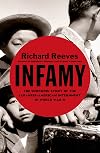
I was never taught as a part of my school curriculum about the incarceration of more than 120,000 Japanese and Japanese Americans on United States soil during World War II. I found out about it quite by accident while visiting an American history museum. I was astounded and continue to be astounded that so many U.S. citizens never learn about that particular part of the war, which is why I believe books like Richard Reeves' Infamy: The Shocking Story of the Japanese American Internment in show more World War II are so important. Reeves is an award-winning journalist and best-selling author of more than a dozen long-form works on American politics and history. Infamy, published by Henry Holt and Company in 2015, is a book that he had wanted to write for years. I was very happy to have the opportunity to read an advance copy of the work.
In Infamy, Reeves explores the history of Japanese residents of the United States and Japanese American citizens during World War II. While a large focus of the book is on their evacuation from the West Coast and their internment within concentration camps, the work also devotes some time to the efforts made by the U.S. government to relocate and detain people of Japanese descent living in Latin America (which before reading Infamy I had not known about), as well as to the service of Japanese Americans in the military as translators, support personnel, and combatants. The narrative of Infamy is largely chronological, beginning with Japan's attack on Pearl Harbor in December 1941 and the signing of Executive Order 9066 soon after in February 1942, which allowed for the establishment of the camps, and ending with V-J Day in August 1945, going on to examine some of the immediate and lasting impacts the internment had on individuals and on the country as a whole.
In writing Infamy, Reeves relies heavily on existing interviews, newspaper articles, and first-hand accounts as well as on official government and court documentation. Infamy is only one among hundreds of works about the Japanese American internment; its extensive notes and bibliography will aid in guiding readers who are interested in learning more to other sources. Stylistically, Infamy is intended for a broad, general audience. It's approachable, engaging, and easy to read, requiring very little previous knowledge of the subject matter. However, readers looking for an academic or impartial approach will likely be disappointed—Reeves has very strong feelings about the people and events surrounding the internment. While Infamy is factual, Reeve's personal opinions on the matter are readily clear in his writing; he is outraged and it shows. Initially I had worried the work would be sensationalistic—the subtitle isn't just "the story of" but "the shocking story of"—but it's more that Reeves is simply emphatic.
Many factors led to the Japanese American internment during World War II, but the two most prominent to be addressed in Infamy are racism—something that the United States continues to struggle with—and the additional fear and hysteria cause by the war itself. While some German and Italian American citizens and resident aliens were detained, those of Japanese descent were the only ones to be imprisoned or forced to relocate en masse and nearly all of them were innocent of any wrong-doing. In addition to racial tensions, generational conflict was also a significant component that complicated the mass imprisonment. The different generations of Japanese Americans experienced the war and the camps differently, but they were all betrayed by the country in which they lived. Reeves makes a point to address those differences in Infamy in addition to other aspects of the internment. Overall, Infamy is both a readable and informative examination of a part of American history that shouldn't be forgotten but that is often overlooked.
Experiments in Manga show less
In Infamy, Reeves explores the history of Japanese residents of the United States and Japanese American citizens during World War II. While a large focus of the book is on their evacuation from the West Coast and their internment within concentration camps, the work also devotes some time to the efforts made by the U.S. government to relocate and detain people of Japanese descent living in Latin America (which before reading Infamy I had not known about), as well as to the service of Japanese Americans in the military as translators, support personnel, and combatants. The narrative of Infamy is largely chronological, beginning with Japan's attack on Pearl Harbor in December 1941 and the signing of Executive Order 9066 soon after in February 1942, which allowed for the establishment of the camps, and ending with V-J Day in August 1945, going on to examine some of the immediate and lasting impacts the internment had on individuals and on the country as a whole.
In writing Infamy, Reeves relies heavily on existing interviews, newspaper articles, and first-hand accounts as well as on official government and court documentation. Infamy is only one among hundreds of works about the Japanese American internment; its extensive notes and bibliography will aid in guiding readers who are interested in learning more to other sources. Stylistically, Infamy is intended for a broad, general audience. It's approachable, engaging, and easy to read, requiring very little previous knowledge of the subject matter. However, readers looking for an academic or impartial approach will likely be disappointed—Reeves has very strong feelings about the people and events surrounding the internment. While Infamy is factual, Reeve's personal opinions on the matter are readily clear in his writing; he is outraged and it shows. Initially I had worried the work would be sensationalistic—the subtitle isn't just "the story of" but "the shocking story of"—but it's more that Reeves is simply emphatic.
Many factors led to the Japanese American internment during World War II, but the two most prominent to be addressed in Infamy are racism—something that the United States continues to struggle with—and the additional fear and hysteria cause by the war itself. While some German and Italian American citizens and resident aliens were detained, those of Japanese descent were the only ones to be imprisoned or forced to relocate en masse and nearly all of them were innocent of any wrong-doing. In addition to racial tensions, generational conflict was also a significant component that complicated the mass imprisonment. The different generations of Japanese Americans experienced the war and the camps differently, but they were all betrayed by the country in which they lived. Reeves makes a point to address those differences in Infamy in addition to other aspects of the internment. Overall, Infamy is both a readable and informative examination of a part of American history that shouldn't be forgotten but that is often overlooked.
Experiments in Manga show less
 This review was written for LibraryThing Early Reviewers.
This is really an outstanding book that I received as an ARC through the Early Reviewers program. Books like this matter more than most. The time in 20th century American History when we had our own concentration camps was pretty well buried if not overtly hidden. No one talked about it. I was more than a little surprised to discover later in life that the small town I grew up in had a detention center from 1942-1946. As a child I wondered about the odd Quonset Huts near the archery range show more that were pretty much all that remained but had no idea until I discovered their history decades later. Perhaps much of younger America first learned of the internment of Japanese Americans in middle school reading "Farewell To Manzanar" which was published in 1973 and is one of the most well known books on the subject.
Reeves' book seems exceptionally well researched and tries to summarize and help us come to terms with how this happened in America. He lets us see from both sides of the barbed wire. I learned a lot from this book. I can recommend this book to any reader with even a casual interest in the subject. It deserves a wider audience than that, however. This is an important book. Perhaps the people who should read it are those who are entirely unaware of what can and did happen in America. I think one of the best points Reeves makes is found in his introduction, which I will quote here:
"The story of the "Japanese Internment," as it is usually called, is a tale of the best and worst in America. I learned, I think, that what pushes America forward and expands our liberty is not the old Anglo-Saxon Protestant views of the Founders, but the almost blind faith of each wave of immigrants-including the ones we put behind barbed wire. The Germans. The Irish. The Italians. The Jews. The Chinese. The Japanese. The latinos. The South Asians. The African-Americans. We are not only a nation of immigrants. We are a nation made by immigrants, foreigners who were needed for their labor and skills and faith-but were often hated because they were not like us until they were us."
I like that line "because they were not like us until they were us."
Reading this book I got angry. Very angry. This story is frightening, detailing how quickly racism, fear, and increasingly greed created a hysteria that spread from the West Coast. There are some true villains in this story, some big, some small. Reeves does an excellent job with some surprising examples (Dr Seuss?!) of the spread of the poison sentiment. This is a very sad time in American History when the constitutional rights of American citizens were completely ignored. We move through each stage of the internment, and see the valuable service that many Japanese Americans still performed in military intelligence and the armed forces. In the end we have an epilogue and see the remorse that came to so many of the perps, perhaps most poignantly that of a weeping Chief Justice Earl Warren. We see the ugly side of America and Americans.
When I started reading this I did not want to put it down. It is that kind of book. Recommended. show less
Reeves' book seems exceptionally well researched and tries to summarize and help us come to terms with how this happened in America. He lets us see from both sides of the barbed wire. I learned a lot from this book. I can recommend this book to any reader with even a casual interest in the subject. It deserves a wider audience than that, however. This is an important book. Perhaps the people who should read it are those who are entirely unaware of what can and did happen in America. I think one of the best points Reeves makes is found in his introduction, which I will quote here:
"The story of the "Japanese Internment," as it is usually called, is a tale of the best and worst in America. I learned, I think, that what pushes America forward and expands our liberty is not the old Anglo-Saxon Protestant views of the Founders, but the almost blind faith of each wave of immigrants-including the ones we put behind barbed wire. The Germans. The Irish. The Italians. The Jews. The Chinese. The Japanese. The latinos. The South Asians. The African-Americans. We are not only a nation of immigrants. We are a nation made by immigrants, foreigners who were needed for their labor and skills and faith-but were often hated because they were not like us until they were us."
I like that line "because they were not like us until they were us."
Reading this book I got angry. Very angry. This story is frightening, detailing how quickly racism, fear, and increasingly greed created a hysteria that spread from the West Coast. There are some true villains in this story, some big, some small. Reeves does an excellent job with some surprising examples (Dr Seuss?!) of the spread of the poison sentiment. This is a very sad time in American History when the constitutional rights of American citizens were completely ignored. We move through each stage of the internment, and see the valuable service that many Japanese Americans still performed in military intelligence and the armed forces. In the end we have an epilogue and see the remorse that came to so many of the perps, perhaps most poignantly that of a weeping Chief Justice Earl Warren. We see the ugly side of America and Americans.
When I started reading this I did not want to put it down. It is that kind of book. Recommended. show less
This review was written for LibraryThing Early Reviewers.Revised Review April 21, 2015:
Infamy Best "Big Picture" History A Reader Could Hope to Find -- Concisely Details Causes, Human Impact & Present Significance of Great Injustice with Passion & Clarity
I. Why I Read This Book --
Because of the gravity and continued relevance today of the issues raised by our country's disgraceful treatment of Japanese-American citizens under color of law during WWII, I was immediately drawn to this book when I saw it listed among the titles available in a recent show more Early Reviewer giveaway. I studied the Supreme Court case failing to invalidate the "internment" program under the Constitution in law school (i.e. Korematsu). However I didn't know any of the details of the policy's development and enforcement -- let alone the experience of the people forced from their homes and collected in concentration camps (that was the name used in government documents apparently -- the term was not linked with the Nazi genocide program directly at that time). I wanted to know more.
II. My Personal Opinion After Reading --
Ultimately, author Richard Reeves did more than satisfy my intellectual curiosity with an engaging, accessible and concise history of the key events. However, these qualities would not suffice to constitute an outstanding history. Reeves managed to accomplish what I think is the more difficult and more important work of the historian -- to give the reader a fuller, more palpable and cognizable sense of the toll on human dignity involved in what happened. He achieved this due to the combined effects of two strengths of this history:
1) The reader got a textured sense of the impact of the incarceration on the substance and quality of daily life of the people affected and on individuals' lifetimes, which was tantamount to stealing years of time from the totality of human beings' experience on this earth! This is to say nothing of the disruptions to the pursuit of life, liberty and happiness of each victim that could not be remedied upon release from internment. Lives could not be picked up and continued as if nothing had happened, to grossly understate the matter. This history makes sure readers get some understanding of what that specifically meant in individual victims' post-war lives. Through reading this book, one way readers can better appeciate the injustice done to Japanese Americans by their government during this period.due to this wise choice to particularly focus on its human impact despite the book's relative brevity. Different histories might have focused primarily on explication of the causes and machinations of state that made the injustices possible as well as detailing exactly what (as well as how,.why, where and to whom) it happened. Rather than going into further analysis of the unfolding of this awful chain of events, Reeves balanced his history with a sense of the lives impacted by the events at issue.
2) Granted I came to this book with a deep sense of personal outrage at what my country's governemnt did -- as an American and as a human being. But, I think that the second way this history does an outstanding job of presenting the breadth, depth and sheer grievousness of what happened is Reeves's own contagious passion -- which is appropriately contained between the lines, yet constant throughout -- about what happened. Because Reeves does not assume a false neutrality to the question of whether actions taken which effectuated this chain of events were right or wrong, he does an outstanding job on maintaining a laser like focus on what is most important. I, for one, couldn't ask for a better big picture from a historian.
This book effectively argues that what was done during WWII in the western part of the United States to some people on the sole basis of personal connections to Japan through ancestral descent and/or nativity, are deeds which should most properly -- most vitally -- live ever on in infamy among the people of this country and every country.
III. My Thoughts for Prospective Readers
In conclusion, I will go so far as to say that whatever you think of the title when you start reading, you will probably better appreciate the relative fitness of the choice when you finish. I personally think this is an outstanding contribution to American historical discourse that should reach as many people as possible of every nationality. I’ve set forth some of its particular strengths that distinguish it from the pack, IMHO, for your consideration...
But for reallies, who the heck am I to estimate your final valuation of a purely hypothetical reading of some book I happen to love? This is the rub: the good people at LibraryThing's Early Reviewers program gave me a free copy of this gem to read on the condition that I'd share my honest impressions in a review posted on their site. I have always thought in such cases: “Why not copy to Goodreads and Amazon?” I figure it couldn't do any great harm. So here we are. Thank you for considering my ideas, and in all seriousness, I really hope they prove useful to some of you. show less
Infamy Best "Big Picture" History A Reader Could Hope to Find -- Concisely Details Causes, Human Impact & Present Significance of Great Injustice with Passion & Clarity
I. Why I Read This Book --
Because of the gravity and continued relevance today of the issues raised by our country's disgraceful treatment of Japanese-American citizens under color of law during WWII, I was immediately drawn to this book when I saw it listed among the titles available in a recent show more Early Reviewer giveaway. I studied the Supreme Court case failing to invalidate the "internment" program under the Constitution in law school (i.e. Korematsu). However I didn't know any of the details of the policy's development and enforcement -- let alone the experience of the people forced from their homes and collected in concentration camps (that was the name used in government documents apparently -- the term was not linked with the Nazi genocide program directly at that time). I wanted to know more.
II. My Personal Opinion After Reading --
Ultimately, author Richard Reeves did more than satisfy my intellectual curiosity with an engaging, accessible and concise history of the key events. However, these qualities would not suffice to constitute an outstanding history. Reeves managed to accomplish what I think is the more difficult and more important work of the historian -- to give the reader a fuller, more palpable and cognizable sense of the toll on human dignity involved in what happened. He achieved this due to the combined effects of two strengths of this history:
1) The reader got a textured sense of the impact of the incarceration on the substance and quality of daily life of the people affected and on individuals' lifetimes, which was tantamount to stealing years of time from the totality of human beings' experience on this earth! This is to say nothing of the disruptions to the pursuit of life, liberty and happiness of each victim that could not be remedied upon release from internment. Lives could not be picked up and continued as if nothing had happened, to grossly understate the matter. This history makes sure readers get some understanding of what that specifically meant in individual victims' post-war lives. Through reading this book, one way readers can better appeciate the injustice done to Japanese Americans by their government during this period.due to this wise choice to particularly focus on its human impact despite the book's relative brevity. Different histories might have focused primarily on explication of the causes and machinations of state that made the injustices possible as well as detailing exactly what (as well as how,.why, where and to whom) it happened. Rather than going into further analysis of the unfolding of this awful chain of events, Reeves balanced his history with a sense of the lives impacted by the events at issue.
2) Granted I came to this book with a deep sense of personal outrage at what my country's governemnt did -- as an American and as a human being. But, I think that the second way this history does an outstanding job of presenting the breadth, depth and sheer grievousness of what happened is Reeves's own contagious passion -- which is appropriately contained between the lines, yet constant throughout -- about what happened. Because Reeves does not assume a false neutrality to the question of whether actions taken which effectuated this chain of events were right or wrong, he does an outstanding job on maintaining a laser like focus on what is most important. I, for one, couldn't ask for a better big picture from a historian.
This book effectively argues that what was done during WWII in the western part of the United States to some people on the sole basis of personal connections to Japan through ancestral descent and/or nativity, are deeds which should most properly -- most vitally -- live ever on in infamy among the people of this country and every country.
III. My Thoughts for Prospective Readers
In conclusion, I will go so far as to say that whatever you think of the title when you start reading, you will probably better appreciate the relative fitness of the choice when you finish. I personally think this is an outstanding contribution to American historical discourse that should reach as many people as possible of every nationality. I’ve set forth some of its particular strengths that distinguish it from the pack, IMHO, for your consideration...
But for reallies, who the heck am I to estimate your final valuation of a purely hypothetical reading of some book I happen to love? This is the rub: the good people at LibraryThing's Early Reviewers program gave me a free copy of this gem to read on the condition that I'd share my honest impressions in a review posted on their site. I have always thought in such cases: “Why not copy to Goodreads and Amazon?” I figure it couldn't do any great harm. So here we are. Thank you for considering my ideas, and in all seriousness, I really hope they prove useful to some of you. show less
This review was written for LibraryThing Early Reviewers.My initial thought about Infamy was Why another book about the internment of Japanese-Americans during WWII? There have been hundreds of books and articles about this stain on American justice and the over-reaction of the Japanese attack on Pearl Harbor in 1941. Richard Reeves addresses this issue in the introduction—the “imprisonment” or “internment” or “forced evacuation” of 120,000 Japanese-Americans, many of them US citizens is really a look at the “dark side” of show more America. History, does in fact, seem to be repeating itself. Maybe not to the extent that resulted in these camps being established, but certainly there is a long-standing history of resistance to immigrants in the US. What Reeves does well is tell the individual stories of those Japanese-Americans incarcerated by the military at the height of the anti-Japanese movement. While in some ways it is difficult to criticize our policy in the fog of war, it is apparent that the Japanese-Americans never posed a threat to US security. This was known long before these camps were dismantled. It is difficult to know what would have happened to this group had they not been interned. Clearly there was a serious case of Japanese-phobia, particularly on the West coast. Some may still argue it was done for their protection. Maybe, but the important story from this book is that we discriminated against an entire class of people in a most primitive way. Racism and war hysteria played the dominant role—this book provides a better understanding of the what happened and a warning that it could happen again. show less
This review was written for LibraryThing Early Reviewers.Lists
Awards


You May Also Like


Associated Authors
Statistics
- Works
- 18
- Also by
- 3
- Members
- 2,137
- Popularity
- #12,039
- Rating
- 3.8
- Reviews
- 36
- ISBNs
- 82
- Languages
- 6
