
Joan Robinson (1) (1903–1983)
Author of Economic Philosophy
For other authors named Joan Robinson, see the disambiguation page.
About the Author
British economist Joan Robinson was widely recognized for her work in monopolistic competition and capital theory. Born Joan Maurice in Chamberley, Surrey, she was educated at Girton College, Cambridge. In 1926 she married Austin Robinson, a Cambridge economist. In 1931 Joan Robinson received an show more appointment at Cambridge, and she remained there until 1971, succeeding her husband as a professor of economics in 1965. Robinson's most famous work, The Economics of Imperfect Competition (1933), was intended to bridge the gap between the two main types of market structures in economics---perfect competition and monopoly. Her solution was to propose a type of industry structure called monopolistic competition in which an industry would have a number of small producers, each behaving as if it were monopolistic even though its actions affected, and were affected by, the actions of its competitors. The concept of monopolistic competition, which was also proposed by Harvard economist Edward Chamberlin at the same time, was a major advance in the field of economics. Both Robinson and Chamberlin spent years defending and distinguishing their versions of the concept. Most treatments of the topic today involve elements of both, although purists give a slight edge to Chamberlin. Robinson was one of the early champions of the Keynesian revolution with her Introduction to the Theory of Employment (1937). She also wrote the classic, Essay on Marxian Economics, in which she pointed out many of the pre-Keynesian concepts in Marx's Das Kapital. Her works The Rate of Interest and Other Essays (1953) and The Accumulation of Capital (1956) attempted to develop a Keynesian approach to long-run equilibrium growth. At about the time that these were written, she thought she had discovered a flaw in the accepted theory of capital, which launched the acrimonious "Cambridge controversies" debate, so named because it involved both Cambridge University in England and Harvard University in Cambridge, Massachusetts. Much later in her career, Robinson rebelled against the prevailing economic theories that relied on comparative static analysis, and she presented her views in Economic Philosophy (1962), Economics---An Awkward Corner 1966), and An Introduction to Modern Economics (1973). Toward the end of her career, she became increasingly radical, expressing admiration for the economic systems of China under Mao Tse-Tung (see Vol. 2), and North Korea under Kim-Sung. Few economists followed her lead, however, and despite her early reputation, she finished her career on the fringes of mainstream economics. (Bowker Author Biography) show less
Image credit: Joan Robinson in 1973
Works by Joan Robinson
Marx vivo: la presenza di Karl Marx nel pensiero contemporaneo (1969) — Contributor — 4 copies, 1 review
Notes from China 3 copies
Reports from China: 1953-1976 3 copies
ENSAYOS DE ECONOMIA POSKEYNESIANA 2 copies
Marx, Marshall and Keynes 1 copy
Appendix: A Model of Models 1 copy
Kina: økonomi og samfund 1 copy
Reflections on the theory of international trade : lectures given in the University of Manchester (1974) 1 copy
Associated Works
The Chinese Road to Socialism: Economics of the Cultural Revolution (1970) — Foreword, some editions — 55 copies
Socialism, Capitalism and Economic Growth: Essays Presented to Maurice Dobb (1975) — Contributor — 5 copies
Tagged
Common Knowledge
- Canonical name
- Robinson, Joan
- Legal name
- Robinson, Joan Violet
- Other names
- Maurice, Joan Violet (birth)
- Birthdate
- 1903-10-31
- Date of death
- 1983-08-05
- Gender
- female
- Education
- University of Cambridge (Girton College)
- Occupations
- economist
professor - Organizations
- Université de Cambridge, Girton College (Professeur ∙ Economie, 1965)
Université de Cambridge, Newnham College (Professeur ∙ Economie, 1962) - Awards and honors
- British Academy (Fellow, 1958)
American Academy of Arts & Sciences (International Honorary Member, 1964) - Relationships
- Robinson, Austin (Epoux, 1926)
Barton Maurice, Frederik (Père)
Marsh, Frederick Howard (Grand-père)
Marsh, Edward (Grand-oncle)
Keynes, John Maynard (Directeur de thèse) - Nationality
- UK
- Birthplace
- Surrey, England, UK
- Place of death
- Cambridge, Cambridgeshire, England, UK
- Associated Place (for map)
- England, UK
Members
Reviews
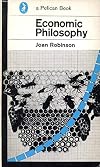
The advantage is that this is a short book; however it is not a systematic exposition of economic thinking for the uninitiated. It reads more like a literary appraisal, full of allusions and metaphors that may make sense if you already have studied the great economic thinkers, Adam Smith, Ricardo, Malthus, Marshall, Pigou and the rest. The last chapter is more topical, debunking the tall claims made by free-market open-borders free-trade protagonists.
Marx vivo: la presenza di Karl Marx nel pensiero contemporaneo : Volume primo Filosofia e metodologia : Volume secondo Sociologia ed economia by Mario Spinella

Due volumi per raccogliere i saggi scritti per il Simposio "Il ruolo di Marx nello sviluppo del pensiero scientifico contemporaneo" con gli auspici dell'UNESCO a Parigi l'8-10 maggio 1968 a cura del Consiglio internazionale per la filosofia e le scienze umane e dal Consiglio internazionale di scienze sociali per il 150° anniversario della nascita di Karl Marx. Il primo è su filosofia e metodologa e il secondo su sociologia ed economia. Il primo volume conserva la sua freschezza e si show more possono leggere tutte le faglie che attraversano il marxismo negli anni che portano al '68, in specie per il rapporto con lo strutturalismo. show less
Dec 16, 2023Italian
You May Also Like


Associated Authors
Statistics
- Works
- 48
- Also by
- 3
- Members
- 644
- Popularity
- #39,180
- Rating
- 3.3
- Reviews
- 3
- ISBNs
- 108
- Languages
- 9
- Favorited
- 1
