
David Kelley (1) (1949–)
Author of The Art of Reasoning
For other authors named David Kelley, see the disambiguation page.
About the Author
David Kelley is the executive director of The Objectivist
Works by David Kelley
Laissez Parlez: Freedom in the Electronic Media (Current Issues in the American West) (1985) 4 copies, 1 review
The Best Within Us 1 copy
Tagged
Common Knowledge
- Birthdate
- 1949
- Gender
- male
- Short biography
- David Kelley, Ph.D., is the founder of The Atlas Society in Washington, DC, which promotes open Objectivism, the philosophy originated by novelist and philosopher Ayn Rand.
He is an internationally-known expert in Ayn Rand's philosophy of Objectivism. A former college professor of philosophy, he has written and lectured extensively on issues in epistemology, ethics, politics, social issues, and public policy. He has also been a consultant to the film adaptation of Ayn Rand's Atlas Shrugged. - Nationality
- USA
- Associated Place (for map)
- USA
Members
Reviews

In rating and reviewing what is in effect a textbook I ask, could I study this on my own and master a subject? In this case, I think the answer is yes. This is clear, readable, and includes useful and well-designed exercises to drive the lessons home. As Kelley puts in it in the introduction: "This is a book about thinking. It's a book about how to think." Mastering logic is definitely useful in promoting clear thinking, and in evaluating and shaping convincing arguments. It's useful in show more particular in evaluating articles and books in subjects you don't know well. You might not have the expertise to evaluate many of the factual claims, but at least you can spot faulty reasoning. I should admit up front I picked this particular book because I knew author David Kelley as both a solid in scholarship and trained academic (he was a professor at Vassar at the time this book was published) and because I knew that like me, he was an admirer of Ayn Rand. He's upfront about his debt to her in his preface. Just as for me this was an attraction, some might find this point a turn-off. Which would be a shame, because I do think this book is an objective and strong presentation on the discipline.
Part One, "Concepts and Propositions" seemed rather elementary, even simplistic to me--I had absorbed these concepts long before. But it's a strength of Kelley's pedagogy that he goes step by step starting with the fundamentals and taking nothing for granted. It's Part Two, "Arguments," Part Three, "Classical Deductive Logic" and Part Five, "Inductive Logic" I find the most useful, at least in reviewing the art of the argument. Particularly useful is the chapter on "Fallacies"--encapsulated in a list on page 133. Part Four is the most difficult and esoteric, where Kelley goes into such advanced topics as symbolic logic. The layman might find this too much information--it's not a tool kit used by many other than professional philosophers. But for what it's worth, I can't imagine a better presentation. show less
Part One, "Concepts and Propositions" seemed rather elementary, even simplistic to me--I had absorbed these concepts long before. But it's a strength of Kelley's pedagogy that he goes step by step starting with the fundamentals and taking nothing for granted. It's Part Two, "Arguments," Part Three, "Classical Deductive Logic" and Part Five, "Inductive Logic" I find the most useful, at least in reviewing the art of the argument. Particularly useful is the chapter on "Fallacies"--encapsulated in a list on page 133. Part Four is the most difficult and esoteric, where Kelley goes into such advanced topics as symbolic logic. The layman might find this too much information--it's not a tool kit used by many other than professional philosophers. But for what it's worth, I can't imagine a better presentation. show less
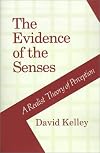
The title and subtitle signal what this book is about: The Evidence of the Senses: A Realist Theory of Perception. That is, this is a work of epistemology: the branch of philosophy that covers knowledge--what it is, how we know what we know and how we can be sure of it. The back cover describes this book as a defense of "realism" and presents an argument that "perception is the discrimination of objects as entities, that the awareness of these objects is direct, and that perception is a show more reliable foundation for empirical knowledge.
Right up front in the Acknowledgments Kelley admits a debt to Ayn Rand, who he calls "the philosopher who had the greatest influence on my thinking about perception." That's a brave thing to do--even to acknowledge she's worthy of the name philosopher considering now many hold her in disdain. Kelley has the academic creds she lacked though--he's taught philosophy and cognitive science at the university level. He's a serious scholar, and this is a serious book on one of the thorniest subjects in philosophy. I'm not claiming parts aren't a slog. But Kelley's not just a lucid thinker but a lucid writer--and I think anyone curious about this subject will find reading this worthwhile. My one caveat is that given this was written in 1986, I wonder if more recent developments in cognitive science might have changed or refined his arguments. show less
Right up front in the Acknowledgments Kelley admits a debt to Ayn Rand, who he calls "the philosopher who had the greatest influence on my thinking about perception." That's a brave thing to do--even to acknowledge she's worthy of the name philosopher considering now many hold her in disdain. Kelley has the academic creds she lacked though--he's taught philosophy and cognitive science at the university level. He's a serious scholar, and this is a serious book on one of the thorniest subjects in philosophy. I'm not claiming parts aren't a slog. But Kelley's not just a lucid thinker but a lucid writer--and I think anyone curious about this subject will find reading this worthwhile. My one caveat is that given this was written in 1986, I wonder if more recent developments in cognitive science might have changed or refined his arguments. show less

Philosophy is for people who want to learn about the basis of objective reality. A theory of perception grounded in the reality of our senses is explained in this book.
Lists
Awards

You May Also Like


Statistics
- Works
- 19
- Members
- 511
- Popularity
- #48,531
- Rating
- 4.1
- Reviews
- 9
- ISBNs
- 54
- Languages
- 5