
Leonard Peikoff
Author of Objectivism: The Philosophy of Ayn Rand
About the Author
Leonard Peikoff is the preeminent Rand scholar writing today. He worked closely with Ayn Rand in New York City for thirty years and was designated by her as heir to her estate. He has taught philosophy at several places, including Hunter College and New York University. Dr. Peikoff is the author of show more The DIM Hypothesis, The Ominous Parallels, and Objectivism: The Philosophy of Ayn Rand. He grew up in Western Canada and now lives in Southern California. show less
Works by Leonard Peikoff
Teaching Johnny to Think: A Philosophy of Education Based on the Principles of Ayn Rand's Objectivism (2014) 15 copies
"Religion Versus America" 6 copies
Medicine, the death of a profession 6 copies
Why Act on Principle? 3 copies
Health Care Is Not A Right 3 copies
The Art of Thinking 2 copies
The Analytic-Synthetic Dichotomy 2 copies
Assault From the Ivory Tower 1 copy
Religion vs. America 1 copy
Question & Answer 1 copy
What To Do About Crime 1 copy
Love, Sex, and Romance 1 copy
Some Notes About Tomorrow 1 copy
A Rational Curriculum 1 copy
Can Capitalism Survive? 1 copy
Founders of Western Philosophy: Thales to Hume, Lecture 4, A Revolution: The Birth of Reason, Part 1 1 copy
Philosophy of Education 1 copy
"What to Do about Crime" 1 copy
Associated Works
Tagged
Common Knowledge
- Birthdate
- 1933-10-15
- Gender
- male
- Education
- University of Manitoba, Winnipeg, Manitoba, Canada
New York University - Occupations
- philosopher
- Organizations
- Ayn Rand Institute (founder)
- Short biography
- The heir to Ayn Rand's estate, still owns her copyrights.
- Nationality
- Canada (birth)
USA (naturalized) - Birthplace
- Winnipeg, Manitoba, Canada
- Places of residence
- New York, New York, USA
- Associated Place (for map)
- Winnipeg, Manitoba, Canada
Members
Reviews
The Ominous Parallels: A Brilliant Study of America Today - and the 'ominous parallels' with the chaos of pre-Hitler Germany by Leonard Peikoff
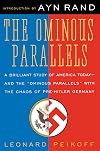
I am currently about 2/3 of the way through the book and find it fascinating reading. Though I am a fan of Romanticism (at least the literary movement) I cannot help but be intrigued by the argument that Romanticism, as the "enemy of Reason," is dangerous. Certainly I could always see the danger in losing oneself in sublime fantasy, but not until being introduced to Ayn Rand, and subsequently Peikoff, had I ever considered the the possibility of Romanticism being "Nazi Dangerous."
Though show more aware of the Nazi's use (or perversion) of the romantic and the spiritual, it had never occurred to me to see such an explicit connection between Romanticism and dictatorship before discovering the works of Ayn Rand. Peikoff writes like he must be Rand's star pupil (or disciple). Both of them are very persuasive, logically impeccable writers. The fact that I don't necessarily buy into their masterfully crafted arguments, but absolutely love reading them, and even getting caught up in the message, is testament to the respect I have for their take- no-prisoners, rhetorically utilitarian writing style -and yes, there is definitely a style, just not for its own sake.
Something I would like to thank Peikoff for in particular is the crash course in philosophy through which "The Ominous Parallels" takes the reader. Not having been a Philosophy major (but still something of an enthusiast) I am able to appreciate this book in part as a bibliographic essay in the major schools of Western Philosophy (particularly German).
In pursuing the works of Plato-Kant-Hegel, Aristotle, etc., I may find that I do not necessarily agree with Peikoff's assessment of their worth, but having such a concrete starting point from which to venture towards my own conclusions is immensely helpful.
Most "Intro to..." philosophy books are so noncommittal in terms of assessment or evaluation that it is difficult for the lay philosophy student to come away with anything more than a list of vague bullet points about their subject that might be helpful on the matching section of a class quiz, but not particularly useful in acquainting the student with the philosophers or philosophies themselves. show less
Though show more aware of the Nazi's use (or perversion) of the romantic and the spiritual, it had never occurred to me to see such an explicit connection between Romanticism and dictatorship before discovering the works of Ayn Rand. Peikoff writes like he must be Rand's star pupil (or disciple). Both of them are very persuasive, logically impeccable writers. The fact that I don't necessarily buy into their masterfully crafted arguments, but absolutely love reading them, and even getting caught up in the message, is testament to the respect I have for their take- no-prisoners, rhetorically utilitarian writing style -and yes, there is definitely a style, just not for its own sake.
Something I would like to thank Peikoff for in particular is the crash course in philosophy through which "The Ominous Parallels" takes the reader. Not having been a Philosophy major (but still something of an enthusiast) I am able to appreciate this book in part as a bibliographic essay in the major schools of Western Philosophy (particularly German).
In pursuing the works of Plato-Kant-Hegel, Aristotle, etc., I may find that I do not necessarily agree with Peikoff's assessment of their worth, but having such a concrete starting point from which to venture towards my own conclusions is immensely helpful.
Most "Intro to..." philosophy books are so noncommittal in terms of assessment or evaluation that it is difficult for the lay philosophy student to come away with anything more than a list of vague bullet points about their subject that might be helpful on the matching section of a class quiz, but not particularly useful in acquainting the student with the philosophers or philosophies themselves. show less
Picked this book up on a raving review from a friend, without knowing anything about it. Put it down again after slogging through the first 15%. DIM falls into the same problem as every philosophical treatise, namely that it argues by authority. "Plato thought this, but Aristotle thought that!" The argument is mainly one of linguistic games: "the OED says $x means this, and therefore we can deduce $y." Although it was pretty funny watching a philosopher trying REALLY HARD to grapple with the show more everyday ideas of mathematical composition and abstraction.
I didn't really understand the point that Peikoff was trying to make --- but I think it might have been "building models of systems is good." He makes the claim that Aristotle should be our role model in this endeavor, because he wanted to build, and... uhh.. believed in science? The argument is definitely that Plato believed too much and Kant too little, so I suppose it's that Aristotle believed just right.
Unfortunately, there is no predictive power here. Plato is wrong because he believed in some form of idealistic naturalism. Kant is wrong because he argued that arguments don't hold water (why does society take this guy seriously?). Aristotle is right because he built systems in exactly the right way, but right because he liked that we can reason from our subjective experiences and because he liked science (as best I can tell --- I was skimming at this point!). Some examples and counter examples would have really helped sell the idea he was hustling here.
I came away from this book with the feeling that Peikoff doesn't know what he's talking about, and furthermore that he's so tangled up that he has no idea that he doesn't know what he's talking about. The book comes off as intentionally dense; as in, if you don't understand it, you must be stupid. This is my best explanation for why everyone seems to rave about this book. Of course, I might just be missing something, but Peikoff really didn't try very hard to help me understand. show less
I didn't really understand the point that Peikoff was trying to make --- but I think it might have been "building models of systems is good." He makes the claim that Aristotle should be our role model in this endeavor, because he wanted to build, and... uhh.. believed in science? The argument is definitely that Plato believed too much and Kant too little, so I suppose it's that Aristotle believed just right.
Unfortunately, there is no predictive power here. Plato is wrong because he believed in some form of idealistic naturalism. Kant is wrong because he argued that arguments don't hold water (why does society take this guy seriously?). Aristotle is right because he built systems in exactly the right way, but right because he liked that we can reason from our subjective experiences and because he liked science (as best I can tell --- I was skimming at this point!). Some examples and counter examples would have really helped sell the idea he was hustling here.
I came away from this book with the feeling that Peikoff doesn't know what he's talking about, and furthermore that he's so tangled up that he has no idea that he doesn't know what he's talking about. The book comes off as intentionally dense; as in, if you don't understand it, you must be stupid. This is my best explanation for why everyone seems to rave about this book. Of course, I might just be missing something, but Peikoff really didn't try very hard to help me understand. show less
Objectivism is an interesting subject, and Dr. Peikoff's method of addressing Integration as a means of promoting it seemed equally interesting. For the most part, this holds true throughout the book, but it couldn't completely overwhelm the author's aggressively apologetic tone or the occasional blaring misinterpretations.
I picked up this book on a late-night whim. I'm not a particularly big fan of Ayn Rand, and I tend to agree with most popular assertions that her work is the perfect show more subject of high school philosophers; of people who will grow out of it. I suppose some of it boils down to my problems with Objectivism itself. The philosophy has (if I borrow from Wikipedia) about 6 key components:
(A) - reality exists independent of consciousness
(B) - that human beings have direct contact with reality through sense perception
(C) - that one can attain objective knowledge from perception through the process of concept formation and inductive logic
(D) - that the proper moral purpose of one's life is the pursuit of one's own happiness (or rational self-interest)
(E) - that the only social system consistent with this morality is full respect for individual rights embodied in laissez-faire capitalism
(F) - that the role of art in human life is to transform humans' metaphysical ideas by selective reproduction of reality into a physical form—a work of art—that one can comprehend and to which one can respond emotionally
Of these six, I can follow the logic and agree with only one (A). Call me a neoplatonist (though I don't take that too far either), but each jump from point to point seems a stretch. This is not the place for me to argue for or against Ayn Rand, though, so I digress.
The DIM Hypothesis holds three methods of Integration as the key components for, well, pretty much everything:
1. Dis-Ingegration
2. Ingetration
3. Mis-Integration
Acronym Explained.
It was an interesting take and not altogether worthless. There's definitely a great deal of insight to be garnered, but at no point was I convinced of the end-all-be-all nature of this philosophy, or even of its proper relationship to Objectivism. It seemed tantamount to saying, "There are two methods of thought: Positive and Negative" and then proceeding to show how history came to be because of one of those two forms. There's a chorus behind you singing the obvious song, but when you do it with credentials like Dr. Peikoff, it is taken a bit too seriously.
The other major issue I had was the introduction's tone. I felt at once that the author was going to take a clever, scientifically detached viewpoint on the work--the thought being dashed violently when he reached his reminiscing upon Ayn Rand and things got personal. No, this book was poisoned in its voice by a sort of "child of God" syndrome where the author felt it necessary to point back to his own validity as it relates to another. This came up again and again, leaving me constantly wishing he'd just get to the point.
With all that aside, the book had some interesting thoughts and clever methods of induction. The call to action at the end was extremely heavy-handed, and altogether inappropriate given the objective logic of the situation. It would be the moral and just thing to allow the philosophy to fail, not to fight a losing war. But that's just one specific thing.
If you are a fan of Ayn Rand, then this book may be a good fit for you. If you roll your eyes when people talk about the Institute, move along. show less
I picked up this book on a late-night whim. I'm not a particularly big fan of Ayn Rand, and I tend to agree with most popular assertions that her work is the perfect show more subject of high school philosophers; of people who will grow out of it. I suppose some of it boils down to my problems with Objectivism itself. The philosophy has (if I borrow from Wikipedia) about 6 key components:
(A) - reality exists independent of consciousness
(B) - that human beings have direct contact with reality through sense perception
(C) - that one can attain objective knowledge from perception through the process of concept formation and inductive logic
(D) - that the proper moral purpose of one's life is the pursuit of one's own happiness (or rational self-interest)
(E) - that the only social system consistent with this morality is full respect for individual rights embodied in laissez-faire capitalism
(F) - that the role of art in human life is to transform humans' metaphysical ideas by selective reproduction of reality into a physical form—a work of art—that one can comprehend and to which one can respond emotionally
Of these six, I can follow the logic and agree with only one (A). Call me a neoplatonist (though I don't take that too far either), but each jump from point to point seems a stretch. This is not the place for me to argue for or against Ayn Rand, though, so I digress.
The DIM Hypothesis holds three methods of Integration as the key components for, well, pretty much everything:
1. Dis-Ingegration
2. Ingetration
3. Mis-Integration
Acronym Explained.
It was an interesting take and not altogether worthless. There's definitely a great deal of insight to be garnered, but at no point was I convinced of the end-all-be-all nature of this philosophy, or even of its proper relationship to Objectivism. It seemed tantamount to saying, "There are two methods of thought: Positive and Negative" and then proceeding to show how history came to be because of one of those two forms. There's a chorus behind you singing the obvious song, but when you do it with credentials like Dr. Peikoff, it is taken a bit too seriously.
The other major issue I had was the introduction's tone. I felt at once that the author was going to take a clever, scientifically detached viewpoint on the work--the thought being dashed violently when he reached his reminiscing upon Ayn Rand and things got personal. No, this book was poisoned in its voice by a sort of "child of God" syndrome where the author felt it necessary to point back to his own validity as it relates to another. This came up again and again, leaving me constantly wishing he'd just get to the point.
With all that aside, the book had some interesting thoughts and clever methods of induction. The call to action at the end was extremely heavy-handed, and altogether inappropriate given the objective logic of the situation. It would be the moral and just thing to allow the philosophy to fail, not to fight a losing war. But that's just one specific thing.
If you are a fan of Ayn Rand, then this book may be a good fit for you. If you roll your eyes when people talk about the Institute, move along. show less
This is the best single book that actually explains, straight out, what Objectivism is all about. There's alot I just don't agree with here, but you can't fault the presentation: Peikoff starts at the beginning, at the basest of metaphysics, and works his way down to the very nitty-gritty, complete with quotes from Rand's fiction. The style is dry. It's not what I would call a "fun read". It's extremely information-dense. But then again, that's what I wanted in a book like this. Rand's books show more are art: this book is the user's manual to a microwave. show less
Awards

You May Also Like


Associated Authors
Statistics
- Works
- 42
- Also by
- 7
- Members
- 1,204
- Popularity
- #21,329
- Rating
- 3.7
- Reviews
- 20
- ISBNs
- 44
- Languages
- 1
- Favorited
- 8