
Joseph Harris (1) (1957–)
Author of Rewriting: How To Do Things With Texts
For other authors named Joseph Harris, see the disambiguation page.
About the Author
Joseph Harris is a professor of English at the University of Delaware, where he teaches composition, creative nonfiction, and digital writing. Previously, he directed the first-year writing programs at the University of Pittsburgh and Duke University. A former editor of CCC, he is also the author show more of Teaching with Student Texts and A Teaching Subject. show less
Works by Joseph Harris
Tagged
Common Knowledge
- Other names
- Harris, Joseph D.
- Birthdate
- 1957
- Gender
- male
- Nationality
- USA
- Associated Place (for map)
- USA
Members
Reviews

I have read very many terrible books on how to write. To my surprise, this is not one of them. This book explains the concepts of academic writing in a surprisingly digestible fashion-- focusing not on formatting or citations or anything pedantic like that, but the intellectual moves that academic writing requires. How do we join in on the "conversation" that is academic discourse? How do we make use of the ideas of others in our own work? How do we develop our own thoughts? If the book has show more a flaw, it is that it seems to be straddling two audiences: as a graduate student, I already do most of the things it describes, so I was mostly appreciative of the fact that it named and codified them, but when I tried it in class, the book was a little above my beginning undergraduates, who are not quite used to this way of thinking and writing. Harris is generally very good at providing examples of what he is describing, which helps a lot, but this creates a letdown in the chapter on revision, where the examples are sparse. show less
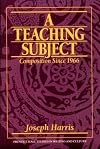
In A Teaching Subject (1997), Joseph Harris outlines a history of the field of composition studies, but most importantly, I believe, critiques and questions the term community. Following Raymond Williams, he explains that the term has no opposite and so may become an "empty and sentimental word," but more importantly, it tends to create what it supposes to describe and becomes hard to resist (99). Harris believes it is important to understand that one does not simply move from one community show more to another, but is always "caught instead in an always changing mix of dominant, residual, and emerging discourses" (103). He views it as more helpful to understand our job as not helping students move from one community to another, but to constantly complicate and add on to their discourses (103). He prefers the term public to community because "it refers not a group of people (like community) but to a kind of space and process, a point of contact that needs both to be created and continuously maintained," and always us to think about discourse across differences (109). show less
You May Also Like


Statistics
- Works
- 4
- Members
- 220
- Popularity
- #101,714
- Rating
- 3.5
- Reviews
- 2
- ISBNs
- 67