
Joseph Samachson (1906–1980)
Author of Batman in the Fifties
About the Author
Disambiguation Notice:
Dr. Joseph Samachson, a biochemist, wrote science fiction, and used the pseudonym William Morrison. He & his wife Dorothy also wrote books on music, opera, ballet, and theatre.
Series
Works by Joseph Samachson
The Sack 9 copies
The Weather on Mercury 3 copies
Country Doctor 2 copies
Batman Vol. 1 #18 2 copies
Short Science Fiction Collection 075 2 copies
Shipping Clerk 2 copies
Picture Bride 2 copies
The Inner Worlds 2 copies
Detective Comics (1937) #83 1 copy
The Addicts 1 copy
Free Land 1 copy
Forgotten Danger 1 copy
Hop O' My Thumb 1 copy
The Hunters 1 copy
Messenger 1 copy
The Weather on Mercury 1 copy
Unwelcomed Visitor 1 copy
Detective Comics (1937) #78 1 copy
Detective Comics (1937) #72 1 copy
Detective Comics (1937) #226 1 copy
Adventure Comics # 101 1 copy
Monster 1 copy
No Star's Land 1 copy
Picture Bride 1 copy
Shipping Clerk 1 copy
Days of Creation 1 copy
Spoken For 1 copy
Task of Kayin 1 copy
Detective Comics (1937) #81 1 copy
Associated Works
The Magazine of Fantasy and Science Fiction June 1956, Vol. 10, No. 6 (1956) — Contributor — 5 copies
DC Masterworks Series of Great Comic Book Artists #2 — Writer "The Shinning Knight stories" — 1 copy
DC Masterworks Series of Great Comic Book Artists #1 — Writer — 1 copy
Tagged
Common Knowledge
- Other names
- Sterrling, Brett
Morrison, William
W. M. - Birthdate
- 1906-10-13
- Date of death
- 1980-06-02
- Gender
- male
- Occupations
- biochemist
science fiction writer - Relationships
- Samachson, Dorothy (wife)
- Nationality
- USA
- Birthplace
- Trenton, New Jersey, USA
- Disambiguation notice
- Dr. Joseph Samachson, a biochemist, wrote science fiction, and used the pseudonym William Morrison. He & his wife Dorothy also wrote books on music, opera, ballet, and theatre.
- Associated Place (for map)
- New Jersey, USA
Members
Reviews

For the second time this week, a review that Stephen wrote has led me to read a short story that I might otherwise have missed. And, while I can't say that this one was as great as the last one, Bedside Manner was interesting and different.
Margaret and her husband were rescued by unknown aliens after their spaceship was destroyed, and they (the aliens) who have helpfully rescued them from certain death are now trying to put them (the couple) back together again - arms, legs, eyes, faces. show more Anyone else would be extremely grateful just to be alive, and for their spouse to be alive as well... but not Margaret. Margaret is plain-vain. She thinks that any minute change of her features will topple the precarious foundation of her marriage... so it would be better to be dead.
Can't say that I care for Margaret all that much. No, scratch that. I didn't like her at all. Vindictive me was hoping that the alien(s) would tell her that she gets the body they give her and she'll like it... or just shove her ungrateful ass out of the airlock. I'd be cheering, popcorn in hand, either way.
"I'll be plain, she thought, but I'll wear well. A background always wears well. Time can't hurt it much, because there's nothing there to hurt."
This line really stood out to me in this story. Margaret is the kind of woman that infuriates me. She either refuses or just cannot comprehend of herself or her husband as anything more than their appearances. He's the handsome one, and she's the rug that really ties the room together. (10 points if you get that reference.) No matter how many times he tries to tell her that he loves her for more than her face providing the contrast to show his own as even more handsome (reverse arm-candy, anyone?), she is too dense to listen to him.
But despite this, I enjoyed the message of this story... that we are more than our appearance, and that we need to learn to see past the superficial and live - and love - who we are on the inside. Maybe a little campy, but as apt a message today as it seems to have been back when this was written. Today we have teen girls buying into the unachievable-for-99%-of-humanity supermodel look, and slowly killing themselves through anorexia and bulimia to do it. It's just sad. Aren't we better than this?
Anyway... This was a good story, definitely recommended, and it's short, so you'll only have to put up with Margaret for a little while. Win-win. ;) show less
Margaret and her husband were rescued by unknown aliens after their spaceship was destroyed, and they (the aliens) who have helpfully rescued them from certain death are now trying to put them (the couple) back together again - arms, legs, eyes, faces. show more Anyone else would be extremely grateful just to be alive, and for their spouse to be alive as well... but not Margaret. Margaret is plain-vain. She thinks that any minute change of her features will topple the precarious foundation of her marriage... so it would be better to be dead.
Can't say that I care for Margaret all that much. No, scratch that. I didn't like her at all. Vindictive me was hoping that the alien(s) would tell her that she gets the body they give her and she'll like it... or just shove her ungrateful ass out of the airlock. I'd be cheering, popcorn in hand, either way.
"I'll be plain, she thought, but I'll wear well. A background always wears well. Time can't hurt it much, because there's nothing there to hurt."
This line really stood out to me in this story. Margaret is the kind of woman that infuriates me. She either refuses or just cannot comprehend of herself or her husband as anything more than their appearances. He's the handsome one, and she's the rug that really ties the room together. (10 points if you get that reference.) No matter how many times he tries to tell her that he loves her for more than her face providing the contrast to show his own as even more handsome (reverse arm-candy, anyone?), she is too dense to listen to him.
But despite this, I enjoyed the message of this story... that we are more than our appearance, and that we need to learn to see past the superficial and live - and love - who we are on the inside. Maybe a little campy, but as apt a message today as it seems to have been back when this was written. Today we have teen girls buying into the unachievable-for-99%-of-humanity supermodel look, and slowly killing themselves through anorexia and bulimia to do it. It's just sad. Aren't we better than this?
Anyway... This was a good story, definitely recommended, and it's short, so you'll only have to put up with Margaret for a little while. Win-win. ;) show less

This was really a very sad story about a grieving father and his young son wandering the universe, and their encounter on an alien planet with something unexpected. I hated the ending but after thinking about it I decided it was inevitable. Some things just can’t be fixed.

The 1950s were the decade when Fredric Wertham's attack on the social evils of the comic book reached its highpoint with the publication of Seduction of the Innocent and his testimony before the Senate Subcommittee on Juvenile Delinquency. It was also a decade of UFO sightings and the beginning of the Space Race. As a result Batman and other superheroes needed to fight crime while modeling wholesome behavior for young boys. Wholesome was especially important in Batman comics because Wertham show more had explicitly accused Batman and Robin of being—gasp!—homosexuals, much too far outside the conservative social norm of the 1950s.
The stories, described in the introduction to this collection as, “wild, wacky, weird [and] wonderful” could also be characterized as short and silly, especially when compared to the portrayals of Batman and his supporting cast that began in the 1970s and has continued into the early twenty-first century. Nevertheless, they are a lot of fun. Bill Finger, France Herron and others wrote these stories filled with memorable supervillains, giant props—a favorite device of Finger’s—scientific crime-fighting gadgets, and extraterrestrials. The square jawed Batman drawn by Bob Kane’s ghost artist Sheldon Moldoff and Dick Spring and the snub nosed sidekick Robin added to the visual wholesomeness of the daring duo. show less
The stories, described in the introduction to this collection as, “wild, wacky, weird [and] wonderful” could also be characterized as short and silly, especially when compared to the portrayals of Batman and his supporting cast that began in the 1970s and has continued into the early twenty-first century. Nevertheless, they are a lot of fun. Bill Finger, France Herron and others wrote these stories filled with memorable supervillains, giant props—a favorite device of Finger’s—scientific crime-fighting gadgets, and extraterrestrials. The square jawed Batman drawn by Bob Kane’s ghost artist Sheldon Moldoff and Dick Spring and the snub nosed sidekick Robin added to the visual wholesomeness of the daring duo. show less
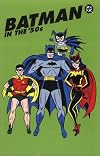
I find those old comics really fascinating. The fact that Batman has been around for seventy years now is part of what makes it so interesting for me, and reading those old stories is sort of like stepping into a time machine? Even though it's still Batman, the stories have a *very* different feel to those of today, and often are unintentionally funny (or funny for different reasons). But it really is fascinating to see where those characters came from. I'm going backwards - I'm still show more waiting for my '40s issue. show less
Lists
Awards

You May Also Like


Associated Authors
Statistics
- Works
- 58
- Also by
- 25
- Members
- 294
- Popularity
- #79,673
- Rating
- 3.7
- Reviews
- 7
- ISBNs
- 28
- Languages
- 2