
Donald Judd (1928–1994)
Author of Donald Judd: The Complete Writings 1959-1975
About the Author
Series
Works by Donald Judd
Donald Judd: Zeichnungen/Drawings, 1956-1976 (English and German Edition) (1976) 12 copies, 2 reviews
Donald Judd: (Ausstellung) Kunstverein St. Gallen, 21. April bis 29. Juli 1990 (German and English Edition) (1990) 7 copies
Donald Judd : stacks 4 copies
John Chamberlain - Current Works and Fond Memories - Sculptures and Photographs 1967-1995 Exhibition: Amsterdam 1996 (1996) 4 copies
The Moscow Installation 3 copies
Donald Judd. Arnulf Rainer: Edges Angles Lines Curves/ Works on Paper (German and English Edition) (2018) 2 copies
Don Judd : [Van Abbemuseum Eindhoven, 16 januari tot 1 maart 1970, White Chapel Art Gallery, London, 29th September till 1st November 1970] (1971) 2 copies
Chinati Foundation newsletter vol21 2 copies
Architektur 2 copies
Una stanza per Panza part IV 1 copy
Donald Judd Prints 1951-1993 1 copy
Untitled, 1993 1 copy
Continuing Abstraction 1 copy
Una stanza per Panza part II 1 copy
Una stanza per Panza part I 1 copy
Donald Judd 2009 1 copy
Associated Works
Theories and Documents of Contemporary Art: A Sourcebook of Artists' Writings (1995) — Contributor — 420 copies, 1 review
Tagged
Common Knowledge
- Canonical name
- Judd, Donald
- Legal name
- Judd, Donald Clarence
- Birthdate
- 1928-06-03
- Date of death
- 1994-02-12
- Gender
- male
- Education
- Art Students League of New York
Columbia University (BA)
College of William and Mary - Occupations
- sculptor
painter
artist - Organizations
- Chinati Foundation
Judd Foundation
United States Army - Awards and honors
- Skowhegan Medal for Sculpture (1987)
Brandeis University Medal for Sculpture (1987)
Frederick R. Weisman Art Foundation Award (1991)
Foreign Member, Royal Swedish Academy of Fine Arts (1992)
Littlefield Society (1992)
Sikkens Award (1993) (show all 7)
Stankowski Prize (1993) - Cause of death
- non-Hodgkin's lymphoma
- Nationality
- USA
- Birthplace
- Excelsior Springs, Missouri, USA
- Places of residence
- New York, New York, USA
Marfa, Texas, USA - Place of death
- New York, New York, USA
- Burial location
- Las Casas, Ayala de Chinati, Presidio County, Texas, USA
- Associated Place (for map)
- USA
Members
Reviews
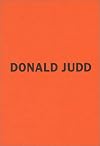
Like no other sculptor today, Donald Judd has informed our understanding of art and its relationship to space. The Panoramas Gallery organized his first solo exhibition in 1957, at a time in which he was still focused on painting, yet moving from the flat picture plane towards the third dimension. His cadmium red pictures cut through with stripes or incisions led the viewer to perceive space as self-evident. From there Judd moved toward a complete abandonment of painting, recognizing, in the show more early 60s, that "actual space is intrinsically more powerful and specific than paint on a flat surface." His switch from painting to sculpture was coincident with a growing interest in architecture and in industrial processes and materials, such as galvanized steel, concrete, plywood, and aluminum, which he used to create large, hollow, Minimalist sculptures. Documented here for the first time is this very crucial development, from the early work of the 1950s to 1968, the point at which Judd's artistic vocabulary reached its complete formation. Numerous works, including previously unrecorded paintings, sc show less

Donald Judd Interviews presents sixty interviews with the artist over the course of four decades, and is the first compilation of its kind. It is the companion volume to the critically acclaimed and bestselling Donald Judd Writings.
This collection of interviews engages a diverse range of topics, from philosophy and politics to Judd’s insightful critiques of his own work and the work of others such as Mark di Suvero, Edward Hopper, Yayoi Kusama, Barnett Newman, and Jackson Pollock. The show more opening discussion of the volume between Judd, Dan Flavin, and Frank Stella provides the foundation for many of the succeeding conversations, focusing on the nature and material conditions of the new art developing in the 1960s. The publication also gathers a substantial body of unpublished material across a range of mediums including extensive interviews with art historians Lucy R. Lippard and Barbara Rose.
Judd’s contributions in interviews, panels, and extemporaneous conversations are marked by his forthright manner and rigorous thinking, whether in dialogue with art critics, art historians, or his contemporaries. In one of the last interviews, he observed, “Generally expensive art is in expensive, chic circumstances; it’s a falsification. The society is basically not interested in art. And most people who are artists do that because they like the work; they like to do that [make art]. Art has an integrity of its own and a purpose of its own, and it’s not to serve the society. That’s been tried now, in the Soviet Union and lots of places, and it doesn’t work. The only role I can think of, in a very general way, for the artist is that they tend to shake up the society a little bit just by their existence, in which case it helps undermine the general political stagnation and, perhaps by providing a little freedom, supports science, which requires freedom. If the artist isn’t free, you won’t have any art.”
Donald Judd Interviews is co-published by Judd Foundation and David Zwirner Books. The interviews expand upon the artist’s thinking present in Donald Judd Writings (Judd Foundation/David Zwirner Books, 2016). show less
This collection of interviews engages a diverse range of topics, from philosophy and politics to Judd’s insightful critiques of his own work and the work of others such as Mark di Suvero, Edward Hopper, Yayoi Kusama, Barnett Newman, and Jackson Pollock. The show more opening discussion of the volume between Judd, Dan Flavin, and Frank Stella provides the foundation for many of the succeeding conversations, focusing on the nature and material conditions of the new art developing in the 1960s. The publication also gathers a substantial body of unpublished material across a range of mediums including extensive interviews with art historians Lucy R. Lippard and Barbara Rose.
Judd’s contributions in interviews, panels, and extemporaneous conversations are marked by his forthright manner and rigorous thinking, whether in dialogue with art critics, art historians, or his contemporaries. In one of the last interviews, he observed, “Generally expensive art is in expensive, chic circumstances; it’s a falsification. The society is basically not interested in art. And most people who are artists do that because they like the work; they like to do that [make art]. Art has an integrity of its own and a purpose of its own, and it’s not to serve the society. That’s been tried now, in the Soviet Union and lots of places, and it doesn’t work. The only role I can think of, in a very general way, for the artist is that they tend to shake up the society a little bit just by their existence, in which case it helps undermine the general political stagnation and, perhaps by providing a little freedom, supports science, which requires freedom. If the artist isn’t free, you won’t have any art.”
Donald Judd Interviews is co-published by Judd Foundation and David Zwirner Books. The interviews expand upon the artist’s thinking present in Donald Judd Writings (Judd Foundation/David Zwirner Books, 2016). show less
This comprehensive collection of Donald Judd's writings includes previously unpublished writings and hundreds of notes
Donald Judd: Writings, copublished by Judd Foundation and David Zwirner Books, is the most comprehensive collection of the artist's writings assembled to date. This timely publication includes Judd’s best-known essays organized chronologically with little-known texts previously published in limited editions. This new collection also includes unpublished college essays and show more hundreds of never-before-seen handwritten notes, a critical but unknown part of Judd’s writing practice.
Judd’s earliest published writing, consisting largely of reviews for hire, defined the terms of art criticism in the 1960s, but his essays as a graduate student at Columbia, published here for the first time, contain the seeds of his later writing, and allow readers to trace the development of his critical style. The writings that followed Judd’s early reviews are no less significant art-historically, but have been relegated to smaller publications and have remained largely unavailable until now.
The largest addition of newly available material is Judd’s unpublished notes--transcribed from his handwritten accounts of and reactions to subjects ranging from the politics of his time, to the literary texts he admired most, from complaints about pluralism in art to his admiration for Giambattista Vico, and through him, Lucretius. In these intimate reflections we see Judd’s thinking at its least mediated--a mind continuing to grapple with questions of its moment, demonstrating the intensity of thought that continues to make Judd such a formidable presence in contemporary art. show less
Donald Judd: Writings, copublished by Judd Foundation and David Zwirner Books, is the most comprehensive collection of the artist's writings assembled to date. This timely publication includes Judd’s best-known essays organized chronologically with little-known texts previously published in limited editions. This new collection also includes unpublished college essays and show more hundreds of never-before-seen handwritten notes, a critical but unknown part of Judd’s writing practice.
Judd’s earliest published writing, consisting largely of reviews for hire, defined the terms of art criticism in the 1960s, but his essays as a graduate student at Columbia, published here for the first time, contain the seeds of his later writing, and allow readers to trace the development of his critical style. The writings that followed Judd’s early reviews are no less significant art-historically, but have been relegated to smaller publications and have remained largely unavailable until now.
The largest addition of newly available material is Judd’s unpublished notes--transcribed from his handwritten accounts of and reactions to subjects ranging from the politics of his time, to the literary texts he admired most, from complaints about pluralism in art to his admiration for Giambattista Vico, and through him, Lucretius. In these intimate reflections we see Judd’s thinking at its least mediated--a mind continuing to grapple with questions of its moment, demonstrating the intensity of thought that continues to make Judd such a formidable presence in contemporary art. show less
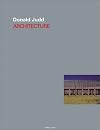
Donald Judd's "specific objects" (as he termed them) undertook a revolutionary analysis and redefinition of sculpture, establishing him as a leading exponent of what came to be called Minimalism. Somewhat less known are Judd's numerous architectural and furniture designs, works which formally are closely related to his art objects, but which reflect his abiding interest in utility. In 1971, Judd bought an old fort near Marfa, Texas, and by systematically acquiring and transforming local show more property, he amassed a huge ensemble of contemporary art, with permanent installations of his own work and that of Carl Andre, John Chamberlain, Dan Flavin and others. Donald Judd: Architecture presents drawings, design sketches, ground plans and photographs of the grounds and architecture of this Minimalist desert oasis, and celebrates Judd's role as its visionary architect and stage director. This book first appeared in German in 1991, and has been thoroughly revised and expanded for this, its first English edition. show less
You May Also Like


Associated Authors
Statistics
- Works
- 72
- Also by
- 2
- Members
- 913
- Popularity
- #28,083
- Rating
- 3.9
- Reviews
- 19
- ISBNs
- 52
- Languages
- 3
- Favorited
- 1