

Johann David Wyss (1743–1818)
Author of The Swiss Family Robinson
About the Author
Disambiguation Notice:
The CK info is Johann David Wyss. His son, Johann Rudolf Wyss, edited and completed the manuscript of The Swiss Family Robinson.
Please do not combine father and son. Thank you.
Image credit: Philatelia.Net
Series
Works by Johann David Wyss
The Swiss Family Robinson (Abridged edition): Abridged Edition (Puffin Classics) 375 copies, 1 review
The Swiss Family Robinson (Illustrated): The Classic Edition with Original Illustrations (2024) 168 copies
Swiss Family Robinson: A Family Survives by Taking Initiative [abridged - Chick-fil-A] (2005) 57 copies
The Swiss family Robinson, simplified : based on The Swiss family Robinson by Johann Wyss 10 copies, 1 review
Willis the Pilot: A Sequel to the Swiss Family Robinson: Or, Adventures of an Emigrant Family Wrecked on an Unknown Coast of the Pacific Ocean (1875) 7 copies
スイスのロビンソン. 上 6 copies
Švýcarský Robinson 2 copies
The Swiss Family Robinson 2 copies
Le Robinson suisse Tome 1 1 copy
Illustrated Classics - The Swiss Family Robinson: Abridged Novels With Review Questions (2020) 1 copy
Šveices Robinsons 1 copy
Lớn Lên Trên Đảo Vắng 1 copy
עד שתגיע למקומו 1 copy
Os Robinsons Suíços 1 copy
Le Robinson suisse Tome 2 1 copy
İsviçreli Robinsonlar 1 copy
FAMILJA ZVICERIANE ROBINSON 1 copy
Gia dinh Robinson Thuy Si 1 copy
The Swiss Family Robinson 1 copy
The Swiss Famil y Robinson 1 copy
Associated Works
The Illustrated Treasury of Children's Literature, Volumes 1-2 (1955) — Contributor — 523 copies, 4 reviews
A Trilogy of Island Adventures 3 copies
Call of the Wild • Grimms' Fairy Tales • Hans Brinker • Robinson Crusoe • Swiss Family Robinson (1963) — Contributor — 2 copies
Tagged
Common Knowledge
- Canonical name
- Wyss, Johann David
- Legal name
- Wyss, Johann David
- Birthdate
- 1743-03-04
- Date of death
- 1818-01-11
- Gender
- male
- Education
- Berne Academy
Academy of Lausanne - Occupations
- pastor
writer - Relationships
- Wyss, Johann Rudolf (son)
Wyss, Johann Emmanuel (son) - Short biography
- Johann David Wyss (May 28, 1743 – January 11, 1818) is best remembered for his book The Swiss Family Robinson. It is said that he was inspired by Daniel Defoe's Robinson Crusoe, but wanted to write a story from which his own children would learn, as the father in the story taught important lessons to his children. The Swiss Family Robinson was first published in 1812 and translated into English two years later. It has since become one of the most popular books of all time. The book was edited by his son, Johann Rudolf Wyss, a scholar who wrote the Swiss national anthem. Another son, Johann Emmanuel Wyss, illustrated the book. Unlike his son, Johann David Wyss lived up to the age of 74, dying in 1818, four years after he wrote The Swiss Family Robinson. Wyss has been described as an author whose style was "firmly Christian and moral in tone".
- Nationality
- Switzerland
- Birthplace
- Bern, Swiss Confederation
- Places of residence
- Köniz, Bern, Swiss Confederation
- Place of death
- Bern, Swiss Confederation
- Map Location
- Switzerland
- Disambiguation notice
- The CK info is Johann David Wyss. His son, Johann Rudolf Wyss, edited and completed the manuscript of The Swiss Family Robinson.
Please do not combine father and son. Thank you.
Members
Discussions
The Swiss Family Robinson, 1963 in George Macy devotees (December 2022)
Reviews
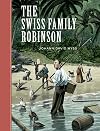
The Swiss Family Robinson (Unabridged Classics) (Sterling Unabridged Classics) (Union Square Kids Unabridged Classics) by Johann David Wyss
I read this as a child and quite enjoyed it, so I decided to revisit it via Librivox audiobooks. The first Librivox version was not a hit. The narrator mentions in his synopsis that it was severely edited during translation by WHG Kingston, and he wasn't kidding. Kingston turned it into a moralising sermon, with the father of the family preaching to his sons for their every mistake.
So after a few chapters I switched to version two, which seems much more like the original book I remember show more reading.
Kids are fortunate in their ability to find the magic in stories, despite inconsistencies and improbabilities.
Adults, unfortunately have grown up and as a consequence those exciting tales of youth become ridiculous. Sadly that's happened for me with The Swiss Family Robinson.
The family have been shipwrecked somewhere in the East Indies. Despite this there is not a single mosquito; however, there are penguins. Yes, you heard correctly, penguins. I'll come back to them in a moment.
The island they landed on is uninhabited. Nevertheless they find a field planted with potatoes, ripe for the picking. I'm not sure how the potatoes got there, as they are not indigenous to the region.
Other plants not indigenous to the region somehow provided by an invisible benefactor are the calabash, the cassava, guavas, rubber trees, and pineapple, etc etc. Actually there's so many plants and animals not indigenous to the area that I gave up trying to keep track of them.
Probably the greatest shock for me in this reread is the frequent gun violence. The characters (except for the mother, as she is continuously referred to) shoot almost every wild animal they see. The exceptions to this are the animals that they club, snare or axe, or those taken by the dogs. If the unfortunate animal survives this attack, the family then makes a pet of it. Miraculously, these pets all suffer from amnesia, forgetting their brush with death at the hands of humans, they are tame within a day, and become loyal well behaved domesticated creatures. This includes the penguins who are apparently quite happy to wander around with the chickens, despite their natural environment being oceans thousands of miles distant.
Another interesting piece of magic contrived by the author is the shipwreck. This vessel is fortunately wedged in between two large boulders, some distance from the shore. This enables the lucky family to make repeated trips out to the wreck for weeks on end, so they can pilfer the many goods in the cargo hold. The ship seems to be in reasonable condition and these forays are very profitable, as the holds contain an abundance of goods destined for the new colony of Port Jackson. At the same time, the family scours the shore for planks that have washed up from the ship. They find enough of these to build a raft, a small bridge, the floor and ladder of their treehouse, and other sundry items. It is a magical ship indeed that can shed so much of its wood, and still remain intact.
Another of the errors is the author's interpretation of the wet season. He thinks of the wet season as being similar to a European winter, with the rain being the equivalent of snow. Therefore, rain only occurs during the "three month" rainy season and never during the rest of the year. The rain is so continuous that the family hibernates for this "winter" period. I can't tell you how much this annoys me. Anyone one who's ever spent a day in a tropical wet season will tell you it's NOT winter.
I think the author has taken all his various ideas and information about the tropics, filtered them through his European mindset and experiences and planted them all on one magical island. While the resulting story was probably an exotic and informative adventure for his contemporary readers, modern adult readers often find it frustrating, completely overrun with inaccuracies and even offensive.
I do like the story, and despite their woodenness I like the characters too. But the killings, the stupid assumptions and the info dumps on nature and engineering are driving me crazy. I've persisted in reading this as I wanted to revisit a story from my childhood. But I've had enough.
CS Lewis says, to quote him loosely, that a story that can be enjoyed at 10, if it's a good story, can be enjoyed as adult. It's a pity The Swiss Family Robinson has failed this test for me.
My rating is based on my opinion of the book when I read it as a child, and not this latest reading. show less
So after a few chapters I switched to version two, which seems much more like the original book I remember show more reading.
Kids are fortunate in their ability to find the magic in stories, despite inconsistencies and improbabilities.
Adults, unfortunately have grown up and as a consequence those exciting tales of youth become ridiculous. Sadly that's happened for me with The Swiss Family Robinson.
The family have been shipwrecked somewhere in the East Indies. Despite this there is not a single mosquito; however, there are penguins. Yes, you heard correctly, penguins. I'll come back to them in a moment.
The island they landed on is uninhabited. Nevertheless they find a field planted with potatoes, ripe for the picking. I'm not sure how the potatoes got there, as they are not indigenous to the region.
Other plants not indigenous to the region somehow provided by an invisible benefactor are the calabash, the cassava, guavas, rubber trees, and pineapple, etc etc. Actually there's so many plants and animals not indigenous to the area that I gave up trying to keep track of them.
Probably the greatest shock for me in this reread is the frequent gun violence. The characters (except for the mother, as she is continuously referred to) shoot almost every wild animal they see. The exceptions to this are the animals that they club, snare or axe, or those taken by the dogs. If the unfortunate animal survives this attack, the family then makes a pet of it. Miraculously, these pets all suffer from amnesia, forgetting their brush with death at the hands of humans, they are tame within a day, and become loyal well behaved domesticated creatures. This includes the penguins who are apparently quite happy to wander around with the chickens, despite their natural environment being oceans thousands of miles distant.
Another interesting piece of magic contrived by the author is the shipwreck. This vessel is fortunately wedged in between two large boulders, some distance from the shore. This enables the lucky family to make repeated trips out to the wreck for weeks on end, so they can pilfer the many goods in the cargo hold. The ship seems to be in reasonable condition and these forays are very profitable, as the holds contain an abundance of goods destined for the new colony of Port Jackson. At the same time, the family scours the shore for planks that have washed up from the ship. They find enough of these to build a raft, a small bridge, the floor and ladder of their treehouse, and other sundry items. It is a magical ship indeed that can shed so much of its wood, and still remain intact.
Another of the errors is the author's interpretation of the wet season. He thinks of the wet season as being similar to a European winter, with the rain being the equivalent of snow. Therefore, rain only occurs during the "three month" rainy season and never during the rest of the year. The rain is so continuous that the family hibernates for this "winter" period. I can't tell you how much this annoys me. Anyone one who's ever spent a day in a tropical wet season will tell you it's NOT winter.
I think the author has taken all his various ideas and information about the tropics, filtered them through his European mindset and experiences and planted them all on one magical island. While the resulting story was probably an exotic and informative adventure for his contemporary readers, modern adult readers often find it frustrating, completely overrun with inaccuracies and even offensive.
I do like the story, and despite their woodenness I like the characters too. But the killings, the stupid assumptions and the info dumps on nature and engineering are driving me crazy. I've persisted in reading this as I wanted to revisit a story from my childhood. But I've had enough.
CS Lewis says, to quote him loosely, that a story that can be enjoyed at 10, if it's a good story, can be enjoyed as adult. It's a pity The Swiss Family Robinson has failed this test for me.
My rating is based on my opinion of the book when I read it as a child, and not this latest reading. show less
By page 74 it was still just a laundry list of each day's discovery of new items from the island, or items recovered from the wrecked ship. No plot, no adventure. This may have passed my standards for a good read (probably not), but the thing that made me press the delete button on the Kindle with particular fury was the way in which Father Robinson was so damn knowledgable about every aspect of "savage" lifestyles and survival tactics. I mean, what middle-class clergyman from the Alps knows show more the exact proper way to halve a tropical gourd? Is it likely that this late-18th century minister from a mountain climate knows that a particular tree from a tropical climate can be used for making sewing thread, and also exactly how to make a navigable boat out of 8 barrels and a bunch of wrecked plywood? It strained the very limits of my suspended disbelief to the snapping point, and snap they did.
Delete from Kindle. show less
Delete from Kindle. show less
This classic didn't quite hold up to the passage of time. The plot was lacking and everything that the family faced they were able to overcome with seemingly little to no effort. Thankfully the father (who was the narrator) was so well versed in everything from zoology to carpentry, hunting to botany, everything in between that everything was able to be spelled out for his children and so that they could successfully survive on the island they were stranded on. I'm not saying they couldn't show more have survived without this knowledge, I'm just saying that it all felt a bit forced and the vast spread of knowledge felt too convenient. In addition, it drove me crazy that the narrator never gave the wife/mother's name and that she was only referred to as "the mother" or "my wife". She seemed to play such a small role in keeping the house and cooking for her 4 male children and husband that she could have been taken out entirely and it would have made no difference to the story. All the children were given names and played a role at some point, so why couldn't she? I guess she did have "magic bag" that was full of seeds that they ended up planting, but that's about the only significant role I could see of her. Unfortunately this didn't hold up to the passage of time. :( show less
Have you ever read Laura Ingalls Wilder's Little House books and wished for more of the frontier DIY bits and less of the annoying family sweetness? Well, this is that book, with more old-time engineering and a whole lot more hunting. If this book were a magazine it'd be the love child of Popular Mechanics and Field & Stream, and for some people that's perfect. To me, it felt like a nature documentary: it got off to a fascinating start but before long it was just animals killing animals, show more over and over. The only thing that got me through the last two out of nine sections of the audiobook was an urgent knitting project. Then at the end the story flashes forward ten years, which is a bit more bearable. Well, that's over with. show less
Lists
Elevenses (1)
KID BOOKS (1)
Out of Copyright (1)
A Reading List (1)
1810s (1)
Ambleside Books (1)
Sonlight Books (1)
Allie's Wishlist (1)
Awards


You May Also Like


Associated Authors
Statistics
- Works
- 118
- Also by
- 8
- Members
- 14,732
- Popularity
- #1,562
- Rating
- 3.6
- Reviews
- 127
- ISBNs
- 497
- Languages
- 12
- Favorited
- 4