
Mike Ploog
Author of The Dream Thief
About the Author
Works by Mike Ploog
Avengers/Doctor Strange: Rise Of The Darkhold (Avengers/Doctor Strange: Rise Of The Darkhold, 1) (2018) 8 copies
The Frankenstein Monster [1973] #1 — Illustrator — 7 copies
The Frankenstein Monster [1973] #4 — Illustrator — 6 copies
The Frankenstein Monster [1973] #6 — Illustrator — 5 copies
Man-Thing (1974) #5 — Illustrator — 5 copies
Werewolf by Night [1972] #13 — Illustrator — 4 copies
Giant-Size Man-Thing 01 — Illustrator — 4 copies
The Frankenstein Monster [1973] #2 — Illustrator — 3 copies
The Frankenstein Monster [1973] #5 — Illustrator — 3 copies
The Frankenstein Monster [1973] #3 — Illustrator — 3 copies
Marvel Spotlight [1971] #06 (Ghost Rider) — Illustrator — 2 copies
Werewolf by Night [1972] #8 — Illustrator — 2 copies
Werewolf by Night [1972] #6 — Illustrator — 2 copies
Werewolf by Night [1972] #2 — Illustrator — 2 copies
Marvel Spotlight [1971] #03 (Werewolf by Night) — Illustrator — 2 copies
Next Issue Ad 1 copy
Marvel Magazines Ad 1 copy
"Curse of the Werewolf", By Herb Davidson & Charlotte Sanders, Power Records & Marvel Comics, 45 RPM, PR 17, Fine- — Illustrator — 1 copy
Werewolf by Night [1972] #16 — Illustrator — 1 copy
Marvel Spotlight [1971] #02 (Werewolf by Night) — Illustrator — 1 copy
Marvel Spotlight [1971] #04 (Werewolf by Night) — Illustrator — 1 copy
Werewolf by Night [1972] #3 — Illustrator — 1 copy
Werewolf by Night [1972] #4 — Illustrator — 1 copy
Werewolf by Night [1972] #5 — Illustrator — 1 copy
Werewolf by Night [1972] #14 — Illustrator — 1 copy
Werewolf by Night [1972] #15 — Illustrator — 1 copy
Werewolf by Night [1972] #7 — Illustrator — 1 copy
Associated Works
Essential Tomb of Dracula Volume 1 (2003) — Pencils & Cover Art (W), some editions — 144 copies, 3 reviews
Big Apple Comix — Contributor — 3 copies
Loup Garou — Illustrator — 1 copy
Tagged
Common Knowledge
- Canonical name
- Ploog, Mike
- Legal name
- Ploog, Michael G.
- Birthdate
- 1942-07-13
- Gender
- male
- Nationality
- USA
- Birthplace
- Mankato, Minnesota, USA
- Associated Place (for map)
- Minnesota, USA
Members
Reviews

Ploog does a great job of taking a very Victorian-styled novel and making it into a bit more of a fantasy adventure. In fact, calling it "L. Frank Baum's..." is a bit misleading, because it really only matches Baum's story in the general overview. Both stories show Claus found as an infant by the Master Woodsman (here, Ark; in the novel, Ak) and adopted by the nymph Necile, and both find him growing up, making the first toys for children, having a conflict with the demonic Awgwas, and show more gradually developing into the Santa Claus we know today. Both stories also conclude with the mortal Claus being bestowed the "mantle of immortality" so he can continue on as the patron saint of children everywhere. Very good. I'm glad we've got that all sorted.
Where the two stories differ considerably is in the actual events. Ploog takes Baum's rather episodic plot as inspiration, but he blows it up into something bigger and far more interconnected. Although he does adapt a few of Baum's sequences outright, most of his alterations work to simply make the story more exciting. Instead of the first "toy" being a wooden effigy of Claus' cat, Blinkie, it's now a little jumping-jack based on Claus' monkey, Toy - and that, later, leads into the creation of the first Christmas tree (something wholly unconnected in Baum's book). Similarly, the Awgwas first set upon Claus and Ark during their trip around their world, and their leader - named, unoriginally, Swine - fosters a grudge against Claus after the boy chops off the end of his tail in self-defense. They aren't major changes, but they manage to make the story run more smoothly. Ploog even addresses the situation of Santa's elves - left unspoken in Baum - by hiring a group of wood elves who've returned from a job building a certain Emerald City. (Ho ho ho.) The whole thing is couched in a framing story where Ark's plea for Claus' immortality is put not to the governing council of Immortals, but to their ruler, the powerful Gnome King (a figure occasionally mentioned in the original novel). Here, he is explicitly made the (G)Nome King of the Oz books, appearing from the side of his "faraway mountain" as per Return to Oz, for which Ploog drew concept art.
Where the graphic novel falls down a little bit is in some of Ploog's artistic portrayals, which are occasionally just a little too...'80s. His women and children have the same odd, elongated, full-cheeked quality as Ian Gibson's girls from The Ballad of Halo Jones, which makes them simultaneously a little too cutesy and a little too waifish. Swine and all of his Awgwas look like nothing more than rejects from Teenage Mutant Ninja Turtles, which is regrettable in the extreme. You'd think the leader of a powerful group of invisible demons would be a little bit more threatening than a boar-headed guy in Robin Hood gear.
Despite the occasional shortcoming, this is a strong adaptation that arguably holds up more under rereading than the original text. It's extremely pleasant, and a lot of fun for Christmas, without being too saccharine (well, at least until the last page). It's too bad Ploog never turned his hand to other Baum adaptations, as I think they might have come out rather well. show less
Where the two stories differ considerably is in the actual events. Ploog takes Baum's rather episodic plot as inspiration, but he blows it up into something bigger and far more interconnected. Although he does adapt a few of Baum's sequences outright, most of his alterations work to simply make the story more exciting. Instead of the first "toy" being a wooden effigy of Claus' cat, Blinkie, it's now a little jumping-jack based on Claus' monkey, Toy - and that, later, leads into the creation of the first Christmas tree (something wholly unconnected in Baum's book). Similarly, the Awgwas first set upon Claus and Ark during their trip around their world, and their leader - named, unoriginally, Swine - fosters a grudge against Claus after the boy chops off the end of his tail in self-defense. They aren't major changes, but they manage to make the story run more smoothly. Ploog even addresses the situation of Santa's elves - left unspoken in Baum - by hiring a group of wood elves who've returned from a job building a certain Emerald City. (Ho ho ho.) The whole thing is couched in a framing story where Ark's plea for Claus' immortality is put not to the governing council of Immortals, but to their ruler, the powerful Gnome King (a figure occasionally mentioned in the original novel). Here, he is explicitly made the (G)Nome King of the Oz books, appearing from the side of his "faraway mountain" as per Return to Oz, for which Ploog drew concept art.
Where the graphic novel falls down a little bit is in some of Ploog's artistic portrayals, which are occasionally just a little too...'80s. His women and children have the same odd, elongated, full-cheeked quality as Ian Gibson's girls from The Ballad of Halo Jones, which makes them simultaneously a little too cutesy and a little too waifish. Swine and all of his Awgwas look like nothing more than rejects from Teenage Mutant Ninja Turtles, which is regrettable in the extreme. You'd think the leader of a powerful group of invisible demons would be a little bit more threatening than a boar-headed guy in Robin Hood gear.
Despite the occasional shortcoming, this is a strong adaptation that arguably holds up more under rereading than the original text. It's extremely pleasant, and a lot of fun for Christmas, without being too saccharine (well, at least until the last page). It's too bad Ploog never turned his hand to other Baum adaptations, as I think they might have come out rather well. show less

This is an enjoyable collection, but my main gripe is that some of the issues are not in chronological order, and easily could be.
The Monster of Frankenstein/Frankenstein Monster is an outstanding 70s Marvel horror series, starting with the origin of Frankenstein retold, then picking up 100 years later with the great, great grandson of Robert Walton in search of the Monster, leading to more misadventures of our misunderstood Monster.
While the Frankenstein Monster monthly was going on, there show more were also a series of black and white tales being told in the Monsters Unleashed magazine format series. These were more adult tales. Marvel used these issues to explain how the Monster arrived in the present day. Here, however, is where my problem lies.
It would have been simple for the compilers of this Essential collection to put the Monsters Unleashed story in the proper order along with the main title run. Instead, the Frankenstein Monster run is complete (with a brief interruption for Giant-Size Werewolf by Night, perfect place for the Monsters Unleashed story), followed by the full Monsters Unleashed run. It makes reading in proper story order difficult.
Another problem, there are several moments where different writers mix up the back story, screwing up certain elements like how the Monster damaged his throat (shown as damage from a vampire bite in the main title run, but explained as damage due to fire in Monsters Unleashed). Considering these books were being produced within months of each other, it's a glaring error that should have been noticed before the books went to print.
Overall, though, a fun read. Definitely worth picking up for comic fans and horror fans alike. show less
The Monster of Frankenstein/Frankenstein Monster is an outstanding 70s Marvel horror series, starting with the origin of Frankenstein retold, then picking up 100 years later with the great, great grandson of Robert Walton in search of the Monster, leading to more misadventures of our misunderstood Monster.
While the Frankenstein Monster monthly was going on, there show more were also a series of black and white tales being told in the Monsters Unleashed magazine format series. These were more adult tales. Marvel used these issues to explain how the Monster arrived in the present day. Here, however, is where my problem lies.
It would have been simple for the compilers of this Essential collection to put the Monsters Unleashed story in the proper order along with the main title run. Instead, the Frankenstein Monster run is complete (with a brief interruption for Giant-Size Werewolf by Night, perfect place for the Monsters Unleashed story), followed by the full Monsters Unleashed run. It makes reading in proper story order difficult.
Another problem, there are several moments where different writers mix up the back story, screwing up certain elements like how the Monster damaged his throat (shown as damage from a vampire bite in the main title run, but explained as damage due to fire in Monsters Unleashed). Considering these books were being produced within months of each other, it's a glaring error that should have been noticed before the books went to print.
Overall, though, a fun read. Definitely worth picking up for comic fans and horror fans alike. show less
I was so excited to find these two volumes at the used bookstore: I read the first issue of the comic when it came out, and I was intrigued. But the translation to a hybrid novel just doesn't work. As a half-prose, half-comic hybrid, we get entirely too much of Kate's voice: clear and distinct, but also bitter, angsty, and snottily disaffected. Some of the opening comics pages look familiar from the original comic, but as the book moves forward, the art becomes increasingly Disney-fied (not show more surprising, since Disney bought all Crossgen's properties, of which the Abadazad comic was one).
I'm not super inclined to track down book 3--for the best since it never got US release, and book 4 seems to be permanently canceled. So much for this 8-book series. show less
I'm not super inclined to track down book 3--for the best since it never got US release, and book 4 seems to be permanently canceled. So much for this 8-book series. show less
Five years ago, little Matt Jameson got on a ride in a street fair and disappeared without a trace. His older sister Kate Jameson and mother Frances are frequently at odds with each other ever since.
Kate is now 14, your average rebellious teenager with a taste for heavy metal and being difficult with her deeply-hurting mother.
One day, their neighbour Mrs Vaughn cornered Kate and told her she knew where Matt is. He has been taken into Abadazad, a fantasy land known to the "real world" as the show more setting of a popular children's book series. This series was Matt and Kate's absolute favourite before he vanished.
How does Mrs Vaughn know all this? Kate originally thought she was a huge fan herself, but it turned out that her old neighbour was the little girl who travelled into Abadazad in the stories.
How could any of this be possible? The "Little Martha" of the stories was a red-haired, green-eyed girl... not a African-American. And Abadazad is just a story, not a real land you can go to.
Mrs Vaughn explained that in her time, the general public won't take kindly to a little "Negro girl" being the heroine of a book. Franklin O. Davis, the writer she worked with, changed her into Caucasian girl and applied some artistic liberty to the stories that Mrs Vaughn supplied him.
Kate decided that Mrs Vaughn was absolutely nuts, and left. But certain events occured after, giving Kate no choice but to believe and take the journey into Abadazad to find Matt.
"The Road to Inconceivable" serves as an introduction (ours and Kate's) to Abadazad. She is reunited with Mrs Vaughn, in the form of Little Martha, and meets Queen Ija, ruler of Inconceivable. Kate learns the difference between the real Abadazad and Davis's version.
A great deal of this book also established Kate's background. She is not anybody's idea of a dream child. Kate represents that difficult age where nobody "understands" her and she is frequently in trouble at school.
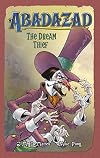
It's only in the second book, "The Dream Thief", where get over Kate's astonishment in finding herself in storybook land, and we finally get into the business of her finding Matt.
The tale starts with an attack on the Queen's castle. Apparently, whoever took Matt realises that Kate will soon be his problem.
Upset that Queen Ija is hesitant on letting her start her search, Kate runs away with Master Wix, a boy made of candlewax and minor character who happens to be Matt's favourite in the book.
We see more of The Lanky Man, our six-armed man villian, and discover his objectives for taking Matt prisoner.
I spotted these books in one of our local book stores and thought they looked interesting. It is a hybrid of journal-style storytelling and a graphic novel. I got one at first because it isn't exactly cheap, then found myself back first thing the next morning for the second book.
Abadazad originally was a comic. When their publisher closed shop, Disney bought the series over. Abadazad is reborn as a high quality and beautifully-illustrated children's book.
Kate's narration and the comic parts of the book flow smoothly in and out of each other. It's a good example of how the two medium can complement each other.
Abadazad is "the Place where sorrow has no home, where time has no meaning, where joy lives forever". The catch phrase has a high level of cheese for those of us above 15, but at least they don't throw that at you before they have you deep in the story.
With hints of Wizard of Oz and Narnia, Abadazad contain elements that I love in fantasy - the transplanting of an everyday person from "real life", into a whimsical fantasy world.
Hold on tight. The journey is only beginning.
(2006) show less
Kate is now 14, your average rebellious teenager with a taste for heavy metal and being difficult with her deeply-hurting mother.
One day, their neighbour Mrs Vaughn cornered Kate and told her she knew where Matt is. He has been taken into Abadazad, a fantasy land known to the "real world" as the show more setting of a popular children's book series. This series was Matt and Kate's absolute favourite before he vanished.
How does Mrs Vaughn know all this? Kate originally thought she was a huge fan herself, but it turned out that her old neighbour was the little girl who travelled into Abadazad in the stories.
How could any of this be possible? The "Little Martha" of the stories was a red-haired, green-eyed girl... not a African-American. And Abadazad is just a story, not a real land you can go to.
Mrs Vaughn explained that in her time, the general public won't take kindly to a little "Negro girl" being the heroine of a book. Franklin O. Davis, the writer she worked with, changed her into Caucasian girl and applied some artistic liberty to the stories that Mrs Vaughn supplied him.
Kate decided that Mrs Vaughn was absolutely nuts, and left. But certain events occured after, giving Kate no choice but to believe and take the journey into Abadazad to find Matt.
"The Road to Inconceivable" serves as an introduction (ours and Kate's) to Abadazad. She is reunited with Mrs Vaughn, in the form of Little Martha, and meets Queen Ija, ruler of Inconceivable. Kate learns the difference between the real Abadazad and Davis's version.
A great deal of this book also established Kate's background. She is not anybody's idea of a dream child. Kate represents that difficult age where nobody "understands" her and she is frequently in trouble at school.
It's only in the second book, "The Dream Thief", where get over Kate's astonishment in finding herself in storybook land, and we finally get into the business of her finding Matt.
The tale starts with an attack on the Queen's castle. Apparently, whoever took Matt realises that Kate will soon be his problem.
Upset that Queen Ija is hesitant on letting her start her search, Kate runs away with Master Wix, a boy made of candlewax and minor character who happens to be Matt's favourite in the book.
We see more of The Lanky Man, our six-armed man villian, and discover his objectives for taking Matt prisoner.
I spotted these books in one of our local book stores and thought they looked interesting. It is a hybrid of journal-style storytelling and a graphic novel. I got one at first because it isn't exactly cheap, then found myself back first thing the next morning for the second book.
Abadazad originally was a comic. When their publisher closed shop, Disney bought the series over. Abadazad is reborn as a high quality and beautifully-illustrated children's book.
Kate's narration and the comic parts of the book flow smoothly in and out of each other. It's a good example of how the two medium can complement each other.
Abadazad is "the Place where sorrow has no home, where time has no meaning, where joy lives forever". The catch phrase has a high level of cheese for those of us above 15, but at least they don't throw that at you before they have you deep in the story.
With hints of Wizard of Oz and Narnia, Abadazad contain elements that I love in fantasy - the transplanting of an everyday person from "real life", into a whimsical fantasy world.
Hold on tight. The journey is only beginning.
(2006) show less
You May Also Like


Associated Authors
Statistics
- Works
- 56
- Also by
- 23
- Members
- 608
- Popularity
- #41,353
- Rating
- 3.6
- Reviews
- 18
- ISBNs
- 38
- Languages
- 9
- Favorited
- 2