

Henrik Pontoppidan (1857–1943)
Author of Lucky Per
About the Author
Works by Henrik Pontoppidan
O visitante real e outras novelas 6 copies
Kirkeskuden 5 copies
Det forjættede Land 5 copies
Noveller og skitser 4 copies
Nattevagt 4 copies
Toldere og Syndere 3 copies
Enslevs død 3 copies
Drengeaar 2 copies
Per, o Afortunado 2 copies
Det ideale Hjem 2 copies
Det forjættede land 2. del 2 copies
Arv og Gæld 2 copies
Vildt 2 copies
SANS AVCISI PER - 2 1 copy
Det forjættede land - I 1 copy
Ung Elskov 1 copy
Noveller og Skitser. Bind 3 1 copy
Asgaardsrejen : et Skuespil 1 copy
Højsang : Skildring fra Alfarvej : Illustreret af N. P. Mols : Forf.s Portræt tegnet af P. S. Krøyer 1 copy
Rotkäppchen 1 copy
Kriminal-Humoresken 1 copy
Das gelobte Land 1 copy
Et Kærligheds-Eventyr 1 copy
Noveller og skitser III 1 copy
Noveller og skitser II 1 copy
Noveller og skitser I 1 copy
O Urso Polar 1 copy
Der Teufel am Herd - Pontoppidan, 1917/ Prometheus der Dulder und Imago - Spitteler, 1919/ Segen der Erde - Hamsun, 1920/ Nobelpreis für Literatur . Diese Ausgabe ist… (1984) — Author — 1 copy
L'ospite regale 1 copy
Nobelpreis 1917-1920: Pontoppidan: Der Teufel am Herd. Spitteler:Prometheus der Dulder und Imago. Hamsun: Segen der Erde. (1994) 1 copy
Erindringer 1 copy
SANS AVCISI PER - 1 1 copy
Surnute riik : romaan 1 copy
A Fisher Nest 1 copy
Stækkede Vinger. Skitser 1 copy
Det forjættede land 1. del 1 copy
Opere 1 copy
Asgaardsreien : et forspil 1 copy
Det store Spøgelse 1 copy
Familjeliv 1 copy
Krøniker 1 copy
Fra Hytterne og Landsbyens Dronning : Udg. af Dansklærerforerirgen ved Johs. P. Olsen : 5. opl 1 copy
Minder 1 copy
Polar Bear 1 copy
De vilde fugle. Skuespil 1 copy
forjættede land, Det 1 copy
Per cel norocos 1 copy
Favsingholm 1 copy
Lille Rødhætte 1 copy
Skye 1 copy
O Urso Polar 1 copy
Associated Works
Hævnen og andre danske mesterfortællinger - Bind 1 (1973) — Author, some editions — 7 copies, 1 review
Tagged
Common Knowledge
- Birthdate
- 1857-07-24
- Date of death
- 1943-08-21
- Gender
- male
- Education
- Copenhagen Technical College (civil engineering ∙ did not graduate)
- Occupations
- novelist
short story writer
primary school teacher
freelance journalist - Awards and honors
- Nobel Prize (Literature, 1917)
- Relationships
- Pontoppidan, Knud (brother)
- Nationality
- Denmark
- Birthplace
- Fredericia, Syddanmark, Denmark
- Places of residence
- Fredericia, Syddanmark, Denmark (birth)
Randers, Jutland, Denmark
Copenhagen, Denmark
Ordrup, Denmark (death) - Place of death
- Charlottenlund, Denmark
- Burial location
- Rørvig Kirke cemetery, Denmark
- Associated Place (for map)
- Denmark
Members
Reviews

Henrik Pontoppidan was a star in his own time, who shared the 1917 Nobel prize with his (possibly even more forgotten) compatriot Karl Gjellerup. Introducing this translation, Garth Risk Hallberg lists Ernst Bloch, György Lukács and Thomas Mann among his more prominent fans. He fits into the "Modern Breakthrough", a Scandinavian modernist cultural and political movement centred around the critic George Brandes. But he's practically unknown in English: he seems to have been forgotten by show more translators after the second part of The promised land came out in the 1890s, and even his Nobel didn't revive interest: English-speaking readers had other things to think about in 1917. His best-known novel, Lykke-Per, which Danish readers count as one of the top Danish novels of all time, had to wait over 100 years to be translated (but there are now two translations: a new one by Paul Larkin appeared in 2018).
Lykke-Per starts out as a classic Bildungsroman, with a very Balzacian hero: Per is good-looking, attractive to both men and women, self-confident, ambitious, more than a little bit naive, and quite heartless. And everything in his life seems to be falling into place for him. But he's not the Lucien de Rubempré of 1880s Copenhagen: although he mixes with the intellectual and artistic disciples of Dr Nathan (an affectionate caricature of George Brandes), he's an engineer, with ambitions to develop canals and wind and wave energy (Pontoppidan didn't know quite how far ahead of his time he was here!). In Denmark in the decades after the Prussian invasion, technical innovation was controversial: the older, conservative generation were inclined to draw in their heads and keep Denmark small, backward and obscure, avoiding catching the eyes of anyone in Berlin.
More to the point, Per is a Lucien who has to live in a world that knows about Kierkegaard, Ibsen and Nietzsche. Like Pontoppidan, he is the son of a pastor from a small town in Jutland. He has broken off his connection to this pious Grundtvigian-Lutheran background and sees himself as a free agent and an agnostic, but of course it isn't as easy as that: the temptation to slip back into that cosy, secure world keeps stalking him, and he's never as confident as he seems. Eventually, things catch up with him, and he takes the Kierkegaard-like step of breaking an engagement for religious reasons, but of course even that is not the end of the story...
There's a wealth of very interesting local and period detail going on around the psychological story, of course, and there are a lot of very strong minor characters, especially Jakobe Salomon, the Jewish heiress who falls deeply in love with Per despite her strong misgivings about his character, and who is the one woman he has feelings for that go beyond the merely sentimental or sexual. She is educated, intelligent, resourceful and single-minded in achieving the things she wants to get done, a fierce critic of organised religion, and generally miles ahead of poor Per. It's the tragedy of the Bildungsroman format that we have to go on following him in the last part of the book whilst Jakobe gets on with her life-work mostly offstage.
Definitely one of those "why weren't we told about this?" books!
Naomi Lebowitz's translation reads very naturally, on the whole, although as in any translation there were occasional things I wanted to quibble with: a slightly too recent English idiom, perhaps, or a word used in a sense that felt more German than English. show less
Lykke-Per starts out as a classic Bildungsroman, with a very Balzacian hero: Per is good-looking, attractive to both men and women, self-confident, ambitious, more than a little bit naive, and quite heartless. And everything in his life seems to be falling into place for him. But he's not the Lucien de Rubempré of 1880s Copenhagen: although he mixes with the intellectual and artistic disciples of Dr Nathan (an affectionate caricature of George Brandes), he's an engineer, with ambitions to develop canals and wind and wave energy (Pontoppidan didn't know quite how far ahead of his time he was here!). In Denmark in the decades after the Prussian invasion, technical innovation was controversial: the older, conservative generation were inclined to draw in their heads and keep Denmark small, backward and obscure, avoiding catching the eyes of anyone in Berlin.
More to the point, Per is a Lucien who has to live in a world that knows about Kierkegaard, Ibsen and Nietzsche. Like Pontoppidan, he is the son of a pastor from a small town in Jutland. He has broken off his connection to this pious Grundtvigian-Lutheran background and sees himself as a free agent and an agnostic, but of course it isn't as easy as that: the temptation to slip back into that cosy, secure world keeps stalking him, and he's never as confident as he seems. Eventually, things catch up with him, and he takes the Kierkegaard-like step of breaking an engagement for religious reasons, but of course even that is not the end of the story...
There's a wealth of very interesting local and period detail going on around the psychological story, of course, and there are a lot of very strong minor characters, especially Jakobe Salomon, the Jewish heiress who falls deeply in love with Per despite her strong misgivings about his character, and who is the one woman he has feelings for that go beyond the merely sentimental or sexual. She is educated, intelligent, resourceful and single-minded in achieving the things she wants to get done, a fierce critic of organised religion, and generally miles ahead of poor Per. It's the tragedy of the Bildungsroman format that we have to go on following him in the last part of the book whilst Jakobe gets on with her life-work mostly offstage.
Definitely one of those "why weren't we told about this?" books!
Naomi Lebowitz's translation reads very naturally, on the whole, although as in any translation there were occasional things I wanted to quibble with: a slightly too recent English idiom, perhaps, or a word used in a sense that felt more German than English. show less
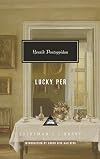
Consider Denmark. When I thought of it before reading Lucky Per, my thoughts were of a modern, forward thinking country, with lots of people engaged in art and design. If I thought about earlier times at all, it would be of the fishing fleets going out into a wider world. All that changed with Lucky Per.
Denmark occupies an awkward geographic position, sticking up into the North Sea, a sort of appendage to Europe, but lacking the benefits of that other appendage, Italy. This put nineteenth show more century Denmark at a significant disadvantage. There was no real traffic through it. The people were bound up in the thoughts and habits of life little changed since the Reformation. New ideas were all happening in Germany, and those with drive and imagination were going there.
Peter Andreas Sidenius was born into a line of pastors that could be traced back to the Reformation. Early on, he realized that was not the path for him. Who he might be, however, was unclear to him. He avoided home and family as much as he could. School frustrated him, religion disgusted him, his family were ashamed of him.
Per did show an aptitude for mechanical things though; a curiosity about how things worked, and how they could be improved. He imagined a system of waterways and canals to irrigate the fields, and to allow the passage of water craft through Denmark rather than going around. He thought this would improve the lives of those living along the new routes, allowing some of the wealth concentrated in the larger centres to penetrate into the interior, and allowing those in the interior to link with other European ports directly.
The optimistic young man took his ideas to Copenhagen and a technical school. At first it seemed as if this would be another in a long line of nineteenth century novels about a young man on the make, carefully apeing those who have arrived where he would like to be; think Balzac, Dickens and others. However, there is also a bit of Hardy here, for what followed was a true object lesson in how stagnation of ideas, and a rigid bureacracy combined with a rigid class system, can prevent even the best ideas from taking hold.Per was rebuffed at every turn.
Later, he did find support, financial and philosophical, from an assimilated Jewish family, the Salomons. Among their circle, Per learned about music and art, about enjoying life and all it has to offer; a remarkable contrast to his Jutland upbringing. Here Pontoppidan creates a foil to Per: the eldest Salomon daughter Jakobe, one of the best drawn characters in the book.
There was a restlessness about Per, however, that drove him to seek ever more new ideas and experiences. Other dreamers have this too. Sometimes it works, sometimes it doesn’t. The drive to discover oneself can take many twists and turns. How life turned out eventually for Per is the surprise of the novel.
Pontoppidan won the Nobel Prize for Literature jointly with his fellow Dane Karl Gjellerup in 1917. Pontoppidan’s citation read in part “ for his authentic descriptions of present day life in Denmark.” In some ways his early life provided the material for Per. The novel is no rural pastoral though. Rather, it reflects the drive for modernism, with its concern with the more forward ideas of his time, but at the same time, the old Denmark is not left completely behind. Reading Lucky Per, the ideas of Kirkegaard and Nietzsche, current at the time of writing, come through, but so does the hold of the established Lutheran church fighting skirmish by skirmish. However, this is no dry book. Pontoppidan easily establishes a bond between his characters and the reader, so that what and who Lucky Per is keeps the reader going. Why it had not been translated into English for almost one hundred years is a mystery. show less
Denmark occupies an awkward geographic position, sticking up into the North Sea, a sort of appendage to Europe, but lacking the benefits of that other appendage, Italy. This put nineteenth show more century Denmark at a significant disadvantage. There was no real traffic through it. The people were bound up in the thoughts and habits of life little changed since the Reformation. New ideas were all happening in Germany, and those with drive and imagination were going there.
Peter Andreas Sidenius was born into a line of pastors that could be traced back to the Reformation. Early on, he realized that was not the path for him. Who he might be, however, was unclear to him. He avoided home and family as much as he could. School frustrated him, religion disgusted him, his family were ashamed of him.
Per did show an aptitude for mechanical things though; a curiosity about how things worked, and how they could be improved. He imagined a system of waterways and canals to irrigate the fields, and to allow the passage of water craft through Denmark rather than going around. He thought this would improve the lives of those living along the new routes, allowing some of the wealth concentrated in the larger centres to penetrate into the interior, and allowing those in the interior to link with other European ports directly.
The optimistic young man took his ideas to Copenhagen and a technical school. At first it seemed as if this would be another in a long line of nineteenth century novels about a young man on the make, carefully apeing those who have arrived where he would like to be; think Balzac, Dickens and others. However, there is also a bit of Hardy here, for what followed was a true object lesson in how stagnation of ideas, and a rigid bureacracy combined with a rigid class system, can prevent even the best ideas from taking hold.Per was rebuffed at every turn.
Later, he did find support, financial and philosophical, from an assimilated Jewish family, the Salomons. Among their circle, Per learned about music and art, about enjoying life and all it has to offer; a remarkable contrast to his Jutland upbringing. Here Pontoppidan creates a foil to Per: the eldest Salomon daughter Jakobe, one of the best drawn characters in the book.
There was a restlessness about Per, however, that drove him to seek ever more new ideas and experiences. Other dreamers have this too. Sometimes it works, sometimes it doesn’t. The drive to discover oneself can take many twists and turns. How life turned out eventually for Per is the surprise of the novel.
Pontoppidan won the Nobel Prize for Literature jointly with his fellow Dane Karl Gjellerup in 1917. Pontoppidan’s citation read in part “ for his authentic descriptions of present day life in Denmark.” In some ways his early life provided the material for Per. The novel is no rural pastoral though. Rather, it reflects the drive for modernism, with its concern with the more forward ideas of his time, but at the same time, the old Denmark is not left completely behind. Reading Lucky Per, the ideas of Kirkegaard and Nietzsche, current at the time of writing, come through, but so does the hold of the established Lutheran church fighting skirmish by skirmish. However, this is no dry book. Pontoppidan easily establishes a bond between his characters and the reader, so that what and who Lucky Per is keeps the reader going. Why it had not been translated into English for almost one hundred years is a mystery. show less
Earlier this year, I was very surprised that Lion Feuchtwanger and his Jew Suss are as little-known as they are. Now, it’s my turn to be shocked that Henrik Pontopiddan and Lucky Per are so little recognized. Feuchtwanger didn’t win a Nobel Prize but Pontopiddan did. Posterity can be cruel. When I read Johannes Jensen’s Fall of the King last year (another work I gave five stars), I noted that “in 1999, two leading Danish newspapers, independently of each other, both named this the show more best Danish book of the 20th century! Now, having read it, I am completely baffled: why on earth isn’t Jensen better known?” Lucky Per came in number two in those ratings. My reaction is the same.
My thoughts? Read this book. The story is the religious awakening, though not entirely written in those terms, of a young Danish man in the last quarter of the 19th century. Don’t let that put you off. Pontopiddan routinely refers to religion but cleverly underplays it, rarely emphasizing the subject (although it appears often enough) until the end when he does so in a tour de force that I found terribly impressive. It is noteworthy that his depiction of Jews is extraordinarily well-done; that’s particularly important because one of the most important characters in the book is Jewish. His ability to create memorable human characters is admirable: there are few minor characters in the book who are not indelible. I read the Everyman’s Library translation by Naomi Lebowitz (there is another recent one in English as well, surprisingly enough); it seemed excellent to me. Both the introduction (by Danish author Garth Hallberg and available in abbreviated form online here) and the afterword by the translator are helpful in situating the work in the author’s and the literary times. Indeed, Lebowitz makes an essential observation: Lucky Per owes a great debt to the Grimms’ tale, Hans im Gluck (“Hans in Luck”) the story of a young man who is paid his wages in gold and trades down—first for a horse, then a cow, and so on—until he is left with nothing. But the moral of the tale is that only now is Hans truly happy. After some 550 pages, I was impressed but somehow not quite convinced. Then I read the last chapter. Pontopiddan brings everything together brilliantly. I simply had to sit still and digest how he had done it. show less
My thoughts? Read this book. The story is the religious awakening, though not entirely written in those terms, of a young Danish man in the last quarter of the 19th century. Don’t let that put you off. Pontopiddan routinely refers to religion but cleverly underplays it, rarely emphasizing the subject (although it appears often enough) until the end when he does so in a tour de force that I found terribly impressive. It is noteworthy that his depiction of Jews is extraordinarily well-done; that’s particularly important because one of the most important characters in the book is Jewish. His ability to create memorable human characters is admirable: there are few minor characters in the book who are not indelible. I read the Everyman’s Library translation by Naomi Lebowitz (there is another recent one in English as well, surprisingly enough); it seemed excellent to me. Both the introduction (by Danish author Garth Hallberg and available in abbreviated form online here) and the afterword by the translator are helpful in situating the work in the author’s and the literary times. Indeed, Lebowitz makes an essential observation: Lucky Per owes a great debt to the Grimms’ tale, Hans im Gluck (“Hans in Luck”) the story of a young man who is paid his wages in gold and trades down—first for a horse, then a cow, and so on—until he is left with nothing. But the moral of the tale is that only now is Hans truly happy. After some 550 pages, I was impressed but somehow not quite convinced. Then I read the last chapter. Pontopiddan brings everything together brilliantly. I simply had to sit still and digest how he had done it. show less

Hansted, az idealista káplán nagy célokat nevel magában, de a vidéki Dánia megreformálása túl nagy falat neki, és elbukik. Pontoppidan ezt a (nem egyedülálló) történetet nagy drámai jelenetek nélkül, szép tájleírásokkal és komótosan meséli el, úgyhogy nekem igazából egyszer sem jutott eszembe, hogy megrángassam a főszereplőt a grabancánál fogva, és az arcába ordítsak: Mi van már veled? Nézz már a hátad mögé! , inkább csak sztoikus nyugalommal show more néztem, ahogy módszeresen egyre mélyebb gödörbe ássa bele magát. Szóval nem egy road movie. Másrészt azért sem érzek bűntudatot, hogy így ellőttem a végkifejletet, mert csak az nem érzi meg az események ívét már az első oldalon, aki nem akarja. Maga Pontoppidan is bőven spoilerez: hogy mást ne mondjak, már a szereplők arcába is bele van kódolva, hogy jók-e avagy nem jók. Ha valakinek tarjagos arca van, vagy sunyi tekintete (ami első blikkre látszik), akkor keresztbe tesz Hanstednek, de ha harmóniát sugároz, akkor támogatója lesz. Szóval ilyen egyszerűen mennek a dolgok.
Aztán van ez az előszó. Bóka László olyan költői hevülettel csókdossa benne a szocialista rendszer valagát, hogy az önmagában tiszteletre méltó. És még azt is leszögezi, hogy Hansted azért bukik el, mert a parasztságot nem lehet kívülről megváltoztatni – szóval ez az egész eleve el van rendelve. Szerintem meg ez egy akkora kamu, hogy még. Hansted azért bukik el, mert ő személyesen olyan, amilyen. Egy lelkes fazon, aki borzasztó nagy szeretettel fordul a dán vidék felé parasztostul, tehenestül, fjordostul meg rozstáblástul*, de igazából sem lelkiereje, sem elemzőkészsége nincs ahhoz, hogy megbirkózzon a saját ideáival. Mondhatni, félember: csupa tiszta szándék, semmi alapozás. Pontoppidan kritikája ezt a típust célozza meg, nagyon okosan, nagyon kimunkáltan – bár nem a legizgalmasabban, ami azt illeti.
* Érdekes, hogy a kor embere, amikor imádatával illette a természetet, általában alig tett különbséget a vadregényes táj és a megművelt mezőgazdasági kultúrák között. Sőt, amikor himnuszt énekelt hozzá, többnyire gyümölcsösök, gabonatáblák és parasztkonform állatok (pl: pacsirta, de semmiképpen sem farkas) dicséretét zengte. show less
Aztán van ez az előszó. Bóka László olyan költői hevülettel csókdossa benne a szocialista rendszer valagát, hogy az önmagában tiszteletre méltó. És még azt is leszögezi, hogy Hansted azért bukik el, mert a parasztságot nem lehet kívülről megváltoztatni – szóval ez az egész eleve el van rendelve. Szerintem meg ez egy akkora kamu, hogy még. Hansted azért bukik el, mert ő személyesen olyan, amilyen. Egy lelkes fazon, aki borzasztó nagy szeretettel fordul a dán vidék felé parasztostul, tehenestül, fjordostul meg rozstáblástul*, de igazából sem lelkiereje, sem elemzőkészsége nincs ahhoz, hogy megbirkózzon a saját ideáival. Mondhatni, félember: csupa tiszta szándék, semmi alapozás. Pontoppidan kritikája ezt a típust célozza meg, nagyon okosan, nagyon kimunkáltan – bár nem a legizgalmasabban, ami azt illeti.
* Érdekes, hogy a kor embere, amikor imádatával illette a természetet, általában alig tett különbséget a vadregényes táj és a megművelt mezőgazdasági kultúrák között. Sőt, amikor himnuszt énekelt hozzá, többnyire gyümölcsösök, gabonatáblák és parasztkonform állatok (pl: pacsirta, de semmiképpen sem farkas) dicséretét zengte. show less
Lists
Awards


You May Also Like


Associated Authors
Statistics
- Works
- 124
- Also by
- 13
- Members
- 763
- Popularity
- #33,345
- Rating
- 4.0
- Reviews
- 20
- ISBNs
- 101
- Languages
- 10
- Favorited
- 3

