
Thomas Maltman
Author of Little Wolves
About the Author
Image credit: Turba Photography
Works by Thomas Maltman
Tagged
Common Knowledge
- Gender
- male
Members
Reviews
'Little Wolves' is a bleak, dark, book, permeated with a sense of inevitable doom. It's filled with violence, abuse, death, deception, torture and oppression. The writing style felt a little self-consciously literary at times and seemed to be reaching for a deeper meaning beneath the story which I wasn't convinced by. The narrative is deeply, sometimes disturbingly, realistic but is laced with references to Norse myths, the nature of monsters and the heroes who battle them, the show more inescapability of fate and a belief in the reality-shaping power of storytelling.
Set in a small, failing town on the Minnesota prairies in 1987, it starts with a troubled teenager shooting the local sheriff with a sawn-off shotgun and follows the impact the killing has on the boy's father and the boy's teacher. The teacher is the preacher's wife, newly arrived, newly married, newly pregnant, haunted by old myths learned from her father about her absent-since-her-birth mother and hungry to discover her origins and root herself. The father of the boy is a struggling local farmer, widower and social outcast with a long-standing enmity with the sheriff. Both the main characters are outsiders with complicated views of the world, and trauma in their past that has twisted their belief in their agency over their own lives.
This is not a conventional drama where the reader is focused on working out how the hero will overcome overwhelming odds and right all the wrongs. Here, the heroes seem cursed, doomed to come face to face with monsters who will do them harm. Hope is replaced by stubborn endurance. Righting wrongs is replaced by the possibility of survival.
The town and the people in it are, for the most part, deeply unpleasant and entirely believable. The violence and anger and oppression that sits just beneath the surface of the social life of this failing town owes nothing to the supernatural and everything to a culture hierarchical culture dominated by violent men and sustained by a consensual silence about how the town works and a collective investment in an alternative narrative in which everything is fine.
There were points in this book when I became completely absorbed in the writing and in the disclosed pasts of the two main characters but there were other points when I felt that it was over-written and over-structured. It reminded me of one of those neo-gothic Scottish Baronial style castles that the Victorians built, look at them one feature at a time and you can admire each turret, medieval arch and mullioned window but when you look at the building as a whole it lacks authenticity.
I got the sense that Thomas Maltman has a strong dislike of rural, Lutheran-dominated small towns and the gap between how life works and how it is described. This book seemed like a way of taking a fresh look at the things he dislikes. show less
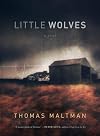
I find Minnesota fascinating. Maybe fascinating isn't the right word for a Great Plains state, but at least interesting. My mom grew up in a small Minnesota town near the Canadian border. I've read some [a:Louise Erdrich|9388|Louise Erdrich|https://d202m5krfqbpi5.cloudfront.net/authors/1348269229p2/9388.jpg] and [b:Peace Like a River|227571|Peace Like a River|Leif Enger|https://d202m5krfqbpi5.cloudfront.net/books/1388187735s/227571.jpg|3332231]*. I think I can safely say that those books are show more not my mom's Minnesota, and neither is the one found in Little Wolves. Maltman's Minnesota is populated by German-American Lutheran farmers who make my mom's Dutch-American Mennonite relatives look like an open-minded, fun-loving bunch. Seriously, these are probably the descendants of the people who ran my Anabaptist ancestors out of Western Europe. So we start with a cast of characters I wouldn't want to spend a day with, let alone a lifetime.
Beginning with the oppressing heat of a summer drought and moving into an early and frigid winter, this book is bleak and dark. You can't really expect anything else from a book with this title and this cover, that begins with a troubled teenager heading into town with a sawed-off shotgun. (This prompted me to ask my science teacher husband what the benefit would be in sawing off "precisely seven inches" of a shotgun barrel. Answer: You can shoot your target at closer range and spray a larger area. Cheerful stuff.) But this isn't the story of that teenager, Seth. Instead this is the story of the aftermath of and the long, slow lead-up to his crime, told from the p.o.v. (via a limited third person narrator) of his father and his substitute English teacher, the new pastor's wife, who didn't answer the door when Seth knocked on his way into town with the aforementioned shotgun. Struggling with their influence on Seth's crime, as well as their own past, they're broken but sympathetic characters. Some of the other m.f.ers in this book, though...not so much.
I don't want to give too much away, but there's a lot packed into these 330 pages: a lot of motherless children (human and otherwise), mythology (Clara, the substitute teacher, is working on her dissertation in early Anglo-Saxon literature, and was teaching Seth's class Beowulf.), ghosts, family grudges & curses, and a lot of secrets. As for the mysteries of this novel, some are solved...sort of. If you want a story with all the ends tied up neatly, this is not for you. Like the characters, there are some things you will just never know.
*[a:Leif Enger|13591|Leif Enger|https://d202m5krfqbpi5.cloudfront.net/authors/1200336963p2/13591.jpg], author of Peace Like a River is quoted on the front and back covers: "Maltman's written an ambitious mythical thriller that hums with energy and portent. Set under brooding prairie skies, Little Wolves has modern psychoses and generational wickedness, ravening devils and uneasy saints. It shifts and dodges like wind, and it rings with conviction and confidence. What more can a reader ask?" What he said. show less
Beginning with the oppressing heat of a summer drought and moving into an early and frigid winter, this book is bleak and dark. You can't really expect anything else from a book with this title and this cover, that begins with a troubled teenager heading into town with a sawed-off shotgun. (This prompted me to ask my science teacher husband what the benefit would be in sawing off "precisely seven inches" of a shotgun barrel. Answer: You can shoot your target at closer range and spray a larger area. Cheerful stuff.) But this isn't the story of that teenager, Seth. Instead this is the story of the aftermath of and the long, slow lead-up to his crime, told from the p.o.v. (via a limited third person narrator) of his father and his substitute English teacher, the new pastor's wife, who didn't answer the door when Seth knocked on his way into town with the aforementioned shotgun. Struggling with their influence on Seth's crime, as well as their own past, they're broken but sympathetic characters. Some of the other m.f.ers in this book, though...not so much.
I don't want to give too much away, but there's a lot packed into these 330 pages: a lot of motherless children (human and otherwise), mythology (Clara, the substitute teacher, is working on her dissertation in early Anglo-Saxon literature, and was teaching Seth's class Beowulf.), ghosts, family grudges & curses, and a lot of secrets. As for the mysteries of this novel, some are solved...sort of. If you want a story with all the ends tied up neatly, this is not for you. Like the characters, there are some things you will just never know.
*[a:Leif Enger|13591|Leif Enger|https://d202m5krfqbpi5.cloudfront.net/authors/1200336963p2/13591.jpg], author of Peace Like a River is quoted on the front and back covers: "Maltman's written an ambitious mythical thriller that hums with energy and portent. Set under brooding prairie skies, Little Wolves has modern psychoses and generational wickedness, ravening devils and uneasy saints. It shifts and dodges like wind, and it rings with conviction and confidence. What more can a reader ask?" What he said. show less
Clara Warren comes to the town of Lone Mountain, MN as a pastor's wife with a secret agenda of learning more about her own past; Lone Mountain is where her mother - of whom her father would never speak except in coded myth - died, and Clara survived. While her husband gets to know his new congregation, Clara teaches English at the high school; there, she meets Seth, an outcast who is drawn to her teaching of Beowulf. But when Seth commits a terrible crime, both Clara and Seth's father Grizz show more feel there must be more to the story than what is apparent on the surface. Separately, they begin to uncover dark secrets about the town. The story alternates between Clara and Grizz, always in third person, and Clara's sections include some of her father's stories as well as some myths she writes down for herself.
Quotes:
Few people know you so well as those who hate you. (20)
From one [box] she hefted out her Shorter Oxford English Dictionary, which she figured a suitable weapon for doing battle with ghosts trying to take up residence under the stairwell. She held the substantial bulk of the alphabet in her hands, a word for every reality. Madness was for when words failed. (28)
This is what she discovered two nights after the murder: In birth all things are kindred, the sounds we make universal to any species. We enter wailing of a lost world. (30)
Writing was her prayer. (60)
"God gave us an imagination. It may be one of the most beautiful functions of our brain. He left the space open for us to fill." (156)
The dead carve out a space inside us, taking up residence like a man stepping under a willow tree in the rain to sit beside the ghost of our former selves. In this manner each of us is haunted, and who would have it any other way? (216)
The story of what happened went on reverberating in the words and gestures of everything people in town said...all of them knowing there was no language large enough to take the awfulness away. (322) show less
Quotes:
Few people know you so well as those who hate you. (20)
From one [box] she hefted out her Shorter Oxford English Dictionary, which she figured a suitable weapon for doing battle with ghosts trying to take up residence under the stairwell. She held the substantial bulk of the alphabet in her hands, a word for every reality. Madness was for when words failed. (28)
This is what she discovered two nights after the murder: In birth all things are kindred, the sounds we make universal to any species. We enter wailing of a lost world. (30)
Writing was her prayer. (60)
"God gave us an imagination. It may be one of the most beautiful functions of our brain. He left the space open for us to fill." (156)
The dead carve out a space inside us, taking up residence like a man stepping under a willow tree in the rain to sit beside the ghost of our former selves. In this manner each of us is haunted, and who would have it any other way? (216)
The story of what happened went on reverberating in the words and gestures of everything people in town said...all of them knowing there was no language large enough to take the awfulness away. (322) show less
4.5 Stars
Little Wolves by Thomas Maltman is a haunting, dark tale and a powerful murder mystery. I don’t normally read murder mystery novels but when I do they have to have that little bit extra to keep me interested and the fantasia of myth and folklore had me from page one.
Lately I have been doing most of my reading on Kindle and am really enjoying the experience. But Little Wolves was a hardback book that I bought and boy the experience of holding and reading a novel like this really show more enhanced the whole reading experience. I really love a hardback and when I see a good book recommendation, I love to treat myself to a copy for my bookshelf.
The author, Thomas Maltman, begins his story with a dark myth about a half-starved wolf that finds and then suckles a human baby abandoned on the prairie.
The story is Set on the Minnesota prairie in the late 1980s during a drought season that's pushing family farms to the brink, Little Wolves features the intertwining stories of a father searching for answers after his son commits a heinous murder, and a pastor's wife (and washed-out scholar of early Anglo-Saxon literature) who has returned to the town for mysterious reasons of her own.
The writing is so haunting and imaginative and I found myself transported to the Minnesota Prairie with the beautiful and sometime scary descriptions.
The characters are extremely well developed and all are complicated and most not very likable. The plot has so many twists and turns that the reader is constantly on the edge of the couch.
I loved this haunting and magical story but I know that this book is not for everybody as some readers will find it dark and strange. But for me truly a memorable read and a captivating story. show less
Little Wolves by Thomas Maltman is a haunting, dark tale and a powerful murder mystery. I don’t normally read murder mystery novels but when I do they have to have that little bit extra to keep me interested and the fantasia of myth and folklore had me from page one.
Lately I have been doing most of my reading on Kindle and am really enjoying the experience. But Little Wolves was a hardback book that I bought and boy the experience of holding and reading a novel like this really show more enhanced the whole reading experience. I really love a hardback and when I see a good book recommendation, I love to treat myself to a copy for my bookshelf.
The author, Thomas Maltman, begins his story with a dark myth about a half-starved wolf that finds and then suckles a human baby abandoned on the prairie.
The story is Set on the Minnesota prairie in the late 1980s during a drought season that's pushing family farms to the brink, Little Wolves features the intertwining stories of a father searching for answers after his son commits a heinous murder, and a pastor's wife (and washed-out scholar of early Anglo-Saxon literature) who has returned to the town for mysterious reasons of her own.
The writing is so haunting and imaginative and I found myself transported to the Minnesota Prairie with the beautiful and sometime scary descriptions.
The characters are extremely well developed and all are complicated and most not very likable. The plot has so many twists and turns that the reader is constantly on the edge of the couch.
I loved this haunting and magical story but I know that this book is not for everybody as some readers will find it dark and strange. But for me truly a memorable read and a captivating story. show less
Lists
All Iowa Reads (1)
Awards


You May Also Like


Statistics
- Works
- 4
- Members
- 448
- Popularity
- #54,748
- Rating
- 3.7
- Reviews
- 20
- ISBNs
- 21