
Dorothy Thompson (2) (1893–1961)
Author of Dorothy Thompson and Rose Wilder Lane: Forty Years of Friendship, Letters, 1921-1960
For other authors named Dorothy Thompson, see the disambiguation page.
Works by Dorothy Thompson
Associated Works
Reporting World War II Part One : American Journalism, 1938-1944 (1995) — Contributor — 480 copies, 3 reviews
An American Album: One Hundred and Fifty Years of Harper's Magazine (2000) — Contributor — 146 copies, 1 review
Women's Magazines, 1940-1960: Gender Roles and the Popular Press (1998) — Contributor — 95 copies, 1 review
Tagged
Common Knowledge
- Canonical name
- Thompson, Dorothy
- Other names
- Lewis, Dorothy Thompson
- Birthdate
- 1893-07-09
- Date of death
- 1961-01-30
- Gender
- female
- Education
- Syracuse University (1914)
- Occupations
- journalist
war correspondent - Organizations
- NBC
Ladies Home Journal
New York Post (Berlin bureau) - Relationships
- Lewis, Sinclair (husband)
Lewis, J. P. Sinclair (grandson)
Lane, Rose Wilder (friend)
Schwarzwald, Eugenie (friend) - Short biography
- Dorothy Thompson was a formidable force in American journalism in the 1920s to the early 1940s. She began working for women's right to vote and then went to Europe to pursue journalism as a career. In 1939, she was named by Time magazine as the second most influential women in America next to Eleanor Roosevelt. In fact, many called her the “First Lady of American journalism." During the World War II era, she successfully straddled the mediums of radio and print: In addition to her three times a week newspaper columns and a monthly column in the Ladies Home Journal, she was also a regular on NBC radio news. She became Berlin bureau chief for The New York Evening Post in 1927. She became a leading opponent of fascism and Nazism and was expelled from Germany in 1934 after the Nazis took offense at her articles and her book I Saw Hitler.
She returned to the U.S. where she became the most syndicated woman journalist in the country. Her radio broadcasts made her one of the most sought-after female public speakers of her time. - Nationality
- USA
- Birthplace
- Lancaster, New York, USA
- Associated Place (for map)
- New York, USA
Members
Reviews
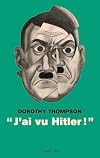
Written in 1932, Thompson's assessments of the Nazi movement, which she calls Hitlerites, is dead on, except for one thing. Thompson never thought that Hitler would get the votes to put him in power and technically he never did. He was appointed Chancellor in 1933 and became the official head of state, which he abolished in favor of his new position as Führer und Reichskanzler, in 1934 upon the death of Hindenburg. Thompson calls Hitler the "Little Man" and he appeals to other little men: show more "Grocery store owners who are in debt to the wholesale dealers; fathers of families who can't pay the butcher; peasants who need money for the mortgage; young men out of work." He wraps them in the warm cloak of patriotism and blames the Jews (even in 1932) for all their problems. Thompson writes about figures of the day whom I had to look up (not being an historian), but the book is a wonderful look into a Germany just on the brink of Fascism. As an aside: Thompson was the first American journalist to be kicked out of Germany in 1934 for the views expressed in this book and in articles like it. show less

Smug American forties liberal blather. Who goes Nazi? Everyone who's not "kind"? Because there were no kind, deluded housewives or whatever in Nazi Germany, right? And you're hardly being "kind" right now by drawing false equivalencies between the upstanding salubrious citizen lawyer and the decent farmer (either of these guys could go Nazi--many did, many didn't), or between big business and big labour (the laziest of all false equivalencies). I mean, Trump's no Hitler (he may yet be worse, show more though signs do not point such, but the details are all different), but if there's one thing this nuts election and administration (which Dorothy Thompson wasn't around for, to be fair) should have demonstrated is that people go Nazi for all kinds of reasons, not because of some perhaps obscure but still somewhere suppurating psychic wound (or not only, or not mostly). But mostly I guess, the character sketches here are fun in a couple cases and all, but I guess I don't really buy this kind of social determinism. show less
DOROTHY THOMPSON & ROSE WILDER Lane: "FORTY YEARS OF FRIENDSHIP, LETTERS, 1921-1960" by Dorothy Thompson
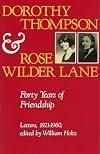
William Holtz is the same person who wrote the biography of Lane: The Ghost in the Little House (1993). As Holtz has shown, Lane was the ghostwriter of her mother's books, the Little House on the Prairie series. At the same time that her mother's books became wildly popular, Rose struggled with her own writing. Holtz says that Lane put the best part of herself into her correspondence, that she wrote some of the best letters of the 20th century.
The letters cover the years 1921-1960. For a show more good biography of Dorothy Thompson, see American Cassandra by Peter Kurth. show less
The letters cover the years 1921-1960. For a show more good biography of Dorothy Thompson, see American Cassandra by Peter Kurth. show less
“…In the early 1930s – when Hitler was driving for power but it was not clear he could make it – Thompson wrote this very condescending piece based on an interview with him. It belittled him. She went out of her way to prick the tenderest spots of Hitler’s psyche. She said he didn’t really look like a German leader and how could someone like this ever really succeed. It appeared originally in the Ladies Home Journal and then became a book. Of course, she was wrong. He did become show more the head of state. …” (reviewed by John Hamilton in FiveBooks).
Full interview is available here: http://fivebooks.com/interviews/john-m-hamilton-on-american-foreign-reporting show less
Full interview is available here: http://fivebooks.com/interviews/john-m-hamilton-on-american-foreign-reporting show less
Lists
Take Four Books (1)
You May Also Like
Associated Authors
Statistics
- Works
- 14
- Also by
- 7
- Members
- 97
- Popularity
- #194,531
- Rating
- 4.0
- Reviews
- 5
- ISBNs
- 41
- Languages
- 3