
Edward O. Wilson (1929–2021)
Author of Consilience: The Unity of Knowledge
About the Author
He was born in Birmingham, Alabama, in 1929. He is currently Pellegrino University Research Professor & Honorary Curator in Entomology of the Museum of Comparative Zoology at Harvard. He is on the Board of Directors of the Nature Conservancy, Conservation International & the American Museum of show more Natural History. He lives in Lexington, Massachusetts. (Bowker Author Biography) show less
Series
Works by Edward O. Wilson
From So Simple a Beginning: Darwin's Four Great Books (2005) — Editor; Introduction — 504 copies, 2 reviews
The Superorganism: The Beauty, Elegance, and Strangeness of Insect Societies (2008) 364 copies, 3 reviews
Biodiversity (Papers from the 1st National Forum on Biodiversity, September 1986, Washington, D.C.) (1988) — Editor — 149 copies, 3 reviews
The Poetic Species: A Conversation with Edward O. Wilson and Robert Hass (2014) 65 copies, 4 reviews
Kingdom of Ants: José Celestino Mutis and the Dawn of Natural History in the New World (2010) 51 copies
Le società degli insetti. Vol. II 2 copies
Le società degli insetti. Vol. I 2 copies
Microcosm 1 copy
The Secret Duchess 1 copy
Serendipity and Dumb Luck: A Conversation, Not Too Fancy, about How Way Leads to Way in a Peculiar Manner (2016) 1 copy
Trailhead 1 copy
In Search of the Big Bang 1 copy
The Universe 1 copy
Dialogues of the Dead 1 copy
Về bản tính người 1 copy
Biologie als Schicksal die soziobiologischen Grundlagen menschlichen Verhaltens (1983) 1 copy, 1 review
Associated Works
The Literary Animal: Evolution and the Nature of Narrative (2005) — Foreword, some editions — 86 copies
Forgotten Grasslands of the South: Natural History and Conservation (2012) — Foreword, some editions — 25 copies
Genetics of Original Sin: The Impact of Natural Selection on the Future of Humanity (2009) — Foreword, some editions — 25 copies, 1 review
Ants: Standard Methods for Measuring and Monitoring Biodiversity (2000) — Foreword, some editions — 19 copies
Tagged
Common Knowledge
- Canonical name
- Wilson, Edward O.
- Legal name
- Wilson, Edward Osborne
- Birthdate
- 1929-06-10
- Date of death
- 2021-12-26
- Gender
- male
- Education
- University of Alabama (BS|1949|MS|1950)
Harvard University (Ph.D|1955) - Occupations
- professor
biologist
naturalist
ecologist
entomologist
sociobiologist - Organizations
- Harvard University (Department of Organismic and Evolutionary Biology)
International Academy of Humanism
Committee for Skeptical Inquiry
Museum of Comparative Zoology - Awards and honors
- National Medal of Science (1977)
American Academy of Arts and Sciences (1959)
National Academy of Sciences (1969)
American Philosophical Society (1976)
Pulitzer Prize for General Non-Fiction (1979, 1991)
Royal Society (Foreign Member, 1990) (show all 36)
Finnish Academy of Science and Letters (Foreign Member, 1990)
Russian Academy of Natural Sciences (Foreign Member, 1994)
Deutsche Akademie der Naturforscher Leopoldina (Fellow, 1977)
Royal Society of Sciences of Uppsala (Fellow, 1989)
Leidy Award (1979)
Kew International Medal (2014)
TED Prize (2007)
Kistler Prize (2000)
Lewis Thomas Prize for Writing about Science (2000)
Humanist of the Year (1999)
Crafoord Prize (1990)
Richard M. Weaver Award (1989)
Tyler Prize for Environmental Achievement (1984)
ECI Prize (1987)
Academy of Achievement Golden Plate Award (1988)
International Prize for Biology (1993)
Carl Sagan Award for Public Understanding of Science (1994)
Audubon Medal (1995)
Benjamin Franklin Medal (1998)
Nierenberg Prize, 2001
Linnean Tercentenary Silver Medal, 2006
Addison Emery Verrill Medal (2007)
The Explorers Club Medal (2009)
BBVA Frontiers of Knowledge Award (2010)
Thomas Jefferson Medal in Architecture, 2010
Heartland Prize (2010)
International Cosmos Prize (2012)
Harper Lee Award (2016)
King Faisal International Prize for Science (2000)
Linnean Society of London (1994) - Agent
- John Taylor Williams
- Relationships
- Pinker, Steven (student)
Farish, Donald J. (student) - Nationality
- USA
- Birthplace
- Birmingham, Alabama, USA
- Places of residence
- Cambridge, Massachusetts, USA
Birmingham, Alabama, USA
Lexington, Massachusetts, USA - Place of death
- Burlington, Massachusetts, USA
- Map Location
- Alabama, USA
Members
Discussions
GROUP READ: The Social Conquest of Earth (main thread) in 75 Books Challenge for 2012 (January 2013)
Reviews

A re-read of the wonderful Folio version after reading the original thirty years ago. At the time it was a clarion call of decisions to preserve the natural world as we knew it. Now it reads more like a funeral dirge of advice not taken. Things are not better, not okay, and we are all worse for it. The only saving grace that comes to mind is that speciation will again take hold as we exit the scene, having wasted our inheritance.

E. O. Wilson's Biophilia explores human attachment to everything living, the natural inclination we have to the living world, to life. We anthropomorphise because everything alive is "people". St. Francis preached to bird-people and fish-people (can't help remembering someone remarked, "if he loved birds so much, why didn't he preach to cats?!"), even the Sun, which, waxing and waning, seems very much alive, even capriciously so. We are attuned to life and turned on to life. Life of other show more species is necessary to our life, and the need broadens much past the physical, into our aesthetics and ethics. Prishvin's Lu Wen and Poncins' Eskimo illustrate the attachment in a natural setting, and its range. Humans couldn't exist without biophilia, wouldn't be human without it. It doesn't mean not hunting, it means loving and cherishing what you hunt (or grow) because it gives you life. show less
Douglas Adams said, "The answer to the ultimate question of life, the universe and everything is 42." :-)
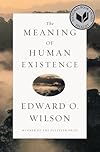
Of course the writing of Douglas Adams and Edward O. Wilson are worlds apart in intent. I found this book interesting and informative, though it necessitates careful reading to appreciate all that E. O. Wilson says. I believe this book should be read by all that are interested in our futures. If you have read Richard Dawkins, it would behove you to also read this book to get a more show more balanced appreciation of the progress of evolutionary science.
In the following, I include paraphrasing of passages from the book to give you and inkling of what to expect, hopefully whetting your interest. To me, his writing is well organized, and is neither overly concise, nor rambling. Unless you have some familiarity with evolutionary biology though, you may need a dictionary or Wikipedia at hand.
As the lead in to this book states, history makes little sense without prehistory, and prehistory makes little sense without biology. Knowledge of prehistory and biology is increasing rapidly, bringing into focus how humanity originated and why a species like our own exists on this planet.
In setting the tone of the book, he explains that the ordinary usage the word "meaning" implies intention, intention implies design, and design implies a designer. There is a second, broader way the word "meaning" is used though, and a very different worldview is implied. It is that the accidents of history, not the intentions of a designer, are the source of meaning. In this broader use of the word "meaning" there is no advance design, but instead overlapping networks of physical cause and effect. During organic evolution, for example, the origin of one adaptation by natural selection makes the origin of certain other adaptations more likely. This concept of meaning, insofar as it illuminates humanity and the rest of life, is the worldview of science.
The French writer Jean Bruller (pen name Vercors) was on the right track when, in his 1952 novel You Shall Know Them, he declared, "All of man’s troubles have arisen from the fact that we do not know what we are and do not agree on what we want to be." Human nature is the ensemble of hereditary regularities in mental development that bias cultural evolution in one direction as opposed to others and thus connect genes to culture in the brain of every person.
One important point I was happy to see, is his explanation of the fauna and flora of any ecosystem being far more than collections of species (which we don't know near the whole of). Ecosystems are complex systems of interactions, where the extinction of any species under certain conditions could have a profound impact on the whole, and ultimately ourselves. Extinction rates are 100 to 1,000 times higher than before the global spread of humanity, and will increase with human induced climate change.
To my amusement, in one chapter he even delves into the inanity of our imaginative science fiction, but I doubt that will change our subjective alternate reality longings. One faulty perception is that of those who believe humanity can emigrate to another planet after using up this one. Those whose imagination ignores that two living worlds, ours and another, are in all probability radically different in origin, molecular machinery, and the endless pathways of evolution that produced the life-forms thereon. Thus the ecosystems and species of an alien world would be wholly incompatible with our own and the result would be a biological train wreck. H. G. Wells was at least on the right tract back in the 1890s with The War of the Worlds.
Another chapter dissects religion, and how it fosters much of the animosity in the world. The Founding Fathers of the United States understood the risk of tribal religious conflict very well, but we have regressed since to the point of the consequences we see today.
In yet another chapter he delves into what we think of as Free Will. Did you know that half of the twenty thousand to twenty-five thousand genes of the entire human genetic code participate in one manner or other in the prescription of the brain-mind system, and this amount of commitment has resulted from one of the most rapid evolutionary changes known in any advanced organ system of the biosphere. Philosophers have labored off and on for over two thousand years to explain consciousness (their job). Innocent of biology, however, they have for the most part understandably gotten nowhere.
One thing he focuses on at various points of this writing is recombining the humanities and science, as began in the Enlightenment (17th and 18th centuries), but faltered in the 19th century Romantic transition (feelings through creative art). For the next two centuries and to the present day, science and the humanities went their own ways. This to me, the eclipsing of objective thinking in the broader populace with subjective perspectives, yet how can we have one without the other? The greatest contribution that science can make to the humanities is to demonstrate how bizarre we are as a species, and why, but understanding that as yet takes more fortitude and forthrightness than we seem to be able to muster in too many. The meaning of human existence cannot be explained until “just is” (Romanticism) is replaced with “just is, because” (Enlightenment). Only then can we begin to understand and compensate for our self-destructive proclivities. It was only after eons of time, during which millions of species had come and gone, that one of the lineages, the direct antecedents of Homo sapiens, won the grand lottery of evolution. The payout was civilization based on symbolic language, and culture, and from these a gargantuan power to extract the nonrenewable resources of the planet—while cheerfully exterminating our fellow species.
All of the points he focuses on lead to a final section and chapter entitled "A Human Future," which I found well examined. show less
Of course the writing of Douglas Adams and Edward O. Wilson are worlds apart in intent. I found this book interesting and informative, though it necessitates careful reading to appreciate all that E. O. Wilson says. I believe this book should be read by all that are interested in our futures. If you have read Richard Dawkins, it would behove you to also read this book to get a more show more balanced appreciation of the progress of evolutionary science.
In the following, I include paraphrasing of passages from the book to give you and inkling of what to expect, hopefully whetting your interest. To me, his writing is well organized, and is neither overly concise, nor rambling. Unless you have some familiarity with evolutionary biology though, you may need a dictionary or Wikipedia at hand.
As the lead in to this book states, history makes little sense without prehistory, and prehistory makes little sense without biology. Knowledge of prehistory and biology is increasing rapidly, bringing into focus how humanity originated and why a species like our own exists on this planet.
In setting the tone of the book, he explains that the ordinary usage the word "meaning" implies intention, intention implies design, and design implies a designer. There is a second, broader way the word "meaning" is used though, and a very different worldview is implied. It is that the accidents of history, not the intentions of a designer, are the source of meaning. In this broader use of the word "meaning" there is no advance design, but instead overlapping networks of physical cause and effect. During organic evolution, for example, the origin of one adaptation by natural selection makes the origin of certain other adaptations more likely. This concept of meaning, insofar as it illuminates humanity and the rest of life, is the worldview of science.
The French writer Jean Bruller (pen name Vercors) was on the right track when, in his 1952 novel You Shall Know Them, he declared, "All of man’s troubles have arisen from the fact that we do not know what we are and do not agree on what we want to be." Human nature is the ensemble of hereditary regularities in mental development that bias cultural evolution in one direction as opposed to others and thus connect genes to culture in the brain of every person.
One important point I was happy to see, is his explanation of the fauna and flora of any ecosystem being far more than collections of species (which we don't know near the whole of). Ecosystems are complex systems of interactions, where the extinction of any species under certain conditions could have a profound impact on the whole, and ultimately ourselves. Extinction rates are 100 to 1,000 times higher than before the global spread of humanity, and will increase with human induced climate change.
To my amusement, in one chapter he even delves into the inanity of our imaginative science fiction, but I doubt that will change our subjective alternate reality longings. One faulty perception is that of those who believe humanity can emigrate to another planet after using up this one. Those whose imagination ignores that two living worlds, ours and another, are in all probability radically different in origin, molecular machinery, and the endless pathways of evolution that produced the life-forms thereon. Thus the ecosystems and species of an alien world would be wholly incompatible with our own and the result would be a biological train wreck. H. G. Wells was at least on the right tract back in the 1890s with The War of the Worlds.
Another chapter dissects religion, and how it fosters much of the animosity in the world. The Founding Fathers of the United States understood the risk of tribal religious conflict very well, but we have regressed since to the point of the consequences we see today.
In yet another chapter he delves into what we think of as Free Will. Did you know that half of the twenty thousand to twenty-five thousand genes of the entire human genetic code participate in one manner or other in the prescription of the brain-mind system, and this amount of commitment has resulted from one of the most rapid evolutionary changes known in any advanced organ system of the biosphere. Philosophers have labored off and on for over two thousand years to explain consciousness (their job). Innocent of biology, however, they have for the most part understandably gotten nowhere.
One thing he focuses on at various points of this writing is recombining the humanities and science, as began in the Enlightenment (17th and 18th centuries), but faltered in the 19th century Romantic transition (feelings through creative art). For the next two centuries and to the present day, science and the humanities went their own ways. This to me, the eclipsing of objective thinking in the broader populace with subjective perspectives, yet how can we have one without the other? The greatest contribution that science can make to the humanities is to demonstrate how bizarre we are as a species, and why, but understanding that as yet takes more fortitude and forthrightness than we seem to be able to muster in too many. The meaning of human existence cannot be explained until “just is” (Romanticism) is replaced with “just is, because” (Enlightenment). Only then can we begin to understand and compensate for our self-destructive proclivities. It was only after eons of time, during which millions of species had come and gone, that one of the lineages, the direct antecedents of Homo sapiens, won the grand lottery of evolution. The payout was civilization based on symbolic language, and culture, and from these a gargantuan power to extract the nonrenewable resources of the planet—while cheerfully exterminating our fellow species.
All of the points he focuses on lead to a final section and chapter entitled "A Human Future," which I found well examined. show less
Wilson's proposal is ambitious, at least judging by the title. However, to understand what he means, one has to get the straighten out our causality thinking about what it means to talk about existence — not in an empty (i.e. non-empirical) ideological way, but taking the hard evidence of the natural sciences and then, only then, think about existence.
This is Wilson's proposal. The book is well written, with good examples and with a narrative that is not too demanding to follow. Since show more life is what it is, and that is truly the only acceptable starting point to discuss The Meaning of Human Existence, in that sense, Wilson is right in trying to tackle such a long and difficult discussion through the biological lens. Wilson does not offer an answer — he wants to open the way to a more fruitful discussion.
If you prefer to swallow the blue pill of whatever dream narrative it best suits your interests, this is not the book for you. On the other hand, if you choose the red one, you have to face the crudeness of how things truly are — only then you can start to think about The Meaning of [your] Human Existence — and this book is probably well suited for you. show less
This is Wilson's proposal. The book is well written, with good examples and with a narrative that is not too demanding to follow. Since show more life is what it is, and that is truly the only acceptable starting point to discuss The Meaning of Human Existence, in that sense, Wilson is right in trying to tackle such a long and difficult discussion through the biological lens. Wilson does not offer an answer — he wants to open the way to a more fruitful discussion.
If you prefer to swallow the blue pill of whatever dream narrative it best suits your interests, this is not the book for you. On the other hand, if you choose the red one, you have to face the crudeness of how things truly are — only then you can start to think about The Meaning of [your] Human Existence — and this book is probably well suited for you. show less
Lists
Wisdom (1)
My Wishlist (1)
Favourite Books (1)
TLS 6010 (1)
Awards


You May Also Like


Associated Authors
Statistics
- Works
- 72
- Also by
- 30
- Members
- 17,958
- Popularity
- #1,223
- Rating
- 3.9
- Reviews
- 293
- ISBNs
- 389
- Languages
- 22
- Favorited
- 63


