
Melvyn P. Leffler
Author of For the Soul of Mankind: The United States, the Soviet Union, and the Cold War
About the Author
Melvyn P. Leffler, Edward Stettinius Professor of History at the University of Virginia
Series
Works by Melvyn P. Leffler
For the Soul of Mankind: The United States, the Soviet Union, and the Cold War (2007) 165 copies, 1 review
The Specter of Communism: The United States and the Origins of the Cold War, 1917-1953 (1994) 120 copies, 1 review
A Preponderance of Power: National Security, the Truman Administration, and the Cold War (1992) 106 copies
Safeguarding Democratic Capitalism: U.S. Foreign Policy and National Security, 1920-2015 (2017) 17 copies
In Uncertain Times: American Foreign Policy after the Berlin Wall and 9/11 (Miller Center of Public Affairs Books) (2011) 8 copies
The Elusive Quest: America's Pursuit of European Stability and French Security, 1919-1933 (1979) 4 copies
Tagged
Common Knowledge
- Canonical name
- Leffler, Melvyn P.
- Legal name
- Leffler, Melvyn Paul
- Birthdate
- 1945-05-13
- Gender
- male
- Education
- Cornell University (B.S.|1966)
Ohio State University (Ph.D.|1972) - Occupations
- educator (professor of history)
- Organizations
- Society for Historians of American Foreign Relations
- Relationships
- Legro, Jeffrey W. (co-editor)
Painter, David S. (co-editor) - Nationality
- USA
- Birthplace
- New York, New York, USA (Brooklyn)
- Associated Place (for map)
- New York, USA
Members
Reviews
The Specter of Communism: The United States and the Origins of the Cold War, 1917-1953 (A Critical Issue) by Melvyn P. Leffler
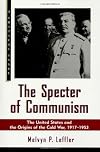
In The Specter of Communism: The United States and the Origins of the Cold War, 1917-1953, Melvyn P. Leffler traces the history of U.S. policymakers’ fears of communism from the Russian Revolution of 1917 through the Korean War. He shows “that the lessons of the 1930s cast a huge shadow over postwar foreign policies. These lessons were not simply that appeasement did not work nor that exports were the key to prosperity, but that configurations of power abroad were critical to the show more maintenance of a free political economy at home. American officials had concluded as early as 1940 that they could not live in a world dominated by totalitarian nations, even if those powers refrained from attacking the United States” (pg. viii). Leffler draws extensively upon newly-declassified or available sources from the time in which he wrote, allowing him to draw conclusions about Stalin and his advisers’ actions.
Leffler writes of the Soviet Union at the end of World War II, “Safeguarding his periphery was critical to Stalin. Peace was desirable in the short run, because his country had been devastated; but war was likely in the long run, so the Soviet Union needed to be prepared for every eventuality” (pg. 39). On the American side, “If victory over the Axis was to usher in a period of peace and stability, Roosevelt believed, Soviet-American amity would need to be a component of that postwar order” (pg. 45) Domestically, “religious ultraconservatives often joined with right-wing extremists and racial segregationists. They equated the struggle against Communism with the eternal battle between Satan and Christ and with the quest to preserve a white-dominated regime in the South” (pg. 60). To this end, “Gradually, between 1947 and 1950, the United States took on the role of hegemon in the international system and in so doing accepted responsibility for revitalizing the international economy, thwarting the spread of Communism, and guaranteeing the security of its partners” (pg. 65). Leffler continues, “A Cold War consensus formed. Truman was willing to fight domestic subversives, as the Republicans demanded, in return for their support of his foreign policy” (pg. 78).
Leffler concludes, “Politicians like Richard M. Nixon initially found anti-Communism an irresistible tool to clobber political foes, win votes, discredit the New Deal, and attack the executive branch. Over time, anti-Communism took on a life of its own. Many Americans found that it helped them make sense of a complex world, a world they knew little about. Its appeal stemmed from the fact that it resonated with their fears or served their interests” (pg. 119). Further, “As the United States became more involved in waging the Cold War and fighting the Korean War, statism, repression, and executive authority appeared to be on the rise rather than free markets and free discourse” (pg. 127).
The Specter of Communism is a useful primer on the early Cold War for both academics and non-academics alike. show less
Leffler writes of the Soviet Union at the end of World War II, “Safeguarding his periphery was critical to Stalin. Peace was desirable in the short run, because his country had been devastated; but war was likely in the long run, so the Soviet Union needed to be prepared for every eventuality” (pg. 39). On the American side, “If victory over the Axis was to usher in a period of peace and stability, Roosevelt believed, Soviet-American amity would need to be a component of that postwar order” (pg. 45) Domestically, “religious ultraconservatives often joined with right-wing extremists and racial segregationists. They equated the struggle against Communism with the eternal battle between Satan and Christ and with the quest to preserve a white-dominated regime in the South” (pg. 60). To this end, “Gradually, between 1947 and 1950, the United States took on the role of hegemon in the international system and in so doing accepted responsibility for revitalizing the international economy, thwarting the spread of Communism, and guaranteeing the security of its partners” (pg. 65). Leffler continues, “A Cold War consensus formed. Truman was willing to fight domestic subversives, as the Republicans demanded, in return for their support of his foreign policy” (pg. 78).
Leffler concludes, “Politicians like Richard M. Nixon initially found anti-Communism an irresistible tool to clobber political foes, win votes, discredit the New Deal, and attack the executive branch. Over time, anti-Communism took on a life of its own. Many Americans found that it helped them make sense of a complex world, a world they knew little about. Its appeal stemmed from the fact that it resonated with their fears or served their interests” (pg. 119). Further, “As the United States became more involved in waging the Cold War and fighting the Korean War, statism, repression, and executive authority appeared to be on the rise rather than free markets and free discourse” (pg. 127).
The Specter of Communism is a useful primer on the early Cold War for both academics and non-academics alike. show less
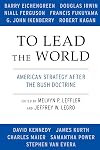
Stephen Van Evera, Professor of Political Science at MIT, would have us believe that the U.S. is in a similar situation as in the Concert of Europe, c. 1815. After the era of Napoleon and the French Revolution, the Concert was adopted by the old great powers of Europe of meeting from time to time in an International Conference, or Congress, in order to plan a solution by mutual agreement (hence "concert"). Austrian Chancellor Prince Klemens Wenzel von Metternich was the primary architect of show more the Concert and its most famous participant. The Concert of Europe became a de facto government of the world. The British balance of power was in abeyance and there followed an era of stability where Europe engaged in no major conflict for 43 years which is no mean accomplishment.
But the historical analogy does not fit. The Congress' first primary objectives were to:
contain France after decades of war;
achieve a balance of power between Europe's great powers;
uphold the territorial arrangements made at the Congress of Vienna in 1814-1815 and in doing so prevent the rise of another Napoleon-esque figure which would result in another continent wide war.
None of the objectives fit the requirements of effective U.S. foreign policy. There is no nation-state, such as France that needs containing; there is nothing advantageous for U.S. interests to simply maintain parity with other leading nations; and, no territory will contain a Napoleon-like figure to any one territory.
A Napoleon or any monster like him today is much more lethal today given the phenomenon of Islamofascism. Second, the U.S. has prospered during a period of American hegemony which is only more difficult today given the difficulties of the U.S. economy, ongoing international threats, and Islamofascism. Boundaries are not barriers today when you consider the role of the media in the information war and the porous nature of territories as in the case of places like Pakistan.
Van Evera equates the danger of a WMD and Napoleon as a threat-from-below. But as many nations are already engaged in actively defending themselves especially since the threats have often moved beyond threats to actual bombings and killings. Yet, the existing bulwarks such as NATO have proved less than successful in thwarting attacks. Van Evera seems to simply state the obvious. Nations need to cooperate. We already know that. The trick is to get them to move in harmony since they are not.
It is unilateral U.S. action that Van Evera reserves for especial disdain. But what is the alternative? America was under attack following 9/11 and if anything the U.S. dragged its feet, or failed to heed the warnings from Bin Laden experts such as Michael Scheuer during the Clinton administration. In large part the Bush Doctrine arouse from being attacked directly and during war no nation can wait for an international Concert before acting.
Van Evera's idealistic faith in diplomacy is laughable. Here is one such precious gem: "the United States should speak in respectful tones to other governments" (p. 19, Leffler). Maybe if the U.S. said "pretty please" to Hugo Chavez he wouldn't be such a bad guy after all. There are significant portions of the world, the lands where our enemies live, that openly applauded the attacks on 9/11. We can't wait for friends or enemies to take decisive action when our national security is on the line.
Van Evera simply recommends diplomacy to stop WMD. Every sane nation desires this but he never explains how the failed diplomacies of the past will now work. He just knows that Bush didn't excercise enough of it. Even our staunchest allies fail to deliver. For example, in July of this year, Japan backed out of an earlier commitment to dispatch its Self-Defence Forces (SDF) to Afghanistan now that the security situation has declined. The self-limitation of allies does not hinder AQAM (al-Qaeda and Allied Movements).
Another unexplained notion is that we have to have ideas to combat al Qaeda. This will convince them? Hardly. No war of ideas will convince AQ that we are right.
As things may get worse Van Evera has the "selective engagement" of Robert Art. This is all well and good but there is no way to distinguish Art from Bush since George would consider himself as targeting the right people and he has selectively chosen to attack the worse threats.
Nations selectively attack their biggest foes. Van Evera approves of Bismarck between 1871-1890 because he "bolstered peace" (p. 24). What Van Evera does not mention is that Bismarck had defeated each of his enemies-–Denmark, Austria, and France-–in isolation. The only way a Bismarckian analogy can be drawn is after the Coalition defeats al Qaeda and its affiliates. In addition, Bismarck as "dove" is questionable at best since he goaded his opponents into war, edited the infamous Zimmerman Telegram, and generally created as much conflict and bloodshed as he desired until it served his purposes to create a peace, a peace that enhanced his power. After 1871 Bismarck was committed to preserving the peace of Europe only because he had already provoked and/or defeated his threats, selectively.
Since the U.S. suffered only 1.7% of war deaths in World War I, and only 3.6% of the deaths in World War II, this is evidence for Van Evera that the U.S. paid a relatively small price while forging great alliances that can work again. The only thing it seems to prove is that the U.S. assisted others in their life and death struggle that if successful, our common enemies would have come for us, and, of course Japan had hit the U.S. mainland.
Van Evera gets the historial parallels wrong so it is not surprising that his arguments for the present conflicts do not fit.
Robert Kagan, Senior Associate of the Carnegie Endowment for International Peace, is more helpful. Kagan challenges the common misconception that Bush represents a radical change from past American foreign policy. Truman, Kennedy, and Clinton, Democrats all, along with Bush, have maintained a consistent American policy since the end of World War II: a "preponderance of power," rather than a balance of power (Cf. Leffler, Melvyn P., National Security, The Truman Administration, and the Cold War, Stanford University Press, 1992).
For example, "regime change" characterized all presidential administrations of the past half-century, Kennedy in Cuba, and Clinton in Bosnia and Haiti. The Clinton administration bombed Iraq over the objection of UN Security Council permanent members, and went to war in Kosovo without UN authorization.
What has changed is the world. The world is a less secure place with the ongoing crisis that transnational rogue elements will deploy WMD; in addition, the fragility of the world's financial situation should be clear in the light of Wall Street's meltdown in the Fall of 20008. Previously, the world acquiesced with an American predominance as a security measure. That world is gone. The American Left will revel in an American fall from grace, and the unrealistic solution is only to offer a multi-polar Concert of the World (p. 49). The world no longer shares what the Concert of Europe could assume, a "common morality and shared principles of government" (p. 49). Kagan suggests a League of Democracies (p.50), to advance American interests in concert with similar nations, since deep-seated divisions already exist between international multi-polar powers. This League could exert and extend our influence to advance our security. A similar proposal was made during the McCain 2008 presidential campaign.
In regards to Bush and Iraq, Charles Maier, Leverett Saltonstall Professor of History at Harvard University, claims that the President's policies have been "calamitous," (p. 60), "reckless," (p. 62), a series of "adventures" (p. 63), and "testosterone-fueled" (p. 78); thus, with that polemic, Maier can hardly be taken seriously. Unless he is willing to engage the issues his analysis is bound to be flawed.
Maier wants to establish that interactions between countries actually occur below the level of official diplomacy, at that level of motivation and the basest instinct of human beings, religion. Yet, he returns to official state representatives, not the below actors considered important earlier, and finds, of all things, moderate Islam (p. 69)? If his intention is to find and discover religion, below the surface, you would think this would be an easy search to conduct. Any number of radical, jihadist examples proliferate in the world but moderate Islamic world spokespersons are much harder to find. Not one moderate Islamic spokesperson has emerged from the Middle East; the discovery of a Martin Luther King, Jr., or a Mother Theresa from the Middle East is not forthcoming. We are left with the world we are actually in and not the world Maier describes.
Maier is all over the place in his search for authentic cultural
expression from below. He even includes "street theater" (p. 72). His argument is not simple as he suggests (p. 61), but simplistic. He approvingly quotes Fareed Zakaria, the celebrator of America's decline (The Future of Freedom, The Post-American World), who naively describes Weimar as a "model democracy" (p. 76), by ignoring its obvious limitations.
The Weimar republic faced severe problems from the start. Politically, it was weak because Germany had many small parties. The chancellor had to form coalitions that easily fell apart.
The government, led by moderate democratic socialists, came under constant fire from both the left and right. communists demanded radical changes like those Lenin had brought to Russia. Conservatives—including the old Junker nobility, military officers, and wealthy bourgeoisie—attacked the government as too liberal and weak. They longed for another strong leader like Bismarck. Germans of all classes blamed the Weimar Republic for the hated Versailles treaty. Bitter, they looked for scapegoats. Many blamed German Jews for economic and political problems.
Weimar was not a model democracy, it was a flawed republic from its creation in 1919.
But Maier is not quite done with analyzing religion. He remarks: "we must work to attenuate the passions of religion" (p. 80). How, he does not say since he is correct in viewing religion as a phenomenon from below and he
should appreciate that the winds of religion blow where they will.
However, it is true that Turkey may be an example of one Islamic country that largely maintains a secular government as opposed to Islamist religionists holding sway. Yet, Maier makes the staggering proposition that "ultimately Iran" will have a "constituency of middle-class electors concerned with property and humane values" (p. 80).
That Iran will peaceably evolve into a European-like Christian Democracy is preposterous. Iranian development is not simply rhetoric but the reality of Iran is alarming. Iran is a country that willingly sacrificed one million of its own citizens in its disastrous war against Iraq from 1980-1988. What European Christian Democracy would do this today? In Europe the Peace of Westphalia settled the question of state violence in advancing the cause of religion. There is no Westphalian equivalent or settlement in the Middle East.
Maier does not seriously consider Bush's doctrine and he alarmingly distorts and misunderstands the phenomenon of religion, particularly Islamism.
G. John Ikenberry, Albert G. Milbank Professor of Public and International Affairs in the Department of Politics and the Woodrow Wilson School of Public and International Affairs at Princeton University, can find no singular, specific, current threat to America (p. 85); this is in fact the conclusion of the Princeton Report that Ikenberry published with Anne-Marie Slaughter. What the authors suggest is that the U.S. will confront diffused, critical, and simultaneous threats. The convergence of these threats is what concerns thinkers such as Ikenberry and Thomas Homer-Dixon (p. 90). Ikenberry states: "Taken together, liberal order building involves investing in the enhancement of global social capital so as to creat capacities to solve problems that, left unattended, will threat national security (p. 91).
Ikenberry contrasts this agenda with the failed Bush administration in which he cites himself as an authority in an unpublished paper (p. 98: p. 107 n. 12). Ikenberry mistakes effect for cause for example by claiming that Bush's actions cause the erosion of liberal hegemonic power. At one time, in the post-War period, American power was accepted because there was something worse in the offing. Now, however, Ikenberry views Bush's introduction of unipolarity in world affairs as the "something worse" (p. 99) as international threats dissipate. It is unfortunate that Ikenberry does not view Islamism as an international something worse. At the very least the rising powers of India and China need to be integrated into the fold of liberal nations. It would difficult to imagine taming these forces without a counter-balance formed by a League of Democracies as proposed by defeated Republican nominee John McCain in 2008.
Niall Ferguson contributes a chapter "The Problem of Conjecture." show less
But the historical analogy does not fit. The Congress' first primary objectives were to:
contain France after decades of war;
achieve a balance of power between Europe's great powers;
uphold the territorial arrangements made at the Congress of Vienna in 1814-1815 and in doing so prevent the rise of another Napoleon-esque figure which would result in another continent wide war.
None of the objectives fit the requirements of effective U.S. foreign policy. There is no nation-state, such as France that needs containing; there is nothing advantageous for U.S. interests to simply maintain parity with other leading nations; and, no territory will contain a Napoleon-like figure to any one territory.
A Napoleon or any monster like him today is much more lethal today given the phenomenon of Islamofascism. Second, the U.S. has prospered during a period of American hegemony which is only more difficult today given the difficulties of the U.S. economy, ongoing international threats, and Islamofascism. Boundaries are not barriers today when you consider the role of the media in the information war and the porous nature of territories as in the case of places like Pakistan.
Van Evera equates the danger of a WMD and Napoleon as a threat-from-below. But as many nations are already engaged in actively defending themselves especially since the threats have often moved beyond threats to actual bombings and killings. Yet, the existing bulwarks such as NATO have proved less than successful in thwarting attacks. Van Evera seems to simply state the obvious. Nations need to cooperate. We already know that. The trick is to get them to move in harmony since they are not.
It is unilateral U.S. action that Van Evera reserves for especial disdain. But what is the alternative? America was under attack following 9/11 and if anything the U.S. dragged its feet, or failed to heed the warnings from Bin Laden experts such as Michael Scheuer during the Clinton administration. In large part the Bush Doctrine arouse from being attacked directly and during war no nation can wait for an international Concert before acting.
Van Evera's idealistic faith in diplomacy is laughable. Here is one such precious gem: "the United States should speak in respectful tones to other governments" (p. 19, Leffler). Maybe if the U.S. said "pretty please" to Hugo Chavez he wouldn't be such a bad guy after all. There are significant portions of the world, the lands where our enemies live, that openly applauded the attacks on 9/11. We can't wait for friends or enemies to take decisive action when our national security is on the line.
Van Evera simply recommends diplomacy to stop WMD. Every sane nation desires this but he never explains how the failed diplomacies of the past will now work. He just knows that Bush didn't excercise enough of it. Even our staunchest allies fail to deliver. For example, in July of this year, Japan backed out of an earlier commitment to dispatch its Self-Defence Forces (SDF) to Afghanistan now that the security situation has declined. The self-limitation of allies does not hinder AQAM (al-Qaeda and Allied Movements).
Another unexplained notion is that we have to have ideas to combat al Qaeda. This will convince them? Hardly. No war of ideas will convince AQ that we are right.
As things may get worse Van Evera has the "selective engagement" of Robert Art. This is all well and good but there is no way to distinguish Art from Bush since George would consider himself as targeting the right people and he has selectively chosen to attack the worse threats.
Nations selectively attack their biggest foes. Van Evera approves of Bismarck between 1871-1890 because he "bolstered peace" (p. 24). What Van Evera does not mention is that Bismarck had defeated each of his enemies-–Denmark, Austria, and France-–in isolation. The only way a Bismarckian analogy can be drawn is after the Coalition defeats al Qaeda and its affiliates. In addition, Bismarck as "dove" is questionable at best since he goaded his opponents into war, edited the infamous Zimmerman Telegram, and generally created as much conflict and bloodshed as he desired until it served his purposes to create a peace, a peace that enhanced his power. After 1871 Bismarck was committed to preserving the peace of Europe only because he had already provoked and/or defeated his threats, selectively.
Since the U.S. suffered only 1.7% of war deaths in World War I, and only 3.6% of the deaths in World War II, this is evidence for Van Evera that the U.S. paid a relatively small price while forging great alliances that can work again. The only thing it seems to prove is that the U.S. assisted others in their life and death struggle that if successful, our common enemies would have come for us, and, of course Japan had hit the U.S. mainland.
Van Evera gets the historial parallels wrong so it is not surprising that his arguments for the present conflicts do not fit.
Robert Kagan, Senior Associate of the Carnegie Endowment for International Peace, is more helpful. Kagan challenges the common misconception that Bush represents a radical change from past American foreign policy. Truman, Kennedy, and Clinton, Democrats all, along with Bush, have maintained a consistent American policy since the end of World War II: a "preponderance of power," rather than a balance of power (Cf. Leffler, Melvyn P., National Security, The Truman Administration, and the Cold War, Stanford University Press, 1992).
For example, "regime change" characterized all presidential administrations of the past half-century, Kennedy in Cuba, and Clinton in Bosnia and Haiti. The Clinton administration bombed Iraq over the objection of UN Security Council permanent members, and went to war in Kosovo without UN authorization.
What has changed is the world. The world is a less secure place with the ongoing crisis that transnational rogue elements will deploy WMD; in addition, the fragility of the world's financial situation should be clear in the light of Wall Street's meltdown in the Fall of 20008. Previously, the world acquiesced with an American predominance as a security measure. That world is gone. The American Left will revel in an American fall from grace, and the unrealistic solution is only to offer a multi-polar Concert of the World (p. 49). The world no longer shares what the Concert of Europe could assume, a "common morality and shared principles of government" (p. 49). Kagan suggests a League of Democracies (p.50), to advance American interests in concert with similar nations, since deep-seated divisions already exist between international multi-polar powers. This League could exert and extend our influence to advance our security. A similar proposal was made during the McCain 2008 presidential campaign.
In regards to Bush and Iraq, Charles Maier, Leverett Saltonstall Professor of History at Harvard University, claims that the President's policies have been "calamitous," (p. 60), "reckless," (p. 62), a series of "adventures" (p. 63), and "testosterone-fueled" (p. 78); thus, with that polemic, Maier can hardly be taken seriously. Unless he is willing to engage the issues his analysis is bound to be flawed.
Maier wants to establish that interactions between countries actually occur below the level of official diplomacy, at that level of motivation and the basest instinct of human beings, religion. Yet, he returns to official state representatives, not the below actors considered important earlier, and finds, of all things, moderate Islam (p. 69)? If his intention is to find and discover religion, below the surface, you would think this would be an easy search to conduct. Any number of radical, jihadist examples proliferate in the world but moderate Islamic world spokespersons are much harder to find. Not one moderate Islamic spokesperson has emerged from the Middle East; the discovery of a Martin Luther King, Jr., or a Mother Theresa from the Middle East is not forthcoming. We are left with the world we are actually in and not the world Maier describes.
Maier is all over the place in his search for authentic cultural
expression from below. He even includes "street theater" (p. 72). His argument is not simple as he suggests (p. 61), but simplistic. He approvingly quotes Fareed Zakaria, the celebrator of America's decline (The Future of Freedom, The Post-American World), who naively describes Weimar as a "model democracy" (p. 76), by ignoring its obvious limitations.
The Weimar republic faced severe problems from the start. Politically, it was weak because Germany had many small parties. The chancellor had to form coalitions that easily fell apart.
The government, led by moderate democratic socialists, came under constant fire from both the left and right. communists demanded radical changes like those Lenin had brought to Russia. Conservatives—including the old Junker nobility, military officers, and wealthy bourgeoisie—attacked the government as too liberal and weak. They longed for another strong leader like Bismarck. Germans of all classes blamed the Weimar Republic for the hated Versailles treaty. Bitter, they looked for scapegoats. Many blamed German Jews for economic and political problems.
Weimar was not a model democracy, it was a flawed republic from its creation in 1919.
But Maier is not quite done with analyzing religion. He remarks: "we must work to attenuate the passions of religion" (p. 80). How, he does not say since he is correct in viewing religion as a phenomenon from below and he
should appreciate that the winds of religion blow where they will.
However, it is true that Turkey may be an example of one Islamic country that largely maintains a secular government as opposed to Islamist religionists holding sway. Yet, Maier makes the staggering proposition that "ultimately Iran" will have a "constituency of middle-class electors concerned with property and humane values" (p. 80).
That Iran will peaceably evolve into a European-like Christian Democracy is preposterous. Iranian development is not simply rhetoric but the reality of Iran is alarming. Iran is a country that willingly sacrificed one million of its own citizens in its disastrous war against Iraq from 1980-1988. What European Christian Democracy would do this today? In Europe the Peace of Westphalia settled the question of state violence in advancing the cause of religion. There is no Westphalian equivalent or settlement in the Middle East.
Maier does not seriously consider Bush's doctrine and he alarmingly distorts and misunderstands the phenomenon of religion, particularly Islamism.
G. John Ikenberry, Albert G. Milbank Professor of Public and International Affairs in the Department of Politics and the Woodrow Wilson School of Public and International Affairs at Princeton University, can find no singular, specific, current threat to America (p. 85); this is in fact the conclusion of the Princeton Report that Ikenberry published with Anne-Marie Slaughter. What the authors suggest is that the U.S. will confront diffused, critical, and simultaneous threats. The convergence of these threats is what concerns thinkers such as Ikenberry and Thomas Homer-Dixon (p. 90). Ikenberry states: "Taken together, liberal order building involves investing in the enhancement of global social capital so as to creat capacities to solve problems that, left unattended, will threat national security (p. 91).
Ikenberry contrasts this agenda with the failed Bush administration in which he cites himself as an authority in an unpublished paper (p. 98: p. 107 n. 12). Ikenberry mistakes effect for cause for example by claiming that Bush's actions cause the erosion of liberal hegemonic power. At one time, in the post-War period, American power was accepted because there was something worse in the offing. Now, however, Ikenberry views Bush's introduction of unipolarity in world affairs as the "something worse" (p. 99) as international threats dissipate. It is unfortunate that Ikenberry does not view Islamism as an international something worse. At the very least the rising powers of India and China need to be integrated into the fold of liberal nations. It would difficult to imagine taming these forces without a counter-balance formed by a League of Democracies as proposed by defeated Republican nominee John McCain in 2008.
Niall Ferguson contributes a chapter "The Problem of Conjecture." show less
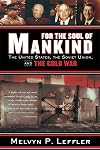
A thorough examination of the Cold War from the WW II roots through to the dissolution of the USSR and German reunification under Gorbachev. This is largely told through the series of American presidents on one side and Soviet leaders on the author through summitry and other communications and interaction. There are some maps and lots of references and bibliography making this a scholarly work. The one thing that I realized through this is that U.S.-China relations from the 50s on through show more the Cold War were much about pulling China toward the U.S. and thus away from the Soviet sphere. show less
Lists
Awards


You May Also Like


Associated Authors
Statistics
- Works
- 19
- Members
- 709
- Popularity
- #35,751
- Rating
- 3.7
- Reviews
- 3
- ISBNs
- 53
- Languages
- 1
- Favorited
- 1