
Georg Cantor (1845–1918)
Author of Contributions to the Founding of the Theory of Transfinite Numbers
About the Author
Georg Cantor was born in St. Petersburg, Russia, in 1845, but was educated and lived the rest of his life in Germany. He studied in Berlin and became a professor of mathematics in 1877. He was the creator of set theory and the founder of the theory of transfinite numbers. Cantor's most important show more work appeared between 1895 and 1897. In addition to developing the philosophical implications of his transfinite set theory, Cantor also studied the theological implications of his work. He founded the German Mathematicians Union in 1891 and served as its first president. It has been said that Cantor became mentally unstable in later life because the mathematics community did not immediately accept his work. (Bowker Author Biography) show less
Works by Georg Cantor
Fundamentos para una teoría general de conjuntos : escritos y correspondencia selecta (2005) 6 copies
Contributions to the Founding of the Theory of Transfinite Numbers (Dover Books on Mathematics) by Georg Cantor (1955) Paperback (1955) 3 copies
Gesammelte Abhandlungen: Mathematischen und Philosophischen Inhalts (German Edition) (1932) 2 copies
Contributions to the Founding of the Theory of Transfinite Numbers - The Open Court Series of Classics of Science and Philosophy, No. I (1952) 2 copies
Associated Works
Tagged
Common Knowledge
- Legal name
- Cantor, Georg Ferdinand Ludwig Philipp
- Birthdate
- 1845-03-03
- Date of death
- 1918-01-06
- Gender
- male
- Nationality
- Germany
- Associated Place (for map)
- Germany
Members
Reviews
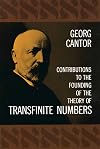
As a teenager studying mathematics, I was fascinated by Cantor's notion of an infinity of infinities. Then I bought this book and read the arguments behind his theories, and realized that, although he had invented an interesting new mathematical game, it was not a part of the standard arithmetical game, for he made several errors. There are many I could list, but two are crucial. Firstly he makes a subtle change in the meaning of equinumerous sets, which should mean that all bijections show more between the members of two sets hold - Cantor reduces this to the sets being equinumerous as long as there is at least one bijection which holds, ie his sense of the notion is weaker than the standard interpretation. Secondly his diagonal proceedure requires the ability to complete an infinite process, which is impossible. He claims that at any stage he produces a number that differs from all those so far processed, which is true, but there always remain an infinite number of numbers which may contain the "different" number he has constructed, and since he must work his process an infinite number of times to produce a number different from all in an infinite set he has to shew that an infinite process can be completed, which is not possible. Nice try Georg, but yours is a game I can admire, but not one I can play! show less
Georg Cantor Contributions to the Founding of the Theory of Transfinite Numbers (Georg Cantor Contributions to the by Georg Cantor
Surprisingly accessible for a century old mathematical treatise. Cantor's demonstration of how the same infinite set of rational numbers could have different orderings remains one of the most mind-blowing ideas I've ever encountered.
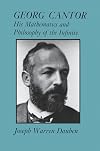
Neither a biography of Cantor nor a study of transfinite numbers, but rather the intellectual history of a mathematical idea as seen from the personal life of its main proponent.
The complete deal -- definitive.
Lists
You May Also Like


Associated Authors
Statistics
- Works
- 18
- Also by
- 1
- Members
- 352
- Popularity
- #67,993
- Rating
- 4.0
- Reviews
- 4
- ISBNs
- 27
- Languages
- 4
- Favorited
- 2