
Elmer L. Towns
Author of Fasting for Spiritual Breakthrough: A Guide to Nine Biblical Fasts
About the Author
Elmer L. Towns is Dean Emeritus of the School of Religion and Theological Seminary at Liberty University, which he cofounded in 1971 with Jerry Falwell. Each Sunday he continues to teach the Pastor's Bible Class at Thomas Road Baptist Church, which is televised on a local network and Angel One.
Series
Works by Elmer L. Towns
What Every Sunday School Teacher Should Know: 24 Secrets That Can Help You Change Lives (2001) 259 copies, 2 reviews
The Gospel of John: Believe and Live (21st Century Biblical Commentary Series) (1990) 165 copies, 1 review
My Father's Names: The Old Testament Names of God and How They Can Help You Know Him More Intimately (1991) 133 copies
A Journey Through the New Testament: The Story of Christ and How He Developed the Church (1996) 105 copies
10 Of Today's Most Innovative Churches: What They're Doing, How They're Doing It and How You Can Apply Their Ideas in Your Church (1990) 98 copies
11 Innovations in the Local Church: How Today's Leaders Can Learn, Discern and Move into the Future (2007) 88 copies, 1 review
The Names of the Holy Spirit: Understanding the Names of the Holy Spirit and How They Can Help You Know God More Intimately (1991) 69 copies, 1 review
10 Sunday Schools That Dared to Change: How Churches Across America Are Changing Paradigms to Reach a New Generation (1993) 68 copies
America's fastest growing churches; why 10 Sunday Schools are growing fast (2014) 47 copies, 1 review
What Every Pastor Should Know About Sunday School: 18 Secrets to Bring New Life and Growth to Your Church (2002) 46 copies
Fasting for Financial Breakthrough: A Guide to Uncovering God's Perfect Plan for Your Finances (2002) 35 copies
Prayer Partners: How to Increase the Power and Joy of Your Prayer Life by Praying with Others (2002) 27 copies
Praying Genesis: (Praying the Scriptures) (Praying the Scriptures (Destiny Images)) (2008) 27 copies
Getting a Church Started: A Student Manual for the Theological Foundation & Practical Techniques of Planting a Church (1985) 19 copies
Getting a church started in the face of insurmountable odds with limited resources in unlikely circumstances: How to est (1975) 19 copies, 1 review
The Ten Most Influential Churches of the Past Century: And How They Impact You Today (2015) 18 copies
10 Questions about Prayer Every Christian Must Answer: Thoughtful Responses about our Communication with God (2014) 16 copies
Fasting with the Lord's Prayer: Experience a Deeper and More Powerful Relationship with God (2013) 13 copies
A Journey Through the Old Testament: The Story of How God Developed His People in the Old Testament (1996) 13 copies
Praying for Your Second Chance: Prayers from Numbers & Deuteronomy: 1 (Praying the Scriptures) (2009) 13 copies
Praying the Gospels (Praying the Scriptures) (Praying the Scriptures) (Praying the Scriptures (Destiny Images)) (2007) 12 copies
Praying Your Way Out of Bondage: Prayers from Exodus and Leviticus (Praying the Scriptures) (2009) 7 copies
Team teaching with success 7 copies
Finishing Well 6 copies
Praying with the Conquerors: Prayers From Joshua, Judges, and Ruth (Praying the Scriptures) (2009) 5 copies
12 Disciples Sunday School Campaing 3 copies
Great Lessons and Grand Blessings: Discover How Grandparents Can Inspire and Transform Their Grandchildren (2015) 2 copies
Praying the Heart of David: Prayers From First and Second Samuel and First Chronicles (Praying the Scriptures) (2009) 2 copies
A Christmas Devotional 1 copy
Beginner's Guide to Fasting 1 copy
João 1 copy
4 Children's Short Stories 1 copy
Great Lessons and Grand Blessings Study Guide: Grandparents Of the Bible Offer Wisdom for Today, (Study Guide) (2016) 1 copy
Stepping Out on Faith 1 copy
Nama- Nama Allah 1 copy
Journey Through the Old Testament: The Story of How God Developed His People in the Old Testament 1 copy
Care Christianity 1 copy
Associated Works
Tagged
Common Knowledge
- Canonical name
- Towns, Elmer L.
- Legal name
- Towns, Elmer Leon
- Birthdate
- 1932-10-21
- Gender
- male
- Occupations
- dean
- Organizations
- Liberty Baptist Sem., Lynchburg, Va.
Members
Reviews
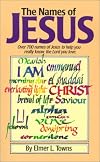
Elmer Towns' The Names of Jesus purports to list over 700 names of Jesus found in the Bible. The problem with that is that many of these "names" are stated as matter-of-fact, with little if any explication.
The book is comprised of twelve chapters, each with different types of names (birth names, Godhead names, apocalyptic names, etc.). Each chapter ends with several discussion questions, suitable for a group Bible study. An Appendix, "The Names of Jesus Christ in Scripture," appears at the show more end of the book. There are, however, problems with this list. First is the issue of translation: names can mean different things in different languages, and even different translations in the same language (sadly, there does not seem to be a standard version that is used throughout; many books will state up front that it relies on a specific translation, which provides context).
For example, one of the names in this alphabetical list is "Shiloh" which appears in the King James Version of Genesis 49:10. In the New International Version, however, "Shiloh" does not even appear, but is translated as "he to whom it belongs" (a footnote reads "or to whom tribute belongs; the meaning of the Hebrew for this phrase is uncertain"). What, then, is the value for ascribing to Jesus 1) a name whose meaning is uncertain; 2) a name that is only in certain English translations (with no mention of which ones); and 3) a name that is, within the context of this book, at most only conjectured to reference Jesus?
This last point is a frequent problem in the list of names--many are from the Old Testament, and whether or not they refer to Jesus is less than obvious. For example, one of the names in the list is "The Riddle" (Judges 14:14). Judges 14 describes Samson's marriage, and then a riddle he tells a group of men for a bet. Aside from its place in the Appendix, Towns references this name and verse once in the text:
No effort is made to explicate why this refers to Christ--much less why it is a "name" of Jesus.
Three names are drawn from Ruth 4:14-15: "The Kinsman" (v. 14), "A Nourisher of Thine Old Age" (v. 15), and "Restorer of Thy Life" (v. 15). Each of these appear alphabetically in the Appendix. There is no other reference to anything in the book of Ruth in any of the rest of the text. Perhaps Christians have allegorically interpreted this as being a reference to Christ, but with absolutely no explication to that effect, it seems a stretch to list these three "names" of Jesus. Rather, it seems that the author is more interested in coming up with a long list than an accurate or meaningful one.
There are, of course, many names in the list that are unambiguous, and there is value in those: "Son of God" (John 1:49), "The Son of the Most High" (Mark 4:7), "The Lord of glory" (1 Corinthians 2:8), and many others clearly refer to Jesus.
After this list, Towns groups several names for God that are used in Scripture; there are over 80 of these. While the book has some value, it fails in that it doesn't live up to its title--there are names of Jesus, yes, but there are many other names that don't appear to refer to Jesus at all, and if they do, little if any explanation is made.
Finally, while this is not an academic book by any stretch, it is a travesty for a book of this type not to have a Scripture Index, which is commonplace in both academic and nonacademic Christian texts. There is a brief bibliography of other books focused on names of Jesus.
I am very much in favor of a study of this topic--but I am not in favor of what appears to be a padded list with little explanation of the choices. show less
The book is comprised of twelve chapters, each with different types of names (birth names, Godhead names, apocalyptic names, etc.). Each chapter ends with several discussion questions, suitable for a group Bible study. An Appendix, "The Names of Jesus Christ in Scripture," appears at the show more end of the book. There are, however, problems with this list. First is the issue of translation: names can mean different things in different languages, and even different translations in the same language (sadly, there does not seem to be a standard version that is used throughout; many books will state up front that it relies on a specific translation, which provides context).
For example, one of the names in this alphabetical list is "Shiloh" which appears in the King James Version of Genesis 49:10. In the New International Version, however, "Shiloh" does not even appear, but is translated as "he to whom it belongs" (a footnote reads "or to whom tribute belongs; the meaning of the Hebrew for this phrase is uncertain"). What, then, is the value for ascribing to Jesus 1) a name whose meaning is uncertain; 2) a name that is only in certain English translations (with no mention of which ones); and 3) a name that is, within the context of this book, at most only conjectured to reference Jesus?
This last point is a frequent problem in the list of names--many are from the Old Testament, and whether or not they refer to Jesus is less than obvious. For example, one of the names in the list is "The Riddle" (Judges 14:14). Judges 14 describes Samson's marriage, and then a riddle he tells a group of men for a bet. Aside from its place in the Appendix, Towns references this name and verse once in the text:
When Samson sought to give the Philistines a riddle they could not resolve on their own, he said, "Out of the strong came forth sweetness" (Judges 14:14). Even today, it is uncommon to find strength and sweetness or beauty in the same thing or being. But Jesus manifested both strength and beauty. As we survey the many names and titles of Christ, we note some which emphasize His strength at the same time that others tend to emphasize his gentleness."
No effort is made to explicate why this refers to Christ--much less why it is a "name" of Jesus.
Three names are drawn from Ruth 4:14-15: "The Kinsman" (v. 14), "A Nourisher of Thine Old Age" (v. 15), and "Restorer of Thy Life" (v. 15). Each of these appear alphabetically in the Appendix. There is no other reference to anything in the book of Ruth in any of the rest of the text. Perhaps Christians have allegorically interpreted this as being a reference to Christ, but with absolutely no explication to that effect, it seems a stretch to list these three "names" of Jesus. Rather, it seems that the author is more interested in coming up with a long list than an accurate or meaningful one.
There are, of course, many names in the list that are unambiguous, and there is value in those: "Son of God" (John 1:49), "The Son of the Most High" (Mark 4:7), "The Lord of glory" (1 Corinthians 2:8), and many others clearly refer to Jesus.
After this list, Towns groups several names for God that are used in Scripture; there are over 80 of these. While the book has some value, it fails in that it doesn't live up to its title--there are names of Jesus, yes, but there are many other names that don't appear to refer to Jesus at all, and if they do, little if any explanation is made.
Finally, while this is not an academic book by any stretch, it is a travesty for a book of this type not to have a Scripture Index, which is commonplace in both academic and nonacademic Christian texts. There is a brief bibliography of other books focused on names of Jesus.
I am very much in favor of a study of this topic--but I am not in favor of what appears to be a padded list with little explanation of the choices. show less
“Stories on the Front Porch” by Elmer Towns is a nostalgic collection of stories from the author’s life. With themes of family, character and life lessons many would find this a reminder of their own childhood. As the author grew up in Georgia, there is a definite Southern feel to these stories. And although some might find this a comforting read, I found it a bit too saccharine sweet for my taste.
The author, Dr. Elmer Towns is a college and seminary professor. He has given show more theological lectures and seminars and is the Dean of the School of Religion at Liberty On-line University.
Each story is followed by a short summary of what life lesson he learnt from his experience and he also supplies a list of “Principles to Take Away”. Obviously these stories are meant as either a teaching guide or a perusal on self-help in religion as he describes his 1940 childhood in a large extended family and how he grew into his faith. Personally, I am not a particularly religious person nor do I feel the need to be lectured on a subject I have little interest in so overall this book did not meet my expectations. Another distraction of the book was the sheer number of typos which made me wonder if the manuscript had been proof-read before publication.
Although there was some humor in the stories, with titles such as “Coleslaw in my pocket, Butter Beans under my Bed”, “Finding Satisfaction in Milking Cows” and “Cussing: Struggling to Quit” I wasn’t absorbed into this book and was quite happy to reach the final page. show less
The author, Dr. Elmer Towns is a college and seminary professor. He has given show more theological lectures and seminars and is the Dean of the School of Religion at Liberty On-line University.
Each story is followed by a short summary of what life lesson he learnt from his experience and he also supplies a list of “Principles to Take Away”. Obviously these stories are meant as either a teaching guide or a perusal on self-help in religion as he describes his 1940 childhood in a large extended family and how he grew into his faith. Personally, I am not a particularly religious person nor do I feel the need to be lectured on a subject I have little interest in so overall this book did not meet my expectations. Another distraction of the book was the sheer number of typos which made me wonder if the manuscript had been proof-read before publication.
Although there was some humor in the stories, with titles such as “Coleslaw in my pocket, Butter Beans under my Bed”, “Finding Satisfaction in Milking Cows” and “Cussing: Struggling to Quit” I wasn’t absorbed into this book and was quite happy to reach the final page. show less
This was an autobiographical reminiscence of the author's childhood and the things he learned from his experiences growing up in a small southern town. At the conclusion of each chapter Towns summarizes what he learned with "Principles to Take Away." He emphasizes that he wrote the book to "help you look within so you too can live by principles." The stories were sweet, and in addition to describing a 1940's childhood in a large extended family, he includes his how he grew in his faith.
My show more complaint with this book is the overwhelming number of typos! I can't believe anyone reviewed or proofread it before publication. This was somewhat distracting, and I was surprised that the author, a college and seminary professor, an author of popular and scholarly works (he has written more than 100 books), could allow these typos to be published. show less
My show more complaint with this book is the overwhelming number of typos! I can't believe anyone reviewed or proofread it before publication. This was somewhat distracting, and I was surprised that the author, a college and seminary professor, an author of popular and scholarly works (he has written more than 100 books), could allow these typos to be published. show less

This is a fascinating story of the ten largest Sunday Schools in America. Why do some Sunday Schools grow in attendance at fantastic rates to unbelievable size--and others stagnate? What is the secret? Is there some magical formula? This book will not give you a surefire solution but it will give you a new vision of your work and its potential.
You May Also Like


Associated Authors
Statistics
- Works
- 199
- Also by
- 1
- Members
- 6,249
- Popularity
- #3,922
- Rating
- 3.5
- Reviews
- 37
- ISBNs
- 298
- Languages
- 6