
Robert Newton Peck (1928–2020)
Author of A Day No Pigs Would Die
About the Author
Robert Newton Peck was born in Vermont on February 17, 1928. During World War II, he served as a machine-gunner in the U.S. Army 88th Infantry Division between 1945 and 1947. He received a B.A. degree from Rollins College in 1953 and studied law at Cornell University. He worked as a lumberjack, in show more a papermill, killing hogs, and as an advertising executive before the publication of his first book, A Day No Pigs Would Die, in 1972. It was named an American Library Association Best Book for Young Adults in 1973. His other works include Soup and Me, Soup on Ice, Cowboy Ghost, Horse Thief, and Bro. (Bowker Author Biography) show less
Image credit: author photo by: sam peck
Series
Works by Robert Newton Peck
Soup for President Paperback 3 copies
Soup on Wheels 1 copy
Soup's Goat 1 copy
SOUP AND ME - SPARE 1 copy
MY VERMONT II 1 copy
Hamilton 1 copy
Associated Works
Reader's Digest Condensed Books 1973 v01: The Stepford Wives / The Odessa File / A Day No Pigs Would Die / Stanfield Harvest / P.S. Your Not Listening (1973) 31 copies
Reader's Digest Condensed Books 1989 v04: While My Pretty One Sleeps / The Bailey Chronicles / The Negotiator / Hallapoosa (1989) 29 copies
Reader's Digest Best Sellers 1973: Wild Goose, Brother Goose | The Day of the Jackal | A Day No Pigs Would Die (1973) — Author — 8 copies
Reader's Digest Condensed Books: The Slow Awakening / Collision / A Day No Pigs Would Die / The Unwanted (1977) — Author — 2 copies
Tagged
Common Knowledge
- Birthdate
- 1928-02-17
- Date of death
- 2020-06-23
- Gender
- male
- Education
- Rollins College
- Organizations
- soldier
lumberjack
butcher
advertising executive - Nationality
- USA
- Birthplace
- Vermont, USA
- Places of residence
- Longwood, Florida, USA
Ticonderoga, New York, USA - Place of death
- Longwood, Florida, USA
- Burial location
- Florida National Cemetery, Bushnell, Florida, USA
- Associated Place (for map)
- Florida, USA
Members
Reviews

I read this to my 3rd grade son at night over the course of a couple weeks. He may have been a bit young for it but he handled it well. There were plenty of opportunities for us to discuss a variety of things such as birth, death, work, religion, animals, materialism, illiteracy, etc. whenever he had a question. Also, it's a good book for a father to read to his son due to the simple yet strong relationship between the main character Robert and his father. I certainly enjoyed it; one chapter show more in particular had me in stitches, while at least three of the chapters were difficult to read aloud without choking up. My son thought some chapters (15 total) were good and some were boring, but I can tell from his questions and reactions that it's a book he will remember for a long time.
Other than the story, the narrative voice of the book's protagonist is a brilliant achievement. Robert is reliable in his honesty and sincerity, but his unwittingly adolescent take on some subjects will keep you smiling. The language used by the Peck family and their neighbors is rife with folksy similes and imaginative phrasings that make the book highly recommended for any lover of American colloquialisms. show less
Other than the story, the narrative voice of the book's protagonist is a brilliant achievement. Robert is reliable in his honesty and sincerity, but his unwittingly adolescent take on some subjects will keep you smiling. The language used by the Peck family and their neighbors is rife with folksy similes and imaginative phrasings that make the book highly recommended for any lover of American colloquialisms. show less

Robert Peck is a Shaker boy whose feat of bravery in helping his neighbor’s cow birth its calf earns him a piglet. With four sisters married and two brothers buried in the orchard, Robert is the only child left to help his father, a pig slaughterer, keep the family farm going. Pinky, the piglet, is his only possession in the world, and he cherishes her with all his heart, caring for her better than he cares for himself. When Robert takes Pinky to the Learning County Fair, his heart swells show more with pride to see his beloved pig win the blue ribbon for “First Prize for Best-Behaved Pig”—even though, as he notices, all other pigs also receive blue ribbons. His dreams of breeding Pinky come to an end once the pig is found to be barren. With his father sick and the prospect of a winter without food, Robert must accept Pinky’s slaughtering at the hands of his own father. At the age of thirteen, after the passing of his father, Robert Peck must assume his father’s role in the family. Robert’s desire of a “day [when] no pigs would die” (146) comes true at a very high price.
Robert Newton Peck’s A Day No Pigs Would Die is a coming-of-age story in which the narrator, twelve-year-old Shaker boy Robert Peck, must let go of his childhood whims embodied by Pinky—in his own words, “the only thing I ever really owned” (139)—to inherit his father’s role within the family. Robert is a practical boy, born and raised in a farm with no luxuries or privilege, and he understands that sometimes one must make sacrifices in order to survive. He learns from his father Haven, an illiterate man who works at the slaughter house, that in life “’Ain’t what you need matters. It’s what you do’” (p. 120). As the story develops, Robert learns about the sacrifices the family makes—his father who smells of blood and death so that the family can pay for the farm, and his mother who loves Robert’s father in spite of the smell of blood and death—and understands that when he is called to make his own sacrifice, he must do so with strength and dignity. Once his father passes away, the humorous and whimsical quality of young Robert’s prose is gone, replaced by a serious and somber tone of someone who has lost more than he could ever replace. The transformation, however, is not a negative one. In the process, Robert gets closer than he has ever been to his father, and in the moment after Pinky’s slaughter, Haven lets his guard down, and father and son share an experience that will help shape Robert’s personality from then on.
To many, the strong scenes of sex (even if between pigs) and violence have deemed A Day No Pigs Would Die a book unfit for young adults, granting it a spot on the ALA list of most banned/challenged books of the past 20 years. The graphic depiction of Pinky’s mating with Samson and her slaughtering may be too shocking for younger readers, but it is nothing more than a true depiction of the experiences the character goes through. This is one of the most impressive qualities of the book: Its honest account of farm living from the point of view of one who lived it. The theme of sacrifice is another highlight of the story. It teaches readers young and old that life can be tough, and many times it is downright unfair, but from these experiences we gather the strength of character that makes us better people. Robert Peck lost his father and Pinky, but he gained the drive to live a life as honest and virtuous as his father’s. show less
Robert Newton Peck’s A Day No Pigs Would Die is a coming-of-age story in which the narrator, twelve-year-old Shaker boy Robert Peck, must let go of his childhood whims embodied by Pinky—in his own words, “the only thing I ever really owned” (139)—to inherit his father’s role within the family. Robert is a practical boy, born and raised in a farm with no luxuries or privilege, and he understands that sometimes one must make sacrifices in order to survive. He learns from his father Haven, an illiterate man who works at the slaughter house, that in life “’Ain’t what you need matters. It’s what you do’” (p. 120). As the story develops, Robert learns about the sacrifices the family makes—his father who smells of blood and death so that the family can pay for the farm, and his mother who loves Robert’s father in spite of the smell of blood and death—and understands that when he is called to make his own sacrifice, he must do so with strength and dignity. Once his father passes away, the humorous and whimsical quality of young Robert’s prose is gone, replaced by a serious and somber tone of someone who has lost more than he could ever replace. The transformation, however, is not a negative one. In the process, Robert gets closer than he has ever been to his father, and in the moment after Pinky’s slaughter, Haven lets his guard down, and father and son share an experience that will help shape Robert’s personality from then on.
To many, the strong scenes of sex (even if between pigs) and violence have deemed A Day No Pigs Would Die a book unfit for young adults, granting it a spot on the ALA list of most banned/challenged books of the past 20 years. The graphic depiction of Pinky’s mating with Samson and her slaughtering may be too shocking for younger readers, but it is nothing more than a true depiction of the experiences the character goes through. This is one of the most impressive qualities of the book: Its honest account of farm living from the point of view of one who lived it. The theme of sacrifice is another highlight of the story. It teaches readers young and old that life can be tough, and many times it is downright unfair, but from these experiences we gather the strength of character that makes us better people. Robert Peck lost his father and Pinky, but he gained the drive to live a life as honest and virtuous as his father’s. show less
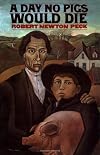
This semi-autobiographical novel is a coming of age story that tells of Robert Peck growing up in a Shaker household in Vermont between the World Wars. Live is hard, but simple. Robert's loving but firm father, who can't read, teaches him the value of education, hard work, honesty, neighbors, family, responsibility, and many more things. Somewhat episodic, the series of story-chapters frequently focus on Pinky, a pig given to Robert by a neighbor in gratitude for a significant service Robert show more provides in the opening chapter. Robert loves Pinky - the only thing that has ever truly been his own. The book is sometimes quite funny, though its overall mood is a serious one. The last two or three chapters become quite somber, as Robert learns some of the most difficult lessons of his young life.
I always am left wondering in these "semi-autobiographical" books, just how much is fiction and how much isn't. One thing is certain though, Robert Peck, author of dozens of books for intermediate readers, loves honors and respects the illiterate father who raised him. In many ways, the book is a love song to his father. show less
I always am left wondering in these "semi-autobiographical" books, just how much is fiction and how much isn't. One thing is certain though, Robert Peck, author of dozens of books for intermediate readers, loves honors and respects the illiterate father who raised him. In many ways, the book is a love song to his father. show less
I liked this book...but I don't think I'd hand it over to my 11-year-old. It's not that it's overly violent - although there's definitely some rough scenes - it's just that it might be a little too much for younger kids. The story was quick, it kept me reading, and I enjoyed references to Rutland (which is only 30 minutes away). It was a look into the past that I enjoyed along with some references local and of that time that I recognized. The semi-autobiographical nature of the book (with show more the author coming from and writing about a Shaker upbringing) also made it more interesting. show less
Lists
Awards


You May Also Like


Associated Authors
Statistics
- Works
- 75
- Also by
- 7
- Members
- 5,542
- Popularity
- #4,493
- Rating
- 3.7
- Reviews
- 55
- ISBNs
- 289
- Languages
- 3
- Favorited
- 3