
Samantha Abeel
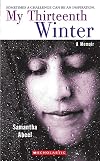
Author of My Thirteenth Winter: A Memoir
About the Author
Works by Samantha Abeel
Tagged
Common Knowledge
- Birthdate
- 1978
- Gender
- female
- Education
- University of Michigan (MSW)
Mount Holyoke College (AB|English) - Occupations
- writer
- Nationality
- USA
- Associated Place (for map)
- USA
Members
Reviews
My Thirteenth Winter has been the first autobiographical read for me this semester, and it is incredible to hear the highs and lows of Samantha Abeel as only she remembers. The perspective allows one as a reader to grasp (as much as is possible) how complicated her learning disability is and how frustrated she is. Her sudden difficulties with simple math beginning in seventh grade are not the only problems - her discomfort around some other people, her desperate need for approval, her show more forgetfulness of simple tasks, and her feeling of lacking self-worth are all burdensome. I personally find them relatable, and I was pleased that Sam was able to get the help she needed from teachers and her parents as well as becoming more confident. This is an important read for teachers to better understand their students; parents to better know their children; and anyone, awkward teenager or otherwise, to learn there are ways to overcome the most seemingly difficult times and situations in one's life. Samantha's simple reflective style contrasts with her most personal and emotional memories, which are written in italics, and her poems and personal writings that help her unleash her self-expression and deepest thoughts and desires. This book is for everyone who can read: it is important and relatable and real. It matters. show less
Truthfully, I was a surprised by how much I enjoyed this book and how much it affected me. Samantha Abeel's memoir was engaging and I became emotionally invested in her struggle while I was reading the book. Her descriptions are so expressive that when she began to describe the onset of a panic attack and the knots that formed in her stomach and her inability to move - I felt it too. Her plight often made me teary-eyed and when her disability was diagnosed I was elated. Her journey was an show more inspirational one and her message was powerful, "We all come in unique packages with strengths and weaknesses, and somewhere there is a precious gift in all of us." (202) I was happy to have shared in her experience through this book.
I read this book in two sittings. The first night I stayed up until nearly 3:30 in the morning because I didn't want to stop reading. Advanced readers should find it easy to finish this book in a couple of days - potentially one if you are particularly dedicated and have the time. Younger readers should be able to finish this book over the course of a week or so. Abeel's writing style is vivid and beautifully uncomplicated. I think many adolescent readers would find this memoir enjoyable especially children who might also be struggling in school or with a learning disability like Abeel did. show less
I read this book in two sittings. The first night I stayed up until nearly 3:30 in the morning because I didn't want to stop reading. Advanced readers should find it easy to finish this book in a couple of days - potentially one if you are particularly dedicated and have the time. Younger readers should be able to finish this book over the course of a week or so. Abeel's writing style is vivid and beautifully uncomplicated. I think many adolescent readers would find this memoir enjoyable especially children who might also be struggling in school or with a learning disability like Abeel did. show less
My Thirteenth Winter by Samantha Abeel is a nonfiction memoir about the author's childhood educational experiences as a student with dyscalculia, with an emphasis on the author's experiences prior to being diagnosed at age 13. The book is written from the perspective of expertise that comes with earning such a diagnosis, and I was disappointed that it did not include a resource list for readers looking for more information.
My reaction to this book is mixed. I found the language to be show more somewhat melodramatic, or at least heavy handed. Of course, teenagers can often feel that way, but even as a teenager the extreme nature of some of those feelings in others can be alienating. I thought presenting sections in italics was somewhat ironic, considering that makes the book more difficult for people with certain learning disabilities to read. My opinion is that this book might have benefitted from being written with more hindsight when the author was older.
The content of the book is nonetheless valuable. The emotions and anxiety connected to learning disorders and learning disabilities are real. I certainly have my fair share, including dyscalculia, and so anything that helps non-LD people understand the lives of people with LD is beneficial, because I know firsthand that a lot of people really don't get it, that things that come so easily to the overwhelming majority of people can mysteriously be so impossible to a minority.
That said, as is often the case, sometimes identifying so closely with someone's struggle can make it more likely to take issue with a recitation of that struggle. I have never been a fan of "inspirational" LD literature; I am personally more interested in a practical examination of what does this mean and how do we work with it. Insofar as math, it is taught in a particularly confounding way, and I hope that modern math teachers are more aware of disabilities like dyscalculia, because often in providing a strong foundation for students with LD to succeed, teachers necessarily end up providing a strong foundation for all students. There is a lot of literature and social science out there advocating for innovation in math curriculum. Personally, I graduated high school feeling extremely inadequate in math, and so was shocked when I received an almost perfect score on my college's entrance quantitative reasoning assessment. It turns out I am terrible at arithmetic and algebra and calculus, but good at quantitative reasoning. It completely changed how I saw myself. I wish one of my high school math teachers had taken the time to notice, I could have had something to cling to.
Additionally, I hope my colleagues in all subject areas take to heart that catering to LD students generally makes the material better understood by all students. For example, as everyone in my Classroom Management class knows, I am a fanatical witness to the value of written instructions. This is because as a student with learning issues, I have always lived and died by the quality of my instructions. I am not going to understand an assignment unless it is presented in a clear manner. For this reason, my grades over the course of my life have only inconsistently reflected my grasp of material. I really encourage my colleagues to be creative and innovative in their assessment of students, and to be flexible when working with students who might understand the material but struggle to express that understanding in the typical way that teacher relies on. show less
My reaction to this book is mixed. I found the language to be show more somewhat melodramatic, or at least heavy handed. Of course, teenagers can often feel that way, but even as a teenager the extreme nature of some of those feelings in others can be alienating. I thought presenting sections in italics was somewhat ironic, considering that makes the book more difficult for people with certain learning disabilities to read. My opinion is that this book might have benefitted from being written with more hindsight when the author was older.
The content of the book is nonetheless valuable. The emotions and anxiety connected to learning disorders and learning disabilities are real. I certainly have my fair share, including dyscalculia, and so anything that helps non-LD people understand the lives of people with LD is beneficial, because I know firsthand that a lot of people really don't get it, that things that come so easily to the overwhelming majority of people can mysteriously be so impossible to a minority.
That said, as is often the case, sometimes identifying so closely with someone's struggle can make it more likely to take issue with a recitation of that struggle. I have never been a fan of "inspirational" LD literature; I am personally more interested in a practical examination of what does this mean and how do we work with it. Insofar as math, it is taught in a particularly confounding way, and I hope that modern math teachers are more aware of disabilities like dyscalculia, because often in providing a strong foundation for students with LD to succeed, teachers necessarily end up providing a strong foundation for all students. There is a lot of literature and social science out there advocating for innovation in math curriculum. Personally, I graduated high school feeling extremely inadequate in math, and so was shocked when I received an almost perfect score on my college's entrance quantitative reasoning assessment. It turns out I am terrible at arithmetic and algebra and calculus, but good at quantitative reasoning. It completely changed how I saw myself. I wish one of my high school math teachers had taken the time to notice, I could have had something to cling to.
Additionally, I hope my colleagues in all subject areas take to heart that catering to LD students generally makes the material better understood by all students. For example, as everyone in my Classroom Management class knows, I am a fanatical witness to the value of written instructions. This is because as a student with learning issues, I have always lived and died by the quality of my instructions. I am not going to understand an assignment unless it is presented in a clear manner. For this reason, my grades over the course of my life have only inconsistently reflected my grasp of material. I really encourage my colleagues to be creative and innovative in their assessment of students, and to be flexible when working with students who might understand the material but struggle to express that understanding in the typical way that teacher relies on. show less
This book made me a little uncomfortable, as if I were prying into the private life of someone who barely trusted me enough to tell the story, or maybe my baby sister. Abeel bavely recounts her experience of discovering dyscalculia, and coping with the consequences of her diagnosis. My discomfort is probably a good thing, as dealing with students for whom the concept of numbers or alogical progression of ideas comes into play very often in my classroom. Any teacher or student thinking about show more teaching needs to read this account, and honestly many students will benefit from hearing from someone who might be like them: disillusioned with the school definition of "smart" meaning the kid who can ace any task the teacher gives them, or who don't like that their abilities almost pigeonhole them. It makes one think carefully about how schools are run more like assembly lines, where non-standard pieces are thrown out, rather than like care-giving facilities, where kids are people not problems. I really liked the accessability of the language and that Abeel really gets you to feel how she did at that age, in words that any 4-7th grader would be ready and willing to deal with. show less
Awards


You May Also Like


Statistics
- Works
- 3
- Members
- 682
- Popularity
- #37,082
- Rating
- 3.8
- Reviews
- 156
- ISBNs
- 9