
Sue Graves
Author of Fat Cat
About the Author
Image credit: via Liberty Books
Series
Works by Sue Graves
Cheetah Learns to Play Nicely - A book about being a good sport (Behaviour Matters) (2018) 34 copies
Koala Makes the Right Choice: A book about choices and consequences (Behaviour Matters) (2020) 22 copies
I Want to Win!: A book about being a good sport (Our Emotions and Behavior) (2017) 15 copies, 1 review
Não estou feliz! 1 copy
DES MOYENS DE TRANSPORT 1 copy
O QUE É A BÍBLIA 1 copy
Post the Pig 1 copy
Learn to Read with: Posy the Pig/Jen the Hen/Dog in the Fog/Fat Cat (Fun With Phonics w/Interactive Letter Wheel) (2004) 1 copy
Números 1 copy
Tagged
Common Knowledge
- Gender
- female
Members
Reviews

The dialogue is not always well written and silly pig's decision to give the ring to the farmer is not "clever", despite the farmer's remark that she is a "clever pig". In fact the reader has no idea why the pig decides to bring the ring to the farmer. However the book still has value in the humorous illustrations and the goofy mistakes silly pig makes on her quest to find "treasure". It is also good for starting a discussion about what is "treasure".
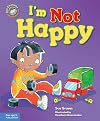
II’m Not Happy (Our Emotions and Behavior Series)
By Sue Graves, Illustrations by Desideria Guicciardini
Review by Debra L Scott
I’m Not Happy is one of a new four-book series from Free Spirit Publishing called “Our Emotions and Behaviors”. The other books in the series are: Not Fair, Won’t Share, But Why Can’t I? , and Who Feels Scared? Ben finds that his friends are sad, upset, angry and worried. He also feels unhappy himself. Ben does simple things that fix the problems that show more beset his friends, but can’t fix his own problem. But as it turns out, the very thing that makes him unhappy makes his Grandma very happy, so that makes him happy in response.
I’m Not Happy is a great little book exploring how simple it can be to find a remedy for the little upsets in life. More importantly, it shows how one child can be helpful to another to make them happy. It also shows that sometimes it’s not a thing that will make you happy again, but the happiness of another. Children at this age level are just starting to learn how to pick up on the feelings of others and how they can actually do something that makes a difference. It may take a bit of work, like the posters he makes to help his friend find her lost dog, or it may take a lot of courage, like standing up to a bully on his friend’s behalf. And sometimes it just means lending a helping hand.
There are a couple places that aren’t clear. When Mike took Tim’s ball, it doesn’t say why Mike decides to give it back except that he ‘felt bad’. I wonder if the author intended Mike to figure this out on his own, or if she meant that Ben, the hero, said something to Mike to encourage him to give it back. The other place is at the very end, where someone returns the lost dog to Ben instead of to Molly. Those are minor errors, but they may be picked up on by a bright child. The teacher/parent would do well to be aware of them and have an answer ready.
After the story, there is a two page story board without words describing a similar situation. Children are encouraged to talk about what is happening in the pictures and answer questions about it. Following this is a teacher/parent guide to the book with tips on how to discuss the issues presented and gives suggested topics for discussion.
The vocabulary of the story is suitable for young readers to sound out by themselves, but not the included instructions which are intended solely for the adult. The illustrations are expressive and simple so that it is easy to see how each character feels about what is happening. show less
By Sue Graves, Illustrations by Desideria Guicciardini
Review by Debra L Scott
I’m Not Happy is one of a new four-book series from Free Spirit Publishing called “Our Emotions and Behaviors”. The other books in the series are: Not Fair, Won’t Share, But Why Can’t I? , and Who Feels Scared? Ben finds that his friends are sad, upset, angry and worried. He also feels unhappy himself. Ben does simple things that fix the problems that show more beset his friends, but can’t fix his own problem. But as it turns out, the very thing that makes him unhappy makes his Grandma very happy, so that makes him happy in response.
I’m Not Happy is a great little book exploring how simple it can be to find a remedy for the little upsets in life. More importantly, it shows how one child can be helpful to another to make them happy. It also shows that sometimes it’s not a thing that will make you happy again, but the happiness of another. Children at this age level are just starting to learn how to pick up on the feelings of others and how they can actually do something that makes a difference. It may take a bit of work, like the posters he makes to help his friend find her lost dog, or it may take a lot of courage, like standing up to a bully on his friend’s behalf. And sometimes it just means lending a helping hand.
There are a couple places that aren’t clear. When Mike took Tim’s ball, it doesn’t say why Mike decides to give it back except that he ‘felt bad’. I wonder if the author intended Mike to figure this out on his own, or if she meant that Ben, the hero, said something to Mike to encourage him to give it back. The other place is at the very end, where someone returns the lost dog to Ben instead of to Molly. Those are minor errors, but they may be picked up on by a bright child. The teacher/parent would do well to be aware of them and have an answer ready.
After the story, there is a two page story board without words describing a similar situation. Children are encouraged to talk about what is happening in the pictures and answer questions about it. Following this is a teacher/parent guide to the book with tips on how to discuss the issues presented and gives suggested topics for discussion.
The vocabulary of the story is suitable for young readers to sound out by themselves, but not the included instructions which are intended solely for the adult. The illustrations are expressive and simple so that it is easy to see how each character feels about what is happening. show less
Graves, Sue
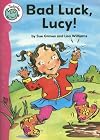
Bad Luck, Lucy!
Illustrated by Lisa Williams. 2008. 24pp. $6.95 pbk. Crabtree Publishing Company. 978-0-7787-3882-4. Grades K-2.
Lucy finds a bright new coin, and her father tells her that finding a coin is lucky. Lucy goes running off to tell her mother, her grandmother, and her grandfather, upsetting teacups, making messes, and hurting herself each time. Finally, Lucy comes to the conclusion that the coin is not lucky at all. This book has inviting cartoonish illustrations with show more bright primary colors detailing Lucy's exploits. The limited vocabulary of the book makes it perfect for beginning readers, and Lucy's effervescent good spirits no matter what befalls her will garner readers' sympathy. Recommended for early readers who like adventurous heroines. show less
Bad Luck, Lucy!
Illustrated by Lisa Williams. 2008. 24pp. $6.95 pbk. Crabtree Publishing Company. 978-0-7787-3882-4. Grades K-2.
Lucy finds a bright new coin, and her father tells her that finding a coin is lucky. Lucy goes running off to tell her mother, her grandmother, and her grandfather, upsetting teacups, making messes, and hurting herself each time. Finally, Lucy comes to the conclusion that the coin is not lucky at all. This book has inviting cartoonish illustrations with show more bright primary colors detailing Lucy's exploits. The limited vocabulary of the book makes it perfect for beginning readers, and Lucy's effervescent good spirits no matter what befalls her will garner readers' sympathy. Recommended for early readers who like adventurous heroines. show less

ISBN 1405418648 - Novelty books almost always impress me as books that kids will find engaging, and the idea of gold stars certainly sounds like a good one. Who doesn't like gold stars? For the record, on the back cover, it says "The jungle animals are taking naps under the big, shady trees, but Monkey is too hungry to sleep! He soon realizes that waking up the others isn't such a good idea!" In actuality, no one seems to be sleeping and Monkey doesn't wake anyone up. Just in case you're the show more type to rely on back covers.
In very simple words, the reader is asked who they can see in the jungle. A lion, an elephant and a crocodile are introduced. Last is a monkey, sitting in a tree, eating bananas and accidentally tossing the peels onto the animals below - so off he runs as the others give chase.
Before the text of the book, there are "Notes for Parents", providing a little guidance for how to use this book and the Gold Stars series to teach your child to read. The advice is easy and sounds like good common sense. In the back of the book are gold stars, awarded to the budding reader when they accomplish certain things: reading the book or finding words in the book. The text by Sue Graves is great for young readers. Easy words used repeatedly and written in a large font, all things designed to make reading easier. The illustrations by Alison Atkins are very cute and, even when the larger animals chase the monkey, the animals appear to be smiling and not especially frightening. All in all, it sounds like a superb book, but it isn't, really. The trouble, surprisingly, comes in the gold stars. The stars are stickers and, once placed, can't be reused. This makes the book, in general, a single-user book - it can't be handed down to another young reader who could make the same use of it because, honestly, the new child is going to want their own stars.
Not a bad book, but it's got such a short life-expectancy that I suggest spending your money somewhere else if you're just looking for a BOOK. On the other hand, and worth noting, if you're looking for homeschooling materials, this might fit that need well; no one really expects to re-use school "workbooks".
- AnnaLovesBooks show less
In very simple words, the reader is asked who they can see in the jungle. A lion, an elephant and a crocodile are introduced. Last is a monkey, sitting in a tree, eating bananas and accidentally tossing the peels onto the animals below - so off he runs as the others give chase.
Before the text of the book, there are "Notes for Parents", providing a little guidance for how to use this book and the Gold Stars series to teach your child to read. The advice is easy and sounds like good common sense. In the back of the book are gold stars, awarded to the budding reader when they accomplish certain things: reading the book or finding words in the book. The text by Sue Graves is great for young readers. Easy words used repeatedly and written in a large font, all things designed to make reading easier. The illustrations by Alison Atkins are very cute and, even when the larger animals chase the monkey, the animals appear to be smiling and not especially frightening. All in all, it sounds like a superb book, but it isn't, really. The trouble, surprisingly, comes in the gold stars. The stars are stickers and, once placed, can't be reused. This makes the book, in general, a single-user book - it can't be handed down to another young reader who could make the same use of it because, honestly, the new child is going to want their own stars.
Not a bad book, but it's got such a short life-expectancy that I suggest spending your money somewhere else if you're just looking for a BOOK. On the other hand, and worth noting, if you're looking for homeschooling materials, this might fit that need well; no one really expects to re-use school "workbooks".
- AnnaLovesBooks show less
You May Also Like


Associated Authors
Statistics
- Works
- 256
- Members
- 4,303
- Popularity
- #5,832
- Rating
- 3.3
- Reviews
- 93
- ISBNs
- 713
- Languages
- 9