
John McCutcheon
Author of Christmas in the Trenches
About the Author
Image credit: Courtesy of Birmingham Alabama Public Library (Flickr)
Works by John McCutcheon
Sprout Wings and Fly 4 copies
22 Days 4 copies
Mail Myself to You 3 copies
Ghost Light 2 copies
Trolling for Dreams 2 copies
The Wind That Shakes the Barley 2 copies
Step By Step 1 copy
John McCutcheon's Book 1 copy
How Can I Keep From Singing? 1 copy
Mightier Than the Sword by 1 copy
fine times at our house 1 copy
What It's Like 1 copy
Fine Time at Our House 1 copy
Joe Hill's Last Will 1 copy
Passage 1 copy
Storied Ground 1 copy
Live at Wolf Trap 1 copy
Winter Solstice 1 copy
Hammer Dulcimer (vhs) 1 copy
Tagged
Common Knowledge
- Birthdate
- 1952-08-14
- Gender
- male
Members
Reviews

Folk artist John McCutcheon is an award-winning singer-songwriter and instrumentalist who has received six Grammy Award nominations, including one in 2006 for Best Spoken Word Album For Children for “Christmas in the Trenches.” This book is based on that song.
His book, like the ballad, features a fictional character, Francis Tolliver, who relates the story of the famous 1914 “Christmas Truce” between the British and German troops in the trenches on the Western Front during World War show more I. A grandfather now, Tolliver is sharing the memories of his favorite Christmas with his two grandchildren. He begins:
“We were all so young . . . just boys . . . lonely and frightened, trying to be brave. We had spent a long, cold month in the muddy trenches that were now our home. We all knew that there would be no break in the fighting. We knew we would be spending Christmas in the trenches.”
On that day, the soldiers later involved in the “Christmas Truce” were entrenched along the French-Belgian border. As darkness fell, they heard a sound - the German soldiers were singing Christmas carols. The English soldiers began to sing as well, and then a single figure came across No Man’s Land from the German side toward the English side holding a white truce flag in one hand, and a Christmas tree shining with candles in the other. Soon everyone on both sides came out of the trenches and started trading small gifts. They even started playing a game of football!
As dawn came, though, each side returned to the trenches and back to the war.
Henri Sørensen created arresting oil paintings to illustrate the book, with double-page spreads conveying a sense of scale.
Back matter includes an Author’s Note, Historical Note, McCutcheon’s song lyrics, and the musical notation for it. There is also a QR code to link to his performances of “Silent Night” and “Christmas in the Trenches.”
The historical note fills in some background about which readers in the suggested age range of 7 and older might not be aware: Where was the Western Front in World War I? What were the trenches? What was No Man’s Land? McCutcheon also includes some quotes from recorded interviews with participants, but only to flesh out what happened the night of the truce. Although “Grandpa’s” account ended there, it wasn’t really the end of the story.
The British Imperial War Museum (IWM) (with excellent online exhibits) has photographs, letters and interviews about the Christmas Eve Truce. The IWM reported that “the High Commands on both sides tried to prevent any truces on a similar scale happening again.” Encountering one’s intended enemies as human beings impacted morale and “conflicted with the patriotic aggression required by both sides.” (This also meant, as the IWM points out, that stories about the truce contradicted media and government propaganda promulgating the perception of German soldiers as “bloodthirsty enemies, baby eaters, devils, ruthless killers.” Thus, as one of the actual truce participants (Anthony Richards) recalled: “You never get anything like the Christmas truce happening again, and over time not only is it seen as an anomaly but almost as a myth, and it gets to the point where people are actually doubting whether it happened in the first place, which continues right up to this day.”)
In his Author’s Note, McCutcheon muses:
“War demands that our enemies be strangers. Not at all like us. Yet, one Christmas Eve over one hundred years ago, two groups of enemies, strangers to one another, stood in trenches separated by a muddy field. They were all far from home and their loved ones. They were lonely, scared, and fighting against soldiers in trenches as close as fifty years away. Then someone started singing a Christmas carol, and others joined in. When they found themselves singing the same song, each in their own language, it changed them. It changed everything. And for one amazing night, peace broke out in the middle of war.”
But they did have to resume killing each other the next day, and only four months later, the war turned even more brutal when poison gas began to be used by all major parties in the war. Amazingly, as Wikipedia reports: “The total number of military and civilian casualties in World War I was about 40 million: estimates range from around 15 to 22 million deaths and about 23 million wounded military personnel, ranking it among the deadliest conflicts in human history.”
McCutcheon’s song lyrics, provided at the end of the book, relate that the experience of interacting with “the enemy” raised questions in the minds of the soldiers. His song ends:
“Soon daylight stole upon us and France was France once more..
With sad farewells we each began to settle back to war
But the question haunted every heart that lived that wondrous night,
‘Whose family have I fixed within my sights?’
’Twas Christmas in the trenches and the frost so bitter hung.
The frozen fields of France were warmed as songs of peace were sung.
For the walls they'd kept between us to exact the work of war
Had been crumbled and were gone forevermore.
My name is Francis Tolliver, in Liverpool I dwell.
Each Christmas come since World War I, I’ve learned its lessons well.
That the ones who calls the shots won't be among the dead and lame,
And on each end of the rifle we're the same.”
Evaluation: This book that will show the recommended age group of 7 and older that when a war is declared, other human beings just like themselves are now defined as “enemies” to be killed. It may help inspire many discussion questions about war generally. show less
His book, like the ballad, features a fictional character, Francis Tolliver, who relates the story of the famous 1914 “Christmas Truce” between the British and German troops in the trenches on the Western Front during World War show more I. A grandfather now, Tolliver is sharing the memories of his favorite Christmas with his two grandchildren. He begins:
“We were all so young . . . just boys . . . lonely and frightened, trying to be brave. We had spent a long, cold month in the muddy trenches that were now our home. We all knew that there would be no break in the fighting. We knew we would be spending Christmas in the trenches.”
On that day, the soldiers later involved in the “Christmas Truce” were entrenched along the French-Belgian border. As darkness fell, they heard a sound - the German soldiers were singing Christmas carols. The English soldiers began to sing as well, and then a single figure came across No Man’s Land from the German side toward the English side holding a white truce flag in one hand, and a Christmas tree shining with candles in the other. Soon everyone on both sides came out of the trenches and started trading small gifts. They even started playing a game of football!
As dawn came, though, each side returned to the trenches and back to the war.
Henri Sørensen created arresting oil paintings to illustrate the book, with double-page spreads conveying a sense of scale.
Back matter includes an Author’s Note, Historical Note, McCutcheon’s song lyrics, and the musical notation for it. There is also a QR code to link to his performances of “Silent Night” and “Christmas in the Trenches.”
The historical note fills in some background about which readers in the suggested age range of 7 and older might not be aware: Where was the Western Front in World War I? What were the trenches? What was No Man’s Land? McCutcheon also includes some quotes from recorded interviews with participants, but only to flesh out what happened the night of the truce. Although “Grandpa’s” account ended there, it wasn’t really the end of the story.
The British Imperial War Museum (IWM) (with excellent online exhibits) has photographs, letters and interviews about the Christmas Eve Truce. The IWM reported that “the High Commands on both sides tried to prevent any truces on a similar scale happening again.” Encountering one’s intended enemies as human beings impacted morale and “conflicted with the patriotic aggression required by both sides.” (This also meant, as the IWM points out, that stories about the truce contradicted media and government propaganda promulgating the perception of German soldiers as “bloodthirsty enemies, baby eaters, devils, ruthless killers.” Thus, as one of the actual truce participants (Anthony Richards) recalled: “You never get anything like the Christmas truce happening again, and over time not only is it seen as an anomaly but almost as a myth, and it gets to the point where people are actually doubting whether it happened in the first place, which continues right up to this day.”)
In his Author’s Note, McCutcheon muses:
“War demands that our enemies be strangers. Not at all like us. Yet, one Christmas Eve over one hundred years ago, two groups of enemies, strangers to one another, stood in trenches separated by a muddy field. They were all far from home and their loved ones. They were lonely, scared, and fighting against soldiers in trenches as close as fifty years away. Then someone started singing a Christmas carol, and others joined in. When they found themselves singing the same song, each in their own language, it changed them. It changed everything. And for one amazing night, peace broke out in the middle of war.”
But they did have to resume killing each other the next day, and only four months later, the war turned even more brutal when poison gas began to be used by all major parties in the war. Amazingly, as Wikipedia reports: “The total number of military and civilian casualties in World War I was about 40 million: estimates range from around 15 to 22 million deaths and about 23 million wounded military personnel, ranking it among the deadliest conflicts in human history.”
McCutcheon’s song lyrics, provided at the end of the book, relate that the experience of interacting with “the enemy” raised questions in the minds of the soldiers. His song ends:
“Soon daylight stole upon us and France was France once more..
With sad farewells we each began to settle back to war
But the question haunted every heart that lived that wondrous night,
‘Whose family have I fixed within my sights?’
’Twas Christmas in the trenches and the frost so bitter hung.
The frozen fields of France were warmed as songs of peace were sung.
For the walls they'd kept between us to exact the work of war
Had been crumbled and were gone forevermore.
My name is Francis Tolliver, in Liverpool I dwell.
Each Christmas come since World War I, I’ve learned its lessons well.
That the ones who calls the shots won't be among the dead and lame,
And on each end of the rifle we're the same.”
Evaluation: This book that will show the recommended age group of 7 and older that when a war is declared, other human beings just like themselves are now defined as “enemies” to be killed. It may help inspire many discussion questions about war generally. show less

Drasko and his father sold flowers in the marketplace of Sarajevo until war came to their part of the world, and Drasko's father had to leave to fight. Continuing on as best he could, Drasko observed the growing grimness of a city under siege, and witnessed a terrible atrocity the day that Sarajevo's only functioning bakery was bombed, slaughtering twenty-two people whose only crime was waiting in line for bread. But then, amidst the carnage and terror, he witnessed something extraordinary: show more the cellist from the nearby symphony decided to hold a public performance in the bombed-out marketplace, returning every day for twenty-two days in order to honor those who had been slain...
Based upon the true story of the Cellist of Sarajevo, Vedran Smailović, who did indeed perform Albinoni's Adagio in G Minor multiple times during the siege of his city, Flowers for Sarajevo is told from a child's perspective, imagining these events as seen through the fictional Drasko's eyes. Author John McCutcheon, a singer/song-writer who has composed a well-known folk song about Smailović, with whom he is friends, spins a poignant tale here, one which addresses a terrible moment in history, and the greatness of the human spirit, in confronting that moment. The accompanying artwork by Kristy Caldwell has a layered look to it, with some people and objects appearing more vividly in the foreground, while others recede into the subtler background. This gives a sense of depth and motion to the illustrations here, making the story come alive in interesting ways. Recommended to anyone looking for children's stories about the Balkan War specifically, or about children caught up in war in general. show less
Based upon the true story of the Cellist of Sarajevo, Vedran Smailović, who did indeed perform Albinoni's Adagio in G Minor multiple times during the siege of his city, Flowers for Sarajevo is told from a child's perspective, imagining these events as seen through the fictional Drasko's eyes. Author John McCutcheon, a singer/song-writer who has composed a well-known folk song about Smailović, with whom he is friends, spins a poignant tale here, one which addresses a terrible moment in history, and the greatness of the human spirit, in confronting that moment. The accompanying artwork by Kristy Caldwell has a layered look to it, with some people and objects appearing more vividly in the foreground, while others recede into the subtler background. This gives a sense of depth and motion to the illustrations here, making the story come alive in interesting ways. Recommended to anyone looking for children's stories about the Balkan War specifically, or about children caught up in war in general. show less
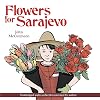
I HAD to read this book because I've spent time in Bosnia and Croatia and my father has spent some significant time there helping in the post-war rebuilding efforts.
First, I was really glad at the end there was a large history lesson given to properly put this story in context. I found it to be informative, easy to read and understand as well as very powerful once you stop to think about what the story was saying. I really want to give the little boy a hug and buy dozens of his flowers show more now....
It is a kids book with adorable illustrations but for anyone not familiar with this area of the world, the story talks about a bombing which killed people. If you're a caregiver who doesn't believe in exposing your child to 'violence' then you may not like this book. For everyone else this is a fantastic book to not only teach a little bit about history but an excellent way to open the conversation to death and other hard topics including what could your child do to help others in their time of grief.
I have 2 daughters with autism and have found books similar to these have been very helpful in talking about otherwise difficult subjects with them.
This book perfectly captured the spirit of the people and left me in tears at the simplicity and beauty pouring forth from its pages. I immediately had to go to Amazon and pre-order a copy for my dad to read to his grandkids. In America with its extreme divisiveness this book is a much needed lesson in how people of different backgrounds can still find common ground to be there for one another. Coming from an Irish family it's a lesson that has taken us quite a while to learn as well so it may be more of something that is needed across the globe rather than in pockets which just goes to show the true beauty of this story in that it's adaptable across all cultures.
I'm not sure I'll ever really look at roses or listen to cello music the same way again.
Thank you to Netgalley and Peachtree Publishers for allowing me to review this book. show less
First, I was really glad at the end there was a large history lesson given to properly put this story in context. I found it to be informative, easy to read and understand as well as very powerful once you stop to think about what the story was saying. I really want to give the little boy a hug and buy dozens of his flowers show more now....
It is a kids book with adorable illustrations but for anyone not familiar with this area of the world, the story talks about a bombing which killed people. If you're a caregiver who doesn't believe in exposing your child to 'violence' then you may not like this book. For everyone else this is a fantastic book to not only teach a little bit about history but an excellent way to open the conversation to death and other hard topics including what could your child do to help others in their time of grief.
I have 2 daughters with autism and have found books similar to these have been very helpful in talking about otherwise difficult subjects with them.
This book perfectly captured the spirit of the people and left me in tears at the simplicity and beauty pouring forth from its pages. I immediately had to go to Amazon and pre-order a copy for my dad to read to his grandkids. In America with its extreme divisiveness this book is a much needed lesson in how people of different backgrounds can still find common ground to be there for one another. Coming from an Irish family it's a lesson that has taken us quite a while to learn as well so it may be more of something that is needed across the globe rather than in pockets which just goes to show the true beauty of this story in that it's adaptable across all cultures.
I'm not sure I'll ever really look at roses or listen to cello music the same way again.
Thank you to Netgalley and Peachtree Publishers for allowing me to review this book. show less
A very short but moving story. As an audiobook it was quite different to have music and a song in it, and an interview with the author, and then for the story to continue. I thought it worked remarkably well. A great way to learn about history in a fun way.
Lists
Awards


You May Also Like


Associated Authors
Statistics
- Works
- 45
- Members
- 713
- Popularity
- #35,569
- Rating
- 4.2
- Reviews
- 59
- ISBNs
- 32
- Languages
- 1
- Favorited
- 1