
Christopher Riopelle
Author of Americans in Paris, 1860-1900
Works by Christopher Riopelle
Forests, Rocks, and Torrents: Norwegian and Swiss Landscape Paintings (National Gallery Company) (National Gallery London) (2011) 12 copies
Harvard's Winthrop Collection: Nineteenth Century Paintings and Drawings from the Grenville L. Winthrop Collection (National Gallery London) (2003) 9 copies
Nineteenth-century Paintings and Drawings from the Grenville L.Winthrop Collection, Harvard University (National Gallery (2003) 7 copies
Associated Works
Tagged
Common Knowledge
- Canonical name
- Riopelle, Christopher
- Gender
- male
- Education
- University of Ottawa
- Occupations
- art historian
curator - Organizations
- National Gallery, London
Philadelphia Museum of Art
J. Paul Getty Museum - Nationality
- Canada
- Associated Place (for map)
- Canada
Members
Reviews

Over the span of his six-decade career, Ed Ruscha (b. 1937) has created a distinctively stylized vision of the modern American landscape of gas stations, highways, and industrial buildings. Incorporating text, stark typography, and commercial logos, the artist’s multivalent images both portray and interrogate the contemporary world’s relentlessly packaged environment. By placing Ruscha’s celebrated Course of Empire—a ten-painting installation originally created for the 2005 Venice show more Biennale—in dialogue with Thomas Cole’s five-picture cycle The Course of Empire from the 1830s, this catalogue offers a fresh perspective on each of these disparate masterpieces. Unlike Cole’s grandiose vision of the rise and fall of classical civilization, Ruscha’s work comprises five black-and-white Los Angeles landscapes made in 1992 paired with color representations of the same sites as they appeared ten years later and draws attention to how often-overlooked changes in the evolving urban landscape are redolent of economic might and globalization or decline and stagnation. show less
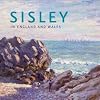
This a catalogue for an exhibition I didn't see - it showed in London and Cardiff but not Bath - but I wish I had! Sisley was born and brought up in France by British parents. He was fluent in French and English and maintained dual nationality throughout his life. He was one of the core group of first-wave Impressionists, frequently painting literally alongside Monet and Renoir. However, he visited Britain a number of times and spent time painting in and near London and on the South Wales show more coast.
The exhibition assembled as many of these scenes as it could and impressive it must have been; even the modestly sized reproductions in this book show that Sisley could hold his own with the other Big Name Impressionists. He even painted a certain seascape repeatly in different weathers and times of day a la Monet serial paintings. These pictures of the Bristol Channel coast are my particular favourites.
From this distance, what with Impressionism being allegedly the world's most popular Fine Art movement, it's hard to understand how the artists' contemporaries circa 130-150 years ago, frequently didn't understand Impressionism, forcing the artists to hold their own exhibitions, and leaving Sisley in poverty much of his life, struggling to find buyers for his work. Much of it was destroyed during the Franco-Prussian War - surely a great loss to the art world. But Sisley is now recognised for his talent and still inspires artists today - he's a particular favourite of Bath's own Pete "the Street" Brown. show less
The exhibition assembled as many of these scenes as it could and impressive it must have been; even the modestly sized reproductions in this book show that Sisley could hold his own with the other Big Name Impressionists. He even painted a certain seascape repeatly in different weathers and times of day a la Monet serial paintings. These pictures of the Bristol Channel coast are my particular favourites.
From this distance, what with Impressionism being allegedly the world's most popular Fine Art movement, it's hard to understand how the artists' contemporaries circa 130-150 years ago, frequently didn't understand Impressionism, forcing the artists to hold their own exhibitions, and leaving Sisley in poverty much of his life, struggling to find buyers for his work. Much of it was destroyed during the Franco-Prussian War - surely a great loss to the art world. But Sisley is now recognised for his talent and still inspires artists today - he's a particular favourite of Bath's own Pete "the Street" Brown. show less
For decades the most continually provocative of British artists, Richard Hamilton (1922–2011, right) was long concerned with the great themes of Western painting. At the time of his death, he was completing plans for an exhibition at the National Gallery, London, to include the first public showing of what turned out to be his final work. Based on Balzac's short story, The Unknown Masterpiece, it depicts three masters of painting—Poussin, Courbet, and Titian—contemplating a reclining show more female nude and reflecting on the meaning of art. As with much of Hamilton's late work, the image was generated by computer but over-painted by hand. Knowing he would not complete it, Hamilton decided to show three preparatory versions simultaneously. In addition, he selected thirty paintings tracing the development of his art, featuring single-point perspective and the depiction of interior spaces, the sacred imagery of the Italian Renaissance, and allusions to the art of Marcel Duchamp. (National Gallery of London) show less
Lists
Awards

You May Also Like


Associated Authors
Statistics
- Works
- 19
- Also by
- 3
- Members
- 340
- Popularity
- #70,095
- Rating
- 4.1
- Reviews
- 3
- ISBNs
- 20