
A.E. Marling
Author of Brood of Bones
About the Author
Series
Works by A.E. Marling
Morgan of sea and storm 1 copy
Associated Works
Tagged
Common Knowledge
- Gender
- male
- Short biography
- Fantasy writer, dancer, law-abiding citizen, human being (in that order).
I encourage everyone to touch the sky of human imagination. Read fantasy.
Discover my fantasy-appreciation blog at:
http://aemarling.com/
[from Author Page, Amazon.com, retrieved 6/1/2014] - Nationality
- USA
- Places of residence
- San Francisco, California, USA
- Associated Place (for map)
- California, USA
Members
Reviews

Newcomer A. E. Marling does a bang-up job with this novel about a magic-wielder afflicted with a sleeping disorder. Her drowsiness does not equate boredom for the reader. On the contrary, "Brood of Bones" is a fantasy whodunnit, with Enchantress Hiresha cast in the role of arcane detective. The setting and the magic are skillfully portrayed; the characters are complex and not always predictable. Hiresha struggles not only with her sleeping problem, but with the past that has formed her; her show more position is her armor and her purpose. Maid Janny is a gem of irreverence, while the Lord of the Feasts is both charming and terrible. The deposed arbiter of the city is exasperating at the same time she is delightful, and the two city leaders (a pair of priests representing different deities) are not what they might seem. I could wish the bodyguard were better developed, but it is a small complaint. The story is told from Hiresha's point of view, depicting her insecurities and fears in a very personal, very *human* way embroidered with the mores of her particular society. I'd have given this book 5 stars but for an unfortunate (though not crippling) tendency toward repetition of information, and I am looking forward to Marling's next book. show less
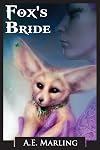
My first ever Kindle Paperwhite book. Well, not quite first ever. I tried another book that was so awful, I couldn't even finish beyond the first chapter. And by 'awful,' I mean that I think I read something similar when I used to grade 9th-grade English papers, only they were a bit less misogynist. But I'll save that for another time. I just point out by way of comparison that diving into Fox's Bride ended up being a relief, an example that it is possible to be creative, to build a show more beautiful world and to create dimensional characters.
Fox is the second in a series, but because of my unfamiliarity with the Kindle, I read it out of order. Luckily, Marling writes a stand-alone story. It opens with a sleep-plagued older enchantress visiting a foreign city with her bodyguard, known as a Spellsword. She's at a reception with the city's elite when one of the local gods, a trickster embodied by a fennec fox, singles her out from among the crowd. The priests interpret this to mean the trickster has found his new bride. Initially annoyed, it becomes serious when she learns being the bride means both her and the 'god' will be sealed in a sarcophagus as part of the marriage ceremony.
I found characterization to be interesting and done well. The jewel enchantress, Hiresha, is experienced and confident in both craft and social position. It's rather enjoyable to have a female lead that isn't twenty, who believes in sculpting her life as she would a jewel: "There is nothing more vulgar than the unplanned,' Hiresha said. "A life isn't great by chance, but by design.'" A classic character flaw, she is going to have to learn that not everything can be planned, and adaptability is an asset.
Her guard, Chaundur, is both younger and naive, maintaining confidence in his upbringing and faith. I thought Marling did a very nice job at capturing his certainty without him seeming merely thoughtless: "A pang race through him, knowing that Hiresha would soon leave this world for the gods' realm. Don't be selfish, he thought, she goes to a better life."
The fennec is adorable and will no doubt incite a new trend in the exotic pet trade.
Characters are lovely and dimensional; filled with conflicting desires to honor their gods, live by a personal code, respect others' culture and fulfill their own dreams. And... and... the woman saves herself. Nice.
The writing was extremely satisfying, falling somewhere closer to Valente in the kind of detail that is full of visual imagery. Consider:
"Hiresha wore a defiance of purple."
"The sky stream connected with other ribbons of water, all leading to a shimmering blue globe that floated above the center of the city."
One of the few faults were an occasional jump in scene or a tendency to pick the purplish word over the commonplace, obscuring interpretation. For instance, at one point, "the spellsword yelled for him and bellowed." Rather redundant. Or "For all she knew, they could be succeeding where she had failed by escaping into the desert." Since Hiresha is not the one escaping into the desert, it struck me as awkwardly worded. There's a few more instances like that that mostly caused confusion in action/scene jumps, so they stood out a little more than it would have otherwise.
A stylized eye often signals the next section and a character identity. I thought it was a nice visual.
The world seemed rather similar to Egyptian culture, with temples, mummies and polytheism, enabling the reader to quickly grasp the essentials and focus on the details. "After the local fashion, he had painted his eyes with the insignia of a god: two scorpion tails curved upward over his cheeks." Marling adds a delightful magical twist with rivers running in midair, and the power of the gods to create floating temples. Hiresha's skill is in creating magic-imbued jewels using dream imagery. The magical talents remind me a little of the ones in Sanderson's [b:The Alloy of Law|10803121|The Alloy of Law (Mistborn, #4)|Brandon Sanderson|http://d.gr-assets.com/books/1317794101s/10803121.jpg|15035863], as they are based on Attraction and Lightening and so forth. It's rather fun to have fantasy that takes magic in unconventional directions.
There is the whiff of an emotional romantic triangle, normally a scenario that lends itself to vigorous eyerolling, but I thought Marling handled it well. Although it somewhat reflects the classic good-boy versus bad-boy set-up, there's enough dimensionality to all of the characters, and it is not a true primary storyline. It helps that Hiresha posits her dilemma in terms of responsibility, planning and the forbidden instead of angsty pining.
Overall, I recommend it. I think it would appeal to fans of [b:The Hundred Thousand Kingdoms|6437061|The Hundred Thousand Kingdoms (The Inheritance Trilogy, #1)|N.K. Jemisin|http://d.gr-assets.com/books/1303143211s/6437061.jpg|6626657] as well as those who enjoy a female-centered adventure and an Egyptian like settings.
Four stars.
Cross posted at http://clsiewert.wordpress.com/2013/06/22/foxs-bride-by-a-e-marling/ show less
Fox is the second in a series, but because of my unfamiliarity with the Kindle, I read it out of order. Luckily, Marling writes a stand-alone story. It opens with a sleep-plagued older enchantress visiting a foreign city with her bodyguard, known as a Spellsword. She's at a reception with the city's elite when one of the local gods, a trickster embodied by a fennec fox, singles her out from among the crowd. The priests interpret this to mean the trickster has found his new bride. Initially annoyed, it becomes serious when she learns being the bride means both her and the 'god' will be sealed in a sarcophagus as part of the marriage ceremony.
I found characterization to be interesting and done well. The jewel enchantress, Hiresha, is experienced and confident in both craft and social position. It's rather enjoyable to have a female lead that isn't twenty, who believes in sculpting her life as she would a jewel: "There is nothing more vulgar than the unplanned,' Hiresha said. "A life isn't great by chance, but by design.'" A classic character flaw, she is going to have to learn that not everything can be planned, and adaptability is an asset.
Her guard, Chaundur, is both younger and naive, maintaining confidence in his upbringing and faith. I thought Marling did a very nice job at capturing his certainty without him seeming merely thoughtless: "A pang race through him, knowing that Hiresha would soon leave this world for the gods' realm. Don't be selfish, he thought, she goes to a better life."
The fennec is adorable and will no doubt incite a new trend in the exotic pet trade.
Characters are lovely and dimensional; filled with conflicting desires to honor their gods, live by a personal code, respect others' culture and fulfill their own dreams. And... and...
The writing was extremely satisfying, falling somewhere closer to Valente in the kind of detail that is full of visual imagery. Consider:
"Hiresha wore a defiance of purple."
"The sky stream connected with other ribbons of water, all leading to a shimmering blue globe that floated above the center of the city."
One of the few faults were an occasional jump in scene or a tendency to pick the purplish word over the commonplace, obscuring interpretation. For instance, at one point, "the spellsword yelled for him and bellowed." Rather redundant. Or "For all she knew, they could be succeeding where she had failed by escaping into the desert." Since Hiresha is not the one escaping into the desert, it struck me as awkwardly worded. There's a few more instances like that that mostly caused confusion in action/scene jumps, so they stood out a little more than it would have otherwise.
A stylized eye often signals the next section and a character identity. I thought it was a nice visual.
The world seemed rather similar to Egyptian culture, with temples, mummies and polytheism, enabling the reader to quickly grasp the essentials and focus on the details. "After the local fashion, he had painted his eyes with the insignia of a god: two scorpion tails curved upward over his cheeks." Marling adds a delightful magical twist with rivers running in midair, and the power of the gods to create floating temples. Hiresha's skill is in creating magic-imbued jewels using dream imagery. The magical talents remind me a little of the ones in Sanderson's [b:The Alloy of Law|10803121|The Alloy of Law (Mistborn, #4)|Brandon Sanderson|http://d.gr-assets.com/books/1317794101s/10803121.jpg|15035863], as they are based on Attraction and Lightening and so forth. It's rather fun to have fantasy that takes magic in unconventional directions.
There is the whiff of an emotional romantic triangle, normally a scenario that lends itself to vigorous eyerolling, but I thought Marling handled it well. Although it somewhat reflects the classic good-boy versus bad-boy set-up, there's enough dimensionality to all of the characters, and it is not a true primary storyline. It helps that Hiresha posits her dilemma in terms of responsibility, planning and the forbidden instead of angsty pining.
Overall, I recommend it. I think it would appeal to fans of [b:The Hundred Thousand Kingdoms|6437061|The Hundred Thousand Kingdoms (The Inheritance Trilogy, #1)|N.K. Jemisin|http://d.gr-assets.com/books/1303143211s/6437061.jpg|6626657] as well as those who enjoy a female-centered adventure and an Egyptian like settings.
Four stars.
Cross posted at http://clsiewert.wordpress.com/2013/06/22/foxs-bride-by-a-e-marling/ show less
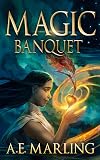
I read this captivating story at a time when I was stuck away from home and forced to eat meal after meal that is stored and cooked in sealed plastic sacks and it was the perfect distraction from the drudgery of my real life. Marling's descriptions made my mouth water and his storytelling once again does not fail to disappoint. Though eating mystery meat from the chow hall became more disappointing after reading the description of deep fried terror bird. Underneath the amazing descriptions show more of fanciful foods is a plot line woven with as much intricacy as the magic carpet the banquet takes place on. The main character is one of those rare main characters whose motives are not perfect all the time and is fallible, but learns throughout her adventure and becomes a character to admire. I wholeheartedly recommend this book for all ages of people who want to disappear from their mundane life for a bit. show less
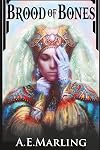
“I never learned the knack for waking. Consciousness hung over me like a sodden rag, weighing on my eyelids and muffling my ears, yet even my stifled senses did not spare me the indignity of hearing my name screamed across a public place.“
Sounds like me...
Brood of Bones is the first in a series about Hiresha, an expert in jewel enchantment and sufferer of severe narcolepsy. She has journeyed back to her hometown, Morimound, at the request of the Siri the Flawless, city arbiter. show more Accompanying Hiresha are her protector, the Spellsword Deepmand, and her servant, Maid Janny. The tale begins as their carriage travels through a city bazaar where they discover Siri is imprisoned–and pregnant–at seventy. Soon Hiresha realizes every woman she sees appears to be pregnant. As she works through her own envy and regret, she investigates the puzzle of the pregnant women of Moribound. Could the city be facing the foretold “Seventh Flood” of disaster? Protecting the women and Moribound may mean an alliance with forbidden magic–and the malevolent Feasters.
It is hard to review a single book in a series, especially from a beginning author, as each book ends up being compared to the series development as much as the genre in general. I enjoyed Brood of Bones, A.E. Marling’s first novel, but I suspect that my enjoyment was related more to the character and world background than the story. That sounds as if I’m damning it with faint praise, but truly, it is because I’m comparing it to two of his other books which were quite wonderful in story and imagery. Some time ago, Marling offered me a reviewer’s copy of Fox’s Bride. I enjoyed it a great deal, and ended up with two other of his books in the series, Brood of Bones (free on Amazon at the moment) and Dream Storm Sea. So I approached this book looking to fill in the history of Enchantress Hiresha. The storyline centering on a plague of pregnancies, and Hiresha’s own emotional conundrums held less resonance for me.
The fantasy setting Marling has created has pleasantly unusual–but constrained–magic systems. Most of Hiresha’s magic takes place in a dream-laboratory, where her skills there allow her recreate observations and further analyze people’s reactions, much as a detective might replay an interview tape. I enjoyed the combination of reasoning and magic as an approach to problem-solving. In terms of world-building, not much in the world is explained outright, but rather pieced together as one reads. It occasionally gives the sense that one might have dropped into the middle of a series, with the fallout of earlier events still resonating and relationships already in place. As I’m rather fond of the immersion school of world-building, I didn’t mind, but it may prove frustrating to those who prefer a more explicit style. On the bonus side, it means an absence of “as you know…” type explanatory conversations.
I find Hiresha an extremely interesting heroine, and look forward to reading more about her story and her unusual magic. One of Marling’s strengths is characterization, but characters here feel more underdeveloped compared to his normal high standard. Initially, it felt as if the descriptive flourishes were too frequent and contradictory, making Hiresha sound more than a tad over-dramatic and mercurial. It could be, however, that it was partially an issue of her immaturity. While it was pleasant to have some of Hiresha’s story filled in, particularly an eventful meeting with a Feaster, I found her thoughts tended to be repetitive. So young! So over-confident! So certain in her morality, so focused on her thwarted dreams and jealousy for those who can achieve the ‘normal’ instead of accepting and embracing herself.
As always, I love the flourishes of humor throughout the story:
“Morimound’s second priest, Salkant of the Fate Weaver, I believed, had slunk behind me in a manner most discourteous. If one had the habit of sneaking up on people then bells tied to one’s feet would be a matter of simple courtesy.“
Dialogue with the Lord of the Feast was particularly amusing, and I confess that I mostly read for their interactions and developing connection. Their dialogue bears a pleasing similarity to a Benedict-Beatrice dynamic, with Maid Janny playing a bawdy Dogberry-type (Much Ado About Nothing).
“He raised his voice:and said, ‘And you needn’t wear all those ridiculous gowns.’
‘Excuse me?’…
‘Your gowns are overdone. And I say that as a man with rubies on his shoes.’
‘I have never been so offended!’
‘I am sorry,’ he said, ‘to hear it. You should have been offended more often.’
‘Well! Those are spinels on your shoes, not rubies.’“
Overall, I’d recommend consideration of it if you are a fan of unusual fantasy, or looking to fill more blanks in Hiresha’s world. If you are just starting in the world, I’m very fond of Fox’s Bride and Dream Storm Sea. show less
Sounds like me...
Brood of Bones is the first in a series about Hiresha, an expert in jewel enchantment and sufferer of severe narcolepsy. She has journeyed back to her hometown, Morimound, at the request of the Siri the Flawless, city arbiter. show more Accompanying Hiresha are her protector, the Spellsword Deepmand, and her servant, Maid Janny. The tale begins as their carriage travels through a city bazaar where they discover Siri is imprisoned–and pregnant–at seventy. Soon Hiresha realizes every woman she sees appears to be pregnant. As she works through her own envy and regret, she investigates the puzzle of the pregnant women of Moribound. Could the city be facing the foretold “Seventh Flood” of disaster? Protecting the women and Moribound may mean an alliance with forbidden magic–and the malevolent Feasters.
It is hard to review a single book in a series, especially from a beginning author, as each book ends up being compared to the series development as much as the genre in general. I enjoyed Brood of Bones, A.E. Marling’s first novel, but I suspect that my enjoyment was related more to the character and world background than the story. That sounds as if I’m damning it with faint praise, but truly, it is because I’m comparing it to two of his other books which were quite wonderful in story and imagery. Some time ago, Marling offered me a reviewer’s copy of Fox’s Bride. I enjoyed it a great deal, and ended up with two other of his books in the series, Brood of Bones (free on Amazon at the moment) and Dream Storm Sea. So I approached this book looking to fill in the history of Enchantress Hiresha. The storyline centering on a plague of pregnancies, and Hiresha’s own emotional conundrums held less resonance for me.
The fantasy setting Marling has created has pleasantly unusual–but constrained–magic systems. Most of Hiresha’s magic takes place in a dream-laboratory, where her skills there allow her recreate observations and further analyze people’s reactions, much as a detective might replay an interview tape. I enjoyed the combination of reasoning and magic as an approach to problem-solving. In terms of world-building, not much in the world is explained outright, but rather pieced together as one reads. It occasionally gives the sense that one might have dropped into the middle of a series, with the fallout of earlier events still resonating and relationships already in place. As I’m rather fond of the immersion school of world-building, I didn’t mind, but it may prove frustrating to those who prefer a more explicit style. On the bonus side, it means an absence of “as you know…” type explanatory conversations.
I find Hiresha an extremely interesting heroine, and look forward to reading more about her story and her unusual magic. One of Marling’s strengths is characterization, but characters here feel more underdeveloped compared to his normal high standard. Initially, it felt as if the descriptive flourishes were too frequent and contradictory, making Hiresha sound more than a tad over-dramatic and mercurial. It could be, however, that it was partially an issue of her immaturity. While it was pleasant to have some of Hiresha’s story filled in, particularly an eventful meeting with a Feaster, I found her thoughts tended to be repetitive. So young! So over-confident! So certain in her morality, so focused on her thwarted dreams and jealousy for those who can achieve the ‘normal’ instead of accepting and embracing herself.
As always, I love the flourishes of humor throughout the story:
“Morimound’s second priest, Salkant of the Fate Weaver, I believed, had slunk behind me in a manner most discourteous. If one had the habit of sneaking up on people then bells tied to one’s feet would be a matter of simple courtesy.“
Dialogue with the Lord of the Feast was particularly amusing, and I confess that I mostly read for their interactions and developing connection. Their dialogue bears a pleasing similarity to a Benedict-Beatrice dynamic, with Maid Janny playing a bawdy Dogberry-type (Much Ado About Nothing).
“He raised his voice:and said, ‘And you needn’t wear all those ridiculous gowns.’
‘Excuse me?’…
‘Your gowns are overdone. And I say that as a man with rubies on his shoes.’
‘I have never been so offended!’
‘I am sorry,’ he said, ‘to hear it. You should have been offended more often.’
‘Well! Those are spinels on your shoes, not rubies.’“
Overall, I’d recommend consideration of it if you are a fan of unusual fantasy, or looking to fill more blanks in Hiresha’s world. If you are just starting in the world, I’m very fond of Fox’s Bride and Dream Storm Sea. show less
Lists
You May Also Like


Associated Authors
Statistics
- Works
- 11
- Also by
- 1
- Members
- 272
- Popularity
- #85,117
- Rating
- 3.8
- Reviews
- 16
- ISBNs
- 12
- Favorited
- 1
