
Gene Barretta
Author of Dear Deer: A Book of Homophones
About the Author
Image credit: By Afgarcia86 - Own work, CC BY-SA 3.0, https://commons.wikimedia.org/w/index.php?curid=16890790
Works by Gene Barretta
Now & Ben 1 copy
Associated Works
Tagged
Common Knowledge
- Gender
- male
- Education
- New York University BFA Film Studies
- Occupations
- illustrator
film and television - Places of residence
- Yardley, Pennsylvania, USA
Philadelphia, Pennsylvania, USA - Associated Place (for map)
- Pennsylvania, USA
Members
Reviews

Picture-book author/artist Gene Barretta, whose 2006 Now & Ben: The Modern Inventions of Benjamin Franklin offered an engaging exploration of the influence of Benjamin Franklin's innovations and inventions on modern life, returns to the same formula with Neo Leo, which, as its subtitle suggests, is an examination of Leonardo Da Vinci's revolutionary designs and ideas, and how they eventually came into being, centuries after he first dreamt of them. From airplanes to contact lens, bicycles to show more single-span bridges, Leonardo imagined and designed these inventions first, long before they actually were (or could) be created. Comparing the "Neo" - the actual invention of various machines and mechanisms - with the "Leo" - the ideas for these inventions, found in Da Vinci's notebooks - Barretta highlights this brilliant Renaissance man's visionary insight into how the world worked, and how it might be improved.
Chosen, along with Now & Ben, as one of our November selections, over in the Picture-Book Club to which I belong, where our theme this month is "Inventions," Neo Leo is an engaging, informative title, one that is sure to spark an interest in young readers with a fascination for innovation and discovery. Like its companion, I found both the text and the artwork appealing, and, unlike its companion, I also appreciated that there was a list of further resources at the rear (something missing from the Franklin title). That said, although I thought the inclusion of words written backward in the artwork - a nod to Da Vinci's own practice of writing backward - was creative, I would have preferred that those words be in print, rather than in cursive script, as it made it extremely difficult to read. Not having a mirror to hand, I gave up after the first few pages, and have docked a star accordingly. Backward writing is one thing, but backward writing that is difficult to read, because of type choice, is another.
Still, this was an engaging book, and I recommend it to all young readers with an interest in that incredible man, Leonardo Da Vinci, or in the history of invention in general. show less
Chosen, along with Now & Ben, as one of our November selections, over in the Picture-Book Club to which I belong, where our theme this month is "Inventions," Neo Leo is an engaging, informative title, one that is sure to spark an interest in young readers with a fascination for innovation and discovery. Like its companion, I found both the text and the artwork appealing, and, unlike its companion, I also appreciated that there was a list of further resources at the rear (something missing from the Franklin title). That said, although I thought the inclusion of words written backward in the artwork - a nod to Da Vinci's own practice of writing backward - was creative, I would have preferred that those words be in print, rather than in cursive script, as it made it extremely difficult to read. Not having a mirror to hand, I gave up after the first few pages, and have docked a star accordingly. Backward writing is one thing, but backward writing that is difficult to read, because of type choice, is another.
Still, this was an engaging book, and I recommend it to all young readers with an interest in that incredible man, Leonardo Da Vinci, or in the history of invention in general. show less

The extraordinary contributions of that eighteenth-century American scientist, author and politician, Benjamin Franklin - his innovations in fields as diverse as electricity and newspaper-printing - are set out here in Gene Barretta's attractive picture-book, ideally suited to younger readers with an interest in invention and discovery. Each two-page spread is devoted to a particular idea or invention, contrasting the scene now, and the scene "Ben" - now we expect that our newspapers will show more include cartoons, while Ben was the first American printer to include political cartoons in his newspapers; now we rely on services provided by institutions like the library and the hospital, while Ben was the first to establish such places, in his city (Philadelphia) - while the decorative endpapers set out a time-line of Franklin's inventions, and groundbreaking ideas.
With a fascinating, fact-filled text that emphasizes how much Benjamin Franklin's ideas and innovations still affect us today, and engaging watercolor illustrations that add humor to the reading experience, Now & Ben: The Modern Inventions of Benjamin Franklin is a book I would wholeheartedly recommend, to any younger children with an interest in invention, and/or Benjamin Franklin. Less of a biography, than a list of inventions and ideas - this is one of our November selections, over in the Picture-Book Club to which I belong, where our theme this month is inventors and inventions - I think it might benefit from being paired with a more traditional account of Franklin's life, for those children interested in the man himself, but as an exploration of the influence of Franklin's ideas, it is top notch! Highly recommend to all young Franklin lovers - I was very taken myself, when a girl, with the kite and key story - and to children with an interest in invention! show less
With a fascinating, fact-filled text that emphasizes how much Benjamin Franklin's ideas and innovations still affect us today, and engaging watercolor illustrations that add humor to the reading experience, Now & Ben: The Modern Inventions of Benjamin Franklin is a book I would wholeheartedly recommend, to any younger children with an interest in invention, and/or Benjamin Franklin. Less of a biography, than a list of inventions and ideas - this is one of our November selections, over in the Picture-Book Club to which I belong, where our theme this month is inventors and inventions - I think it might benefit from being paired with a more traditional account of Franklin's life, for those children interested in the man himself, but as an exploration of the influence of Franklin's ideas, it is top notch! Highly recommend to all young Franklin lovers - I was very taken myself, when a girl, with the kite and key story - and to children with an interest in invention! show less
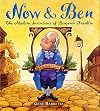
“Now and Ben” is a story about all of Benjamin Franklin’s inventions and how they are still being used today. The main idea of this story was to show the importance of Ben Franklin’s inventions and their relevance today. One way the author got this message across was by splitting the pages in half. On one half they put “Ben….” and then described one of Ben Frankin’s inventions. On the other half of the paper the author wrote “Now…” and then described how this invention show more is used still today or how its modification is used now. By doing this the reader is easily able to distinguish between the past and the present. It also enforces how a previous invention is still being used today. Another way the author enforced the message was by using a wide range of Franklin’s inventions. The book covered inventions from the grabber all the way the electricity. This way the reader is able to see that Franklin gave us some inventions that we can’t live without today but also gave us from helpful and fun inventions as well. I found this to be a very fun book that was also easy to follow while at the same time being very informational. Often in this generation it is easy to forget that a person has invented everything that we use and this book enforces how Benjamin Franklin was one of those influential people in a fun way. The images in this book were also very crucial to the meaning as they enforced what some of the inventions were if the reader did not know them right away by the name. The “Ben” pictures also used clothing and environment from Benjamin Franklin’s time period to enforce how long ago it really was. show less
skill in agriculture.
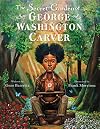
The book opens in 1921 as Carver addresses the U.S. Congress, astounding them with dozens of uses for the peanut. The narration then takes readers back to Carver’s childhood to discover how he reached that career highlight. As a child, he loved flowers, but he was warned not to waste time on plants that couldn’t be eaten or sold, so he kept his colorful garden hidden in the woods. Shut out of schools because he was black, he studied nature independently and learned show more through experimentation. Eventually, he started caring for neighbors’ sick plants, becoming known as “the Plant Doctor.” At 12, he left the farm on which he was raised and attained a formal education, after which he taught students at the Tuskegee Institute and farmers with a mobile classroom mounted on a wagon. This journey through Carver’s childhood and accomplishments ends with Carver’s simple but memorable words, “Regard Nature. Revere Nature. Respect Nature.” The substantial text holds readers on each spread long enough to appreciate not only the subject matter of the painted illustrations, but Morrison’s artistic techniques—strong strokes and careful dots, artful combinations of textures and shapes—which create lush forest scenes and portraitlike human faces and forms. The childhood story feels more cohesive than the final pages, which list his adult accomplishments but lack the narrative thread.
Memorable art earns this biography a respectable place on the shelf. (timeline, bibliography, further reading) (Picture book/biography. 4-9)
-Kirkus Review show less
The book opens in 1921 as Carver addresses the U.S. Congress, astounding them with dozens of uses for the peanut. The narration then takes readers back to Carver’s childhood to discover how he reached that career highlight. As a child, he loved flowers, but he was warned not to waste time on plants that couldn’t be eaten or sold, so he kept his colorful garden hidden in the woods. Shut out of schools because he was black, he studied nature independently and learned show more through experimentation. Eventually, he started caring for neighbors’ sick plants, becoming known as “the Plant Doctor.” At 12, he left the farm on which he was raised and attained a formal education, after which he taught students at the Tuskegee Institute and farmers with a mobile classroom mounted on a wagon. This journey through Carver’s childhood and accomplishments ends with Carver’s simple but memorable words, “Regard Nature. Revere Nature. Respect Nature.” The substantial text holds readers on each spread long enough to appreciate not only the subject matter of the painted illustrations, but Morrison’s artistic techniques—strong strokes and careful dots, artful combinations of textures and shapes—which create lush forest scenes and portraitlike human faces and forms. The childhood story feels more cohesive than the final pages, which list his adult accomplishments but lack the narrative thread.
Memorable art earns this biography a respectable place on the shelf. (timeline, bibliography, further reading) (Picture book/biography. 4-9)
-Kirkus Review show less
Awards


You May Also Like


Associated Authors
Statistics
- Works
- 16
- Also by
- 1
- Members
- 4,366
- Popularity
- #5,742
- Rating
- 4.2
- Reviews
- 121
- ISBNs
- 62
- Languages
- 1