
Doreen Rappaport
Author of Martin's Big Words: The Life of Dr. Martin Luther King, Jr.
About the Author
Series
Works by Doreen Rappaport
42 Is Not Just a Number: The Odyssey of Jackie Robinson, American Hero (2017) 394 copies, 12 reviews
Beyond Courage: The Untold Story of Jewish Resistance During the Holocaust (2012) 340 copies, 16 reviews
Nobody Gonna Turn Me 'Round: Stories and Songs of the Civil Rights Movement (2006) — Author — 179 copies, 2 reviews
Dirt on Their Skirts: The Story of the Young Women who Won the World Championship (2000) — Author — 136 copies, 20 reviews
Frederick's Journey: The Life of Frederick Douglass (A Big Words Book, 8) (2015) 121 copies, 9 reviews
Ellen Takes Flight: The Life of Astronaut Ellen Ochoa (A Big Words Book, 12) (2023) 22 copies, 3 reviews
Abe's Honest Words: The Life of Abraham Lincoln [2016 short film] — Author — 3 copies
But The Women Rose: Voices Of Women In American History, Vol 2 — Editor — 2 copies
But The Women Rose: Voices Of Women In American History, Vol 1 — Editor — 1 copy
Tagged
Common Knowledge
- Birthdate
- 20th Century
- Gender
- female
- Education
- Brandeis University
- Occupations
- teacher
author - Nationality
- USA
- Birthplace
- New York, New York, USA
- Places of residence
- New York, New York, USA
Copake Falls, New York, USA - Associated Place (for map)
- New York, USA
Members
Reviews

I have profoundly mixed feelings about this book. Feelings with which I have struggled, vacillating between a two and four star rating, alternately convinced that I was being petty, in my objections, and cowardly, in my reluctance to voice them. Martin's Big Words is, in so many ways, a lovely picture-book. Intended for younger children, it pairs Doreen Rappaport's brief narrative about the life of this great American hero with equally brief quotations from King's own speeches and writing. show more The accompanying collage and watercolor illustrations by Bryan Collier are simply gorgeous, well deserving of the Caldecott Honor and Coretta Scott King Award that they won. I would like to say that this was the ideal picture-book introduction, for young children, to the life and philosophy of Martin Luther King, Jr. Unfortunately, I can't.
To understand why this book, and the way in which it portrays the Civil Rights Movement, from both a narrative and illustrative standpoint, bothers me so much, one needs to know a little bit about me. I am a white (or Euro-American) woman, raised by a progressive white man - a minister, who always described Rev. King as one of his great heroes. I grew up hearing the stories of my father's participation in the Civil Rights Movement, including the one in which he and many of his fellow seminarians, black and white, went south to join the great Selma to Montgomery Civil Rights March of 1965. They had a forty year reunion for all the CTS (Chicago Theological Seminary) students and faculty who marched, a few years back, and it turned out that it included almost the entire class! King's work, along with that of Mahatma Gandhi and the Rev. André Trocmé, had pride of place in my father's library, and I was keenly conscious, from an early age, that here was a man to be admired and emulated.
It feels almost churlish to argue with a book whose purpose is to promulgate the vision of Rev. King, when I agree so wholeheartedly with that vision, and have long admired the man himself. As it happens, my problem with Rappaport and Collier's book lies not in how they depict Martin Luther King, Jr., himself, but in how they depict the larger Civil Rights Struggle. The trouble begins when Rappaport writes: "In the next ten years, black Americans all over the South protested for equal rights. Martin walked with them and talked with them and prayed with them. White ministers told them to stop. Mayors and governors and police chiefs and judges ordered them to stop. But they kept on marching." All of which is true, of course. Black Americans did protest for equal rights, often showing great courage and determination, in the face of violent persecution. Martin Luther King was certainly there, constantly lending his support, his encouragement, and his spiritual guidance to those who needed it. And yes, many white authority figures, including ministers, were opposed to the changes that civil rights activists sought.
But that isn't the whole story, is it? In reality, many white Americans were also civil rights activists - and yes, a great many of them ministers or priests - often adding their voices, and their presence, to the struggle for justice. I'm not suggesting that it was their struggle, or that their experiences should somehow be paramount. Far from it! But they too are part of the story, and it strikes me as odd that Rappaport seems to be deliberately excluding them from that story. Equally disturbing is the way in which Collier's illustration, for the two-page spread which contains this passage, also works to exclude white activists. His artwork is clearly inspired by Steve Schapiro's famous photograph from the Selma to Montgomery march. This image, in which an American flag, as well as a mostly obscured United Nations flag, is carried by marchers on the long trek, shows a diverse group - most black, but a few white - trudging determinedly along. Every time I see it, I think of my father, and what he must have experienced and felt, walking along that same road. Was he in front of this particular group? Somewhere behind? Did he know anyone in this photograph? Did he meet them, in the course of the march? I've never thought to ask. My father isn't in this photograph, but he could have been. That is to say, he could have been in real life. But not in Rappaport's narrative, nor in Collier's art, which depicts the same scene, with all non-African-American marchers removed:
Now this is one two-page spread, and I imagine that some would argue that it isn't that important. I read an excellent review of Martin's Big Words which, although it agreed that the narrative and artistic choices made here were "odd," argued that there were already so many positive images of whites, in our children's books, that the absence of one in this book wasn't so important. I can't deny that there is some truth to this. Does it really matter that this single picture-book promotes the idea that blacks struggled alone, in their fight for equality, against universal white opposition, when the reality is so much more complicated and rich?
My answer to that question comes when I think of my father, lying in a hospital bed as I write this. If I had children, would I want to introduce them to the life and work of Martin Luther King, Jr. with a book that wrote their grandfather out of history? Would I want to use such a book to introduce any child to this important topic? Sadly, the answer has to be no. Beautiful and effective, in communicating its message, Martin's Big Words has significant flaws, and I would only recommend its use in conjunction with some other work on King, and the Civil Rights Movement.
Addendum: since writing the above review, back in 2011, I have had the chance to think about these issues further, and to consider my rating of this book, which originally stood at three stars - a compromise between the four stars I thought it deserved for its aesthetic qualities, and the two it deserved for its simplification of history. My father, mentioned above, has since passed away, but I remain immensely proud of his participation in this important moment in American history. I was reminded of this book recently, and of my mixed feelings about it, after watching a video online of a group discussion of race. The discussion took place in the UK, and concerned public perceptions in that country of Meghan Markle. One young participant, who was the sole African-American (or American of any kind) in the group, vociferously objected at one point to the idea that there were any white participants in the Civil Rights Movement here in the states, and nothing any of the other participants said could convince her she was mistaken. Watching her objections, I was struck by the oddity of the situation: here was the lone American in the room, having the least accurate knowledge of American history! When I considered why that might be, this book came floating up in my memory, and while there is simply no way of knowing whether this young lady ever encountered it, it certainly represents the kind of oversimplification that might, if reproduced in enough texts and images, create such an incorrect impression. Given that this is so, I realized that I simply couldn't dismiss Martin's Big Words as misguided, in this respect. It is, when taken together with other works of its kind, harmful. I have therefore reduced my star rating, with regret, from three to two. show less
To understand why this book, and the way in which it portrays the Civil Rights Movement, from both a narrative and illustrative standpoint, bothers me so much, one needs to know a little bit about me. I am a white (or Euro-American) woman, raised by a progressive white man - a minister, who always described Rev. King as one of his great heroes. I grew up hearing the stories of my father's participation in the Civil Rights Movement, including the one in which he and many of his fellow seminarians, black and white, went south to join the great Selma to Montgomery Civil Rights March of 1965. They had a forty year reunion for all the CTS (Chicago Theological Seminary) students and faculty who marched, a few years back, and it turned out that it included almost the entire class! King's work, along with that of Mahatma Gandhi and the Rev. André Trocmé, had pride of place in my father's library, and I was keenly conscious, from an early age, that here was a man to be admired and emulated.
It feels almost churlish to argue with a book whose purpose is to promulgate the vision of Rev. King, when I agree so wholeheartedly with that vision, and have long admired the man himself. As it happens, my problem with Rappaport and Collier's book lies not in how they depict Martin Luther King, Jr., himself, but in how they depict the larger Civil Rights Struggle. The trouble begins when Rappaport writes: "In the next ten years, black Americans all over the South protested for equal rights. Martin walked with them and talked with them and prayed with them. White ministers told them to stop. Mayors and governors and police chiefs and judges ordered them to stop. But they kept on marching." All of which is true, of course. Black Americans did protest for equal rights, often showing great courage and determination, in the face of violent persecution. Martin Luther King was certainly there, constantly lending his support, his encouragement, and his spiritual guidance to those who needed it. And yes, many white authority figures, including ministers, were opposed to the changes that civil rights activists sought.
But that isn't the whole story, is it? In reality, many white Americans were also civil rights activists - and yes, a great many of them ministers or priests - often adding their voices, and their presence, to the struggle for justice. I'm not suggesting that it was their struggle, or that their experiences should somehow be paramount. Far from it! But they too are part of the story, and it strikes me as odd that Rappaport seems to be deliberately excluding them from that story. Equally disturbing is the way in which Collier's illustration, for the two-page spread which contains this passage, also works to exclude white activists. His artwork is clearly inspired by Steve Schapiro's famous photograph from the Selma to Montgomery march. This image, in which an American flag, as well as a mostly obscured United Nations flag, is carried by marchers on the long trek, shows a diverse group - most black, but a few white - trudging determinedly along. Every time I see it, I think of my father, and what he must have experienced and felt, walking along that same road. Was he in front of this particular group? Somewhere behind? Did he know anyone in this photograph? Did he meet them, in the course of the march? I've never thought to ask. My father isn't in this photograph, but he could have been. That is to say, he could have been in real life. But not in Rappaport's narrative, nor in Collier's art, which depicts the same scene, with all non-African-American marchers removed:
Now this is one two-page spread, and I imagine that some would argue that it isn't that important. I read an excellent review of Martin's Big Words which, although it agreed that the narrative and artistic choices made here were "odd," argued that there were already so many positive images of whites, in our children's books, that the absence of one in this book wasn't so important. I can't deny that there is some truth to this. Does it really matter that this single picture-book promotes the idea that blacks struggled alone, in their fight for equality, against universal white opposition, when the reality is so much more complicated and rich?
My answer to that question comes when I think of my father, lying in a hospital bed as I write this. If I had children, would I want to introduce them to the life and work of Martin Luther King, Jr. with a book that wrote their grandfather out of history? Would I want to use such a book to introduce any child to this important topic? Sadly, the answer has to be no. Beautiful and effective, in communicating its message, Martin's Big Words has significant flaws, and I would only recommend its use in conjunction with some other work on King, and the Civil Rights Movement.
Addendum: since writing the above review, back in 2011, I have had the chance to think about these issues further, and to consider my rating of this book, which originally stood at three stars - a compromise between the four stars I thought it deserved for its aesthetic qualities, and the two it deserved for its simplification of history. My father, mentioned above, has since passed away, but I remain immensely proud of his participation in this important moment in American history. I was reminded of this book recently, and of my mixed feelings about it, after watching a video online of a group discussion of race. The discussion took place in the UK, and concerned public perceptions in that country of Meghan Markle. One young participant, who was the sole African-American (or American of any kind) in the group, vociferously objected at one point to the idea that there were any white participants in the Civil Rights Movement here in the states, and nothing any of the other participants said could convince her she was mistaken. Watching her objections, I was struck by the oddity of the situation: here was the lone American in the room, having the least accurate knowledge of American history! When I considered why that might be, this book came floating up in my memory, and while there is simply no way of knowing whether this young lady ever encountered it, it certainly represents the kind of oversimplification that might, if reproduced in enough texts and images, create such an incorrect impression. Given that this is so, I realized that I simply couldn't dismiss Martin's Big Words as misguided, in this respect. It is, when taken together with other works of its kind, harmful. I have therefore reduced my star rating, with regret, from three to two. show less

42 IS NOT JUST A NUMBER is a compelling sports biography for upper elementary and junior high readers. It recounts the life of Jackie Robinson, the first black player in the Major Leagues. It deals with his youth quickly, setting a context for the discrimination he faces, and then concentrates on his years playing baseball. There’s a short denouement to wrap up his story: his induction into the Major League Hall of Fame, his death in 1972, and a celebration in 1997 that marked his courage show more in daring to play ball in an openly racist setting.
What I particularly admired about this book is that it doesn’t pull punches. It uses some of the language Robinson encountered (although offensive, what’s captured in the book is much milder than what Robinson would have lived with virtually every day of his life) and describes the violence and hatred that characterized the United States in the 1930s and 1940s. Many adults would like to think things are better now, and in some respects they are; but many students — particularly black students — will recognize the complex racism that persists today. This book is, sadly, still timely and relevant; it arrives at a moment when it may do some valuable work for young readers of all backgrounds.
The book is thoughtfully constructed for readers with lower literacy. The chapters are short and cleanly presented. The author has provided notes and a bibliography, and the book is supported by an index. All in all, a smart, accessible package.
I hope 42 IS NOT JUST A NUMBER is widely adopted by school and public libraries, particularly in those areas where librarians believe their patrons won’t read a book like this. This is exactly the kind of book for a trusted adult to hand a struggling reader and perhaps make a positive difference in a reader’s life. It’s a strong and important book. show less
What I particularly admired about this book is that it doesn’t pull punches. It uses some of the language Robinson encountered (although offensive, what’s captured in the book is much milder than what Robinson would have lived with virtually every day of his life) and describes the violence and hatred that characterized the United States in the 1930s and 1940s. Many adults would like to think things are better now, and in some respects they are; but many students — particularly black students — will recognize the complex racism that persists today. This book is, sadly, still timely and relevant; it arrives at a moment when it may do some valuable work for young readers of all backgrounds.
The book is thoughtfully constructed for readers with lower literacy. The chapters are short and cleanly presented. The author has provided notes and a bibliography, and the book is supported by an index. All in all, a smart, accessible package.
I hope 42 IS NOT JUST A NUMBER is widely adopted by school and public libraries, particularly in those areas where librarians believe their patrons won’t read a book like this. This is exactly the kind of book for a trusted adult to hand a struggling reader and perhaps make a positive difference in a reader’s life. It’s a strong and important book. show less
 This review was written for LibraryThing Early Reviewers.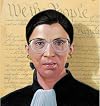
This is another excellent addition to Rappaport’s “Big Words” series in which she incorporates quotes from the subject of her biography into the narrative.
The late Supreme Court Justice Ruth Bader Ginsburg is featured here, along with samplings of her own voice in larger text and outstanding oil paintings by Eric Velasquez.
Rappaport begins the book when Ruth was a child, taught by her mother to go after her dreams:
“My parents taught me to love learning, to care about people, and to show more work hard for whatever I wanted or believed in.”
Ruth read a lot as a child, carrying on her dedication to learning throughout her life. At Cornell University she was inspired to become a lawyer in order to do something for society. She was undeterred that at the time, in the 1950s, women made up less than three percent of all lawyers in the United States. Ruth graduated first in her class and was accepted at Harvard Law School.
She also married Martin Ginsburg, also pursuing law but who encouraged Ruth to go after whatever she wanted to accomplish. When Marty got a job in New York City, Ruth transferred to Columbia Law School, tying for first place in her graduating class. Not one law firm would consider her:
“Traditional law firms were just beginning to hire Jews, but to be a woman, a Jew, and a mother to boot, that combination was a bit much.”
But one of her professors persuaded a judge to hire Ruth as a clerk. She also began teaching law at Rutgers University, albeit paid less than male professors.
Ruth opined:
“The 1787 notion of ‘We the People’ left out the majority of the adult population: slaves, debtors, paupers, Indians, and women. The Constitution was a document of governance for and by white, propertied adult males.”
Ruth set out to change that.
On January 17, 1973, Ruth argued her first case before the Supreme Court. The judges ruled eight to one in her favor. Over the next few years Ruth won another five of the six gender cases she brought before the Supreme Court.
Her reputation grew and in 1980 President Carter appointed her to the U.S. Court of Appeals for the D.C. Circuit. In 1993 President Clinton appointed her to the U.S. Supreme Court. She famously replied, when someone asked when will there be enough women on the Court,” when there are nine.”
Ruth Bader Ginsburg died on September 18, 2020.
The book ends with a list of important dates in Ruth’s life, an Author’s Note, an Illustrator’s Note, and a guide to more resources on Ruth Bader Ginsburg.
Evaluation: Rappaport’s “big words” books are terrific, and this one has the added bonus of not only highlighting a great person in our history, but teaching readers about the laws of our government as well. show less
The late Supreme Court Justice Ruth Bader Ginsburg is featured here, along with samplings of her own voice in larger text and outstanding oil paintings by Eric Velasquez.
Rappaport begins the book when Ruth was a child, taught by her mother to go after her dreams:
“My parents taught me to love learning, to care about people, and to show more work hard for whatever I wanted or believed in.”
Ruth read a lot as a child, carrying on her dedication to learning throughout her life. At Cornell University she was inspired to become a lawyer in order to do something for society. She was undeterred that at the time, in the 1950s, women made up less than three percent of all lawyers in the United States. Ruth graduated first in her class and was accepted at Harvard Law School.
She also married Martin Ginsburg, also pursuing law but who encouraged Ruth to go after whatever she wanted to accomplish. When Marty got a job in New York City, Ruth transferred to Columbia Law School, tying for first place in her graduating class. Not one law firm would consider her:
“Traditional law firms were just beginning to hire Jews, but to be a woman, a Jew, and a mother to boot, that combination was a bit much.”
But one of her professors persuaded a judge to hire Ruth as a clerk. She also began teaching law at Rutgers University, albeit paid less than male professors.
Ruth opined:
“The 1787 notion of ‘We the People’ left out the majority of the adult population: slaves, debtors, paupers, Indians, and women. The Constitution was a document of governance for and by white, propertied adult males.”
Ruth set out to change that.
On January 17, 1973, Ruth argued her first case before the Supreme Court. The judges ruled eight to one in her favor. Over the next few years Ruth won another five of the six gender cases she brought before the Supreme Court.
Her reputation grew and in 1980 President Carter appointed her to the U.S. Court of Appeals for the D.C. Circuit. In 1993 President Clinton appointed her to the U.S. Supreme Court. She famously replied, when someone asked when will there be enough women on the Court,” when there are nine.”
Ruth Bader Ginsburg died on September 18, 2020.
The book ends with a list of important dates in Ruth’s life, an Author’s Note, an Illustrator’s Note, and a guide to more resources on Ruth Bader Ginsburg.
Evaluation: Rappaport’s “big words” books are terrific, and this one has the added bonus of not only highlighting a great person in our history, but teaching readers about the laws of our government as well. show less
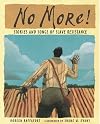
poem about the impossibility of enslaving the mind and soul of a person in chains sets the tone for this stunning collection of stories and songs in tribute to slave resistance in America. Working chronologically, Rappaport (Martin’s Big Words, 2001, etc.) is especially interested in the use of song as an instrument of resistance, and she includes well-known spirituals such as Go Down, Moses as well as more obscure songs whose tunes have been long forgotten. Powerful lines such as “Run, show more nigger, run, patroller’ll ketch ya / Hit ya thirty-nine and swear he didn’t tech ya” tell of unspeakable cruelty and despair; others of defiance and the hope of deliverance. Ranging in acts of rebellion, from planting less corn to learning to read, slave narratives comprise the bulk of the text. Vignettes are included from the lives of Nat Turner, Frederick Douglass, Harriet Tubman, John Scobell, Suzie King Taylor, and others who resisted their enslavement physically, intellectually, or spiritually. Rappaport creates several characters that are composites of actual slaves, which seems both unnecessary and potentially confusing when juxtaposed with actual historical figures. Nevertheless, the focus on resistance works well, and Evans’s bold, dramatic oils portray the subject unflinchingly. Oversized pages of thick stock give full range to the power of his art. An excellent account of the many ways in which slaves participated in bringing down the greatest evil in our nation’s history. (author’s note, chronology of important events, bibliography, recommended reading, index) (Nonfiction. 8-12)
-Kirkus Review show less
-Kirkus Review show less
Lists
Awards


Wilma regresa a casa: la vida de Wilma Mankiller (Wilma's Way Home: The Life of Wilma Mankiller) (Spanish Edition) (Palabras De Grandes/ Big Words) (Mención de honor – Biografía infantil. Temas Universales. – 2022)
Las honestas palabras de Abraham : la vida de Abraham Lincoln (Mención de honor – Biografía infantil. Temas Universales. – 2022)


You May Also Like


Associated Authors
Statistics
- Works
- 55
- Members
- 11,139
- Popularity
- #2,119
- Rating
- 4.3
- Reviews
- 526
- ISBNs
- 222
- Languages
- 3
- Favorited
- 1
