
Robert F. Blitzer
Author of Introductory and Intermediate Algebra (2nd Edition)
About the Author
Works by Robert F. Blitzer
Intermediate Algebra for College Students Access Card Package (7th Edition) (Blitzer Developmental Algebra Series) (2016) 4 copies
Thinking Mathematically 2 copies
Precalculus plus NEW MyMathLab with Pearson eText -- Access Card Package (5th Edition) (Blitzer Precalculus Series) (2013) 2 copies
Precalculus, Books A La Carte Edition Plus MyMathLab with eText -- Access Card Package (6th Edition) (2017) 2 copies
Student Solutions Manual for Introductory and Intermediate Algebra for College Students (2002) 2 copies
Student Solutions Manual for Pathways to College Mathematics (Student's Solutions Manual) (2019) 2 copies
Algebra for College Students 1 copy
Algebra and Trigonometry (5th Edition) 5th edition by Blitzer, Robert F. (2012) Hardcover (2012) 1 copy
Student's Solutions Manual for Precalculus 5th edition by Blitzer, Robert F. (2013) Paperback (2013) 1 copy
Student's Solutions Manual for College Algebra 6th edition by Blitzer, Robert F. (2013) Paperback 1 copy
Algebra and Trigonometry, Books A La Carte Edition Plus MyLab Math with eText -- Access Card Package (6th Edition) (2017) 1 copy
Thinking Mathematically, Books a la Carte Plus MyLab Math -- Access Card Package (7th Edition) (2018) 1 copy
MyLab Math with Pearson eText -- Standalone Access Card -- for College Algebra with Integrated Review (7th Edition) (2017) 1 copy
College Algebra Essentials, Books A La Carte Edition Plus MyLab Math with eText -- Access Card Package (5th Edition) (2017) 1 copy
Introductory & Intermediate Algebra for College Students, Books A la Carte Edition (4th Edition) (2012) 1 copy
Thinking Mathematically Plus MyLab Math with Integrated Review -- Access Card Package (7th Edition) (2018) 1 copy
MyLab Math with Pearson eText -- Standalone Access Card -- for Precalculus with Integrated Review (6th Edition) (2017) 1 copy
MyLab Math with Pearson eText -- Standalone Access Card -- for Algebra and Trigonometry with Integrated Review (6th Edition) (2017) 1 copy
Precalculus Essentials, Books A La Carte Edition Plus MyLab Math with eText -- 24-Month Access Card Package (5th Edition) (2017) 1 copy
Thinking Mathematically Plus MyLab Math -- Access Card Package (7th Edition) (What's New in Service Math) (2018) 1 copy
Learning Guide for Precalculus Plus NEW MyLab Math with Pearson eText -- Access Card Package (6th Edition) (2017) 1 copy
MyLab Math with Pearson eText -- Standalone Access Card -- for Precalculus (6th Edition) (2017) 1 copy
Learning Guide for Algebra and Trigonometry Plus NEW MyLab Math with Pearson eText -- Access Card Package (6th Edition) (2017) 1 copy
MyLab Math with Pearson eText -- Standalone Access Card -- for Algebra and Trigonometry (6th Edition) (2017) 1 copy
MyLab Math with Pearson eText -- Standalone Access Card -- for Trigonometry (2nd Edition) (2017) 1 copy
College Algebra with Integrated Review and Worksheets Plus MyLab Math with eText -- Access Card Package (7th Edition) (2017) 1 copy
Trigonometry Plus MyLab Math with eText -- Title-Specific Access Card Package (2nd Edition) (2017) 1 copy
College Algebra, Books A La Carte Edition Plus MyLab Math with eText -- Access Card Package (7th Edition) (2017) 1 copy
College Algebra Plus MyLab Math with eText -- Title-Specific Access Card Package (7th Edition) (2017) 1 copy
Tagged
Common Knowledge
- Gender
- male
Members
Reviews

There are things I like and don't like about this text. I like the preliminaries/review section and the material on LP and linear system inequalities. I am unhappy with the thin coverage of root function inequalities (such a good area to discuss range and domain) and using the TI calculators to do linear regression (great real world applicability.) I also like the material on exponential models which builds mathematical sophistication in modeling and interpreting common models.
I appreciate show more the more detailed coverage than I find typical of linear systems, LP optimization and Gauss - Jordan.
Binomial Theorem before Counting Theory seems crazy to me, like it's section 8.1 which bombards the reader with summation and sequence notation including recursion before they are introduced to the basics of arithmetic sequences (8.2). This is on par for books in the field when to me geometric series should be before or immediately after exponential functions, etc.
Where are the related rate/work rate problems? That's like a crucially missing section, IMO. I am on the fence about the exclusion of parametric equations. I may have a nostalgic yearning for them in excess of their true value.
Overall, that odd exceptions to content tilt this toward a mediocre offering for this level, this era. While the content is complete enough, there are a couple of key areas where the order of delivery makes it unnecessarily incongruent, IMO. For instance, teaching nonlinear systems with inequalities that have graphical representations as ellipses or hyperbolae prior to even introducing conic sections. Also, recursive and complex series and their summations are taught before the natural precedents of arithmetic and geometric series. show less
I appreciate show more the more detailed coverage than I find typical of linear systems, LP optimization and Gauss - Jordan.
Binomial Theorem before Counting Theory seems crazy to me, like it's section 8.1 which bombards the reader with summation and sequence notation including recursion before they are introduced to the basics of arithmetic sequences (8.2). This is on par for books in the field when to me geometric series should be before or immediately after exponential functions, etc.
Where are the related rate/work rate problems? That's like a crucially missing section, IMO. I am on the fence about the exclusion of parametric equations. I may have a nostalgic yearning for them in excess of their true value.
Overall, that odd exceptions to content tilt this toward a mediocre offering for this level, this era. While the content is complete enough, there are a couple of key areas where the order of delivery makes it unnecessarily incongruent, IMO. For instance, teaching nonlinear systems with inequalities that have graphical representations as ellipses or hyperbolae prior to even introducing conic sections. Also, recursive and complex series and their summations are taught before the natural precedents of arithmetic and geometric series. show less

The text covers the concepts of college algebra, but it is poor at explaining the steps involved in each example. There are a lot of practice problems and a partial answer key in the back of the student edition. Overall, its not bad if you know what you're doing in algebra. If you need more help in the subject, you might want to consider another text.
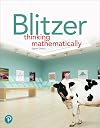
Very wide in scope, this is an applied algebra course aimed, in the curriculum I was assigned to teach it, at liberal arts majors and future teachers. I liked most the focus on mathematically understanding loans in interest in the context of practical life decisions.
You May Also Like


Statistics
- Works
- 134
- Members
- 963
- Popularity
- #26,728
- Rating
- 3.6
- Reviews
- 5
- ISBNs
- 334