
Lauren Markham
Author of The Far Away Brothers: Two Young Migrants and the Making of an American Life
About the Author
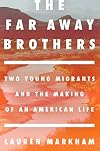
Growing up in rural El Salvador in the wake of the civil war, identical twins Ernesto and Ral Flores always had a fascination with the United States, a distant land of fantasy and opportunity-until, at age seventeen, a deadly threat from the region's brutal gangs forces them to flee the only home show more they've ever known. In this urgent chronicle of contemporary immigration, journalist Lauren Markham follows the Flores twins as they make their way across the Rio Grande and the Texas desert, into the hands of immigration authorities, and from there to their estranged older brother in Oakland, California. Soon these unaccompanied minors are navigating school in a new language, working to pay down their mounting coyote debt, and facing their day in immigration court, while also encountering the triumphs and pitfalls of teenage life with only each other for support. With intimate access and breathtaking range, Markham offers an unforgettable testament to the migrant experience. show less
Image credit: By Larry D. Moore, CC BY-SA 4.0, https://commons.wikimedia.org/w/index.php?curid=64103383
Works by Lauren Markham
The Far Away Brothers: Two Young Migrants and the Making of an American Life (2017) 155 copies, 5 reviews
The Far Away Brothers (Adapted for Young Adults): Two Teenage Immigrants Making a Life in America (2019) 100 copies, 4 reviews
Associated Works
Tagged
Common Knowledge
- Gender
- female
Members
Reviews

Rating: 4.5* of five
The Publisher Says: A speculative essay on language in the face of climate catastrophe: how we memorialize what has been lost and what soon will be, pushing public imagination into generative realms.
“I am in need of a word,” writes Lauren Markham in an email to the Bureau of Linguistical Reality, an organization that coins neologisms. She describes her desire to memorialize something that is in the process of being lost—a landscape, a species, birdsong. How do we show more mourn the abstracted casualties of what’s to come?
In a dazzling synthesis of reporting, memoir, and essay, Markham reflects on the design and function of memorials, from the traditional to the speculative—the Vietnam Memorial in Washington, DC, a converted prison in Ljubljana, a “ghost forest” of dead cedar trees in a Manhattan park—in an attempt to reckon with the grief of climate catastrophe. Can memorials look toward the future as they do to the past? How can we create “a psychic space for feeling” while spurring action and agitating for change?
I RECEIVED A DRC FROM THE PUBLISHER VIA EDELWEISS+. THANK YOU.
My Review: The issue many of us have been braying about for a generation now has burst upon us unmissably. The climate has changed. The results are blatantly obvious and the profiteers, mainly insurance companies and oil companies at the moment, are raking in the money out of your pockets.
The other costs, the ones not as tangible as lost spending power, are still to be named, and still to be felt. Until we can name something, like "spending power," it's nebulous to us as linear-time-trapped people. What name can we give to sights we will never see again? To descendants who can never be born, or can't be kept alive? To lives unlivable, to thoughts unthinkable, because there was/is no one trained, taught, allowed to think them?
Author Markham does the heavy lifting of identifying this dawning reality for us. She asks us to make room in our heads and hearts for an unbearable, unthinkably terrible, loss we're not making room for. It takes a person to speak a truth for it to be recognized. This truth, still nameless, is spoken, and it's now in our collective court to put a stop to our losses before they mount up in reality.
There is something like a haunting, a poltergeist infestation, in the idea of absences as losses. The absence of children unborn, of life...not unlived, nor even unlivable, simply "un"...impossible to experience this void of Reality unless one's alerted to it. Author Markham's essay, tight and compact of duration, carries resonances forward into time for her readers, makes patterns of thought that, now they exist, are indelible. An example of how the "un" is real....
Time's weird at the simplest level...what is it? explain it and how you know what it is, I'll wait...but when bent like this, when folded into a curve that feels untraversable, it begins to feel physical to me. I can respond to time in a new way, not a fun way but a new one, thanks to Author Markham. Immaterial is an ironic title for something that, through its power of observation alone, caused me to concpetualize time as a physical, separate entity from my world. Its positing of conditional loss, of non-existence as a loss, is a powerful insight I'd never have come up with on my own.
I won't get all the way to a fifth star because I felt at times a punch being pulled, an implication she knew was too much being avoided. The rigorous honesty of the piece was incomplete, partial; but I'd be extremely hard pressed to do half so well as Author Markham's done. Don't allow my weird frisson to dissuade you from wrapping your head around her arguments. show less
The Publisher Says: A speculative essay on language in the face of climate catastrophe: how we memorialize what has been lost and what soon will be, pushing public imagination into generative realms.
“I am in need of a word,” writes Lauren Markham in an email to the Bureau of Linguistical Reality, an organization that coins neologisms. She describes her desire to memorialize something that is in the process of being lost—a landscape, a species, birdsong. How do we show more mourn the abstracted casualties of what’s to come?
In a dazzling synthesis of reporting, memoir, and essay, Markham reflects on the design and function of memorials, from the traditional to the speculative—the Vietnam Memorial in Washington, DC, a converted prison in Ljubljana, a “ghost forest” of dead cedar trees in a Manhattan park—in an attempt to reckon with the grief of climate catastrophe. Can memorials look toward the future as they do to the past? How can we create “a psychic space for feeling” while spurring action and agitating for change?
I RECEIVED A DRC FROM THE PUBLISHER VIA EDELWEISS+. THANK YOU.
My Review: The issue many of us have been braying about for a generation now has burst upon us unmissably. The climate has changed. The results are blatantly obvious and the profiteers, mainly insurance companies and oil companies at the moment, are raking in the money out of your pockets.
The other costs, the ones not as tangible as lost spending power, are still to be named, and still to be felt. Until we can name something, like "spending power," it's nebulous to us as linear-time-trapped people. What name can we give to sights we will never see again? To descendants who can never be born, or can't be kept alive? To lives unlivable, to thoughts unthinkable, because there was/is no one trained, taught, allowed to think them?
Author Markham does the heavy lifting of identifying this dawning reality for us. She asks us to make room in our heads and hearts for an unbearable, unthinkably terrible, loss we're not making room for. It takes a person to speak a truth for it to be recognized. This truth, still nameless, is spoken, and it's now in our collective court to put a stop to our losses before they mount up in reality.
There is something like a haunting, a poltergeist infestation, in the idea of absences as losses. The absence of children unborn, of life...not unlived, nor even unlivable, simply "un"...impossible to experience this void of Reality unless one's alerted to it. Author Markham's essay, tight and compact of duration, carries resonances forward into time for her readers, makes patterns of thought that, now they exist, are indelible. An example of how the "un" is real....
Time's weird at the simplest level...what is it? explain it and how you know what it is, I'll wait...but when bent like this, when folded into a curve that feels untraversable, it begins to feel physical to me. I can respond to time in a new way, not a fun way but a new one, thanks to Author Markham. Immaterial is an ironic title for something that, through its power of observation alone, caused me to concpetualize time as a physical, separate entity from my world. Its positing of conditional loss, of non-existence as a loss, is a powerful insight I'd never have come up with on my own.
I won't get all the way to a fifth star because I felt at times a punch being pulled, an implication she knew was too much being avoided. The rigorous honesty of the piece was incomplete, partial; but I'd be extremely hard pressed to do half so well as Author Markham's done. Don't allow my weird frisson to dissuade you from wrapping your head around her arguments. show less
I've probably said this about books before, and I've heard others say it about books, but this time I mean it: EVERY American should read this book!
There are so many things about immigrants coming to the US that I never would have known. Probably chief among them was that parents are sending their children to America alone--paying up to $7,000 to a "coyote" to guide them along the way. This does not ensure their safety or that they'll arrive in their final destination.... it merely ensures show more they'll have someone who theoretically knows how to get them there. These children aren't leaving their homes and families and friends because they WANT to--they're leaving because staying is a worse option, even knowing they might not make it to the US safely. I'm absolutely blown away by the terrible sacrifices that these children and their families make, and by the struggles they continue to face even when they do arrive in America. Just landing here is the first step in a long line of challenges.
So many Americans are descendants of immigrants--we should all have a greater respect for what today's migrants are going through! show less
There are so many things about immigrants coming to the US that I never would have known. Probably chief among them was that parents are sending their children to America alone--paying up to $7,000 to a "coyote" to guide them along the way. This does not ensure their safety or that they'll arrive in their final destination.... it merely ensures show more they'll have someone who theoretically knows how to get them there. These children aren't leaving their homes and families and friends because they WANT to--they're leaving because staying is a worse option, even knowing they might not make it to the US safely. I'm absolutely blown away by the terrible sacrifices that these children and their families make, and by the struggles they continue to face even when they do arrive in America. Just landing here is the first step in a long line of challenges.
So many Americans are descendants of immigrants--we should all have a greater respect for what today's migrants are going through! show less
To solve a problem one must understand what caused it and address its root causes. That is a hard thing, requiring work and effort and creative thinking. Why not just make the problem illegal?
We have been trying that and it does not seem to work. "Just say no" to sex or drugs, prison sentences for drug possession, throwing a pregnant teenage daughter out of the house--none of these ever solved anything.
Illegal immigration has become the issue of the day under the present administration. show more Migrants have been arrested, abused, sent back, and yet more come. Build a wall, we are told, that will keep them out. I doubt it. There is a reason why people leave their homeland and family, and the reasons are rarely trite.
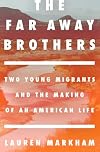
In her timely book The Far Away Brothers , Lauren Markham tells the story of the twin Flores brothers who flee El Salvador to join their undocumented migrant brother in America. We learn about their lives in El Salvador, about their families, the challenges they faced on their journey north, and the multiple difficulties of their lives in the United States.
Markham, who has reported on undocumented immigration for a decade, spent two years researching for this book, plus she draws from her experience working with immigrant students at Oakland International High School. She chose to write about twins to illustrate how each immigrant has their own motivation and individual response to the experience.
In the past the draw to the United States was for economic opportunity and security. Today migrants leave their homes to escape the domination and violence of the gangs who have taken over power. Last year 60,000 unaccompanied minors entered the United States, most from Guatemala, Honduras, and El Salvador--the 'murder capital of the world'.
When one of the Flores twins is targeted by their uncle's gang he decides he must leave to survive, and his twin brother joins him. The boys' family puts their livelihood at risk by offering the their land as security to raise money for transport to the border. They falsely assume the debt can be paid off quickly once the boys get jobs, but the interest blows their debt up to $20,000.
The journey leaves its psychic scars; one twin has nightmares and cannot talk about what he had seen.
To stay in America the boys must be in school, under their older brother's authority. Somehow they must also earn money to start paying off their debt to the coyotes. They are teenagers, too, who are finally 'free' and they don't always handle that freedom well. Readers may not always like the boys, but hopefully they will understand their fears, confusion, and motivations.
The author is not afraid to offer a paragraph on American policies that have contributed to the Central American 'catastrophe', by supplying weapons and by creating free-trade deals that hurt small farmers. Then there is the legacy of large corporations that bought up land for farming, controlling resources and the economic benefits.
As Markham writes, "People migrate now for the same reason they always have: survival." Investment in improving educational and economic opportunities, addressing the root causes of migration, would be a better use of federal funds than building a wall.
I read Enique's Journey by Sonia Nazario about ten years ago. Here is what she had to say about The Far Away Brothers:
“Powerful…Focusing primarily on one family’s struggle to survive in violence-riddled El Salvador by sending some of its members illegally to the U.S.,…[this] compellingly intimate narrative…keenly examines the plights of juveniles sent to America without adult supervision….One of the most searing books on illegal immigration since Sonia Nazario’s Enrique’s Journey.” —Kirkus
I received a free ebook through First to Read in exchange for a fair and unbiased review. show less
We have been trying that and it does not seem to work. "Just say no" to sex or drugs, prison sentences for drug possession, throwing a pregnant teenage daughter out of the house--none of these ever solved anything.
Illegal immigration has become the issue of the day under the present administration. show more Migrants have been arrested, abused, sent back, and yet more come. Build a wall, we are told, that will keep them out. I doubt it. There is a reason why people leave their homeland and family, and the reasons are rarely trite.
In her timely book The Far Away Brothers , Lauren Markham tells the story of the twin Flores brothers who flee El Salvador to join their undocumented migrant brother in America. We learn about their lives in El Salvador, about their families, the challenges they faced on their journey north, and the multiple difficulties of their lives in the United States.
Markham, who has reported on undocumented immigration for a decade, spent two years researching for this book, plus she draws from her experience working with immigrant students at Oakland International High School. She chose to write about twins to illustrate how each immigrant has their own motivation and individual response to the experience.
In the past the draw to the United States was for economic opportunity and security. Today migrants leave their homes to escape the domination and violence of the gangs who have taken over power. Last year 60,000 unaccompanied minors entered the United States, most from Guatemala, Honduras, and El Salvador--the 'murder capital of the world'.
When one of the Flores twins is targeted by their uncle's gang he decides he must leave to survive, and his twin brother joins him. The boys' family puts their livelihood at risk by offering the their land as security to raise money for transport to the border. They falsely assume the debt can be paid off quickly once the boys get jobs, but the interest blows their debt up to $20,000.
The journey leaves its psychic scars; one twin has nightmares and cannot talk about what he had seen.
To stay in America the boys must be in school, under their older brother's authority. Somehow they must also earn money to start paying off their debt to the coyotes. They are teenagers, too, who are finally 'free' and they don't always handle that freedom well. Readers may not always like the boys, but hopefully they will understand their fears, confusion, and motivations.
The author is not afraid to offer a paragraph on American policies that have contributed to the Central American 'catastrophe', by supplying weapons and by creating free-trade deals that hurt small farmers. Then there is the legacy of large corporations that bought up land for farming, controlling resources and the economic benefits.
As Markham writes, "People migrate now for the same reason they always have: survival." Investment in improving educational and economic opportunities, addressing the root causes of migration, would be a better use of federal funds than building a wall.
I read Enique's Journey by Sonia Nazario about ten years ago. Here is what she had to say about The Far Away Brothers:
“Powerful…Focusing primarily on one family’s struggle to survive in violence-riddled El Salvador by sending some of its members illegally to the U.S.,…[this] compellingly intimate narrative…keenly examines the plights of juveniles sent to America without adult supervision….One of the most searing books on illegal immigration since Sonia Nazario’s Enrique’s Journey.” —Kirkus
I received a free ebook through First to Read in exchange for a fair and unbiased review. show less
I read this book with an open-heart and open-mind. Living in California, I have heard so many stories like the Flores Twins.
Lauren Markham has done a wonderful job writing of the hard, terrorizing journey of kids who leave their countries to avoid danger, hardship and potential death and come to a country that doesn’t quit know what to do with them.
As a daughter of an immigrant from Germany after World War Two, I know the harsh reality of a teenager trying to fit in, even though doing so show more legally. The Flores twins have to try and find their way to make the connection from illegal to becoming a citizen of the United States.
I am not sure what is the right way for that to happen, however I am thankful that people like Lauren Markham exist.
This book will help all those who read it to see that these teens are just like their teens, to an extent, hopefully more people will come to an understanding that kids are still kids and need to be looked after, taken care of and nurtured, no matter their legal standing.
I was given this books through Penguin First to Read in lieu of my honest opinion. Thanks Penguin Random House! show less
Lauren Markham has done a wonderful job writing of the hard, terrorizing journey of kids who leave their countries to avoid danger, hardship and potential death and come to a country that doesn’t quit know what to do with them.
As a daughter of an immigrant from Germany after World War Two, I know the harsh reality of a teenager trying to fit in, even though doing so show more legally. The Flores twins have to try and find their way to make the connection from illegal to becoming a citizen of the United States.
I am not sure what is the right way for that to happen, however I am thankful that people like Lauren Markham exist.
This book will help all those who read it to see that these teens are just like their teens, to an extent, hopefully more people will come to an understanding that kids are still kids and need to be looked after, taken care of and nurtured, no matter their legal standing.
I was given this books through Penguin First to Read in lieu of my honest opinion. Thanks Penguin Random House! show less
Lists
Awards


You May Also Like


Associated Authors
Statistics
- Works
- 5
- Also by
- 1
- Members
- 345
- Popularity
- #69,184
- Rating
- 3.8
- Reviews
- 10
- ISBNs
- 17