
About the Author
Parmy Olson is a writer with Forbes magazine. She lives in San Francisco.
Image credit: Forbes
Works by Parmy Olson
We Are Anonymous: Inside the Hacker World of LulzSec, Anonymous, and the Global Cyber Insurgency (2012) 378 copies, 16 reviews
Tagged
Common Knowledge
- Gender
- female
Members
Reviews
Rating: 4.5* of five
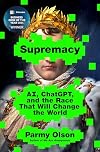
The Publisher Says: In November of 2022, a webpage was posted online with a simple text box. It was an AI chatbot called ChatGPT, and was unlike any app people had used before. It was more human than a customer service agent, more convenient than a Google search. Behind the scenes, battles for control and prestige between the world’s two leading AI firms, OpenAI and DeepMind, who now steers Google's AI efforts, has remained elusive—until now.
In Supremacy, Olson, tech show more writer at Bloomberg, tells the astonishing story of the battle between these two AI firms, their struggles to use their tech for good, and the hazardous direction they could go as they serve two tech monopolies whose power is unprecedented in history. The story focuses on the continuing rivalry of two key CEOs at the center of it all, who cultivated a religion around their mission to build god-like super intelligent machines: Sam Altman, CEO of OpenAI, and Demis Hassabis, the CEO of DeepMind.
Supremacy sharply alerts readers to the real threat of artificial intelligence that its top creators are ignoring: the profit-driven spread of flawed and biased technology into industries, education, media and more. With exclusive access to a network of high-ranking sources, Parmy Olson uses her 13 years of experience covering technology to bring to light the exploitation of the greatest invention in human history, and how it will impact us all.
I RECEIVED A DRC FROM THE PUBLISHER VIA NETGALLEY. THANK YOU.
My Review: I urge you to read this book. It does not matter what your politics are, It especially does not matter if you care even a scintilla about technology. This is not a book about the way these...people, I must be polite...are making their dream of an AGI happen, it's about the people doing it, the people giving them the money to do it, and how all of those pieces of a complicated puzzle are failing to do a good job for Humanity. It's important to know what is happening, you are already getting "AI-assisted" stuff advertised to you and no smallest advisory, still less a warning, about what that means.
I strongly urge you to read this book. Before the election if possible, but soon no matter what.
Please. show less
The Publisher Says: In November of 2022, a webpage was posted online with a simple text box. It was an AI chatbot called ChatGPT, and was unlike any app people had used before. It was more human than a customer service agent, more convenient than a Google search. Behind the scenes, battles for control and prestige between the world’s two leading AI firms, OpenAI and DeepMind, who now steers Google's AI efforts, has remained elusive—until now.
In Supremacy, Olson, tech show more writer at Bloomberg, tells the astonishing story of the battle between these two AI firms, their struggles to use their tech for good, and the hazardous direction they could go as they serve two tech monopolies whose power is unprecedented in history. The story focuses on the continuing rivalry of two key CEOs at the center of it all, who cultivated a religion around their mission to build god-like super intelligent machines: Sam Altman, CEO of OpenAI, and Demis Hassabis, the CEO of DeepMind.
Supremacy sharply alerts readers to the real threat of artificial intelligence that its top creators are ignoring: the profit-driven spread of flawed and biased technology into industries, education, media and more. With exclusive access to a network of high-ranking sources, Parmy Olson uses her 13 years of experience covering technology to bring to light the exploitation of the greatest invention in human history, and how it will impact us all.
I RECEIVED A DRC FROM THE PUBLISHER VIA NETGALLEY. THANK YOU.
My Review: I urge you to read this book. It does not matter what your politics are, It especially does not matter if you care even a scintilla about technology. This is not a book about the way these...people, I must be polite...are making their dream of an AGI happen, it's about the people doing it, the people giving them the money to do it, and how all of those pieces of a complicated puzzle are failing to do a good job for Humanity. It's important to know what is happening, you are already getting "AI-assisted" stuff advertised to you and no smallest advisory, still less a warning, about what that means.
I strongly urge you to read this book. Before the election if possible, but soon no matter what.
Please. show less
We Are Anonymous: Inside the Hacker World of LulzSec, Anonymous, and the Global Cyber Insurgency by Parmy Olson

Well-written in the face of disinformation, secrets, and outright lies. Double and triple fact checking probably didn't cut much ice here, and Olson did a creditable job of ferreting out what seems to be a coherent narrative. The journalism is solid, the authorial voice very engaging.
I'm deeply sympathetic to hackers, and this book didn't dissuade me one bit. Yeah, they do some harm- it's undeniable. But when they are taking down banks and evil corporations, I'm right up there cheering them show more on, so who am I to castigate them for their other, more nefarious actions? I enjoyed the "ripped from the headlines" aspect of this book, and I dug getting to feel like I was, however briefly, on the inside. I'm in their corner, with my knee-jerk anti-authority bias intact. show less
I'm deeply sympathetic to hackers, and this book didn't dissuade me one bit. Yeah, they do some harm- it's undeniable. But when they are taking down banks and evil corporations, I'm right up there cheering them show more on, so who am I to castigate them for their other, more nefarious actions? I enjoyed the "ripped from the headlines" aspect of this book, and I dug getting to feel like I was, however briefly, on the inside. I'm in their corner, with my knee-jerk anti-authority bias intact. show less
“The race to build the AGI (Artificial General Intelligence) had started with a question: What if you could build artificial intelligence systems that were smarter than humans. The two innovators at the forefront grappled with the answer as their quests turned into a heated rivalry. Demis Hassabis believed that AGI could help us better understand the universe and drive forward scientific discovery, while Sam Altman thought it could create an abundance of wealth that would raise show more everyone’s living standards.”
Parmy Olson, a journalist specializing in technology, examines the rise of artificial intelligence tools, particularly chatbots, and the people behind them. The author initially focuses on Deep Mind and OpenAI, the two primary firms, and the associated later involvement of Google and Microsoft. She starts with the founding CEOs, who planned to use their products for the greater good of humanity, Demis Hassabis of DeepMind and Sam Altman OpenAI. The author tracks the ways their ideals ended up intertwined with the tech industry giants, and the results.
Olson explores two main issues surrounding AI – the idea that AI will get out of hand and damage humans (safety concerns) and the possibility of replicating existing social biases or manipulating them (ethical concerns). To some extent, she also examines large language models, which are used in AI training and learning. One of the primary drivers fueling these concerns is the same one we have seen wreak havoc in recent years – namely, that profit-driven corporations will use technology, along with personal data and habits, to increase their wealth and the expense of the social welfare. We have, of course, seen this occur repeatedly throughout history, where short term profits are valued over long-term impact. One recent example is social media, owned by tech companies, to gain huge advertising revenues while enabling misinformation to spread unchecked.
It is not really a surprise that one of the most salient points in Supremacy is that big money and power tend to win out over altruism. Entrepreneurial efforts tend to repeatedly get swallowed up by the tech giants. The author points out that there is a fundamental lack of transparency among the corporate-owned AI tools in the current technology arena. This is a concern for all of us. Olson calls for the use of tools that are above board about their learning models, and who care about ensuring that their systems do not cause harm. Luckily, there are a few altruistic attempts still being made. The example provided by the author is Anthropic and its chatbot, Claude, which is funded by philanthropists. Artificial Intelligence is here already, and further developments are coming, so in my opinion, it is important to understand what is going on with this technology. show less
Parmy Olson, a journalist specializing in technology, examines the rise of artificial intelligence tools, particularly chatbots, and the people behind them. The author initially focuses on Deep Mind and OpenAI, the two primary firms, and the associated later involvement of Google and Microsoft. She starts with the founding CEOs, who planned to use their products for the greater good of humanity, Demis Hassabis of DeepMind and Sam Altman OpenAI. The author tracks the ways their ideals ended up intertwined with the tech industry giants, and the results.
Olson explores two main issues surrounding AI – the idea that AI will get out of hand and damage humans (safety concerns) and the possibility of replicating existing social biases or manipulating them (ethical concerns). To some extent, she also examines large language models, which are used in AI training and learning. One of the primary drivers fueling these concerns is the same one we have seen wreak havoc in recent years – namely, that profit-driven corporations will use technology, along with personal data and habits, to increase their wealth and the expense of the social welfare. We have, of course, seen this occur repeatedly throughout history, where short term profits are valued over long-term impact. One recent example is social media, owned by tech companies, to gain huge advertising revenues while enabling misinformation to spread unchecked.
It is not really a surprise that one of the most salient points in Supremacy is that big money and power tend to win out over altruism. Entrepreneurial efforts tend to repeatedly get swallowed up by the tech giants. The author points out that there is a fundamental lack of transparency among the corporate-owned AI tools in the current technology arena. This is a concern for all of us. Olson calls for the use of tools that are above board about their learning models, and who care about ensuring that their systems do not cause harm. Luckily, there are a few altruistic attempts still being made. The example provided by the author is Anthropic and its chatbot, Claude, which is funded by philanthropists. Artificial Intelligence is here already, and further developments are coming, so in my opinion, it is important to understand what is going on with this technology. show less
4.5 stars
The subheading tells you generally what this is about, but it also includes some biographical information on two people who were working on getting AI to where it is today. They both wanted to use AI for the good of humanity and didn’t want it to be abused or used for ill. Of course, given the amount of computing power needed to get AI “ready” for the world, they both ultimately sold out to large companies, Google and Microsoft. They both tried to include restrictions (like an show more independent ethics board, for example) to prevent it from going sour, but here we are...
I thought this was very interesting. I found it particularly interesting to find Elon Musk so involved, particularly in the “ethics” side of things. Though there was a difference explained between AI ethics and AI safety. Elon Musk ended up promoting the “safety” side of things. I didn’t know about that part of the AI controversy, but apparently there are a bunch of people who legitimately think AI will annihilate humans in some way, shape, or form, Musk being one of them. So they formed organizations to help prevent that. On the more frustrating side was the part I did know about: the ethics – the racism, sexism, made up information/citations, etc. Frustrating in that there were (at least initially) people hired to help prevent this, but (without saying too much in my review), that just didn’t pan out. I have read a bit about AI, and at work (I’m a librarian), AI has become a big topic, so not everything was new to me. show less
The subheading tells you generally what this is about, but it also includes some biographical information on two people who were working on getting AI to where it is today. They both wanted to use AI for the good of humanity and didn’t want it to be abused or used for ill. Of course, given the amount of computing power needed to get AI “ready” for the world, they both ultimately sold out to large companies, Google and Microsoft. They both tried to include restrictions (like an show more independent ethics board, for example) to prevent it from going sour, but here we are...
I thought this was very interesting. I found it particularly interesting to find Elon Musk so involved, particularly in the “ethics” side of things. Though there was a difference explained between AI ethics and AI safety. Elon Musk ended up promoting the “safety” side of things. I didn’t know about that part of the AI controversy, but apparently there are a bunch of people who legitimately think AI will annihilate humans in some way, shape, or form, Musk being one of them. So they formed organizations to help prevent that. On the more frustrating side was the part I did know about: the ethics – the racism, sexism, made up information/citations, etc. Frustrating in that there were (at least initially) people hired to help prevent this, but (without saying too much in my review), that just didn’t pan out. I have read a bit about AI, and at work (I’m a librarian), AI has become a big topic, so not everything was new to me. show less
Lists
Awards


You May Also Like


Associated Authors
Statistics
- Works
- 2
- Members
- 527
- Popularity
- #47,212
- Rating
- 3.8
- Reviews
- 21
- ISBNs
- 24
- Languages
- 5