
Christopher Hayes (1) (1979–)
Author of Twilight of the Elites: America After Meritocracy
For other authors named Christopher Hayes, see the disambiguation page.
About the Author
Image credit: Sarah Shatz
Works by Christopher Hayes
The Sirens' Call: How Attention Became the World's Most Endangered Resource (2025) 318 copies, 9 reviews
Tagged
Common Knowledge
- Birthdate
- 1979-02-28
- Gender
- male
- Occupations
- broadcaster
editor
journalist - Organizations
- The Nation
MSNBC - Nationality
- USA
- Birthplace
- New York, New York, USA
- Places of residence
- Brooklyn, New York, USA
- Associated Place (for map)
- New York, USA
Members
Reviews

Hayes explores the economy of attention, which he calls the "most endangered resource" of the information age. There's some interesting stuff to be found here, but ultimately, despite Hayes' protestations to the contrary, this is just another piece of the current moral panic surrounding social media.
It's not a new phenomenon. We've gone through it with the printing press, recorded music, radio, television, movies, comic books, video games -- any revolution in communication, especially one show more that appeals to young people, stirs fears that it's going to destroy the minds of a generation and be the ruin of society. Hayes acknowledges the phenomenon, pointing out that it goes back at least to Socrates, who fretted about the dangers of that newfangled "writing" nonsense, which he was sure would destroy the human ability to remember anything.
And sure, there are growing pains and a period of adjustment when a new technology changes the world. But eventually, we figure out how to absorb the new tech into our lives and our society, and the cries of the Cassandras never do come true. Twenty years from now, we'll be saying the same about social media, and in our conversations about whether new thing is making folks clutch their pearls, Hayes' book will be remembered along [[Fredric Wertham]]'s [Seduction of the Innocent] as another reminder that this panic, too, shall pass. show less
It's not a new phenomenon. We've gone through it with the printing press, recorded music, radio, television, movies, comic books, video games -- any revolution in communication, especially one show more that appeals to young people, stirs fears that it's going to destroy the minds of a generation and be the ruin of society. Hayes acknowledges the phenomenon, pointing out that it goes back at least to Socrates, who fretted about the dangers of that newfangled "writing" nonsense, which he was sure would destroy the human ability to remember anything.
And sure, there are growing pains and a period of adjustment when a new technology changes the world. But eventually, we figure out how to absorb the new tech into our lives and our society, and the cries of the Cassandras never do come true. Twenty years from now, we'll be saying the same about social media, and in our conversations about whether new thing is making folks clutch their pearls, Hayes' book will be remembered along [[Fredric Wertham]]'s [Seduction of the Innocent] as another reminder that this panic, too, shall pass. show less
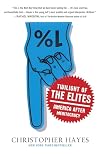
I was already a fan of Chris Hayes due to his work on MSNBC, so I fully expected to like this book, and I did. He is describing how the "meritocratic elite" that has run things in the US for so long is breaking down in its ability to make good decisions, and how the public at large has grown disillusioned with their ability to do so. The examples he keeps returning to include our political leaders, the Catholic Church (and its response to the sexual abuse scandal), and Wall Street in light show more of the banking crisis of 2007-09.
The book was written in 2012, but it holds up very well five years later, especially in light of Donald Trump's election- which is really all about the Rabble rising up and displacing the elites, first in the Republican party and then in the country as a whole.
The sad reality at the center of the book is that what we think of as purely meritocratic processes, starting with the example of the exclusive public school in New York for the gifted that Hayes attended, has become a rigged game- yes, anyone who tests high enough can go to the school, but wealthy and privileged families are the ones who can afford the test prep required to get to the top of the heap. Similar gaming occurs in every sector, and the US has consequently become a place with high inequality and low social mobility.
I totally agree with the diagnosis of the problem. I was less excited about the end- prescription for fixing this problem seems vague and unlikely. But a great read, not hard to get through. show less
The book was written in 2012, but it holds up very well five years later, especially in light of Donald Trump's election- which is really all about the Rabble rising up and displacing the elites, first in the Republican party and then in the country as a whole.
The sad reality at the center of the book is that what we think of as purely meritocratic processes, starting with the example of the exclusive public school in New York for the gifted that Hayes attended, has become a rigged game- yes, anyone who tests high enough can go to the school, but wealthy and privileged families are the ones who can afford the test prep required to get to the top of the heap. Similar gaming occurs in every sector, and the US has consequently become a place with high inequality and low social mobility.
I totally agree with the diagnosis of the problem. I was less excited about the end- prescription for fixing this problem seems vague and unlikely. But a great read, not hard to get through. show less

Television newsmonger personality Chris Hayes has written this book about the fact that a small and declining portion of the public can marshal the sustained attention to read it. While the sirens of the title are briefly explored in terms of modern vehicle klaxons, the "call" is of course the one from Homer's Odyssey. (Although neither song was ever cited in the book, I supplied the Cream tune "Tales of Brave Ulysses" and "Home at Last" by Steely Dan as occasional interior accompaniment to show more my reading of it.) Hayes makes good use of this classical allusion in his opening and closing passages, but he is less deft in his citation of Plato's Phaedrus, inaccurately attributing worry over literacy to Socrates while neglecting the actual framing of Plato's myth in the dialogue's argumentation (5-6).
Hayes supplies a diagnosis of the consummated contemporary trade in eyeballs, i.e. the commodification of attention through digital media. He freely admits to his own vulnerability from both sides of this exchange, as a social media user and a performer looking to reap "attention as a resource." He draws out a constructive analogy between the alienation of labor power in the industrial age and the alienation of attention--which is also volition, individual and social--in the information age.
The alienation of individual attention results in psychological distress, while the alienation of social attention eliminates the patterns and preconditions--what Hayes calls "regimes of attention"--that could result in public discourse like the Lincoln-Douglas debates. I'm not sure that the phrase "attention span" even occurs in the book, but certainly the shortening of that span is part of the fragmentation and Hobbesian anarchy that Hayes describes as the results of the obsolescence of regimes of attention. The social media platforms that purport to facilitate community actually dissolve it.
"The promise of the information age was unparalleled access to every single last bit of human knowledge at every moment, and the reality is a collective civic mental life that permanently teeters on the edge of madness." (248)
There is an attempt at a call to action in the final pages, where Hayes refers readers to https://www.friendsofattention.net/. He also derives some hope from the revalorization of media once deemed extinct, like vinyl LPs. Partly inspired by this book, I have made John William Waterhouse's painting Pandora (1896) the wallpaper for my smartphone. show less
Hayes supplies a diagnosis of the consummated contemporary trade in eyeballs, i.e. the commodification of attention through digital media. He freely admits to his own vulnerability from both sides of this exchange, as a social media user and a performer looking to reap "attention as a resource." He draws out a constructive analogy between the alienation of labor power in the industrial age and the alienation of attention--which is also volition, individual and social--in the information age.
The alienation of individual attention results in psychological distress, while the alienation of social attention eliminates the patterns and preconditions--what Hayes calls "regimes of attention"--that could result in public discourse like the Lincoln-Douglas debates. I'm not sure that the phrase "attention span" even occurs in the book, but certainly the shortening of that span is part of the fragmentation and Hobbesian anarchy that Hayes describes as the results of the obsolescence of regimes of attention. The social media platforms that purport to facilitate community actually dissolve it.
"The promise of the information age was unparalleled access to every single last bit of human knowledge at every moment, and the reality is a collective civic mental life that permanently teeters on the edge of madness." (248)
There is an attempt at a call to action in the final pages, where Hayes refers readers to https://www.friendsofattention.net/. He also derives some hope from the revalorization of media once deemed extinct, like vinyl LPs. Partly inspired by this book, I have made John William Waterhouse's painting Pandora (1896) the wallpaper for my smartphone. show less
This is a great analysis of the failures of meritocracy, a system that seems impossible to criticize. Hayes shows how a meritocracy does not really allow for all people to rise by their own efforts but rather that those at the top use the system, as all other systems, to protect their own position, promote advancements for their friends and family and ignore the needs of those lower down. From the financial system to education to health care and even baseball emphasis on a meritocracy is show more shown to promote cheating in order to rise in the system and a sense of entitlement that leads to a distance from and lack of care about those further down the system. This attitude in the long run can lead to a collapse of the whole system. If only we could come up with a solution, but I guess pointing out the problem is a first step show less
Lists
Awards


You May Also Like


Statistics
- Works
- 3
- Members
- 1,458
- Popularity
- #17,623
- Rating
- 3.9
- Reviews
- 42
- ISBNs
- 29