
Thomas Frank (1) (1965–)
Author of What's the Matter with Kansas?: How Conservatives Won the Heart of America
For other authors named Thomas Frank, see the disambiguation page.
Series
Works by Thomas Frank
What's the Matter with Kansas?: How Conservatives Won the Heart of America (2004) — Author — 2,935 copies, 46 reviews
One Market Under God: Extreme Capitalism, Market Populism, and the End of Economic Democracy (2000) 545 copies, 3 reviews
The Conquest of Cool: Business Culture, Counterculture, and the Rise of Hip Consumerism (1997) 452 copies, 3 reviews
Commodify Your Dissent: Salvos from the Baffler (1997) — Editor; Introduction — 410 copies, 3 reviews
Pity the Billionaire: The Hard-Times Swindle and the Unlikely Comeback of the Right (2012) 359 copies, 13 reviews
Boob Jubilee: The Mad Cultural Politics of the New Economy: Salvos from the Baffler (2003) — Editor — 86 copies
Associated Works
Tagged
Common Knowledge
- Canonical name
- Frank, Thomas
- Legal name
- Frank, Thomas Carr
- Birthdate
- 1965-03-21
- Gender
- male
- Education
- University of Kansas
University of Virginia (BA|1988)
University of Chicago (MA|1990|Ph.D|1994) - Occupations
- political analyst
historian
journalist - Organizations
- The Baffler (founder, editor)
The Wall Street Journal
Harper's Magazine - Awards and honors
- Lannan Literary Fellowship (2004)
Eugene Debs Award (2005) - Agent
- Joe Spieler
- Short biography
- Thomas Frank is a former columnist for The Wall Street Journal and Harper's. Frank is founding editor of The Baffler and writes regularly for Salon. He lives outside Washington, D.C. [adapted from Listen, Liberal (2016)]
- Nationality
- USA
- Birthplace
- Kansas City, Missouri, USA
- Places of residence
- Kansas City, Missouri, USA
Mission Hills, Kansas, USA
Washington, D.C., USA
Bethesda, Maryland, USA - Associated Place (for map)
- USA
Members
Discussions
Stuff to ponder as Your World ™ continues to turn to Shit in Pro and Con (October 2019)
Reviews
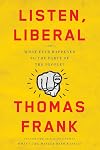
I received a free advanced reading copy of this book through the Library Thing Early Reviewers program.
Thomas Frank asks the question - if the Democrats have held the Presidency for 16 of the last 24 years, and have the demographic majority to take full control of the country, and have been in control in many states and regions for some time, why is it that the middle and working class continue in steep decline while Wall Street gets bailouts and the rich get richer? The answer is that the show more Democrats have abandoned their traditional base of working class people and organized labor, instead becoming enamored with what Frank calls the professional class. These are the wealthy and well-educated people credited as being "creative" and "innovators" and who are called upon to resolve problems with their innate brilliance on a revolving door among prominent universities, corporate boardrooms, and political office. Meritocracy is baked into this idea of the professional class with the people who've succeeded being credited with working hard to earn their degrees and get to the place where they are (with the unspoken counter being that those who fail and are poor can only blame themselves for not trying hard enough).
Frank traces the Democrats connection to the professional class to the wake of the troubled 1968 election when Democratic leaders made a conscious decision to move away from their traditional base of organized labor and working people (assuming that these people would have to vote Democratic anyway). The Democrats lost several Presidential elections over the 1970s & 1980s and the assumption for party insiders was always that they were always too Liberal and moved the party further to the right. The core of the book is several chapters about the 1990s and Bill Clinton where the Democrats finally could win again and the professional class took control of the reins of government. Only Nixon could go to China, and only Clinton could ratify NAFTA, approve the sweeping crime bill, dismantle the social safety net of welfare, and other things that had been on the Republican wishlist for decades. Frank even details negotiations between Clinton and Newt Gingrich to privatize Social Security, the cornerstone of the abandoned New Deal, that were only scuttled due to the impeachment proceedings against Clinton. With only professionals represented in the Clinton government, alternatives were not considered, and all problems were resolved by doing what would most benefit the professional class.
Frank also covers the Barack Obama presidency where Obama was swept in to power on a populist movement in the wake of the financial crisis. Frank notes that Obama had the powers to punish those responsible for the Great Recession, but instead chose to bring Wall Street professional class "innovators" into the government to regulate themselves and work towards bipartisan consensus with the Republicans who were clearly not interested. The presumptive 2016 Democratic candidate Hillary Clinton is described as someone working to advance women's equality, but doing so in a narrow way that only sees women working hard to become successful "entrepreneurs" (another variation on the meritocracy of the professional class) and working class women are just not seen at her events or in her policies. The book also details how the place where the New Democrat ethos of the professional class has had it's greatest implementation - Massachusetts - is emblematic of this reverence of the "creative class," and also why the state has the greatest level of inequality in the nation.
This book does an excellent job of explicating what has happened in the Democratic party over the last several decades where it's gotten to a point that a lot of their ideology is indistinguishable from Republicans and the large portion of Americans have suffered as a result. The year's still young, but I think this is going to be one of the most important books of the year and I suggest that everyone should read it. show less
Thomas Frank asks the question - if the Democrats have held the Presidency for 16 of the last 24 years, and have the demographic majority to take full control of the country, and have been in control in many states and regions for some time, why is it that the middle and working class continue in steep decline while Wall Street gets bailouts and the rich get richer? The answer is that the show more Democrats have abandoned their traditional base of working class people and organized labor, instead becoming enamored with what Frank calls the professional class. These are the wealthy and well-educated people credited as being "creative" and "innovators" and who are called upon to resolve problems with their innate brilliance on a revolving door among prominent universities, corporate boardrooms, and political office. Meritocracy is baked into this idea of the professional class with the people who've succeeded being credited with working hard to earn their degrees and get to the place where they are (with the unspoken counter being that those who fail and are poor can only blame themselves for not trying hard enough).
Frank traces the Democrats connection to the professional class to the wake of the troubled 1968 election when Democratic leaders made a conscious decision to move away from their traditional base of organized labor and working people (assuming that these people would have to vote Democratic anyway). The Democrats lost several Presidential elections over the 1970s & 1980s and the assumption for party insiders was always that they were always too Liberal and moved the party further to the right. The core of the book is several chapters about the 1990s and Bill Clinton where the Democrats finally could win again and the professional class took control of the reins of government. Only Nixon could go to China, and only Clinton could ratify NAFTA, approve the sweeping crime bill, dismantle the social safety net of welfare, and other things that had been on the Republican wishlist for decades. Frank even details negotiations between Clinton and Newt Gingrich to privatize Social Security, the cornerstone of the abandoned New Deal, that were only scuttled due to the impeachment proceedings against Clinton. With only professionals represented in the Clinton government, alternatives were not considered, and all problems were resolved by doing what would most benefit the professional class.
Frank also covers the Barack Obama presidency where Obama was swept in to power on a populist movement in the wake of the financial crisis. Frank notes that Obama had the powers to punish those responsible for the Great Recession, but instead chose to bring Wall Street professional class "innovators" into the government to regulate themselves and work towards bipartisan consensus with the Republicans who were clearly not interested. The presumptive 2016 Democratic candidate Hillary Clinton is described as someone working to advance women's equality, but doing so in a narrow way that only sees women working hard to become successful "entrepreneurs" (another variation on the meritocracy of the professional class) and working class women are just not seen at her events or in her policies. The book also details how the place where the New Democrat ethos of the professional class has had it's greatest implementation - Massachusetts - is emblematic of this reverence of the "creative class," and also why the state has the greatest level of inequality in the nation.
This book does an excellent job of explicating what has happened in the Democratic party over the last several decades where it's gotten to a point that a lot of their ideology is indistinguishable from Republicans and the large portion of Americans have suffered as a result. The year's still young, but I think this is going to be one of the most important books of the year and I suggest that everyone should read it. show less
 This review was written for LibraryThing Early Reviewers.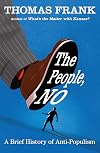
Thomas Frank has discovered that the term populism is fungible.
Since its invention in the late 1800s, when it meant the native intelligence of the populace at large to correct the ills and corruption of the USA, it has been hijacked numerous times in different eras. Like everything else in the universe, it doesn’t stay fixed for long.
Populism started out as anger over property taxes, injustice, corruption and inequality in the Gilded Age, all of which were actually worse in the 1890s than show more they are today. Groups and movements formed. Authors began exposing abuses. The country slowly came around to seeing things weren’t as the founders had envisioned. To boil it down to a phrase, populism valued human rights over property rights.
Inevitably, the rich fired back. They portrayed populists not as reasoned citizens with legitimate positions, but as ignorant hayseeds, unfit to even speak let alone govern. Governing was for the governing class, made up of the rich and the credentialed, not farmers and laborers, women or nonwhites. Academics in particular showed themselves to be narrowminded, selfish and power-mad in their denunciations of populism.
As time wore on, they assigned populism to ever more evil traits. It didn’t matter how crazy the attack was. The elites lashed out in all directions, fighting to keep their exclusive domain of governing and pillaging. They attached it to Nazism, for example, when until that point populism had always been considered a leftist disease. It had been associated with the rise of labor unions, not fascists.
But, despite the battering and the haranguing by newspapers and magazines against it, the movement had a profound effect. It resulted in FDR’s unprecedented four terms as president, in which he established regulating agencies, old age pensions, works projects and numerous other egalitarian institutions for all, much to the continuing horror of the establishment. It was, as Noam Chomsky posited of such movements, a “Democracy Scare”.
The scales tipped back in the 1960s, when populism began to fade. There were numerous reasons, most of which Frank does not go into. People became weary of conformity and equality. They wanted to break out, to move ahead of the pack, not nestle in it. The cult of the individual arose and government receded. Populism became a sneeringly bad concept, assigned to crackpot Argentine dictators and buffoonish Italian prime ministers of the extreme right.
Now, in the Trump era, the concept has mutated into something that makes no sense at all – a corrupt billionaire president making himself and his class even richer, while claiming to represent the long-aggrieved and deceived working class. Frank says “If this is populism, the word has truly come to mean nothing.”
Frank has definitely done the research. He has found long forgotten leaders, long forgotten tracts, and long forgotten events - and rehabilitated them. Even the book’s title, The People, No is a takeoff on a long forgotten 1936 booklength poem by populist Carl Sandburg – The People, Yes.
Today, the term populism is shackled to bigotry, white supremacy, the patriarchy, and nothing at all to do with its roots in human rights and equality. It makes the book a wild ride.
For some reason, this is the season for books on populism. This is at least the fourth one I’ve seen so far, and the second I have read. The other, Robert Putnam’s Upswing, puts populism in perspective instead of exhaustive examination. Putnam shows the record inequality of the Gilded Age, the remarkable pendulum swing to the New Deal, the rise of the individual and decline of protections - as waves. He asks, can America break free of this stranglehold again? Can populism (the original version) return? Frank, on the other hand, is total immersion in the rise and perversion of populism. Two books, each with important messages not to be overlooked.
David Wineberg show less
Since its invention in the late 1800s, when it meant the native intelligence of the populace at large to correct the ills and corruption of the USA, it has been hijacked numerous times in different eras. Like everything else in the universe, it doesn’t stay fixed for long.
Populism started out as anger over property taxes, injustice, corruption and inequality in the Gilded Age, all of which were actually worse in the 1890s than show more they are today. Groups and movements formed. Authors began exposing abuses. The country slowly came around to seeing things weren’t as the founders had envisioned. To boil it down to a phrase, populism valued human rights over property rights.
Inevitably, the rich fired back. They portrayed populists not as reasoned citizens with legitimate positions, but as ignorant hayseeds, unfit to even speak let alone govern. Governing was for the governing class, made up of the rich and the credentialed, not farmers and laborers, women or nonwhites. Academics in particular showed themselves to be narrowminded, selfish and power-mad in their denunciations of populism.
As time wore on, they assigned populism to ever more evil traits. It didn’t matter how crazy the attack was. The elites lashed out in all directions, fighting to keep their exclusive domain of governing and pillaging. They attached it to Nazism, for example, when until that point populism had always been considered a leftist disease. It had been associated with the rise of labor unions, not fascists.
But, despite the battering and the haranguing by newspapers and magazines against it, the movement had a profound effect. It resulted in FDR’s unprecedented four terms as president, in which he established regulating agencies, old age pensions, works projects and numerous other egalitarian institutions for all, much to the continuing horror of the establishment. It was, as Noam Chomsky posited of such movements, a “Democracy Scare”.
The scales tipped back in the 1960s, when populism began to fade. There were numerous reasons, most of which Frank does not go into. People became weary of conformity and equality. They wanted to break out, to move ahead of the pack, not nestle in it. The cult of the individual arose and government receded. Populism became a sneeringly bad concept, assigned to crackpot Argentine dictators and buffoonish Italian prime ministers of the extreme right.
Now, in the Trump era, the concept has mutated into something that makes no sense at all – a corrupt billionaire president making himself and his class even richer, while claiming to represent the long-aggrieved and deceived working class. Frank says “If this is populism, the word has truly come to mean nothing.”
Frank has definitely done the research. He has found long forgotten leaders, long forgotten tracts, and long forgotten events - and rehabilitated them. Even the book’s title, The People, No is a takeoff on a long forgotten 1936 booklength poem by populist Carl Sandburg – The People, Yes.
Today, the term populism is shackled to bigotry, white supremacy, the patriarchy, and nothing at all to do with its roots in human rights and equality. It makes the book a wild ride.
For some reason, this is the season for books on populism. This is at least the fourth one I’ve seen so far, and the second I have read. The other, Robert Putnam’s Upswing, puts populism in perspective instead of exhaustive examination. Putnam shows the record inequality of the Gilded Age, the remarkable pendulum swing to the New Deal, the rise of the individual and decline of protections - as waves. He asks, can America break free of this stranglehold again? Can populism (the original version) return? Frank, on the other hand, is total immersion in the rise and perversion of populism. Two books, each with important messages not to be overlooked.
David Wineberg show less
Many of us will have to take off our defensive hats and absorb the blows provided by this strongly anti-Clinton and Obama administration diatribe. The author has had it with "neo-liberals" and Third Way centrists, as represented now by Hillary Clinton.
His premise is that the Democratic Party shit on unions to become the defenders of the professional/innovative/"creative" classes - Google execs, Rahm Emanuel, Goldman Sachs banksters, and their ilk. His chapters on Bill Clinton's welfare show more takedown and NAFTA cheerleading, his rabid incarceration and his love of compromising with Republicans, are very persuasive. What he can't explain is why that led to a period of incredible prosperity - except, of course, for blue collar workers just starting to take it on the chin.
Resident evils cited (and not fought against by the Obama administration) are the two-class system, with younger workers never able to achieve the benefits or salaries of their older grandfathered comrades, their conviction of the meritocracy based upon Ivy League cred (Larry Summers: "One of the reasons the inequality has probably gone up in our society is that people are being treated closer to the way that they're supposed to be treated."), the deference shown to Wall Street and need to trust them because they understand complex finance and we don't. As Frank states, "Not only is it more profitable to make your living by speculation than by working, but it puts you above the law as well."
The Obama administration is lauded for health insurance reform and the creation of the Consumer Financial Protection Bureau, but taken to task for ignoring income inequality and the demise of labor unions vs the constant touting of the record highs of the Dow, which only enriches that already favored class.
Elizabeth Warren: "The President chose his team, and when there was only so much time and money to go around, the President's team chose Wall Street."
Timothy Geithner on the original Bush bank bailout measure: "The banks can handle ten million foreclosures - this program will foam the runway for them."
"Warren had challenged Geithner on how the program would help homeowners. Geithner had responded by citing how it would help the banks."
And on my own beloved Massachusetts: "Boston is the headquarters for two industries that are steadily bankrupting middle America: big learning and big medicine. Once the visitor leads the brainy bustle of Boston, this state is filled with wreckage - former manufacturing towns, with workers watching their way of life drain away, with cities that are little more than warehouses for people on Medicare."
OW. THE TRUTH HURTS.
The book's main failings are ignoring the even worse plight of people of color, and of not presenting any kind of suggestions for changing the future other than abandoning both political parties (no Bernie mentioned). show less
His premise is that the Democratic Party shit on unions to become the defenders of the professional/innovative/"creative" classes - Google execs, Rahm Emanuel, Goldman Sachs banksters, and their ilk. His chapters on Bill Clinton's welfare show more takedown and NAFTA cheerleading, his rabid incarceration and his love of compromising with Republicans, are very persuasive. What he can't explain is why that led to a period of incredible prosperity - except, of course, for blue collar workers just starting to take it on the chin.
Resident evils cited (and not fought against by the Obama administration) are the two-class system, with younger workers never able to achieve the benefits or salaries of their older grandfathered comrades, their conviction of the meritocracy based upon Ivy League cred (Larry Summers: "One of the reasons the inequality has probably gone up in our society is that people are being treated closer to the way that they're supposed to be treated."), the deference shown to Wall Street and need to trust them because they understand complex finance and we don't. As Frank states, "Not only is it more profitable to make your living by speculation than by working, but it puts you above the law as well."
The Obama administration is lauded for health insurance reform and the creation of the Consumer Financial Protection Bureau, but taken to task for ignoring income inequality and the demise of labor unions vs the constant touting of the record highs of the Dow, which only enriches that already favored class.
Elizabeth Warren: "The President chose his team, and when there was only so much time and money to go around, the President's team chose Wall Street."
Timothy Geithner on the original Bush bank bailout measure: "The banks can handle ten million foreclosures - this program will foam the runway for them."
"Warren had challenged Geithner on how the program would help homeowners. Geithner had responded by citing how it would help the banks."
And on my own beloved Massachusetts: "Boston is the headquarters for two industries that are steadily bankrupting middle America: big learning and big medicine. Once the visitor leads the brainy bustle of Boston, this state is filled with wreckage - former manufacturing towns, with workers watching their way of life drain away, with cities that are little more than warehouses for people on Medicare."
OW. THE TRUTH HURTS.
The book's main failings are ignoring the even worse plight of people of color, and of not presenting any kind of suggestions for changing the future other than abandoning both political parties (no Bernie mentioned). show less
Fascinating but depressing.
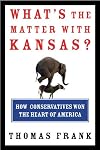
Thomas Frank, born and raised in Kansas, goes home and takes a long hard look at the self-destructive wholesale adoption of hard-right, fundamentalist-christian, conservative politics by the plain ol’ folks of the state.
He fills in Kansas’s historical background of Populism and anti-slavery (Republican in the Lincolnesque sense), and shows how today’s politics represent a complete about-face. Through interviews and anecdotes, he vividly illustrates how the show more “culture war” works, and how in their eagerness to sign up and fight in that war, farmers and working-class people destroy their own way of life.
Frank also takes the Democratic party to task for creating the vacuum conservative Republicans rushed to fill when they completely abandoned their traditional supporters in pursuit of wealthy business owners whose politics were somewhat liberal, thereby taking economic issues off the table and making themselves over into a “Republican-lite” party where moderate Republicans may feel more comfortable as their party continues to become more and more radicalized.
Well worth reading if you want a clear, well-written description how American politics has moved dramatically rightwards. Frank offers no solution, but for most people not high up in the political party hierarchies, there may be no solution save waiting until the parties burn themselves out or wreck the country to the point that revolution becomes a viable and desirable option. show less
Thomas Frank, born and raised in Kansas, goes home and takes a long hard look at the self-destructive wholesale adoption of hard-right, fundamentalist-christian, conservative politics by the plain ol’ folks of the state.
He fills in Kansas’s historical background of Populism and anti-slavery (Republican in the Lincolnesque sense), and shows how today’s politics represent a complete about-face. Through interviews and anecdotes, he vividly illustrates how the show more “culture war” works, and how in their eagerness to sign up and fight in that war, farmers and working-class people destroy their own way of life.
Frank also takes the Democratic party to task for creating the vacuum conservative Republicans rushed to fill when they completely abandoned their traditional supporters in pursuit of wealthy business owners whose politics were somewhat liberal, thereby taking economic issues off the table and making themselves over into a “Republican-lite” party where moderate Republicans may feel more comfortable as their party continues to become more and more radicalized.
Well worth reading if you want a clear, well-written description how American politics has moved dramatically rightwards. Frank offers no solution, but for most people not high up in the political party hierarchies, there may be no solution save waiting until the parties burn themselves out or wreck the country to the point that revolution becomes a viable and desirable option. show less
Lists
Awards


You May Also Like


Associated Authors
Statistics
- Works
- 32
- Also by
- 2
- Members
- 6,800
- Popularity
- #3,593
- Rating
- 3.8
- Reviews
- 140
- ISBNs
- 112
- Languages
- 6
- Favorited
- 9


