
Chris Hedges
Author of War Is a Force that Gives Us Meaning
About the Author
Chris Hedges is a graduate of Harvard Divinity School and a former Pulitzer Prize-winning journalist for The New York Times. He is the author of eleven books, including the New York Times bestsellers War Is a Force That Gives Us Meaning, American Fascists, and Days of Destruction, Days of Revolt, show more which he coauthored with Joe Sacco. show less
Works by Chris Hedges
Empire of Illusion: The End of Literacy and the Triumph of Spectacle (2009) 1,246 copies, 42 reviews
Unspeakable: Talks with David Talbot about the Most Forbidden Topics in America (2016) 88 copies, 5 reviews
A Genocide Foretold: Reporting on Survival and Resistance in Occupied Palestine (2025) 39 copies, 1 review
The Death of Truth 1 copy
The Age of Social Murder 1 copy
Associated Works
Friendly Fascism: The New Face of Power in America (1980) — Introduction, some editions — 205 copies
War Is...: Soldiers, Survivors and Storytellers Talk about War (2008) — Contributor — 145 copies, 8 reviews
The Life of Meaning: Reflections on Faith, Doubt, and Repairing the World (2007) — Contributor — 132 copies, 5 reviews
Wrestling with Zion: Progressive Jewish-American Responses to the Israeli-Palestinian Conflict (2003) — Contributor — 84 copies, 1 review
Will the Last Reporter Please Turn Out the Lights: The Collapse of Journalism and What Can Be Done to Fix It (2010) — Contributor — 62 copies
Bullet Points and Punch Lines: The Most Important Commentary Ever Written on the Epic American Tragicomedy (2020) — Foreword, some editions — 25 copies
The Corporate Coup d'État [2018 documentary film] — Self — 1 copy
Tagged
Common Knowledge
- Canonical name
- Hedges, Chris
- Legal name
- Hedges, Christopher Lynn
- Birthdate
- 1956-09-18
- Gender
- male
- Education
- Colgate University (BA|1979)
Harvard University (M.Div|1983)
Loomis Chaffee School - Occupations
- journalist
- Organizations
- The New York Times
Truthdig
The Nation Institute - Awards and honors
- Lannan Literary Fellowship (2006)
- Relationships
- Wong, Eunice (wife)
- Nationality
- USA
- Birthplace
- St. Johnsbury, Vermont, USA
- Places of residence
- Princeton, New Jersey, USA
St. Johnsbury, Vermont, USA - Associated Place (for map)
- USA
Members
Reviews
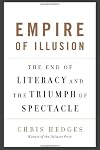
It takes a special kind of talent – or lack thereof – to make me find fault with an argument I'm predisposed to agree with. It also takes a special kind of talent to write a two-hundred page book that I just can't finish. Mr. Hedges, however, has succeeded brilliantly. "Empire of Illusion" is less a book than Biggie-sized version of the anguished lefty rants that Harper's Magazine publishes at least once an issue. I can't recommend it to anyone.
It's not that I don't agree with Mr. show more Hedges; I do. Mass culture is often nothing more than trite, sensationalistic trash. The porn industry is a nasty business. A belief in unencumbered capitalism is replacing any other value Americans might have held. Still, it doesn't seem like the author has much to add to these debates. He doesn't seem to have done a great deal of original research and provides lengthy quotations from earlier, more important, thinkers, which makes him seem like a college freshman trying to discuss ideas he can't quite connect with. Lacking either journalistic specificity or a deep engagement with the underlying philosophical issues at play, Hedges' writing is essentially a lengthy jeremiad aimed at everything wrong with America today, a lengthy gloss on arguments that you've already heard, and perhaps even made. It's a lefty version of the "kids these days" rant that your Republican grandfather made, in which everything wrong with the country could be attributed to Roosevelt or miniskirts.
There's also a nasty personal undertone to this entire exercise. I'm one of those educated, coastal liberals that Fox News loves to hate and a serious reader to boot, but I admit that I'm not above enjoying some mass culture every now and again. Hedges, however, strikes me as a Humbert Humbert type – a person who can only enjoy mass culture by decrying it. There's a pretty thin line between criticizing the lowest dregs of the entertainment industry and wallowing in them, but Hedges walks that line pretty often in "Empire of Illusion." Lastly, when he's not trying to shock his readers, his tone is one of sad exasperation. He seems like a person who's genuinely disgusted with the cultural milieu he's forced to inhabit, which doesn't make the book a particularly enjoyable read.
Now that I'm done with this review, I think I'll go eat a whole bag of potato chips while I watch a few "Maury" reruns. Take that, Chris. show less
It's not that I don't agree with Mr. show more Hedges; I do. Mass culture is often nothing more than trite, sensationalistic trash. The porn industry is a nasty business. A belief in unencumbered capitalism is replacing any other value Americans might have held. Still, it doesn't seem like the author has much to add to these debates. He doesn't seem to have done a great deal of original research and provides lengthy quotations from earlier, more important, thinkers, which makes him seem like a college freshman trying to discuss ideas he can't quite connect with. Lacking either journalistic specificity or a deep engagement with the underlying philosophical issues at play, Hedges' writing is essentially a lengthy jeremiad aimed at everything wrong with America today, a lengthy gloss on arguments that you've already heard, and perhaps even made. It's a lefty version of the "kids these days" rant that your Republican grandfather made, in which everything wrong with the country could be attributed to Roosevelt or miniskirts.
There's also a nasty personal undertone to this entire exercise. I'm one of those educated, coastal liberals that Fox News loves to hate and a serious reader to boot, but I admit that I'm not above enjoying some mass culture every now and again. Hedges, however, strikes me as a Humbert Humbert type – a person who can only enjoy mass culture by decrying it. There's a pretty thin line between criticizing the lowest dregs of the entertainment industry and wallowing in them, but Hedges walks that line pretty often in "Empire of Illusion." Lastly, when he's not trying to shock his readers, his tone is one of sad exasperation. He seems like a person who's genuinely disgusted with the cultural milieu he's forced to inhabit, which doesn't make the book a particularly enjoyable read.
Now that I'm done with this review, I think I'll go eat a whole bag of potato chips while I watch a few "Maury" reruns. Take that, Chris. show less
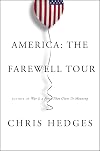
Chris Hedges has written a sober and grim analysis of American decline characterized by welfare for the wealthy and unending sacrifice for the majority of Americans, who are divided into the poor and a middle class that is confronted with upheaval caused by technological dislocation in the transportation, manufacturing, and service industries. This stratification provides a rich breeding ground for discontent and the rise of fascism among those who feel most threatened by transformations show more that they little understand and are unable to change.
Anyone optimistic about MAGA should read this book, but won’t. show less
Anyone optimistic about MAGA should read this book, but won’t. show less
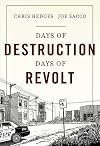
Hedges and Sacco examine colonialism in the United States by actively investigating communities of Native Americans both on and off reservations, poverty stricken neighborhoods (reservations) in Camden, New Jersey, mining areas in West Virginia, and current day slavery in Immokalee, Florida (which Senator Bernie Sanders calls the bottom in the race to the bottom). Each separate section on these places and topics include history and facts of colonial takeover laid out very clearly and show more logically. The authors have managed to make institutional racism and discrimination, something that many people struggle with understanding or believing, very clear. That is quite a feat.
Each section is also illustrated with personal stories of local individuals, families or groups with detailed stories of their struggles. This makes this one of those educational books that read so well you can't put it down. Although I DID put it down between sections that were so self-contained I could get the complete idea, theory and real stories in one sitting and then let the information percolate for awhile before I went on to the next section. The authors draw clear connections to illustrate how and why people make some of the choices that look destructive from the outside, such as why we take our rage out on each other, burning our own communities, etc.
I am American so it is especially eye-opening to see these terms such as colonialism applied to myself as a colonized person. No matter how much I read, learn, study and come to understand and believe these ideas, I am still sometimes surprised to hear this language applied to the U.S. It is so much easier to think in terms of the other while I am, e.g., reading about Palestine and -you know - OTHERS!
This book is hard hitting and depressing, but does not leave the reader there. The closing section is about the Occupy movement, its history, founders, possibilities for the future and to NOT coin a phrase, "Being the change". This history of Occupy has not received a lot of media attention so many think it was simply very spontaneous and unorganized, although before the physical occupation began, well trained teams were already in place to provide legal services, security at the park, medical services and food as well as the famous library and educational team. These are people who know revolution, how it has worked historically, and are full of creative ideas such as my personal favorite movement, Strike Debt. The media kept saying Occupiers were simply a bunch of homeless addicts going nowhere and accomplishing nothing. And yes of course there were plenty of homeless and addicts. The beautiful difference is how they were included and cared for rather than ostracized. The media kept asking all the wrong questions of Occupy - who are your leaders and what are your demands. You'll also develop an understanding of those issues before you finish the book. AND.....you will finish it quickly - it is a fast and easy read and still covers all of this! Amazing accomplishment! Five stars and highly recommended.
P.S. If you can't tell, I really, really loved this book! show less
Each section is also illustrated with personal stories of local individuals, families or groups with detailed stories of their struggles. This makes this one of those educational books that read so well you can't put it down. Although I DID put it down between sections that were so self-contained I could get the complete idea, theory and real stories in one sitting and then let the information percolate for awhile before I went on to the next section. The authors draw clear connections to illustrate how and why people make some of the choices that look destructive from the outside, such as why we take our rage out on each other, burning our own communities, etc.
I am American so it is especially eye-opening to see these terms such as colonialism applied to myself as a colonized person. No matter how much I read, learn, study and come to understand and believe these ideas, I am still sometimes surprised to hear this language applied to the U.S. It is so much easier to think in terms of the other while I am, e.g., reading about Palestine and -you know - OTHERS!
This book is hard hitting and depressing, but does not leave the reader there. The closing section is about the Occupy movement, its history, founders, possibilities for the future and to NOT coin a phrase, "Being the change". This history of Occupy has not received a lot of media attention so many think it was simply very spontaneous and unorganized, although before the physical occupation began, well trained teams were already in place to provide legal services, security at the park, medical services and food as well as the famous library and educational team. These are people who know revolution, how it has worked historically, and are full of creative ideas such as my personal favorite movement, Strike Debt. The media kept saying Occupiers were simply a bunch of homeless addicts going nowhere and accomplishing nothing. And yes of course there were plenty of homeless and addicts. The beautiful difference is how they were included and cared for rather than ostracized. The media kept asking all the wrong questions of Occupy - who are your leaders and what are your demands. You'll also develop an understanding of those issues before you finish the book. AND.....you will finish it quickly - it is a fast and easy read and still covers all of this! Amazing accomplishment! Five stars and highly recommended.
P.S. If you can't tell, I really, really loved this book! show less
This is a passionate diatribe against corporate dominance in our culture. While Hedges is most likely hitting the target quite squarely, I fear that his preaching will only be accepted by the choir. I don't see that Hedges even gives the choir any very useful instructions. What he gives us is a pathology report. If you already think things are bad, and you think they're bad because e.g. Goldman Sachs run the treasury, Archer Daniels Midland run the Department of Agricutlure, Exxon runs the show more Department of Energy, etc., then Hedges will probably convince you that things are even worse than you thought.
If, on the other hand, you think our problem today is that the government interferes excessively with pharmaceuticals, petroleum, finance, agriculture, etc., and the way to happiness and prosperity is to give the big corporations a freer hand in maximizing profit, then I don't see how Hedges is going to budge you from your position. Perhaps such a case is just hopeless - the chasm is so broad that any kind of bridge will take far longer to build than the time remaining before utter disaster hits - utter disaster perhaps defined as the time when Hedges and folks who loudly resist corporate power as he does are rounded up and silenced.
The book is a quick read, so the fact that it doesn't really work to create a change is not such a flaw. A more thorough diagnosis surely has enough value to make reading the book worth the while. Certainly Hedges writes well and presents a coherent view.
The tactic that intrigues me right now: perhaps the grass roots passion of the Tea Party can be dissociated from the corporate control of Murdoch etc. and then connected instead to something like the Transition Town movement. There's nothing wrong with small government, as long as the other players in the game are similarly small. To make small government work, we need to dismantle the American Empire, the hundreds of military bases around the world. For this to work, we need to dismantle the globalized corporations that live in symbiosis with that Empire.
Of course, the USA is hardly the only contender for World Empire. The dismantling of our bid may occur whether we choose that path or not. Looking at budget deficits at every scale of government, we will likely get small government one way or another. But it could easily mean that we end up under the thumb of multinational corporations all the same, but corporations in symbiosis with some other World Empire. As most anyone in a banana republic will tell you, that is not a happy prospect.
We really need to look for alternatives. Hedges is a smart fellow. It's reasonable that he doesn't elaborate any of these, but just a few pointers to likely candidates would make the book a lot more valuable. Ultimately his conclusion is right, that love can never be conquered by evil, but that's about as weak an alternative as can be. While we have our voices, while we still have remarkable freedoms and resources, let us use these wisely to steer away from those bleakest prospects to which we seem headed. show less
If, on the other hand, you think our problem today is that the government interferes excessively with pharmaceuticals, petroleum, finance, agriculture, etc., and the way to happiness and prosperity is to give the big corporations a freer hand in maximizing profit, then I don't see how Hedges is going to budge you from your position. Perhaps such a case is just hopeless - the chasm is so broad that any kind of bridge will take far longer to build than the time remaining before utter disaster hits - utter disaster perhaps defined as the time when Hedges and folks who loudly resist corporate power as he does are rounded up and silenced.
The book is a quick read, so the fact that it doesn't really work to create a change is not such a flaw. A more thorough diagnosis surely has enough value to make reading the book worth the while. Certainly Hedges writes well and presents a coherent view.
The tactic that intrigues me right now: perhaps the grass roots passion of the Tea Party can be dissociated from the corporate control of Murdoch etc. and then connected instead to something like the Transition Town movement. There's nothing wrong with small government, as long as the other players in the game are similarly small. To make small government work, we need to dismantle the American Empire, the hundreds of military bases around the world. For this to work, we need to dismantle the globalized corporations that live in symbiosis with that Empire.
Of course, the USA is hardly the only contender for World Empire. The dismantling of our bid may occur whether we choose that path or not. Looking at budget deficits at every scale of government, we will likely get small government one way or another. But it could easily mean that we end up under the thumb of multinational corporations all the same, but corporations in symbiosis with some other World Empire. As most anyone in a banana republic will tell you, that is not a happy prospect.
We really need to look for alternatives. Hedges is a smart fellow. It's reasonable that he doesn't elaborate any of these, but just a few pointers to likely candidates would make the book a lot more valuable. Ultimately his conclusion is right, that love can never be conquered by evil, but that's about as weak an alternative as can be. While we have our voices, while we still have remarkable freedoms and resources, let us use these wisely to steer away from those bleakest prospects to which we seem headed. show less
Lists
Awards


You May Also Like


Associated Authors
Statistics
- Works
- 31
- Also by
- 11
- Members
- 7,682
- Popularity
- #3,169
- Rating
- 3.9
- Reviews
- 169
- ISBNs
- 147
- Languages
- 8
- Favorited
- 26

